



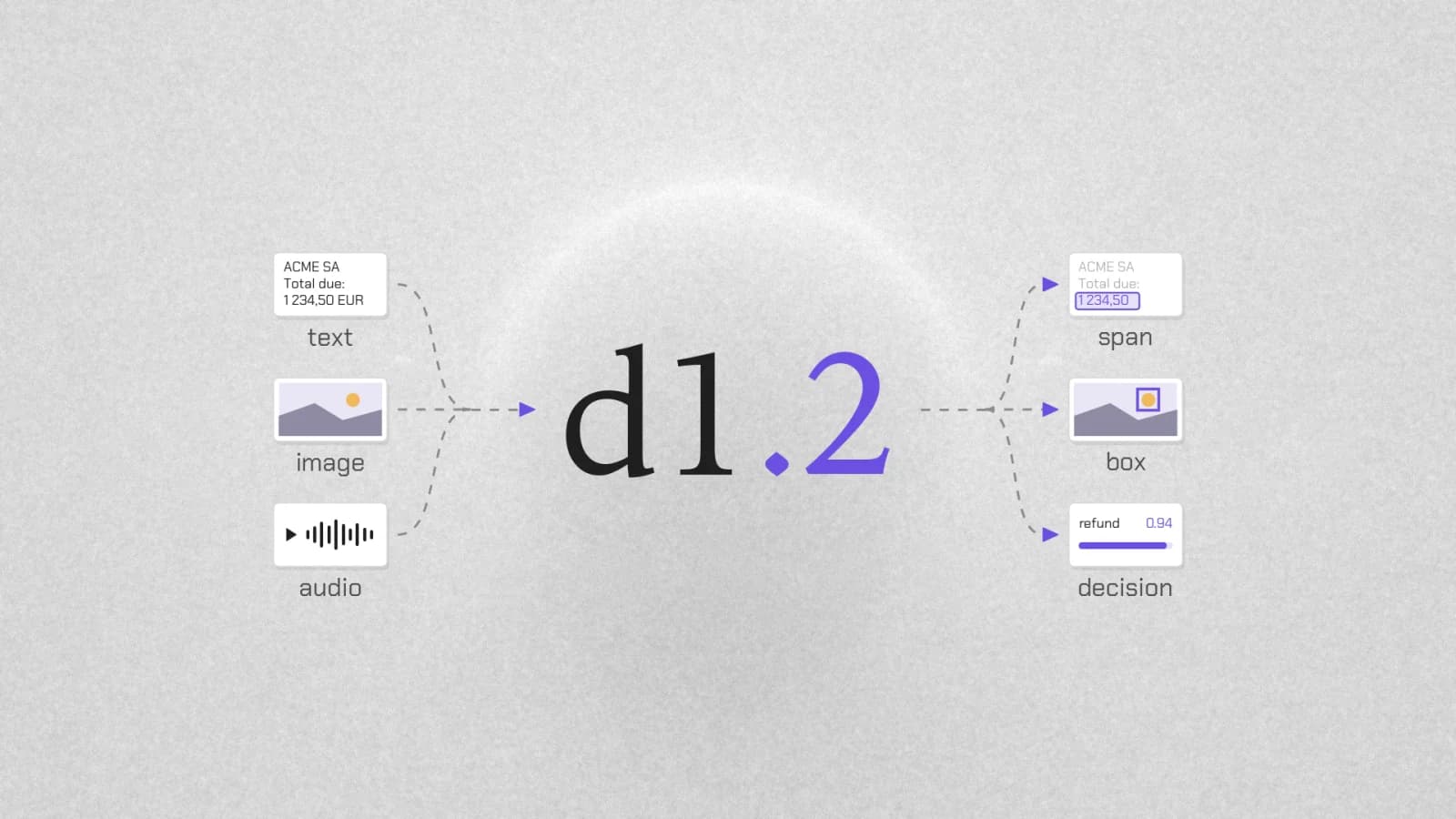
Liquid AI released d1.2 and d1.2-ultra on November 16, 2026, adding audio input, five new structured decision tasks, and a claimed 75 on Artificial Analysis Decision Index v2.1 for the ultra tier. The announcement is on Liquid's blog with API pricing $0.02 per million input tokens for d1.2 and $0.042 for d1.2-ultra.
If you only know chat models, decision models return calibrated probabilities for closed questions in one forward pass — no parsing assistant paragraphs. We explained the category in what are decision models and tracked d1-ultra's October launch. d1.2 is the task-and-modality expansion, not a new pricing philosophy.
TL;DR
| Question | Answer |
|---|---|
| Release date | November 16, 2026 (Liquid blog) |
| Model IDs | d1.2, d1.2-ultra on Liquid API |
| Price (input) | $0.02/M (d1.2), $0.042/M (d1.2-ultra) |
| Index claim | 75 on Decision Index v2.1 (d1.2-ultra) |
| New inputs | Audio (subject or spoken question) |
| New tasks | Value read, spans, boxes, count+range, multi-select |
| Endpoint | POST /decisions/v1/systemone (docs) |
Five new task types (what builders gain)
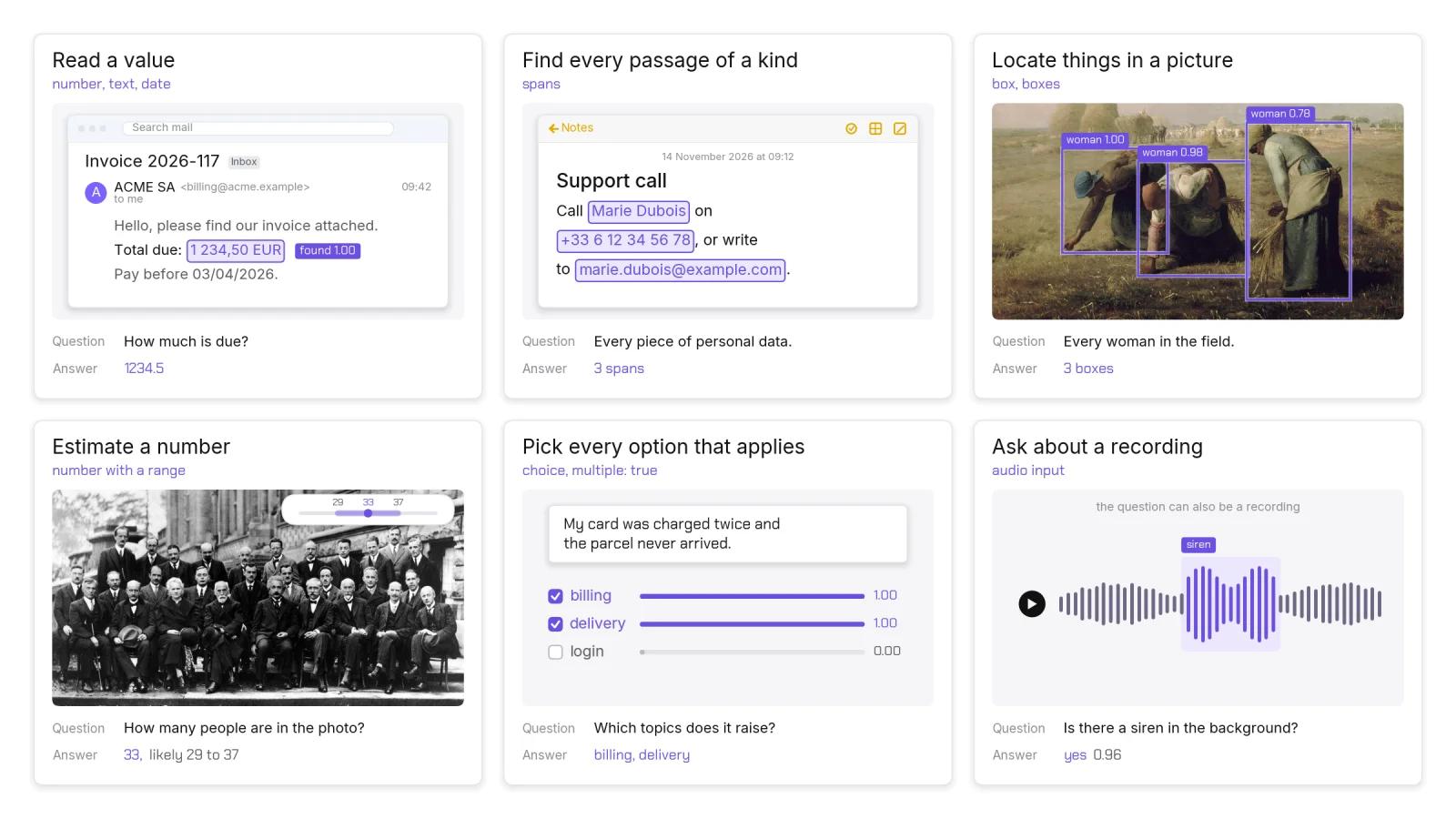 Liquid AI d1.2 multimodal decision task types illustration
Image: Liquid AI
Liquid's post lists tasks that usually require fragile regex or a full VLM chat loop:
- Read a value from invoices or forms — returns the value or not found instead of hallucinating.
- Span detection — find every PII passage with positions (Nemotron PII-style evals in their table).
- Box localization — one object or every instance in a photo (RefCOCO family).
- Numeric estimation — count with range (COCO-style counting).
- Multi-select choice — multiple topics true at once, each with probability.
Each type uses the same endpoint and request shape Liquid showed for d1-ultra, which lowers integration cost if you already run Mercedes on-device voice experiments or Amazon Bedrock decision screening.
Audio: when it matters
Audio support matters for safety and ops pipelines where sound is the signal:
- Detect sirens, languages, or background machinery in field video.
- Accept spoken questions when operators wear gloves on factory floors.
Liquid does not publish sample rate limits in the headline post; check Liquid API docs before you ship production MIME types.
Decision Index v2.1: claimed leaderboard
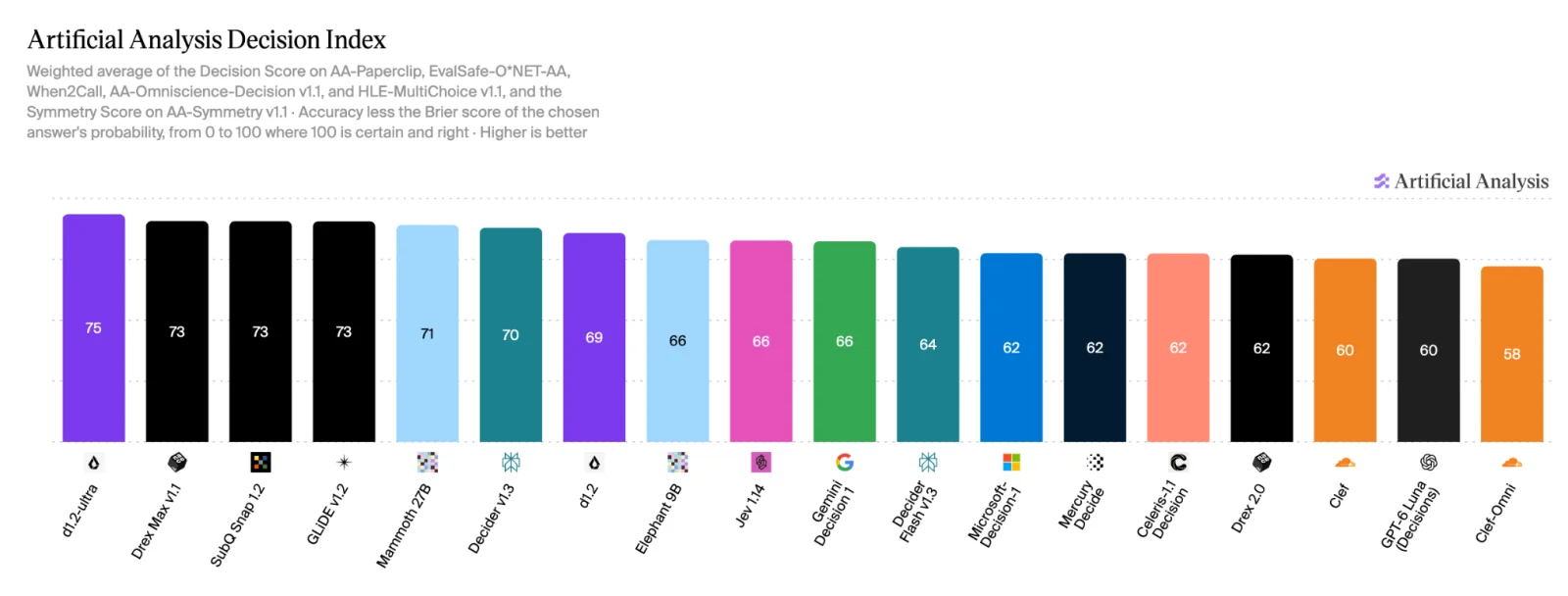 Artificial Analysis Decision Index v2.1 scores for d1.2-ultra
Image: Liquid AI
Liquid says d1.2-ultra hits 75 on Artificial Analysis Decision Index v2.1, two points above the prior best, and claims both models are best for their cost tier on that index.
Treat the index like any vendor-adjacent benchmark:
| Claim | Source | Independent check |
|---|---|---|
| Score 75 | Liquid blog Nov 16 | Reproduce via AA when public |
| +2 vs prior best | Liquid blog | Compare to d1-ultra October post |
| Best cost curve | Liquid blog | Plot $/M input vs score yourself |
Our Jev 1.14 guide and Phonic speech-to-speech index claims show how explainx.ai handles index-only launches — ship the how-to, flag unverified leaderboard lines.
Calibration table (vendor numbers)
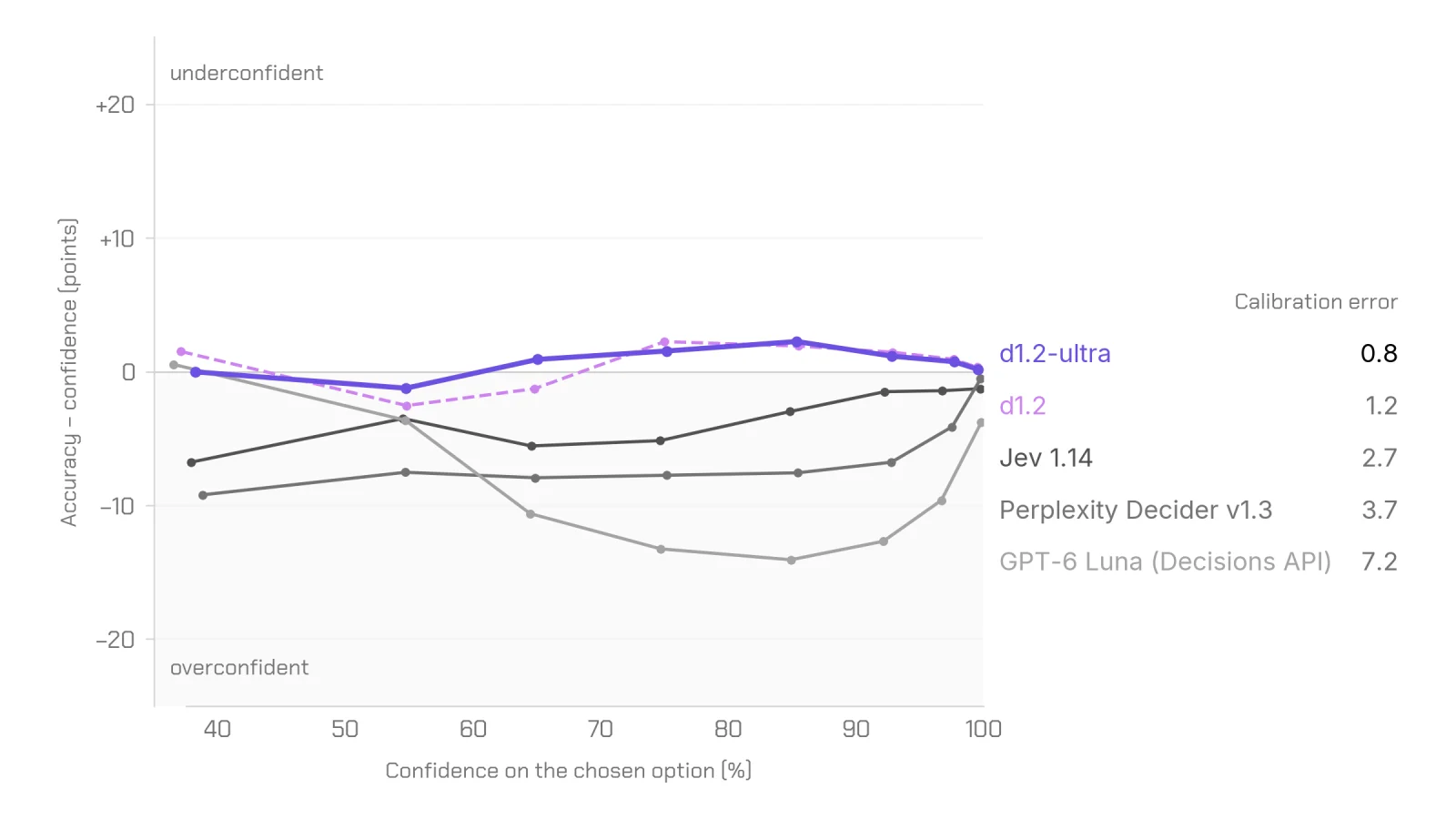 Liquid AI d1.2-ultra calibration error comparison chart
Image: Liquid AI
Liquid publishes calibration error across 13 benchmarks and 22,505 questions:
| Model | Calibration error (Liquid) |
|---|---|
| d1.2-ultra | 0.8 |
| d1.2 | 1.2 |
| Jev 1.14 | 2.7 |
| Perplexity Decider v1.3 | 3.7 |
| GPT-6 Luna (Decisions API) | 7.2 |
Calibration matters because threshold automation only works when 0.8 means ~80% correct. For compliance routing, pair calibrated scores with human review queues rather than blind auto-approve.
Sample accuracy rows Liquid published
| Task | d1.2-ultra | d1.2 |
|---|---|---|
| Receipt value read (CORD, SROIE) | 98% | 96% |
| PII spans precision / recall | 94% / 93% | 92% / 88% |
| RefCOCO localization | 94% | 94% |
| COCO count within one | 93% | 92% |
Run your documents — receipt layouts and camera angles differ from benchmarks.
When to pick d1.2 vs a chat model
Chat models excel at open-ended drafting. They are expensive and brittle when you only need yes/no with a score, one label from ten, or a count in a band. Decision models never generate prose, so you skip JSON repair and tool-parse failures.
| Job | Chat model risk | d1.2-style answer |
|---|---|---|
| Invoice total | Invents a number | Value read or not found |
| PII scrub check | Misses a phone in paragraph 3 | Span list with offsets |
| Warehouse photo QC | Long caption, no boxes | Rectangles per defect |
| Support ticket routing | Overconfident single tag | Multi-select with probabilities |
That pattern shows up in Cloudflare Clef-Omni and NACE Drex launches too — Liquid is pushing task breadth and audio as its differentiator this week.
Agent pipelines: where d1.2 slots in
A typical agent harness can call d1.2 as a cheap screen before an expensive frontier model runs:
- Ingest email, PDF, image, or audio clip.
- Ask structured questions (
noul, spans, boxes). - Branch on probability thresholds — auto-approve, escalate, or call a frontier chat model for synthesis only on low-confidence rows.
This is the same screening-layer idea as Bedrock AgentCore evaluations, but with Liquid-native pricing at two cents per million input tokens on the base tier.
Audio tasks in practice
Liquid gives two audio patterns:
- Audio as state — the model hears the clip and answers typed questions (siren, language, machine noise).
- Audio as question — operators ask aloud instead of typing.
For compliance, log whether spoken questions include PII before you send them to a cloud API. On-device LFM2.5-Audio may fit air-gapped lanes later; d1.2 is hosted API today.
Cost worked example (input-only billing)
Liquid bills input tokens only on decision models. If a 1024×1024 image costs 1,536 tokens (per d1-ultra docs) and you ask four questions, you pay roughly four prompts worth of input, not generated answer tokens.
At $0.02 per million for d1.2, one million image tokens of state is two cents before questions — attractive for high-volume triage if latency meets your SLA. Ultra at $0.042 is still far below frontier chat output pricing for the same workload, though you must accept closed-world questions.
Claimed vs verified checklist
| Item | Status Nov 16 |
|---|---|
| Models live on Liquid API | Stated on Liquid blog |
| Decision Index 75 | Vendor table; AA confirmation pending |
| Calibration 0.8 error | Vendor table across 22,505 questions |
| Receipt 98% cell | Vendor benchmark row |
| OpenRouter / Vercel | Liquid says coming soon on Nov 16 post |
Builders should run 50 real invoices before swapping production fraud rules — the same discipline we used for Liquid d1 vision.
How to try d1.2 today
- Create a key at console.liquid.ai.
- Call
POST https://api.liquid.ai/decisions/v1/systemonewith"model": "d1.2"or"d1.2-ultra". - Pack state (text, images, or audio per docs) and typed questions matching Liquid's System One schema.
- Read probabilities from the response — no output token stream.
Liquid's post includes an invoice extraction example that asks for a missing fourth field to prove not-found behavior — copy that pattern when you unit-test agents that currently use GPT-6 Astra JSON mode.
d1.2 vs d1-ultra vs open d1 weights
| Track | Best for |
|---|---|
| d1.2 API | New tasks + audio, lowest $0.02 tier for bulk triage |
| d1.2-ultra API | Highest index score in Liquid's table, same $0.042 ultra price |
| Open d1 on Hugging Face | Edge and on-device per open d1 guide |
How this fits the LFM3 family
Liquid shipped LFM3 open multimodal 2B models in October. d1.2 is the decision-specific lane — smaller surface, probability outputs, input-only billing. Teams often pair LFM3 for drafting and d1.2 for gates.
What people are asking
Is d1.2-ultra worth 2.1× the d1.2 price?
Only if your error cost dominates API cost. Fraud, safety, and regulated PII flows often fit that math; bulk content moderation may not.
Will OpenRouter carry d1.2?
Liquid listed OpenRouter for earlier tiers; November 16 says OpenRouter and Vercel coming soon while Liquid API ships first. Watch Liquid models page for gateway badges.
Does this replace Claude or GPT for coding?
No. Decision models classify and score; they do not edit repos. Keep Claude Code for patches and d1.2 for pre-flight checks.
Related on explainx.ai
- Liquid d1-ultra October launch
- What are decision models
- Open d1 edge weights
- LFM3 multimodal family
- Jev 1.14 comparison baseline
- NACE Drex open decision models
- Bedrock AgentCore decision screening
Sources
- Liquid AI: d1.2 announcement (Nov 16, 2026) — primary.
- Liquid API reference: Make decisions — primary.
Migration from d1-ultra and d1.1
If you pinned d1-ultra:latest, Liquid previously documented d1:latest aliases on the Make decisions endpoint. d1.2 adds task types your older schema may not send — audit question type enums before cutover.
d1.1 (October 30 on Liquid's news page) remains listed; d1.2 is the modality + task superset announcement. Teams on Jev or Perplexity Decider should compare calibration tables on identical holdout sets, not marketing index points alone.
Security and abuse considerations
Decision models can leak training biases into probability skew on demographic proxies in photos or audio. For HR and lending, keep human review on any auto-action and log model version (d1.2 vs d1.2-ultra) with each decision.
Span and box tasks can surface PII you intended to redact — treat model outputs as sensitive data in your vault, similar to ChatMate RPE lessons on exfiltration via assistant channels.
Accurate as of November 16, 2026. Index scores and benchmark percentages are Liquid's unless Artificial Analysis republishes them. Re-run benchmarks after each model pin change.