




openset-llm is a new MIT-licensed inference engine that runs a 27-billion-parameter model on a plain CPU with 8 GB of RAM and no GPU. Its authors, the group opensetlabs, report 17 to 20 tokens per second for one user on an 8-core Ice Lake Xeon. They say that is about 4x the next-fastest engine they tested. The repo gained about 1,228 stars in the two weeks after it appeared and now shows 1.2k stars and 117 forks.
Read the numbers as the authors' own. The README publishes a benchmark folder so others can reproduce them, but we found no independent rerun yet. The speed also depends on a narrow hardware class: x86 CPUs with AVX-512, on Linux or WSL2.
TL;DR: what you need to know
| Question | Answer |
|---|---|
| What is it? | A CPU inference engine and OpenAI-compatible server, built as patches on PrismML's llama.cpp fork |
| Which model? | Bonsai-2-27B, PrismML's ternary build of Qwen3.8-27B, a 5.95 GB file |
| Headline speed | 17 to 20 tokens per second, one user, 8 vCPU and 8 GB (authors' figure) |
| Hardware | Linux or WSL2, AVX-512 with VNNI and VBMI for the fast path, 8 GB RAM minimum |
| Cost and licence | Free. Code is MIT. Weights are Apache 2.0 |
| Install | git clone the repo, then ./start |
| Biggest caveat | No third-party benchmarks yet, and most laptops get a much slower fallback |
What openset-llm actually is
The project is not a new model. It is an engine. In the authors' words, an LLM is "a stack of parts you can rewrite: matmul kernels, decoding, attention, caches." They rewrote those parts for ordinary CPUs and kept the model fixed. The result is a set of patches applied by install.sh on top of the PrismML llama.cpp fork, pinned to a specific commit.
The patch set has five parts, as the README lists them:
- New AVX-512 kernels for the ternary weights, for both generating tokens and reading prompts.
- Speculative decoding with the model's own multi-token-prediction head. The engine drafts a few tokens ahead and the full model checks each one.
- A fused attention kernel that keeps long contexts fast.
- Batched requests with
./serve --multi N, where each stream's output is byte-identical to the same request served alone. - Agent-loop resume. When a client resends a long prompt with a changed ending, the server continues from the point where the two prompts diverge instead of reading everything again.
If you want the background on the last idea, our guide to speculative decoding explains why drafting ahead can speed up decoding without changing the answer.
 Speculative decoding drawn as a fast draft arrow ahead of a slower checking arrow, the technique openset-llm uses to speed up CPU inference
Why a 27B model fits in 8 GB
The trick is the model file. PrismML's Bonsai-2-27B stores each language weight as one of three values, minus one, zero or plus one, with a scale per group of weights. The shipped PTQ1_0 packing brings the 27B model to 5.95 GB. A standard 4-bit build of the same Qwen3.8-27B is a 16 to 19 GB file, according to the openset-llm README, which is why models of this size normally need a GPU or a 24 to 32 GB machine.
We covered the model itself in earlier posts: PrismML's Bonsai 2 27B near-lossless compression and the later Bonsai 2.5 27B update with agentic coding scores. PrismML publishes the weights under Apache 2.0 on Hugging Face. The openset-llm README notes that the quality comparison between the ternary model and the full-precision one lives on PrismML's model card, not in this repo.
The memory budget is tight. The README measures the server at 6.99 GiB resident when idle and 7.22 GiB after a roughly 4,000-token prompt on an 8 GB machine, with at least 0.19 GiB still available. Peak memory during a 512-token prompt read reaches 7.89 GB. That is why the installer refuses to run below 8 GB of RAM.
The benchmark numbers, and who measured them
All figures below come from the openset-llm README, run by its authors on 8 vCPU cloud boxes. The two main rivals are ik_llama.cpp and PrismML's own llama.cpp fork, each in its fastest setting.
| Measurement | openset-llm | ik_llama.cpp | PrismML fork |
|---|---|---|---|
| Single-user speed, Ice Lake 8 GB | 17 to 20 tok/s | about one quarter of that | about one sixth |
| Speed ratio (authors) | baseline | 4.2 to 4.3x slower | 5.9 to 6.1x slower |
| Agent step at 16k context, Ice Lake | 55 s | 314 s (5.8x) | 1,230 s (23x) |
| Agent step at 16k context, Zen 4 16 GB | 63 s | 274 s (4.4x) | 716 s (9.0x) |
Two things stand out. First, the gains are larger on agent loops than on plain generation. The agent test replays a recorded 11-request coding session where the client rewrites the end of the prompt on every step. Resuming from the divergence point cuts prompt tokens re-read over steps one to ten from 96,386 to 19,101. Second, the authors state that both rivals ran without speculative decoding, "which is how they ship for this model." The comparison is between what a user of each engine gets, not between identical algorithms.
Plain decoding without any speculation is a narrower win. The README reports 2.20x over ik_llama.cpp on Ice Lake and 1.89x on Zen 4 for decoding with the same prompts. The 4x headline needs speculation on.
Quality after the speed-ups
The authors tested whether the speedups hurt answers. On GSM8K with 40 problems, the new build scored 39 of 40, and coding pass@1 over 160 HumanEval and MBPP problems was 83.1 percent. The earlier build scored 39 of 40 and 83.8 percent. They report a p-value of 1.0. WikiText-2 perplexity was 7.5702 against 7.5699, each with an uncertainty of about 0.21. These sets are small, so they show no obvious damage rather than proving none.
A related caveat: speculation changes a reply only at near-ties. Greedy replies matched plain decoding on 17 of 24 benchmark prompts and 75 of 128 in a broader set, while task scores stayed level.
Compared with other models on the same box
The README also tests a different model in the same 8 GB: Thinking Machines' 26.4B Inkling 2 Mini as a 1-bit Unsloth GGUF on Unsloth's llama.cpp build. On the same Ice Lake box, openset-llm decoded at a median 20.07 tokens per second against 7.40, a 2.8x gap per prompt. GSM8K was 39 of 40 for both. Coding pass@1 was 83.1 percent against 80.0 percent, a difference the authors call not statistically significant.
The authors note this compares two models as well as two engines. Inkling always reasons before it answers, and used about six times the tokens per coding answer. Its recommended 4-bit file paged on 8 GB and ran at 1.2 tokens per second. With more memory it would do better, and the authors say they did not measure that. If you track Inkling, see our posts on Inkling 2 Mini and the Atomic Engine speed and memory results, which attack the same low-memory problem from the GPU side.
Which CPUs get the fast path
This is the most important section if you plan to try it. The README gives a table, and it is blunt.
| CPU | Instruction set | Result |
|---|---|---|
| Intel Xeon Ice Lake and newer | AVX-512 VNNI and VBMI | Full fast path, measured |
| AMD EPYC Zen 4 and Zen 5, Ryzen 7000 and 9000 | AVX-512 VNNI and VBMI | Full fast path; Zen 5 EPYC 9275F measured at 35 to 36 tok/s with speculation |
| Intel Cascade Lake and Cooper Lake | AVX-512 VNNI, no VBMI | Partial; 0.67 to 0.82x of the full path |
| Intel Core 12th generation and newer, most laptops | AVX2 only | Fallback; 4.8 to 5.7x slower |
| ARM64 Linux (Graviton, Ampere, Raspberry Pi 5) | NEON | Builds, untested |
| Apple Silicon | none | Not supported by install.sh |
The authors add that their Ice Lake test boxes expose 8 vCPUs that behave like 8 physical cores. A typical cloud 8 vCPU instance is about 4 cores, so expect lower absolute speed there. To check your own machine without cloning anything, the README gives a short shell snippet that reads /proc/cpuinfo, or you can run ./install.sh --check inside a clone.
How to try it
On Linux, the one-line path is a clone followed by the start script. You need git, cmake and a C++ compiler. On Ubuntu or Debian, install build-essential cmake git first.
git clone https://github.com/opensetlabs/openset-llm
cd openset-llm
./start
The first run builds the engine, downloads about 7.3 GB of model files and opens a chat page. For a server you can point existing tools at, run ./serve. It speaks the OpenAI chat-completions format:
curl http://127.0.0.1:8080/v1/chat/completions \
  -H 'Content-Type: application/json' \
  -d '{"messages":[{"role":"user","content":"Write a haiku about cache misses."}]}'
On Windows, use WSL2 and raise its memory limit first, because WSL2 gets half your RAM by default. Clone into the Linux home folder, not /mnt/c, since reading the model through the Windows mount is much slower. Docker is also supported, with at least 8 GB of memory allotted and a warning that the container has no authentication, so bind it to localhost.
Expect a 20 to 45 second wait at every start. The server repacks the weights before it accepts requests.
Limits the README states
The authors list limits plainly, which is a good sign. We repeat the ones that matter most.
- Context is short by default. The default is 4,096 tokens, chosen on purpose because a full 4k context with speculation leaves about 0.2 GB free on an 8 GB machine.
- Long context turns speculation off. Above 4,096 tokens on machines under 12 GB, the server uses plain decoding. Experimental
--kv8,--kv6and--kv5caches stretch this. The 5-bit cache keeps speculation on to 16k and plain decoding to 64k, but reading a full 64k prompt the first time takes about 50 minutes. - One model. Today it runs Bonsai-2-27B only. More models and hardware are promised, not shipped.
- Thinking is off by default. Use
./serve --thinkto turn reasoning on. - Prompt states are saved on disk. Resume stores up to 8 prefix states of about 0.3 GB each in
~/.openset-llm/state. Delete the folder or use--no-resumeto clear them. - LoRA adapters are experimental. One test with an OpenCode adapter dropped decode speed from 14.7 to 8.4 tokens per second and left the box out of memory. On 8 GB, use
--no-specwith an adapter. - Several users cost speed. With
--multi 4, four short prompts together reach 21.96 tokens per second in total, 2.28x one stream. Longer prompts of about 800 tokens drop the total to 7 to 10.
What this means for what you build or pay
For a builder, the useful shift is cost shape. A box with 8 vCPUs and 8 GB of RAM is far cheaper to rent than a GPU instance, and the server speaks the same API as the hosted models. That makes it a fit for background jobs, search, extraction and low-traffic agents where 17 tokens per second is acceptable and you pay no per-token fee. It is a poor fit for chat at scale, long documents or reasoning-heavy work, given the short default context and the speed drop when several users share the box.
For a founder, the claim to weigh is the hardware dependence. The speed comes from AVX-512 kernels, so the gain exists only on Xeon Ice Lake or newer and AMD Zen 4 or newer. A fleet of older or ARM machines would not see it. And because the 4x figure comes from the authors, run ./bench/quick.sh --plain on your own CPU before you plan capacity. The README says it prints a ready-to-paste result block in about five minutes, and it asks for reports from other CPUs.
It also fits a pattern we have followed for months: small, aggressively compressed models plus a hand-tuned engine. Compare the GPU-side approach in TensorFold, and see our primer on llama.cpp and the llama.cpp 1.0 release for the runtime openset-llm patches. The README itself spot-checks mainline llama.cpp v1.0.0 on the 8 GB box: it did not finish a long prompt within minutes because the 7.63 GB packing pages from disk, and its speculative mode ran at 0.17 tokens per second. The authors say more memory would help and they did not measure it.
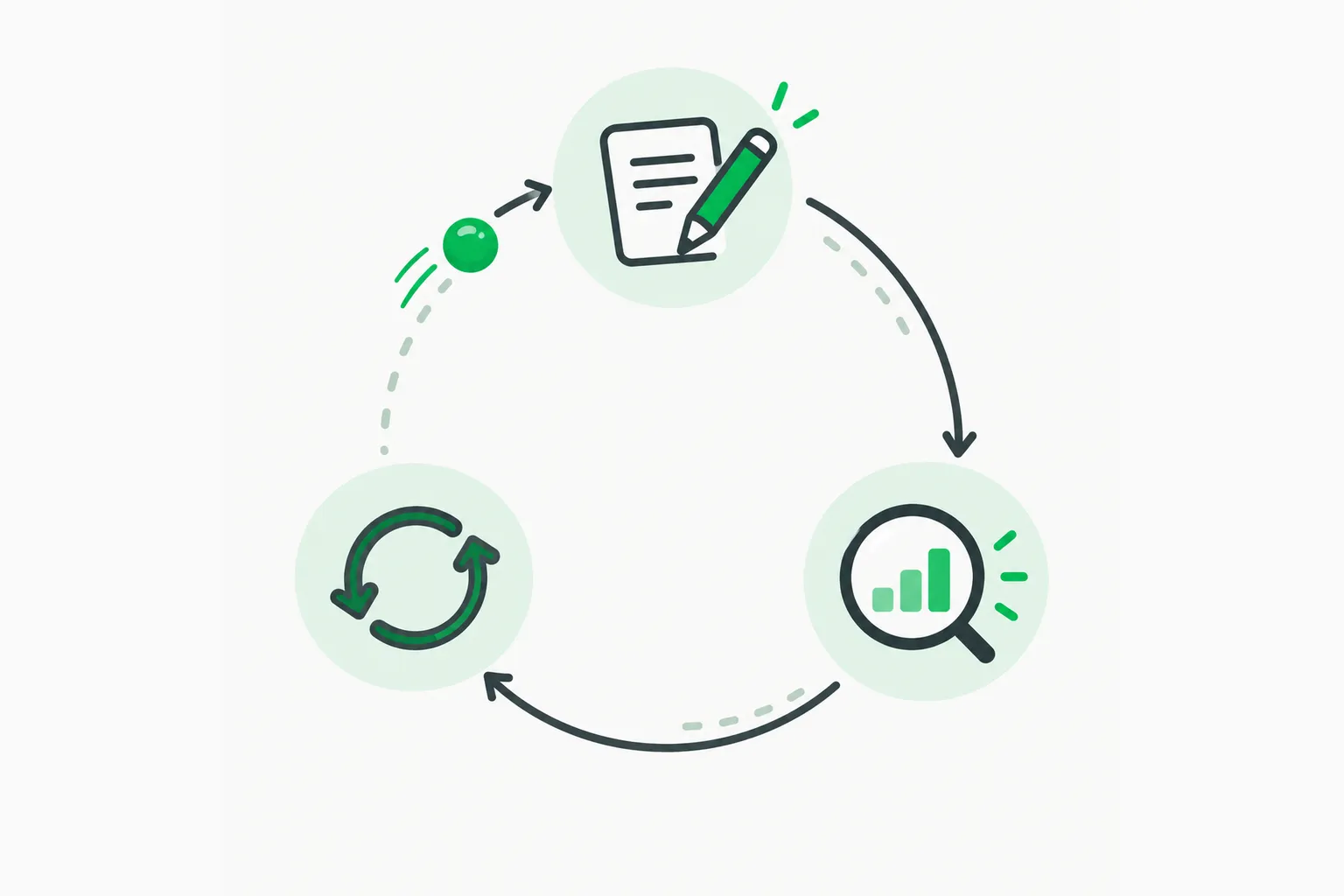 Agent loop drawn as a dot travelling around a circle of steps, the pattern openset-llm resumes instead of re-reading prompts
What to watch next
Three things decide whether this becomes more than a good demo. One is independent measurements: the authors invite reports from other CPUs, and the first outside reruns will show if the ratios hold. Another is model support, since a single 27B model is a narrow base. The third is ARM: Graviton and Raspberry Pi 5 builds exist but are untested. We will add an update here if outside benchmarks appear.
Related reading
- PrismML Bonsai 2 27B: near-lossless compression
- PrismML Ternary Bonsai 2.5 27B: 5.9 GB agentic coding model
- Atomic Engine: 3x Inkling 2 Mini speed at half the RAM
- Inkling 2 Mini on a laptop
- TensorFold: Zig LLM server for Metal and CUDA
- What is llama.cpp?
- What is speculative decoding?
Details and benchmark figures are accurate as of November 26, 2026, taken from the openset-llm README at that date. The repository changes quickly.