



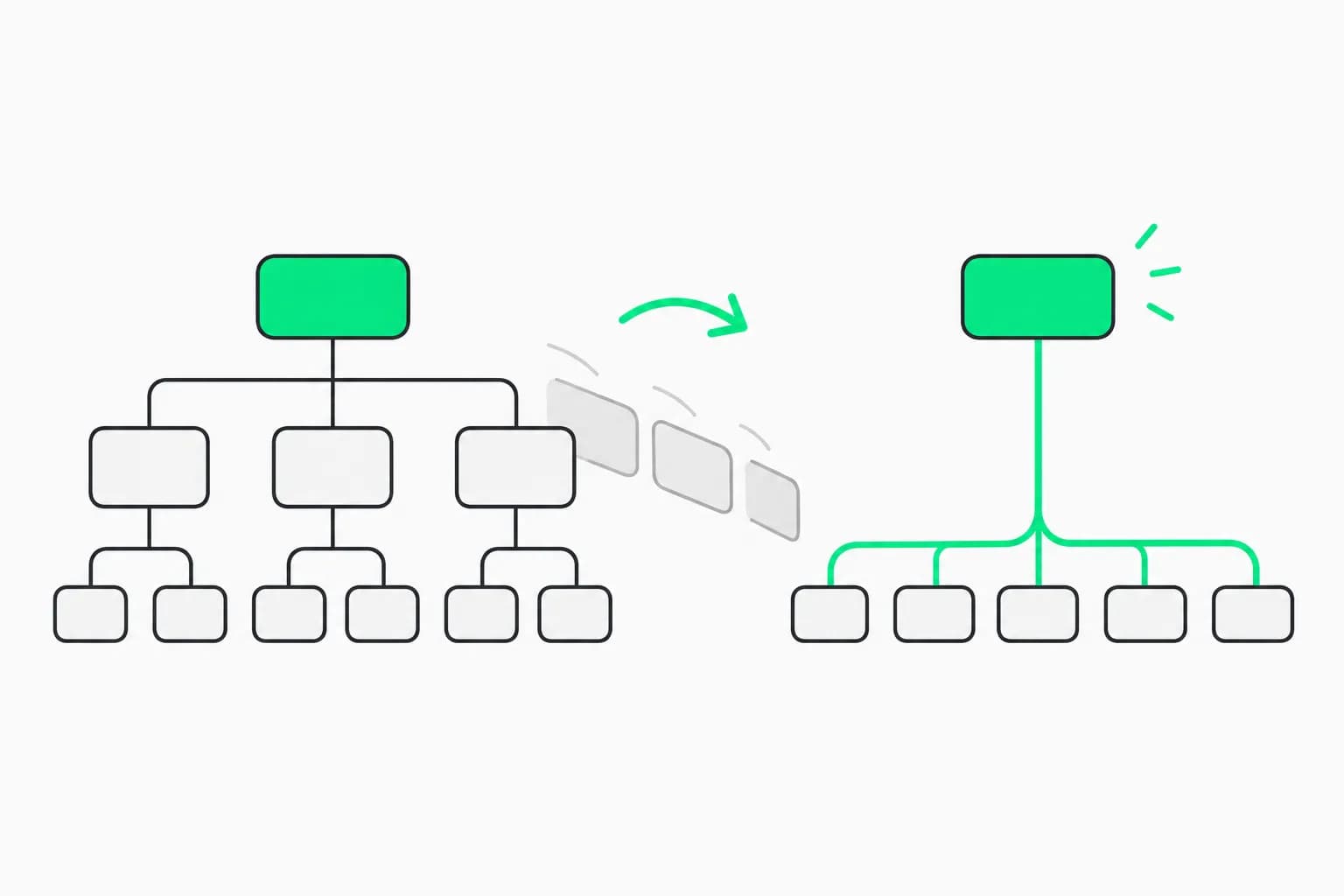
OpenAI has published a long essay on a question every manager is starting to ask: when AI joins the company, where does it sit on the org chart? In The future of the firm, published on October 28, 2026 under the banner "How AI might enter the org chart—beneath, beside, and between us," authors Hemanth Asirvatham and Elliott Mokski lay out three scenarios and what each would do to red tape, worker agency, firm size and pay.
One caveat comes first, and the essay states it itself: this is "the second essay in our series on the next economy," part of "a new platform to host independent voices exploring an AGI future," and "reflects our views, not those of OpenAI or our colleagues." It is an informed personal take from two people who manage teams there, not a product announcement or company policy. That is also what makes it worth reading: it shows how people inside a leading lab think adoption will unfold.
Note on scope: we read the opening and the first three scenarios in full; the part of the page covering the employment contract and the closing sections (red tape, firm size, pay disparity) did not load for us, so we describe those only by the authors' own list and do not characterise their conclusions.
TL;DR: the three scenarios
| Scenario | Name in essay | What changes | Who adopts first |
|---|---|---|---|
| Beneath | "The Promoting" | Everyone keeps their seat and becomes a manager of AI agents; the org chart gets a "basement" | Front-line workers who know the work |
| Beside | "The Interleaving" | AI joins the chart alongside people, reporting to human managers and later higher | Existing managers, once AI is competent as a team member |
| Between | "The Layering" | Human, AI, human: AI coordinates and monitors work in the middle | Executives, via an AI "consultancy" |
Scenario one: beneath us, or everyone becomes a manager
In the first scenario nothing looks different from the outside. People keep their seats and reporting lines, but beneath each of them grows "a new AI labor force." The authors say it starts with "one or two agents apiece, less as seasoned employees, more as eager interns we must supervise and readily forgive," and expands to managers and specialists among the agents, until each person's operation "looks like a small firm in its own right, with its own org chart and you as its board of directors."
Their worked example is an accountant, Jace, whose job shifts from clicking through spreadsheets to coordination and judgement while the team does not shrink because the rest of the company demands more accounting. Two of their arguments are worth noting.
- "Automation without pink slips." They argue you can "automate our past selves" and move up. If AI does 90% of what you did, you may be left with a full job aimed at an objective ten times larger. They tie the outcome to consumer appetite: if demand for output saturates, they say, society might choose fewer workers or fewer hours.
- "Entry level is no longer the lowest level." The lowest rung would be filled by something that "doesn't mind," which removes apprenticeship through grunt work. The authors call that a real cost but mostly a privilege, since a junior with an idea can build it without headcount. This is the most contested claim, and we come back to it below.
For teams trying this now, our guide to loop engineering for coding agents is a practical look at how a single worker supervises agent loops, and Anthropic's Claude Duet proactive agent shows a product built for this pattern.
Scenario two: beside us, or AI as a colleague
In the second scenario managers hand slices of their team's work to a model "the way she might delegate to any employee." The example is Sheila, a VP at a furniture company who has never run an ad campaign: she gives an AI marketing team a budget and a sofa to sell, and gets back a campaign to approve plus a flag that the photos make the sofa look too blue.
The central idea is the "escalator of scope": AI moves from automating a task to a job, a team and finally a firm, and each step needs broader competence. Then comes what the authors call the central asymmetry: "bigger scope is easier to adopt." A tool with narrow capabilities needs retraining across the workforce, while a whole automated team can be adopted by an executive directly. Their formulation: "Firms learn technology; labor learns the firm." The more AI behaves like labor, with initiative and adaptability, the less the firm has to learn to harness it.
They also push back on the idea of AGI as "automating a job," arguing that very little of the economy's output comes from lone-wolf workers and that "an economic AGI must reach the standard of people, not person." The practical risk they name is that a model wedged beside every worker creates "a thousand seams and handoffs", which could slow adoption and set up a race between early, less capable setups and later, more capable models.
Scenario three: between us, or the automation sandwich
The third is the one the authors call most confounding: AI above some people and below others. They say it sounds far-fetched but "in less radical ways, this has already begun." Their example is a chief executive whose AI consultancy flags that sales promised a feature engineering is not building, drawn from ordinary work threads, then recommends delaying the launch, reassigning engineers and recognising an engineer who quietly built useful infrastructure.
Two claims stand out:
- Management may automate before the work it oversees. The authors note that managers' work mostly lives on a computer and in the mind, whereas ground-level work often "tangles with atoms and tools." They concede we lack evaluations for orchestration at manager scale, so "we don't yet know how good the models are at management."
- The effect would be centralisation. An executive who can ask an AI to read hundreds of channels and documents shortens "the distance between C-suite and the company proper," vesting "more power at the top, where information frictions used to favor more decentralized decision-making."
They also raise the employment contract: firms have long measured "pantomimes" of work, such as clicks and status dots, because observing real work was expensive, and AI might offer richer monitoring. We did not get the text on how they resolve that tension, so we do not summarise it. Related worries about monitoring appear in our coverage of Newsom's bill on AI emotion tracking and robo-bosses and of the Amazon Atlas risk score for UK warehouse workers.
What the essay leaves open
Reading it as a skeptic, several points deserve scrutiny.
- Evidence. The essay is scenario writing with illustrative characters, not data. The authors say none of the scenarios will play out exactly as described. Compare it with measured findings such as the Monday and Nielsen survey of 1,700 leaders on managers evaluating AI work.
- Incentives. An AI lab's staff arguing that adoption is easier the more capable the model, and that jobs shift upward rather than vanish, aligns with a lab's interests. That does not make it wrong; it is a reason to weigh outside estimates like the Goldman Sachs 9 percent displacement scenario and the bearish Acemoglu forecast.
- The junior-worker problem. The claim that removing grunt work is "a privilege" assumes juniors still learn judgement without the apprenticeship. Evidence on retraining is thin; see Anthropic's review of 56 randomized studies on worker retraining.
- Quality and trust. The "promoting" scenario depends on supervising agents that "still make their share of mistakes," a point the authors make themselves. Supervision cost is the quantity that decides whether the arithmetic works.
- Power. The layering scenario concentrates information at the top. Who audits the AI consultant is not a technical detail.
What to test on your own team
You can treat the three scenarios as three experiments.
- Beneath: pick one repeatable workflow, such as weekly reporting, and give one person an agent for it for two weeks. Record time spent supervising versus doing, and error rate.
- Beside: let a manager delegate a bounded project, like a campaign draft or a data pull, to a team of agents and keep a log of what a human had to fix.
- Between: if you try an AI that reads team channels for risks, decide in advance what it may surface, who sees it and how staff are told. Transparency matters more here than anywhere.
Whatever you test, keep written limits on what agents can do without approval. If your agents touch real systems, AgentBeam is the agent security platform from the explainx.ai team that stops AI agents before they take dangerous actions.
Why OpenAI publishing this matters
The essay arrives alongside concrete products: OpenAI's always-on agent offerings from DevDay and its work products are the "basement" and "consultancy" in early form. Reading the essay next to the products helps you see the direction: agents that act on your behalf first, then agents that advise leaders about the organisation. It also frames a policy debate, because the second essay in a series on "the next economy" is evidently meant to feed conversation about work, not just sell software. For the political side, see our coverage of Democrats' AI regulation push ahead of the midterms.
Bottom line
The essay's contribution is a vocabulary: promoting, interleaving, layering, and the idea that scope, not capability alone, determines how fast firms adopt. Its limits are equally clear: no data, a personal view, and a lab's perspective. Use it as a checklist of questions for your own organisation rather than a forecast.
Related reading
- Loop engineering for coding agents
- Claude Duet proactive agent
- Monday and Nielsen survey on managers and AI work
- Goldman Sachs on AI displacement
- Acemoglu's bearish AI forecast
- Anthropic's worker retraining evidence review
- Official: OpenAI, The future of the firm and OpenAI's introduction of dots
Details are accurate as of October 28, 2026 and come from the essay as published; the authors' views are their own.