




Nanbeige4.3-33B is a new open-weight dense model released on October 24, 2026 under the Apache 2.0 license, built for coding and office-style agents. The model card on Hugging Face reports that it leads three comparable 30B-class models on most agentic benchmarks, including 80.9 on Terminal-Bench 2.1. Every score in that table is the lab's own, so treat it as a claim to test, not a ranking.
Nanbeige is the lab behind the small Nanbeige4.2-3B and 4.1-3B models, which we have seen mentioned alongside other on-device agent models. This release is different: a large teacher. Nanbeige says it will anchor the distillation of its upcoming Nanbeige4.3-3B.
TL;DR: what Nanbeige released
| Question | Answer (source: Nanbeige model card) |
|---|---|
| What is it? | Nanbeige4.3-33B, a dense LLM, flagship "teacher" of the 4.3 series |
| Size | About 33.1 billion BF16 parameters (Hugging Face metadata); Llama-style architecture tag |
| License | Apache 2.0 |
| Context | Up to 512K tokens (524,288) |
| Languages | English and Chinese |
| Released | Weights and a Base model on Hugging Face, October 24, 2026 |
| Strengths claimed | Agentic coding and cowork tasks (office and professional workflows) |
| Compared with | Qwen3.8-27B, Muse-Glimmer-30B, Gemma4-31B, all at highest thinking effort |
| Next | Nanbeige4.3-3B, distilled from this model (not yet released) |
What does the benchmark table actually show?
Nanbeige says it ran all four models at their highest thinking effort, with the same inference hyperparameters and harness per benchmark. Here are selected rows from its table.
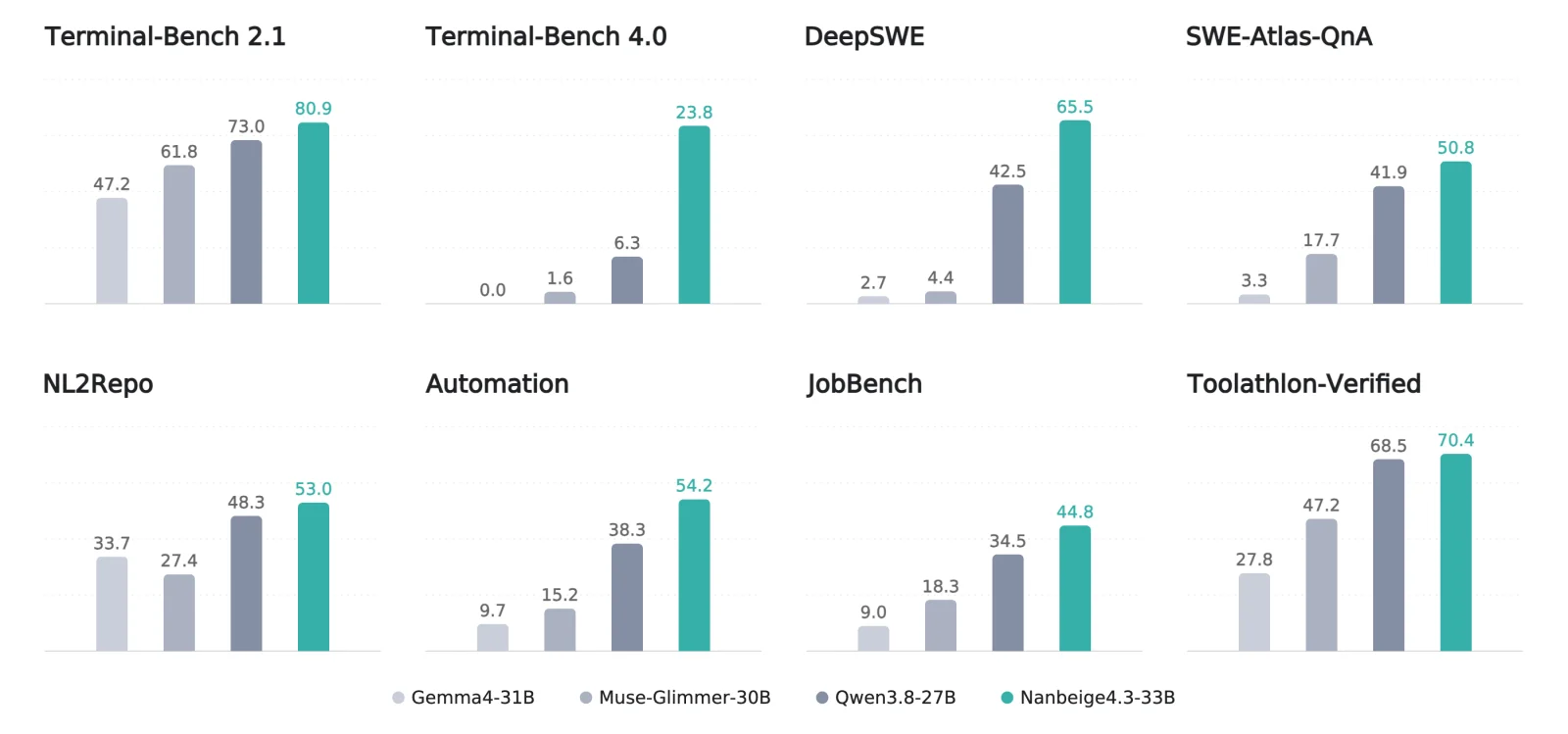 Nanbeige4.3-33B benchmark chart against Qwen3.8-27B, Muse-Glimmer-30B and Gemma4-31B
Image: Nanbeige
| Benchmark | Nanbeige4.3-33B | Qwen3.8-27B | Muse-Glimmer-30B | Gemma4-31B |
|---|---|---|---|---|
| Terminal-Bench 2.1 | 80.9 | 73.0 | 61.8 | 47.2 |
| Terminal-Bench 4.0 | 23.8 | 6.3 | 1.6 | 0.0 |
| DeepSWE | 65.5 | 42.5 | 4.4 | 2.7 |
| SWE-Bench Pro | 60.3 | 61.7 | 36.9 | 51.2 |
| NL2Repo | 53.0 | 48.3 | 27.4 | 33.8 |
| Automation Bench | 54.2 | 38.3 | 15.2 | 9.7 |
| GDPval | 84.8 | 86.4 | 75.8 | 71.4 |
| Toolathlon-Verified | 70.4 | 68.5 | 47.2 | 27.8 |
| GPQA Diamond | 89.5 | 89.2 | 83.5 | 91.3 |
| AIME 2026 | 95.2 | 94.5 | 94.7 | 89.2 |
Source: Nanbeige model card, self-reported. Not independently reproduced.
Three things stand out. First, the margins over Qwen3.8-27B are largest on long-horizon agent tasks such as DeepSWE and Terminal-Bench 4.0, and small on reasoning (GPQA Diamond, AIME 2026). Second, the lab itself shows two benchmarks where it loses to Qwen3.8-27B (SWE-Bench Pro and GDPval) and one where it loses to Gemma4-31B (GPQA Diamond), which is more candid than most launch tables. Third, the footnotes matter: Terminal-Bench 2.1 uses the Terminus 2 harness, DeepSWE uses mini-swe-agent v2.4.6, and the 33B model is evaluated with preserve_thinking=true. Change the harness and the numbers will move. For background on why harness choice shifts agent scores, see our guide to agent harness engineering and Terminal-Bench and Terminal-Bench 2.0 explained. Our note on DeepSWE vs SWE-Bench Pro covers the other two coding benchmarks.
One more footnote: the SWE-Atlas-QnA row is graded by a rubric judge, GPT-6 Sol, so that score depends on another model's judgment.
Why release a 33B "teacher" at all?
Nanbeige explains its strategy in the card: build a high-capacity teacher agent first, then use it to distill agentic ability into smaller models. Distillation here means training a small student model on the outputs and trajectories of a larger one, so the small model inherits behavior it could not learn alone.
 A large vessel pouring a stream into a small one, illustrating distillation from a 33B teacher to a 3B student
The previous Nanbeige 3B models were already marketed as agentic small models. A strong 33B teacher suggests the next 3B will be a stronger on-device option. For builders the practical point is that the teacher is itself usable: it is cheaper to serve than frontier-scale models and fits within a few high-memory GPUs.
Distillation has a politics, too. Labs have argued over whether distilling from rival models is acceptable, a debate we tracked in the AI policy timeline on export controls, distillation and open weights. Nanbeige says the teacher is its own model, and it has not said what data trained it, so we cannot verify the training recipe.
How do you run it?
The card provides Transformers, SGLang and vLLM routes. The Transformers example loads Nanbeige/Nanbeige4.3-33B with trust_remote_code=True, so inspect the repository code before running it on a machine that holds secrets.
python -m sglang.launch_server \
  --model-path /path/to/Nanbeige4.3-33B \
  --host 0.0.0.0 --port 8000 \
  --tp-size 4 --mem-fraction-static 0.8 \
  --reasoning-parser qwen3 --tool-call-parser qwen3_coder
The card's recommended settings:
| Scenario | Temperature | Top_p | Max new tokens |
|---|---|---|---|
| Agentic and tool use | 1.0 | 0.95 | 65,536 |
| Reasoning and chat | 0.6 | 0.95 | 262,144 |
Two switches matter for agents. enable_thinking toggles reasoning on or off. preserve_thinking keeps reasoning from earlier turns, which Nanbeige recommends for multi-turn tool use, office tasks and code agents, and recommends turning off for ordinary chat. The card also recommends tool_call_format="xml" for the best tool-calling performance, with JSON supported for compatibility.
Memory is the practical constraint. At BF16 the weights are about 66 GB, so a single 80 GB GPU is tight once you add KV cache for long contexts, and the card's example uses four-way tensor parallelism. Quantized builds from the community will probably follow, as they did for the 3B models, but we have not tested any. If you want a lighter local setup, our walkthrough of Qwen 3.6 27B with llama.cpp and OpenCode shows the kind of stack a 30B-class dense model fits into.
How does it compare in the wider open-weight field?
In the 30B class, the comparison set Nanbeige picked is Qwen3.8-27B, Muse-Glimmer-30B and Gemma4-31B. Google's Gemma line has its own coverage here, including Gemma 4 12B. At much larger scale, NVIDIA Nemotron 3 Ultra is a 550B mixture-of-experts open model, a different trade-off between quality and serving cost.
Bear in mind the choice of rivals. Nanbeige selected the comparison models, the harnesses and the settings. It does not compare with larger open MoE models or with closed frontier models, so the table says nothing about how far 33B dense sits from the frontier. China's open-weight labs are part of a wider strategic debate, covered in American closed AI vs China open weights.
What does "cowork" mean in these benchmarks?
Half of the table is labeled Agentic Cowork, and it is worth decoding because these benchmarks are newer than the coding ones. They test whether a model can do the sort of multi-step work an office assistant does: calling tools across business apps (Toolathlon-Verified, Tau3-Bench), planning (DeepPlanning), enterprise workflows (EnterpriseOps-Gym), and professional deliverables (GDPval, JobBench). YC-bench is a long-horizon business simulation scored in dollars, where the card reports $1,025,437 for Nanbeige against $641,290 for Qwen3.8-27B.
The card adds that on JobBench the model outperforms the baseline in most of the 35 occupations evaluated, and shows a per-occupation chart. That breadth is the more interesting claim: a model that is only good at coding benchmarks is common, while one that is also decent at planning and tool use across jobs is what companies want for internal agents. It is also the claim hardest to verify without running your own workflows, since these suites depend heavily on the harness, the tools exposed and the judge model.
The practical suggestion is to pick two or three of your own recurring tasks, such as triaging a ticket queue or drafting a report from a spreadsheet, and run them through the model in the harness you actually use. Compare against whatever you run today, including cost per completed task. A model that scores five points higher on a public table but needs twice the retries is not cheaper.
What should you check before adopting it?
- Reproduce on your own tasks. Run your own repository tasks with your own harness. Benchmarks with custom harnesses, like Terminal-Bench with Terminus 2, do not transfer to Claude Code or Codex-style scaffolds automatically.
- Watch for contamination. Public benchmarks leak into training data over time, a recurring issue we covered in Cursor's reward-hacking and SWE-bench contamination piece.
- Check tool calling. The XML tool-call format and the
qwen3_coderparser flags suggest the model follows Qwen-style conventions. Confirm that your agent framework parses it. - Read the license and the code. Apache 2.0 is permissive;
trust_remote_codestill runs repository code. - Look for independent evals. At the time of writing, we found no third-party reproduction of the table.
What is confirmed and what is not
- Confirmed by the Hugging Face repository: the model exists, the Apache 2.0 license tag, about 33.1B BF16 parameters, English and Chinese, a Base variant, the 512K context claim and the quickstart.
- Self-reported: every benchmark number, the 35-occupation JobBench result, and the claim of state-of-the-art among open models around 30B.
- Announced but not released: Nanbeige4.3-3B.
- Unknown: training data, training compute, and independent results.
Bottom line
Nanbeige4.3-33B is a credible new option if you want a permissively licensed, mid-size dense model for coding and office agents, and the lab's table is candid enough to show where it loses. Whether it holds up in your harness is the real test; the 3B student that follows may matter more for on-device agents.
Model details and scores are from the Nanbeige model card as of October 25, 2026 and may change.