



If you code with an AI agent all day, you have probably thought it: should I just buy five $20 accounts instead of one $200 plan? It sounds like the same money and more headroom. It is neither.
The better question is why you are running out at all. A plan that runs dry in two days is usually not too small. It is carrying stale context, re-reading the same dead conversation on every turn. This post does the per-dollar math across Claude, ChatGPT/Codex, Cursor and Google, covers what the terms say about stacking accounts, and then shows where the tokens actually go. The advice applies to every vendor.
TL;DR: stack small plans or buy one big one?
| Question | Short answer |
|---|---|
| Which is cheaper per unit of usage? | At Claude, Cursor and Google, the 20x tier is about $10 per Pro-equivalent. Stacked $20 plans cost $20 each |
| Does OpenAI differ? | One third-party tracker says OpenAI prices a flat $20 per Plus-equivalent across tiers, so a bigger plan buys a bigger bucket, not a better rate |
| Is stacking accounts allowed? | Mixed. Anthropic said multiple Max accounts are not against its terms, but abuse filters banned some. Sharing, reselling and third-party OAuth are the risky behaviors |
| What do extra accounts not fix? | Stale context, bloated tool definitions, and cold caches. A new account starts with none of your cached prefix |
| Where is the real leak? | Long sessions. Reads grow quadratically with turns |
| Best first move | /clear between tasks, audit what loads before you type, and compact before breaks |
What do the plans actually give you per dollar?
Vendors rarely publish absolute token counts. They publish multipliers against their $20 tier, so the honest way to compare is price per multiplier. Figures below come from vendor pages as summarized by third parties; each vendor can change them, so check the pricing page before you buy.
| Vendor | $20 tier | Mid tier | Top tier | Price per $20-equivalent |
|---|---|---|---|---|
| Claude | Pro $20 (1x) | Max 5x $100 | Max 20x $200 | $20, $20, $10 |
| ChatGPT / Codex | Plus $20 (1x) | Pro $100 (5x) | Pro $200 (10x), Pro $500 (25x) | $20, $20, $20 |
| Cursor | Pro $20 | Pro+ $60 (3x Pro on Agent) | Ultra $200 (20x Pro on Agent) | $20, $20, $10 |
| Google (Antigravity) | AI Pro $19.99 | AI Ultra $99.99 (5x) | AI Ultra $199.99 (20x) | $20, $20, $10 |
Three cautions on that table.
- Multipliers are not weekly quotas. One Claude Pro-versus-Max analysis points out that Max's 5x and 20x are published as session multipliers. Neither plan publishes an absolute weekly capacity, and both have weekly limits that can stop work.
- OpenAI changed its tiers recently. A third-party summary dated October 2 says the Pro tiers split on September 29 at DevDay, that the new Pro 200 is 10x where the old $200 plan was 20x, and that old Pro 200 holders keep the old allowance through October 29. The 5x and 10x multipliers come from an OpenAI staff forum post, not the help page. See our Ultrafast and Pro 500 coverage for the tier launch.
- Cursor's dollar pools are unofficial. Cursor lists Pro as "extended limits," Pro+ as "3x Pro limits" and Ultra as "20x Pro limits" on Agent. Third-party guides list API pools of $20, $70 and $400, but Cursor does not publish those.
The takeaway for Claude, Cursor and Google: the 20x tier halves your price per unit. Ten stacked Pro accounts cost the same $200 as one 20x plan and give you 10 units against 20. At OpenAI, price per unit is flat, so the dollars do not decide it. Limits and the 10x cut do.
Is it allowed to run several accounts?
Be careful here, because the sources are partly secondhand.
For Anthropic, a February 2026 report says developers saw bans on accounts holding multiple Max subscriptions in mid-February. It quotes Anthropic staffer Thariq Shihipar around February 19-20: "We haven't changed anything here. It's not against terms of service to have multiple MAX accounts." It also says Anthropic told users "some user accounts were automatically banned for triggering abuse filters" and that incorrect bans were being reversed. That article is a third-party blog, so treat the quotes as reported, not as Anthropic's current policy.
The same report cites an earlier Anthropic post from July 28, 2025: "a small number of users are violating our usage policies by sharing and reselling accounts." The behaviors tied to enforcement across guides are:
- Sharing one subscription across several people.
- Reselling or proxying subscription access.
- Using subscription OAuth tokens in third-party tools. One guide calls this "the pattern most associated with account suspensions."
- Heavy autonomous overnight loops that look like resale. This is the report's own analysis, not an Anthropic statement.
For OpenAI, one guide quotes the terms as prohibiting "circumventing rate limits or restrictions." We could not open the primary page, so verify the wording yourself. Our reading, flagged as opinion: opening a second account to get past a cap you just hit is exactly the pattern that clause describes, and it is a bad bet for a work account you cannot afford to lose. The practical risk is not only a ban. A ban means losing your history, your projects, and any refund process, with reports of slow or automated appeals.
For Cursor we found nothing on stacking individual plans. The only pooled option is the Teams plan, listed at $40 per user per month, which adds admin and billing controls.
When multiple accounts are fine: a work account and a personal account, or one account per vendor because you want a second model's opinion. That is model diversity. See why one strong agent usually beats a team of agents for the evidence that routing to the right model matters more than adding more of the same.
Why does stacking accounts not fix the real problem?
Because your context does not move with you.
Prompt caching is what makes long agent sessions affordable. Anthropic's docs state the caching rules plainly: reads cost a fraction of normal input, and "caches are isolated between organizations. Different organizations never share caches, even if they use identical prompts." That sentence is about API organizations. Subscription accounts are separate identities too, so we would expect the same isolation, but Anthropic's page does not say so for consumer plans. That part is our inference.
Here is what the docs confirm, for the API:
| Cache fact | Value (Anthropic docs) |
|---|---|
| Default lifetime | 5 minutes, refreshed free each time the cache is used |
| Longer option | 1 hour at extra cost |
| Cache read price | 0.1x base input on most models; 0.05x on Opus 5.5 and Sonnet 5.5; 0.025x on Fable 5.1 |
| 5-minute write | 1.25x base input |
| 1-hour write | 2x base input |
On a subscription, our token efficiency guide notes the cache lasts an hour, against five minutes on a bare API key. Either way, when you hop to a fresh account mid-task you start cold: no cached prefix, no session history, no project memory. You pay the full price to re-read your instructions and re-explain the work. The cap you were dodging gets spent again on re-setup.
So stacking accounts adds friction. It does not remove the leak.
Where do the tokens actually go?
Every turn sends the whole conversation again. A turn does not cost what you typed; it costs everything that came before, plus what you typed.
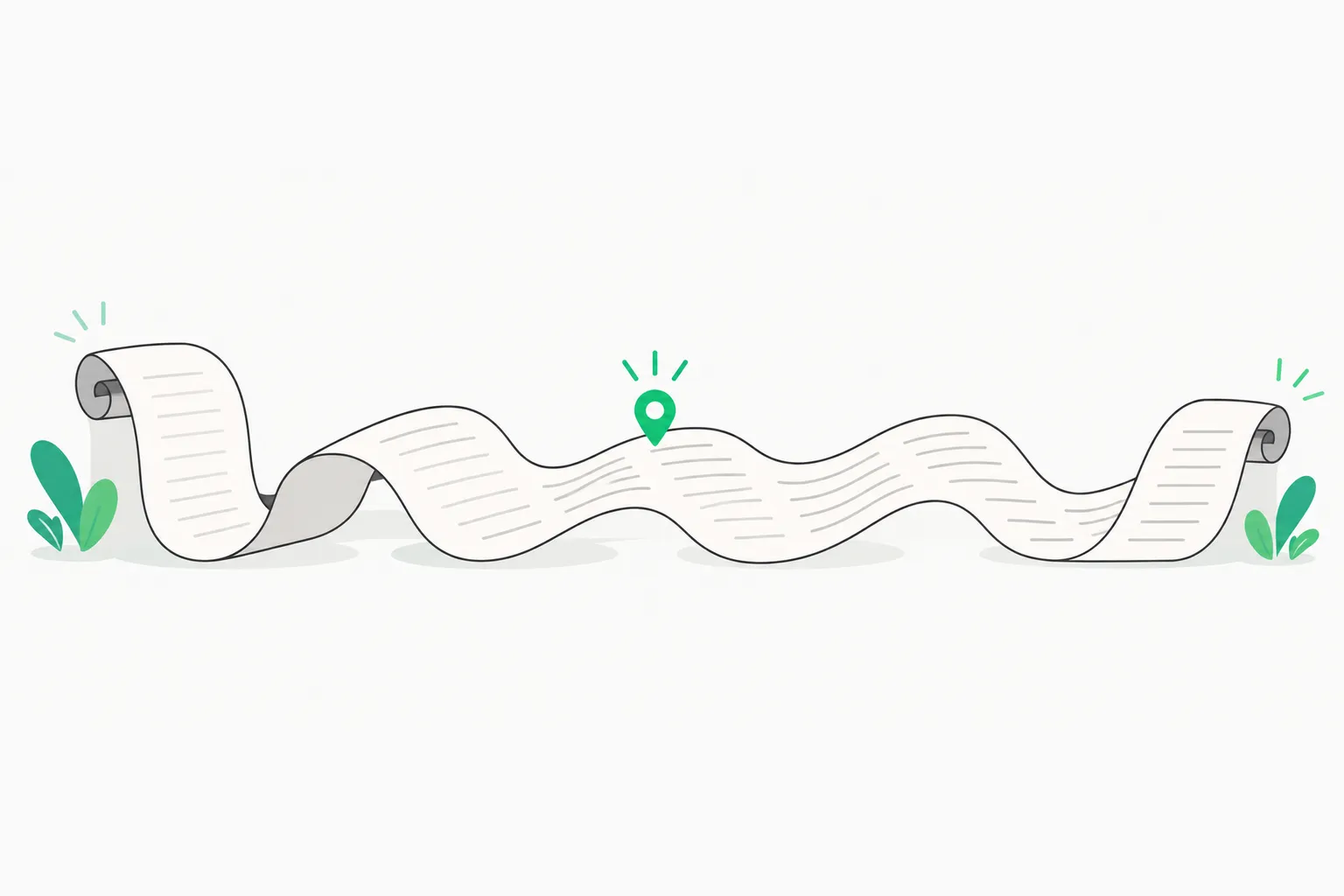 A very long scroll unrolling with a tiny marker in the middle, standing for stale context in a long AI session
Do the arithmetic with simple numbers. Say each turn adds 2,000 tokens of new material.
- After 1 turn the model reads 2,000 tokens.
- After 50 turns it reads about 100,000 in that single request.
- Summed across 100 turns, the session re-reads about 10.1 million tokens (2,000 times the 5,050 you get from adding 1 through 100).
- Start fresh every 25 turns and you re-read four short sessions of about 650,000 each, 2.6 million in total.
That is 3.9 times fewer reads for the same 100 turns of work. This is our illustration, not a measured figure. Real harnesses cache most of those reads and plans do not say how they count tokens, so your ratio will differ. The shape is what matters: the cost grows with the square of the session length.
Try it with your own numbers:
Two more costs sit on top.
The fixed prefix. Before you type anything, the agent loads its tool definitions, system prompt and instruction files. We measured it before in Claude Code loads about 19k tokens of tools before you type. Every new session pays it again, which is why clearing too often has a floor. The lab above lets you set it.
Output and effort. Our token guide reports output tokens cost roughly 5x input in Claude Code, so a high reasoning effort on a trivial question is a quiet burner.
Why does stale context also make answers worse?
It is not only a billing problem. Chroma's July 14, 2025 report on context rot tested 18 models including GPT-4.1, Claude 4 and Gemini 2.5 and found reliability declines as input length grows, even on simple tasks. The authors are Kelly Hong, Anton Troynikov and Jeff Huber. Secondary summaries add that models do worse when relevant information sits in the middle of a long input and when distractor passages look similar to the target. We could not confirm the specific percentage drops quoted by blogs, so we leave them out.
For an agent, the distractors are your own history: the failed approach from turn 12, the file you read and abandoned, the plan you changed. A stale session carries all of it into every new decision.
 A long folded ribbon passing through a wide ring, standing for a context window carrying old turns
That makes the trade-off asymmetric. A long session costs more and is less sharp. A fresh session with a short, accurate handoff costs less and is usually sharper. Apple researchers are even training agents to decide when to compress their own history; our write-up of SelfCompact covers it.
The context hygiene playbook that works on any vendor
The tool names differ. The habits do not.
- Start a fresh session between unrelated tasks. Claude Code:
/clear. Codex and chat tools: a new thread. Cursor: a new chat. Of everything in our token efficiency guide, this is the cheapest habit. - Write a handoff note, not a transcript. Ask the agent for a short file listing the goal, decisions made, files touched, and next step. Start the next session from that file. You control what survives, which beats an automatic summary.
- Audit what loads before you type. Run
/contextin a fresh Claude Code session and look at tool definitions, MCP servers and instruction files. Remove what you do not use. Cut yourCLAUDE.mdorAGENTS.mdto the rules that change behavior. - Use
/rewind, not/compact, when you can. Per our guide, rewinding trims the end of the conversation and leaves the cached prefix intact. Compaction rewrites everything, so do it before you step away, while the old cache is still warm. - Do not switch model or effort mid-session. Each model has its own cache, so a mid-conversation switch re-reads the whole history at full price. Change them right after a clear.
- Right-size the model. Send small edits and search to a cheaper model. Our Haiku 5.5 launch coverage shows what the small tier can do.
- Be careful with subagents and agent teams. They can help, but a team of agents has been measured at up to 5.1x the cost of one agent in one benchmark. See the Vals AI results.
- Watch your own burn. Check the usage page at the same time across a full reset cycle. One analysis puts it bluntly: do not upgrade to fix poor context hygiene, because a bigger plan can fund wasteful loops as easily as useful ones.
If your habits are already good and you still run out, that is a real signal to move up a tier. If you do, make it one tier at one vendor, not five accounts.
When should you actually upgrade?
Use a rule, not a feeling.
| Your situation | Reasonable move |
|---|---|
| Hit the cap once a week, mostly in long sessions | Fix context habits first. Re-measure after two weeks |
| Hit the cap daily with short, focused sessions | Move up one tier at one vendor |
| Need two different models' strengths | Pay for $20 at two vendors, not two at one |
| Mostly scripted or unattended jobs | Use the API with per-token billing. Max plans include monthly API credit, covered in our Claude Max credits guide |
| Employer data involved | Separate work account, never a shared one |
Pricing on this page can change within days, as the OpenAI Pro split shows. Our Claude Code pricing guide and context window pricing explainer are the places to check the arithmetic against current rates.
What we could not verify
- Absolute token limits. No vendor publishes them for these plans. Every ratio here is a multiplier.
- Primary terms text. We could not open Anthropic's consumer terms or OpenAI's terms pages. The terms discussion relies on third-party guides and one February 2026 report.
- Subscription cache isolation. Anthropic documents it for API organizations. Extending it to consumer accounts is our inference.
- Current OpenAI Pro allowances. Several sources conflict on the $200 tier, and one claims a second change on October 30 that another source does not mention.
- Cursor pool sizes. Not published by Cursor.
Prices, multipliers and terms change often and are accurate as of October 17, 2026. This is not legal advice; read each vendor's current terms before relying on any account strategy.
Related reading
- Maximizing Claude Code sessions: what actually costs you tokens
- Claude Code loads about 19k tokens of tools before you type
- Claude Max and Team API credits: how to claim and what they cover
- OpenAI Ultrafast and Pro 500: speed becomes a paid SKU
- AI agent teams cost up to 5.1x more than one agent
- SelfCompact: letting agents compress their own context
- Prompt caching and LLM cost optimization
- Context engineering vs prompt engineering
Sources: Anthropic prompt caching docs, Chroma context rot report, MetricNexus on Claude multi-account bans, Limit Lifeboat on multiple Claude accounts, ChatGPT Plus vs Pro tiers, Claude Code Pro vs Max analysis.