




Mozilla's Add-ons blog put a spotlight on WebBrain on November 20, 2026: an open-source browser extension that runs an AI agent beside your tabs with local or bring-your-own-model inference. Founder Emre Sokullu told Mozilla that cloud chat is not end-to-end encrypted and that sensitive pages deserve on-device models. The same week, the webbrain-one/webbrain repo held about 1,740 GitHub stars, giving Firefox users a visible alternative to closed browser copilots.
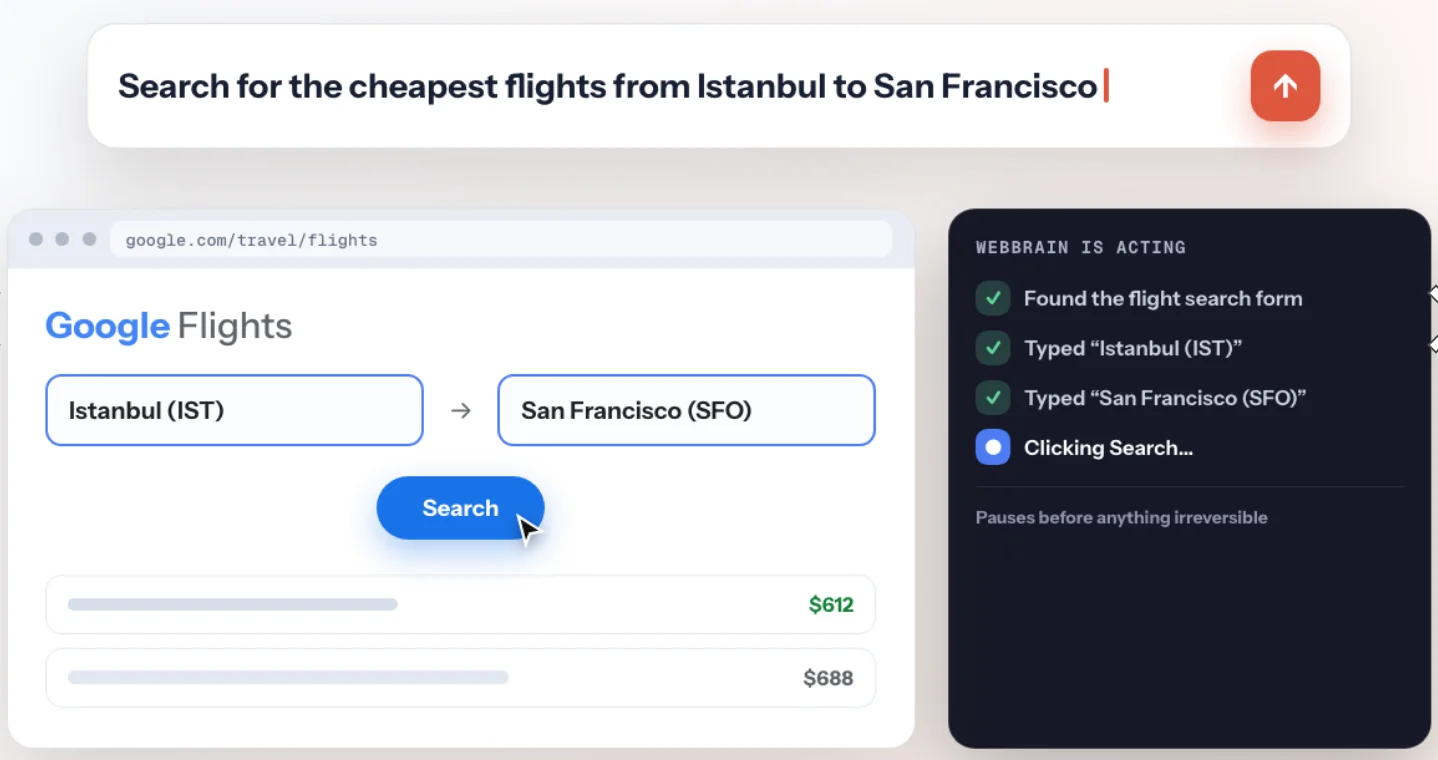 Mozilla Developer Spotlight screenshot of WebBrain local-first AI browser agent side panel
Image: Mozilla Add-ons blog
TL;DR
| Question | Answer |
|---|---|
| What shipped? | Mozilla Developer Spotlight blog post, not a new Firefox build |
| License | GPL-3.0-or-later per GitHub LICENSE |
| Browsers | Chrome, Firefox, Edge store listings |
| Local AI | llama.cpp, Ollama, or other OpenAI-compatible endpoints |
| Default model | WebBrain Compass 1.0 needs no API key |
| Modes | Ask (read), Act (click/type), Dev (debug) |
| RAM guidance | 16 GB system RAM or 16 GB VRAM for offline LLMs (Mozilla post) |
What Mozilla's spotlight emphasizes
The Mozilla Add-ons post frames WebBrain as privacy-forward by default when you pick offline models. Sokullu contrasts cloud providers with intimate data like health and finance pages.
Mozilla lists concrete tasks WebBrain advertises on arbitrary sites:
- Summaries on news and dense pages
- Image context on visual pages
- Downloads on video sites when permitted
- Automations such as GitHub or social interactions when you configure Act mode
The post also describes learned form preferences (usernames, emails) stored only locally, and optional integration with paid AI accounts you already own.
Apocalypse Mode
Mozilla highlights Apocalypse Mode: offline chat with bundled Wikipedia and medical sources for outages or disasters. That is a product narrative, not a security feature, but it shows how WebBrain markets offline bundles beyond generic chat.
What the GitHub README adds
Mozilla links the repo for technical readers. The README (main branch) provides builder details Mozilla's spotlight shortens:
Three control modes
| Mode | Capability |
|---|---|
| Ask | Read-only analysis, links, fetches |
| Act | Clicks, typing, navigation, uploads, downloads |
| Dev | Page source, styles, console, network, reversible edits |
WebBrain chooses a mode from your message unless you force /ask, /act, or /dev.
Model routing
- Default: WebBrain Compass 1.0 without an API key
- Local: Any OpenAI-compatible server (README names llama.cpp and Ollama)
- Cloud BYOK: OpenAI, Anthropic, Gemini, OpenRouter, and dozens more in settings
That last point matters for cost: you can keep page context local while still routing hard steps to a frontier model, or run entirely offline on a workstation.
Vision and planning features
The README advertises vision mode (screenshot-driven Act for vision-capable models), Plan before Act approval UI, and an accessibility-tree-first page model rather than brittle CSS selectors. Those choices align with how Vercel's agent-browser project pitches ref-based automation for coding agents, but WebBrain targets everyday browser users inside a side panel.
Install paths Mozilla and WebBrain agree on
 Browser windows passing a baton to illustrate agent handoff between tabs
Mozilla steers non-developers to official stores:
- Chrome Web Store listing
- Firefox Add-ons (linked from webbrain.one)
- Edge Add-ons
Developers can git clone the monorepo and load unpacked builds. The README documents Chrome Load unpacked on src/chrome or a npm run build:chrome output, plus Firefox temporary add-ons via about:debugging.
Hardware and privacy tradeoffs
 Stylus placing a bead into a form field slot on a browser card
Mozilla's 16 GB RAM / 16 GB VRAM guidance sets expectations: local agents are not phone-light yet. If you lack that hardware, Compass or a small cloud model still works, but you reintroduce data leaving the machine.
Read webbrain.one/privacy before pointing Act mode at logged-in SaaS tabs. The Chrome Web Store blurb notes a default Help Improve WebBrain setting you can disable.
Compared with n8n Nod's local sandboxed agent, WebBrain lives inside your everyday browser profile, not a separate VM. That is lighter weight and higher risk on sites where you are already authenticated.
How WebBrain fits Mozilla's 2026 AI story
In September, we summarized Mozilla research on the open-weight frontier gap. WebBrain does not close that model gap by itself. It gives Firefox enthusiasts a harness that can swap models as open weights improve.
Mozilla also ran the spotlight the same day as a new Firefox Add-on Developer Hub. WebBrain is ecosystem marketing: credible third-party agents help Firefox compete with Chrome's integrated Gemini workflows without Mozilla shipping frontier weights inside the browser.
What Hacker News readers said
The Mozilla blog hit Hacker News with modest traction (single-digit upvotes as of November 21, 2026). wbqa_oct6_0e57 wrote that Mozilla is "finally catching up with chrome in terms of ai" — that is one reader's take, not a benchmark. WebBrain author esokullu replied that Wikimedia, Automattic, and Mozilla are "very important instituitions" builders should support — his opinion, not Mozilla policy. No deep technical teardown yet, so treat performance claims as vendor and README documentation, not independent benchmarks.
Practical first tests for builders
If you evaluate WebBrain this week:
- Install from a store build, not a random fork.
- Start in Ask on a static article to verify accessibility-tree reads.
- Point Act at a throwaway test form, not production admin panels.
- Try local Ollama with a tool-capable model before pasting customer data into cloud keys.
- Compare latency and token use against OpenCode or Claude Code browser tooling you already run.
For teams standardizing agent permissions, pair experiments with site-specific rules similar to Signal's screenshot blocks for agent OS access.
WebBrain versus Chrome and Edge built-in AI
Chrome and Edge increasingly ship vendor-chosen models inside the browser chrome. WebBrain keeps the model picker in user hands:
| Approach | Who picks the model | Where context goes |
|---|---|---|
| Browser vendor AI | Google or Microsoft default | Vendor cloud unless stated otherwise |
| WebBrain + local llama.cpp | You | Stays on device during local inference |
| WebBrain + OpenRouter | You, per request | Follows router upstream rules |
That table is why Mozilla's privacy pitch resonates with Firefox's audience. It does not automatically make WebBrain safer: Act mode plus cloud keys reintroduces the same router and ZDR problems we covered elsewhere in November.
Building your first local stack
Mozilla's 16 GB guidance matches what many Qwen, Llama, and Mistral quant builds need for usable Act loops. A pragmatic lab setup:
- Install Ollama or llama.cpp with a tool-capable small model.
- Point WebBrain settings at
http://127.0.0.1:.../v1OpenAI-compatible base URL. - Stay in Ask until summaries look accurate on internal docs.
- Promote one low-risk workflow to Act (for example filling a staging form).
- Keep Dev mode off for non-engineers.
For teams already running Hugging Face SafeAgents proxy, WebBrain is another client that needs the same tool-call policy review.
Store policies and signing
Firefox permanent installation requires Mozilla signing, while Chrome and Edge listings update through their review queues. Sokullu's Product Hunt launch notes a long open-web history (Grou.ps, GraphJS). WebBrain is GPLv3: forks are allowed, but store impersonation is not. Download only from webbrain.one or the official store IDs Mozilla links.
Accessibility-tree automation in plain language
WebBrain's README stresses the accessibility tree instead of pixel hunting. That matches how assistive technologies see the page, which tends to survive CSS redesigns better than brittle selectors. The tradeoff: dynamic SPAs that hide structure from the tree still confuse agents, the same failure mode coding-agent browser harnesses report.
When you demo WebBrain to stakeholders, show one successful Act and one graceful failure so buyers expect supervision, not magic.
Enterprise add-on policies Mozilla shipped this fall
Mozilla's Add-ons blog also covered enterprise add-on policies in late October. IT teams rolling WebBrain fleet-wide should read that post alongside Mozilla's spotlight: signed extensions, update channels, and permission prompts are how Firefox keeps Act-mode agents from becoming shadow IT.
A sensible pilot:
- Allow WebBrain only on a dedicated Firefox profile without banking SSO.
- Block Dev mode except for security engineers.
- Require local models for any tab that loads customer tickets or health portals.
Comparison with Meta Muse connectors (ecosystem, not feature parity)
Meta Muse developer connectors chase server-side automations across SaaS APIs. WebBrain lives inside the browser session the user already authenticated. Neither replaces the other:
- Muse fits scheduled backend jobs with OAuth service accounts.
- WebBrain fits ad hoc page tasks where only a logged-in human (or agent beside them) can see the DOM.
Teams building customer support copilots might prototype in WebBrain, then harden the same workflow in a server agent once selectors stabilize.
Teaching WebBrain in workshops
explainx.ai's agent workshops emphasize permission boundaries before model choice. If you teach WebBrain:
- Start with Ask on public documentation sites.
- Introduce Plan before Act approval UI from the README.
- Show how vision mode changes token costs when screenshots replace tree reads.
- End with a threat model: what Act mode can post publicly on a logged-in X or LinkedIn tab.
That sequence mirrors how we teach Claude Code and Codex harness safety without pretending browser agents are toys.
Limits and risks to state plainly
WebBrain is GPL agent software with real Act mode, not a read-only summarizer. Misconfigured automations can post, click checkout buttons, or exfiltrate page text to whichever model you selected.
Mozilla's post is not a security audit. The repo's issue count and rapid star growth mean read release notes before auto-updating on machines with corporate SSO sessions.