




Mistral AI just shipped its first embodied model—and it is not another chat wrapper. Robostral Navigate is an 8B vision-language policy that takes a plain-language route description and a single RGB camera frame, then moves a robot through offices, corridors, and supply rooms without LiDAR, depth sensors, or a pre-captured map. On R2R-CE (Room-to-Room in Continuous Environments), it hits 76.6% success on validation unseen and 79.4% on seen environments—beating prior single-camera systems by 9.7 points and depth-or-multi-camera stacks by 4.5 points despite using neither.
The announcement landed on Hacker News with 400+ points and immediately split the thread: robotics veterans debating whether 76.6% is deployable, hobbyists asking how to bolt it onto an OpenClaw farm robot, and privacy skeptics questioning camera-equipped LLMs in homes. Mistral's own team weighed in to confirm the architecture is map-less—only text plus front-camera RGB. This post unpacks what Robostral Navigate actually does, what the benchmarks mean, and where it sits next to Europe's Mistral bet, NVIDIA Cosmos 3, and the Figure AI humanoid wave.
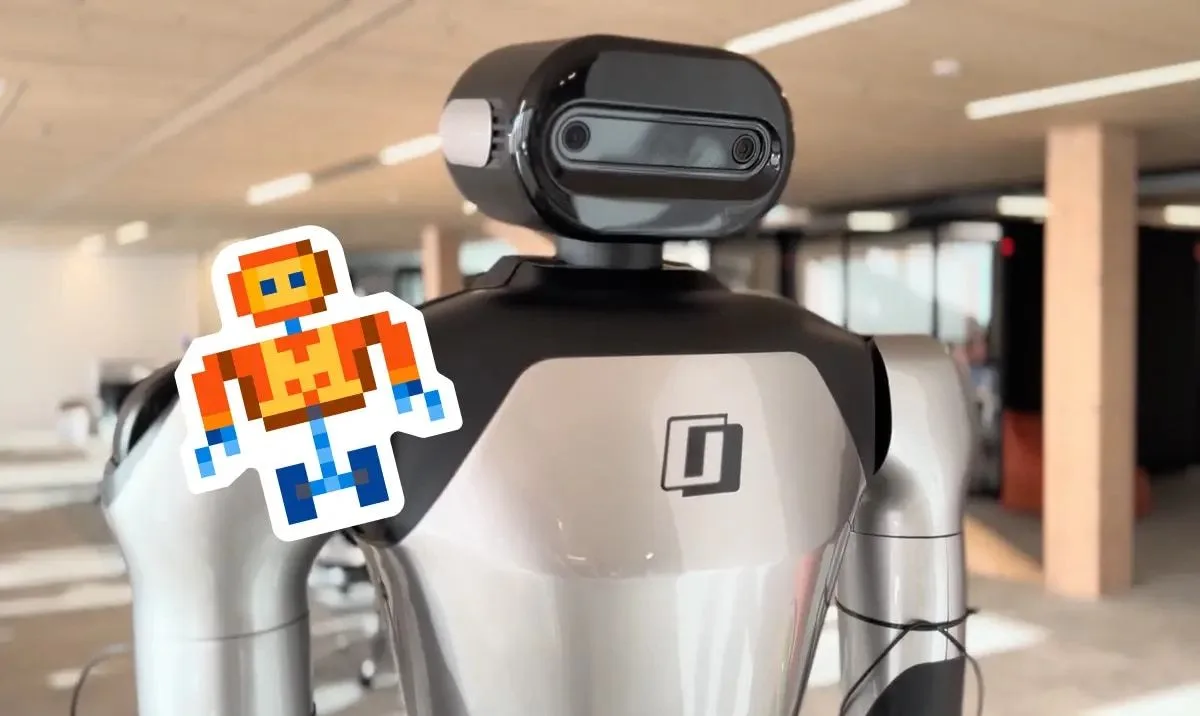 Robostral Navigate navigating an office corridor from a single RGB camera
TL;DR: What people are asking
| Question | Answer |
|---|---|
| Is it map-less? | Yes—Mistral confirmed on HN: inputs are text + front RGB only, no SLAM map required. |
| What sensors does it need? | One ordinary RGB camera. No LiDAR, no depth camera, no multi-camera rig. |
| How good is it? | 76.6% R2R-CE success (unseen), 79.4% (seen). SOTA on that benchmark as of July 2026. |
| What fails the other ~23%? | Ambiguous instructions ("two doors—pick one"), landmarks outside FOV, and long-horizon drift—not random wrong turns (low navigation error on Mistral's charts). |
| Can I download it? | No public weights or API yet. Enterprise contact-sales only. |
| How big is the model? | 8B parameters—small enough for on-device inference vs cloud-only frontier VLAs. |
| Does "go back where you started" work? | Mistral team: yes, including return-to-origin style instructions. |
| How was it trained? | In-house VLM grounding base → ~400k simulated trajectories across 6k scenes → prefix-cached SFT → CISPO online RL (+3.2% success). |
What Robostral Navigate does
Give the model one instruction and it executes the full route autonomously. Mistral's example:
"Leave the lobby, walk through the corridor, enter the supply room, and stop to face the second shelf."
The demo video shows a robot traversing a live office with people and obstacles never seen in training—long-horizon, single-shot execution. That is the pitch: manufacturing floors, logistics hubs, hospitality, and delivery routes where you want language-conditioned navigation without rebuilding a geometric map every time the furniture moves.
Most competing systems stack depth sensors, LiDAR, or multiple cameras and often depend on pre-mapped environments. Robostral Navigate deliberately strips that down to one RGB stream plus language—closer to how a human follows verbal directions from what they can see right now.
Navigation via pointing (and when it falls back)
The core action space is pointing: given task text and observation history, the model predicts image coordinates of where to move next and the orientation on arrival. Pointing is intrinsically robust to camera intrinsics and world scale—you are not hard-coding metric odometry that breaks when you swap lens mounts or robot sizes.
When the target is outside the current field of view, pointing cannot apply. The model then emits local-frame displacements:
"Move 2 meters forward, 1.5 meters to the left, and turn 25 degrees left."
That hybrid—semantic pointing when visible, metric dead reckoning when not—is how map-less systems bridge the "kidnapped robot" gap HN commenters raised. You do not need a global pose graph if each step is grounded in what the camera shows or a short relative move until the landmark re-enters view.
Benchmarks: what 76.6% on R2R-CE actually means
R2R-CE evaluates instruction-following navigation in continuous indoor environments—rooms and corridors held out of training. Mistral reports:
| Metric | Validation seen | Validation unseen |
|---|---|---|
| Success rate | 79.4% | 76.6% |
| vs best single-camera prior | — | +9.7 pts |
| vs best depth/multi-camera prior | — | +4.5 pts |
"Success" means the robot reached the goal under the instruction—not that it took the shortest path. Mistral also publishes oracle success, success weighted by path length (SPL), and navigation error curves on their announcement page. The navigation-error chart matters for the HN joke thread: failures skew toward could not figure it out more than went wildly wrong.
Still, ~one in four unseen runs failing is exactly why factory robotics engineers on HN pushed back. In structured industrial automation, 95%+ reliability is often the bar before you remove the human escort. Navigation at 76–80% is research-SOTA and demo-impressive—it is not yet "replace the AMR fleet" territory without human oversight or a higher-level planner retrying failed legs.
Training stack: simulation, prefix-caching, CISPO
Robostral Navigate is built entirely in-house—not fine-tuned from an open-source VLA. Mistral initializes from an internal grounding VLM (pointing, counting, object localization) and treats navigation as the next skill: once you know where things are, learn how to move toward them.
Data: ~400,000 trajectories across 6,000 simulated scenes, generated through an in-house pipeline for rapid iteration—no reliance on scarce real-world teleop logs at scale.
Supervised training: A prefix-caching algorithm with tree-based attention masking compresses an entire episode into one sequence, training all timesteps in a single forward pass without leaking future observations. Mistral claims 22× fewer training tokens vs one-sample-per-timestep training—turning month-long runs into days.
Reinforcement learning: Post-SFT CISPO online RL (the same family Mistral used on Leanstral 1.5) adds +3.2% success from trial-and-error recovery—mitigating behavior-cloning distribution shift. Mistral says they are not plateauing yet.
Generalization claims: Wheeled, legged, and flying robots; robust to camera intrinsics changes; trained only in simulation but demonstrated in real offices with dynamic humans.
Hacker News: the debates that matter
The HN thread surfaced deployment questions Mistral's blog does not fully answer.
Map-less vs SLAM
Commenters asked whether modern VSLAM already solves localization. Mistral's answer is architectural: they are not selling a mapping product—they are selling a language-conditioned policy that navigates from pixels. A partner could still run SLAM upstream for fleet coordination; Robostral is the semantic locomotion layer.
Olivier Duchenne (Mistral robotics): "I confirm this is map-less. The only inputs are the text prompt and the front camera rgb image."
The 23.4% failure rate
Fair skepticism. Autonomous driving at 1-in-5 wrong actions would be unacceptable; indoor AMRs at 80% success need supervision, geofencing, or replanning. Mistral's near-term ICP is likely pilot deployments with human oversight in manufacturing and logistics—not unsupervised home vacuum replacement.
Open weights and hobbyists
Multiple builders asked for a 4B open release to skip ROS stacks and hook VLMs to cheap robots—especially paired with OpenClaw-style agent bodies. Mistral has not committed. Today it is enterprise sales, consistent with Mistral's industrial partner focus in Europe's manufacturing narrative.
Privacy and home deployment
Camera + LLM + autonomous locomotion in residential spaces triggered predictable pushback. An 8B model can run locally—Mistral's European "on-site inference" positioning helps—but vacuum OEMs would still need transparent data policies. Industrial sites with existing camera coverage are the easier first wedge.
Manipulation is a different problem
HN correctly noted navigation ≠ "pick up the arbitrary thing." Grippers need depth, force control, and an entirely different action space. Robostral is locomotion only—the first brick in Mistral's "unified embodied agent" roadmap, not a general-purpose household helper.
Update — July 10, 2026: 1X NEO's 25-DoF hands target that manipulation gap — force-transparent tendons, tactile skin, 10K hands/year.
How Robostral fits the Physical AI landscape
| Layer | Player | What it optimizes |
|---|---|---|
| World models / simulation | NVIDIA Cosmos 3 | Predictive video, action-conditioned rollouts, synthetic data |
| Humanoid deployment | Figure AI | Factory-scale VLA humanoids (Helix), customer-paid pilots |
| Language navigation policy | Robostral Navigate | Map-less instruction following, single RGB, 8B |
| Formal verification | Leanstral 1.5 | Proof engines, not motors |
Mistral is running a wide-and-niche strategy: frontier LLMs where they can, specialized embodied and verification models where general models are too slow, too expensive, or too unreliable. Robostral shares DNA with Leanstral—CISPO RL, in-house training stacks, European industrial customers who want models without US cloud dependency.
Cosmos 3 answers "what happens if the robot pushes this cart?" Robostral answers "which doorway matches 'enter the supply room'?" Composable, not competitive—though Mistral has not published a Cosmos integration.
What is not in the announcement
Be precise about gaps:
- No model card, weights, or inference API — cannot reproduce benchmarks locally
- No pricing — unlike Mistral OCR 4 or chat APIs
- No low-level control interface spec — how pointing becomes wheel velocities is undisclosed (HN asked; no public answer)
- No outdoor or automotive evaluation — indoor R2R-CE only in the blog
- No manipulation or grasping — navigation policy only
For procurement teams: treat July 2026 coverage as validated research plus enterprise preview, not a shrink-wrapped SDK.
Who should care
Manufacturing and logistics operators evaluating language-conditioned AMRs without rebuilding lidar maps after layout changes.
Robotics ML engineers watching whether pointing + RL beats metric map pipelines on sim-to-real transfer.
European sovereignty buyers aligning with Mistral's on-premise, single-camera story under the EU AI Act high-risk robotics discussions.
Agent builders dreaming of embodied OpenClaw—navigation remains the clunkiest layer in DIY robot videos; an 8B map-less policy would be the missing piece if Mistral ever ships weights.
Related reading
- Shieldstral: Mistral's Policy-Adaptive Safety Classifier — same Forge platform, specialization strategy
- Europe AI Landscape 2026: EU Act, Mistral, Sovereign Compute — Mistral's strategic role and industrial partner angle
- Leanstral 1.5: Proof Abundance for All — shared CISPO RL stack and Mistral specialization strategy
- NVIDIA Cosmos 3: Open Physical AI World Models — simulation and world-model layer for robotics pipelines
- Figure AI: Robots Outnumber Humans — humanoid deployment economics vs navigation-only policies
- OpenClaw Foundation: 501(c)(3) Non-Profit — agent bodies hobbyists want to pair with navigation models
- What is OpenClaw? Personal AI Assistant Guide — gateway architecture for long-horizon agent tasks on edge hardware
- Moonshine Micro — voice on RP2350 MCUs — on-device wake and command layer for robots that run Robostral-class models on a separate GPU
Official sources: Mistral — Introducing Robostral Navigate · Hacker News discussion
Update — October 9, 2026: Why a general chatbot is not a safe route planner: a teen's Claude-guided hike ended in rescue. Full breakdown →
This article is accurate as of July 9, 2026. Benchmark numbers, availability, and deployment options reflect Mistral's public announcement and HN team comments—verify with Mistral sales before production commitments.