



MiniMax's Hailuo AI team launched Design on August 21, 2026 — not a new model, but a desktop agent app built to take a single creative brief and orchestrate multiple underlying models into a finished commercial asset. The announcement thread crossed 114,000 views within hours, and replies immediately asked the questions that actually matter: is it open source, can it run locally, what does it cost, and how is it different from the MiniMax H3 video model already out there. Here are verified answers to all four, pulled directly from design.minimax.io.
TL;DR
| Question | Answer |
|---|---|
| What is it? | A downloadable desktop agent (Mac/Windows) that orchestrates image, video, voice, and editing models from one creative goal |
| Is it open source / local? | No — closed, cloud-billed via credits; input files stay local, generation and models do not |
| What models does it bundle? | MiniMax's own H3 (video), Music 2.6, Speech 2.8 — plus third-party GPT Image 2 and Nano Banana Pro |
| Pricing? | Starter $8.4/mo, Plus $60.8/mo, Pro $172/mo (annual billing; ~25-30% more if billed monthly) |
| Free trial? | 3 free H3 generations in 2K before Aug 26, plus a reported 3,000 bonus credits for new users |
| Same as MiniMax H3? | No — H3 is the underlying open-weight video model; Design is a separate closed app built on top of it |
What actually shipped
MiniMax's own announcement describes three pillars: Agent-Driven Workflow ("Input your goal. Agents autonomously plan, execute, and deliver"), Built for Commercial Creation (ads, e-commerce assets, motion graphics, post-production content), and Open & Flexible Integration (connect local assets, deploy privately, scale through APIs). The product page's own tagline is more concrete: "A new-generation multimodal AI agent that understands your creative intent and orchestrates image, video, voice and editing models — from idea to finished cut."
That orchestration claim is the actual product. Rather than manually generating a video, then separately picking an image model, then separately adding voice, you describe the end goal and the agent sequences the calls across models itself.
Not open source, not local inference — a hosted agent
The single most-asked question in replies was some version of "is this open source, can I run it locally." The direct answer: no, on both counts. MiniMax Design is a downloadable desktop app, but that only means the client runs on your Mac or Windows machine — actual generation happens on MiniMax's cloud infrastructure and draws down your credit balance. "Local files stay on your machine" in MiniMax's own marketing describes your input assets (references, source footage) not being bulk-uploaded, not the models running on-device.
That distinction matters more than usual here because the app bundles third-party proprietary models alongside MiniMax's own:
- MiniMax H3 — MiniMax's own open-weight omni-modal video model, which you can self-host separately outside of Design
- MiniMax Music 2.6 and MiniMax Speech 2.8 — MiniMax's own audio models
- GPT Image 2 — OpenAI's image model, accessed through MiniMax's orchestration layer
- Nano Banana Pro — Google's image model, same arrangement
None of the third-party models are open weights, and none of them run locally regardless of what device the Design client is installed on. This is closer to a multi-model API aggregator with an orchestration agent on top, wrapped in a native desktop app, than it is to a self-hostable stack.
Real pricing, verified on the site
 MiniMax Design annual pricing tiers: Starter $8.4/mo, Plus $60.8/mo, Pro $172/mo
Source: design.minimax.io/media-plan/subscribe, screenshotted August 21, 2026.
Three membership tiers, confirmed directly on MiniMax's pricing page rather than taken from the launch tweet:
| Tier | Annual (per mo) | Monthly | Monthly credits |
|---|---|---|---|
| Starter | $8.4 | $10.5 | 10,000 |
| Plus | $60.8 | $76 | 87,000 |
| Pro | $172 | $215 | 270,000 |
Annual billing runs roughly 20-25% cheaper per month than paying monthly — standard SaaS structure, marketed as "2 months free." A limited-time offer, active as of publication, adds a permanent 20% reduction in H3 credit consumption for anyone who buys an annual pass before August 26, 2026 — worth noting the deadline if you're evaluating this seriously, since it changes the effective per-generation cost for the life of the plan, not just at checkout.
What the credits actually buy
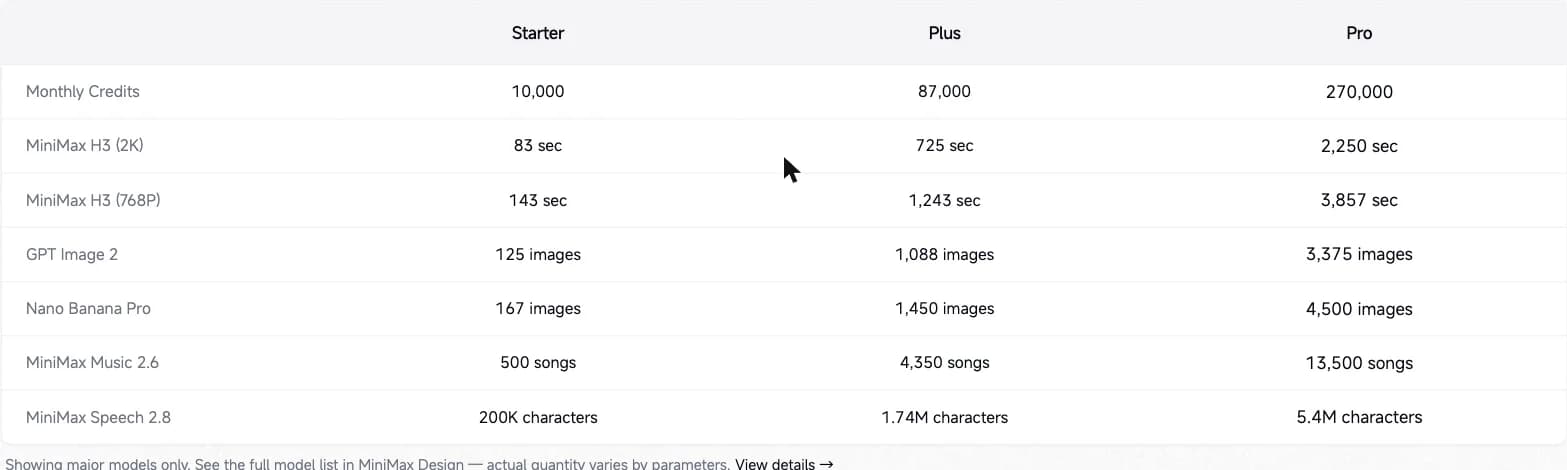
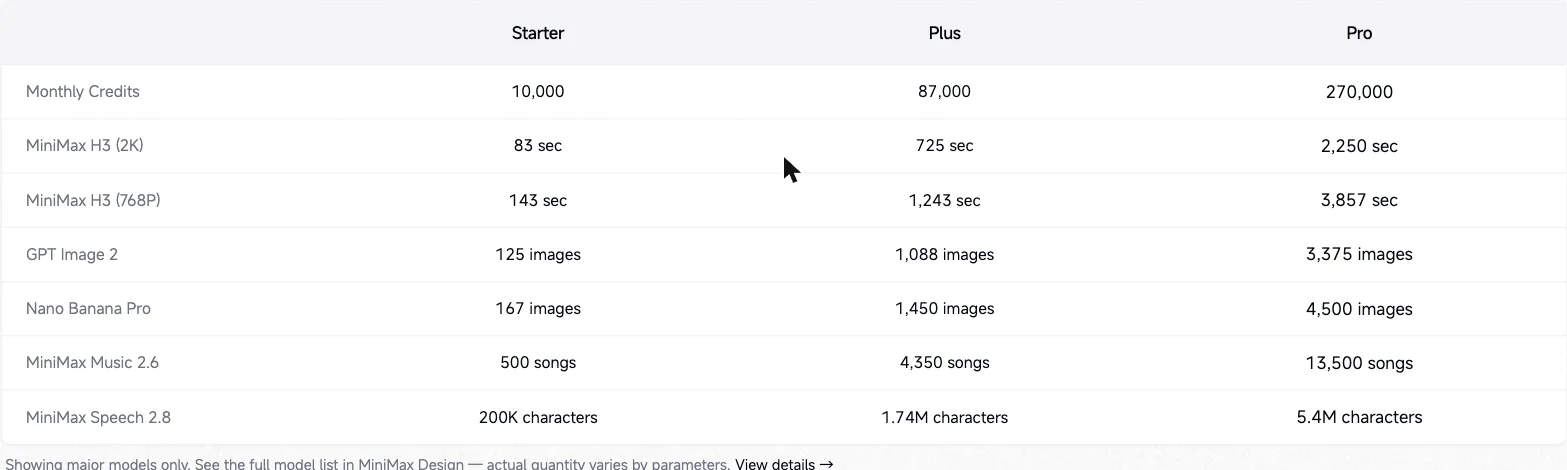 MiniMax Design credit allocation table by tier, showing H3 video seconds, GPT Image 2 and Nano Banana Pro image counts, Music and Speech quotas
Source: design.minimax.io/media-plan/subscribe, screenshotted August 21, 2026.
| Included per month | Starter | Plus | Pro |
|---|---|---|---|
| MiniMax H3 (2K video) | 83 sec | 725 sec | 2,250 sec |
| MiniMax H3 (768P video) | 143 sec | 1,243 sec | 3,857 sec |
| GPT Image 2 | 125 images | 1,088 images | 3,375 images |
| Nano Banana Pro | 167 images | 1,450 images | 4,500 images |
| MiniMax Music 2.6 | 500 songs | 4,350 songs | 13,500 songs |
| MiniMax Speech 2.8 | 200K chars | 1.74M chars | 5.4M chars |
MiniMax's own footnote is worth repeating: this table shows major models only, and actual quantity per credit varies by generation parameters (resolution, duration, quality settings) — treat these as representative allocations, not a hard unit-economics guarantee for every possible generation you might run.
How this fits against MiniMax H3, the open-weight model
MiniMax has now shipped two very different things under overlapping branding within the same month, and it's worth being precise about which is which:
- MiniMax H3 (Aug 3, 2026) — an open-weight, 33B omni-modal video model you can download and run yourself, subject to a license that excludes the US, EU, UK, and South Korea from local deployment.
- MiniMax Design (Aug 21, 2026) — a closed, hosted, credit-billed desktop agent app that uses H3 (and other models) under the hood, available with no territory restriction mentioned on the pricing page, but not something you self-host.
If your interest is running an open-weight video model on your own hardware, Design isn't that product — go to the H3 weights directly, and mind the licensing exclusions covered in explainx.ai's H3 breakdown. If your interest is a turnkey agent that produces finished commercial creative without managing multiple tools and API keys yourself, Design is the one to evaluate — and it comes with a real subscription cost, not a self-hosting cost.
What people are asking
Does the site differ between the Chinese and English versions?
Several replies asked this in Chinese, and it wasn't answered on the public site as of publication — MiniMax has shipped region-differentiated feature sets before with some of its other products, so treat feature parity as unconfirmed until MiniMax states otherwise, rather than assuming the English version is identical to what's shown domestically.
Is this a threat to After Effects or similar tools?
One popular reply claimed "AE usage is going to drop significantly" after integrating Design into a workflow. That's an individual user's workflow claim, not evidence of a broader shift — Design targets fast, prompt-driven asset generation (ads, motion graphics, post-production content), which competes with a slice of what a compositing tool like After Effects does, not the full manual-control editing use case professional motion designers still need for precise frame-level work.
Can I use my own API keys or connect it to other tools?
MiniMax's own bullet list mentions "scale through APIs" under its integration pillar, implying an API surface exists for Design beyond the desktop client, but pricing and API-specific documentation weren't visible on the consumer pricing page at launch. If programmatic access matters for your use case, check MiniMax's developer docs directly before assuming desktop-app pricing applies to API usage.
Related on explainx.ai
- MiniMax H3: open video model — locked out of the US and EU
- Higgsfield unlimited Seedance 2.5 video generation
- Antirez's H3C: MiniMax H3 on Apple Silicon Metal
- Choosing open-weight vs. closed AI models
- VIMAX: agentic video generation, complete guide
Primary sources: @Hailuo_AI on X · design.minimax.io · MiniMax Design pricing
Pricing, credit allocations, and promotional offers verified directly on design.minimax.io as of August 21, 2026 — subscription products change pricing and promotions without notice, so confirm current terms before purchasing. Follow @explainx_ai for updates.