



London startup Machenta has announced a $40 million seed round and a bold pitch for robotics: show a robot a task once, and it can do it, with no further training. The company calls this "instant robot learning," and says the model behind it is pretrained entirely in simulation. Reports on the launch come from the company, Business Insider, Unite.AI and Humanoids Daily; we found no independent test of the model.
Robot learning from one example is a long-standing goal, and it connects to a wave of robot foundation models we have covered, including Physical Intelligence's API beta, Reward's OM-1 and Dream Labs' Dream 1. This post separates what Machenta claims from what its evidence supports.
TL;DR: claim versus evidence
| Question | Answer |
|---|---|
| What is it? | A vision-demo-action (VDA) robot foundation model |
| Core claim | Learns a new task from one real demonstration, with no weight updates |
| Training | Pretrained in simulation only, per the company |
| Funding | $40M seed, co-led by Creandum and Union Square Ventures |
| Team | 11 people, founded by Imperial College researchers Edward Johns and Vitalis Vosylius |
| Reported trials | 74/74 block placements, 78/78 screwdriver handovers, 97/99 bottle standing |
| Independent verification | None found |
| Availability | Early-access sign-up; no commercial plans soon, per reports |
How is this different from other robot models?
Most robot foundation models take a language instruction plus camera images and output actions. Machenta's VDA model replaces the instruction with a demonstration. As reported by Humanoids Daily, it takes a demonstration alongside live visual observations and predicts actions, and Machenta says no additional weight updates or training run are needed after the demonstration. The usual alternative is task-specific training: collect examples, fine-tune, redeploy.
The idea is in-context learning, the same trick language models use when examples in a prompt change their behavior without changing weights. As Unite.AI notes, it is harder in robotics because the output must become a sequence of physical actions under real-world constraints, not a plausible sentence. Machenta still trains its foundation model; what it aims to remove is the new dataset and training cycle for each new job.
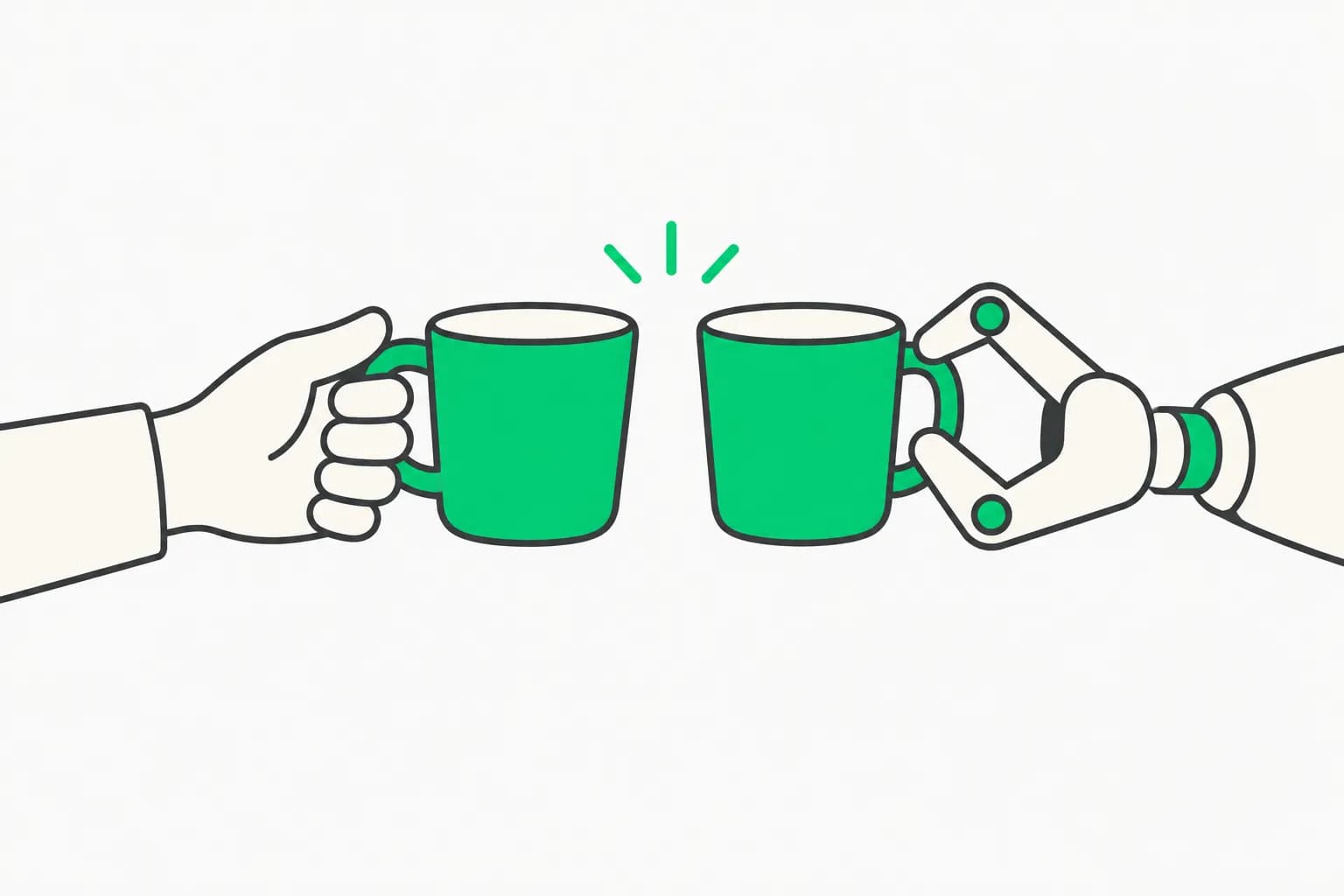
 A robotic gripper mirroring an outlined hand holding a cup, picturing Machenta instant robot learning from one demonstration
What is the research behind it?
According to Unite.AI, the company builds on work by Edward Johns, Professor of Robot Learning at Imperial, and Vitalis Vosylius. Their Instant Policy paper, published at ICLR 2025, describes in-context imitation learning from one or two demonstrations. It represents demonstrations, observations and actions as a graph and uses a learned diffusion process to generate the structure needed for action prediction. It trained with pseudo-demonstrations: trajectories generated in simulation that provide a large pool of examples. Unite.AI is careful to say this explains the scientific foundation without proving that the current commercial model has the same architecture.
That is an important distinction. A peer-reviewed predecessor lends credibility to the direction, but the new model's design, size and training data have not been published in a form we could review, and the technical post is the company's own.
What did the trials show?
Machenta's technical introduction, as summarized by Unite.AI, reports hour-long trials on three simple, self-resetting tasks:
| Task | Result |
|---|---|
| Placing blocks | 74 of 74 successful |
| Screwdriver handovers | 78 of 78 successful |
| Standing a bottle | 97 of 99 successful |
The company attributes the two bottle failures to collision risk and kinematic constraints. Humanoids Daily adds that the launch includes manipulation demonstrations across six robots, plus preliminary experiments with humanoid hands, with a humanoid example labeled autonomous and shown at 4x speed. The company also shows packaging, assembly and tidying demos, and a video shared with Business Insider reportedly shows three robots packing and closing a box.
These are encouraging numbers, but read them for what they are. Three self-resetting tasks are friendly to repeated trials. Success rates on block placement say little about a task with deformable objects, tight tolerances or a safety-critical environment. No third party has reported running the model, and the company says broader reliability and commercial deployment remain to be established.
How does teaching by demonstration compare with the alternatives?
There are three broad ways to get a robot to do a new job today, and Machenta's pitch sits between them.
Programming. An engineer writes motion and logic by hand. It is reliable for fixed tasks and expensive to change, which is why classic industrial robots need the environment to conform to the program.
Task-specific learning. Teams collect teleoperated or recorded demonstrations, often dozens to thousands, and fine-tune a policy. This handles variation better than scripts but turns each workflow change into a data and training project. Language-conditioned foundation models reduce some of that effort, yet they still depend on fine-tuning for precise or unusual tasks, which is the motivation behind services such as the fine-tuning API we covered for Physical Intelligence.
In-context learning from a demonstration. The model is already trained, and the demonstration is part of its input at run time. If it works, teaching becomes a few minutes of someone showing the task. The trade-off is that everything must be learned in advance, in this case in simulation, so the quality of the simulated training distribution caps what the model can understand later.
A useful way to judge any of these is time to a working behavior, success rate on variations, and failure recovery. Machenta's reported numbers speak to the first two on three simple tasks, and the company describes "instant failing" and "instant recovery" as goals on its site without publishing recovery statistics we could find.
Why simulation-only pretraining is both the bet and the risk
Real-world robot data is slow and costly to gather: someone must operate hardware for hours. Simulation can produce unlimited trajectories with perfect labels, and it scales with compute, which is the resource the funding is meant to buy. The risk is the sim-to-real gap, where differences in friction, contact, lighting and camera noise make a policy that works in simulation fail on a real arm.
The company's answer, as reported, is that the model learns how to learn from a demonstration rather than memorizing tasks, and that real demonstrations and live cameras supply the real-world grounding at inference time. That is a reasonable design, and the Instant Policy paper supports the general approach at small scale. Whether it holds across six robots, humanoid hands and messy workplaces is what the next releases will need to show. For the broader debate about where robot data should come from, see our coverage of Reward's human-data approach and Greenwam's world foundation model across 20 robot families.
What are the open questions?
- Generalization: how far does one demonstration go when objects, lighting or arrangement change a lot?
- Hardware limits: a fast learner cannot make a gripper handle an object it cannot physically grasp.
- Recovery and safety: Unite.AI notes the gap between a convincing demo and a deployable system includes repeatability, recovery from failure and safe behavior near people.
- Simulation gap: pretraining without real data is the central bet; it is plausible given the earlier paper, but the real-world results come from the company's own setup.
- Cost and access: no pricing, API or benchmark release was reported.
Why it matters if it holds up
If teaching time falls from weeks of data collection to a single demonstration, robots become viable for work that changes too often to justify programming and integration, such as small-batch manufacturing or tasks in places with no robotics specialists. It would also shift the cost of robotics from data collection toward compute and simulation. For a view on the data side of that shift, see our explainers on egocentric data collection and wearable capture for robot training data.
How to evaluate claims like this
- Ask for success rates over many trials and many task variations, not only the best demo.
- Ask whether the test robot, camera placement and objects match the training distribution.
- Look for an independent benchmark; our write-up of AA Robotics v0.1 shows what early third-party robot evaluations look like.
- Separate the funding news from the capability evidence: a $40 million seed round shows investor interest, not performance.
What is confirmed and what is not
Confirmed by multiple outlets quoting the announcement: the October 27 date, the $40 million seed round, the co-leads Creandum and Union Square Ventures, the founders and the small team. One outlet's currency figure differed, so check the company's release if the exact amount matters. Company statements only: the simulation-only pretraining, the three trial results, the demonstrations on six robots and the humanoid-hand experiments. Not found anywhere: independent replication, a public model release, a benchmark comparison against other robot foundation models, or details of training scale.
What this means for what you build
If you build robot software, watch for a model release or paper from Machenta and compare it with in-context approaches in the open literature. If you buy robots, treat one-shot learning as a promising research direction rather than a purchasing criterion today. The company's own site invites early-access registration, which is the realistic way to test it.
Related reading
- Physical Intelligence pi API beta
- Reward OM-1 robot foundation model
- Dream Labs Dream 1
- AA Robotics v0.1 benchmark
- NVIDIA FLORA robot data engine
- Egocentric data collection for robots
- Official: Machenta and Unite.AI coverage
Details are accurate as of October 29, 2026 and rely on company statements and press coverage.