



IQuest-Q1 is a new open-weight agentic model: a sparse mixture-of-experts network with about 320B total parameters and roughly 15B active per token, tuned for work in the terminal. The weights are on Hugging Face, and the technical report is on arXiv, where it picked up 33 upvotes on the Hugging Face papers feed within two days. The headline claim is that a model with a 15B active footprint can sit in the same table as much larger closed and open systems on agentic coding tasks. Every number below is the authors' own, so we flag that throughout.
IQuest-Q1 at a glance
| Question | Answer (source: model card and paper) |
|---|---|
| What is it? | Sparse MoE language model for agentic CLI work |
| Size | About 320B total, about 15B active per token |
| Layout | 88 layers, hidden size 3,072, 256 experts with 8 active per token |
| Context | Up to 524,288 tokens |
| Modality | Text only |
| Training data | About 29T tokens across pre-training and mid-training, per the paper |
| Serving | SGLang or vLLM, OpenAI-compatible API |
| Agent guides | Claude Code (Anthropic Messages) and Codex CLI (OpenAI Responses) |
| License | Listed on the card as "iquest-q1" |
| Independent verification | None yet |
What does "built for agentic CLI" mean?
Most open models are trained as chat models and then adapted to agents. The IQuest paper, titled "Advancing Foundation Capabilities for Agentic CLI Systems," goes the other way: the whole recipe is pointed at working in a shell. That means reading a repository, running commands, reading the failures and trying again over long sessions.
The paper describes a three-stage process. Pre-training combines the Stable SplitNorm, Muon and muP techniques with a two-stage curriculum whose second stage raises the share of coding data. Mid-training extends the context. Post-training then mixes supervised fine-tuning, reinforcement learning, multi-teacher on-policy distillation and model merging. That last step matters for readers choosing a model: merging several specialist teachers into one set of weights is how many 2026 open releases try to keep both coding and general reasoning scores up.
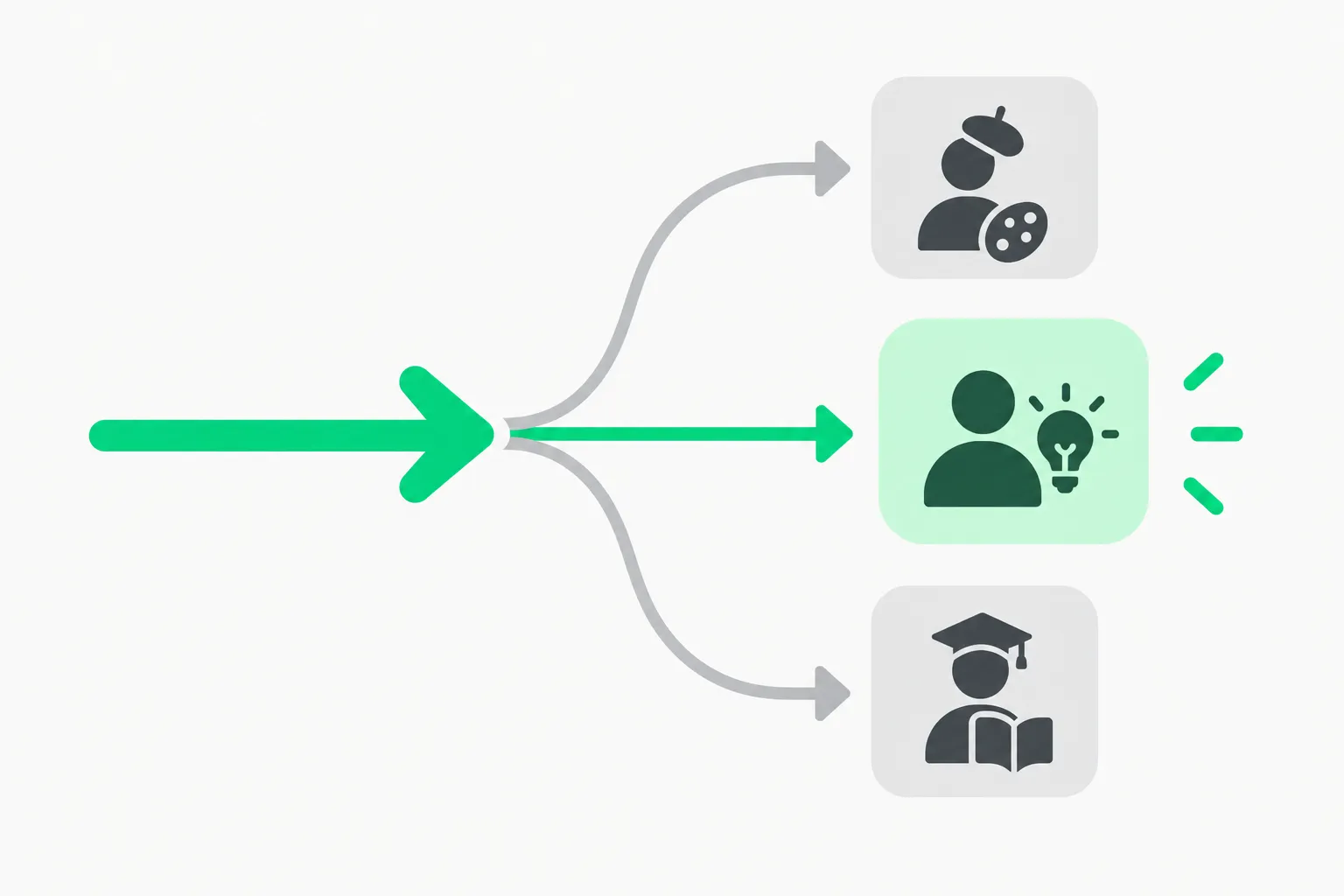 Mixture-of-experts routing sending each token to a few experts, the idea behind IQuest-Q1 open-weight efficiency
Why 15B active parameters matters
In a mixture-of-experts model, a router picks a few experts for every token. IQuest-Q1 holds 256 experts and activates 8, so the compute per token looks like a 15B dense model while the knowledge capacity is closer to 320B. For terminal agents, which make thousands of model calls per task, that ratio drives cost and latency. The attention stack mixes sliding-window layers with full-attention layers, which is how the model keeps a 524K context affordable in memory.
The catch is the same as with every large MoE: the weights still have to fit somewhere. You pay for 320B of parameters in memory even though you only compute 15B. Secondary guides describe serving at tensor-parallel size 8, so this is a multi-GPU server model, not a laptop one. If you want something you can run locally, our top open-weight models for laptops list is the better place to start.
What do the benchmarks say?
 IQuest-Q1 open-weight agentic CLI model benchmark comparison chart
Image: IQuest
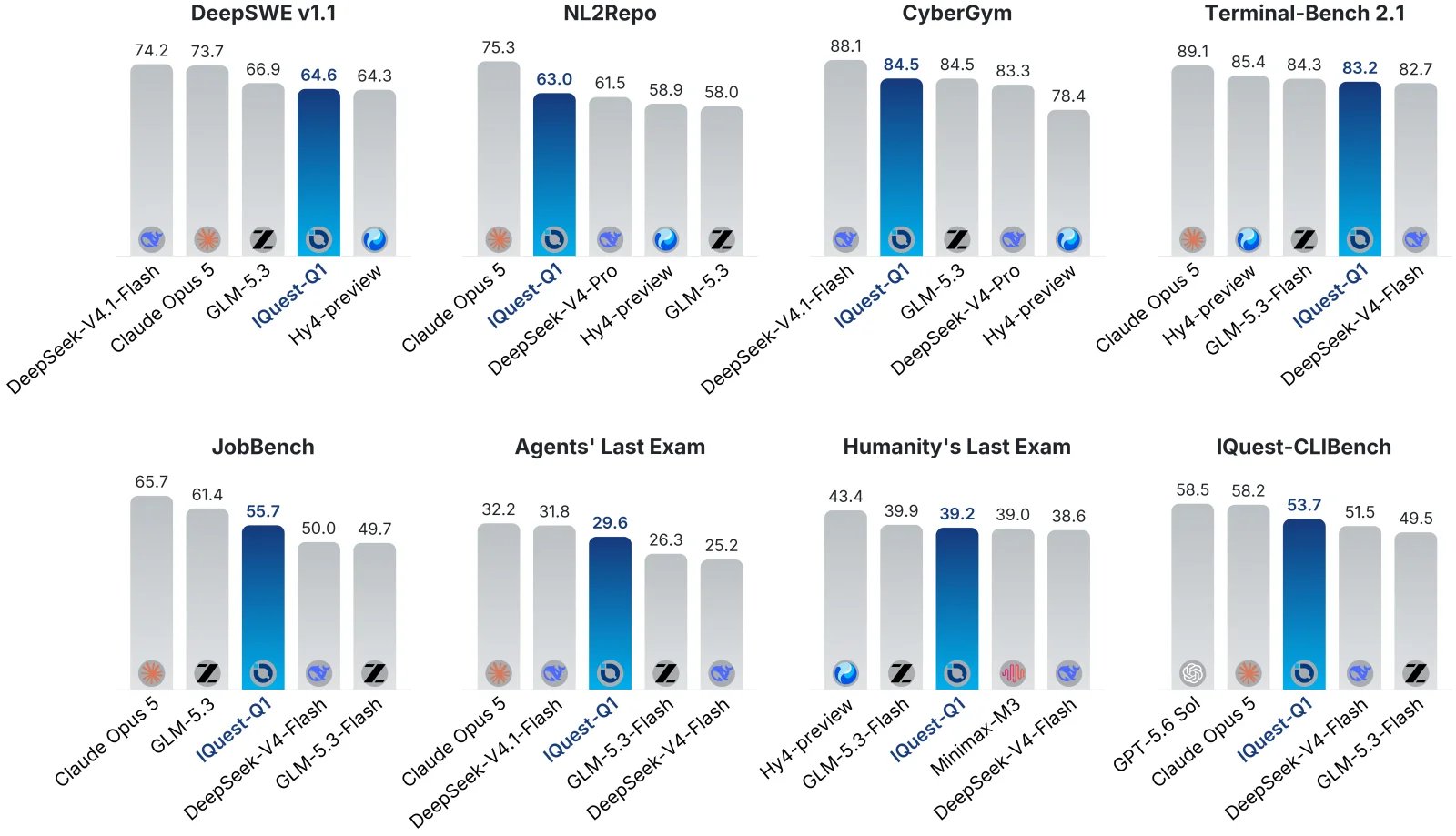
The paper's Table 2 compares IQuest-Q1 against Claude Opus 5, GPT-5.6 Sol, GLM-5.3-Flash, DeepSeek-V4-Flash-0731, Tencent Hy3 and MiniMax M3. Selected IQuest-Q1 scores as reported by the authors:
| Area | Benchmark | IQuest-Q1 (author-reported) |
|---|---|---|
| Terminal | Terminal-Bench 2.1 | 83.2 |
| Terminal | Terminal-Bench 3.0 | 17.9 |
| Terminal | Terminal-Bench 4.0 | 22.7 |
| Software engineering | SWE-bench Multilingual | 80.3 |
| Software engineering | SWE-Bench Pro | 57.5 |
| Software engineering | DeepSWE v1.1 | 64.6 |
| Coding | LiveCodeBench v6 | 89.7 |
| Security | CyberGym | 84.5 |
| Tool use | Toolathlon-Verified | 75.0 |
| Tool use | MCP-Atlas | 78.4 |
| Reasoning | GPQA Diamond | 93.3 |
| Reasoning | Humanity's Last Exam | 39.2 (55.7 with tools) |
| Search | BrowseComp | 85.5 |
| In-house | IQuest-CLIBench | 53.7 |
Two things stand out. First, the Terminal-Bench numbers fall off sharply from 2.1 to 3.0 and 4.0. That is the pattern of the benchmark itself getting harder, and a useful reminder that a score of 83 on one version says little about the next. Our coverage of the Terminal-Bench 4.0 audit shows why you should read those numbers carefully. Second, IQuest-CLIBench is the authors' own test, so it cannot be used to rank the model against others.
The paper's full comparison table also covers how each baseline scored. We have not reproduced those rows, because we could not cross-check them against the other labs' own numbers. If you need the head-to-head, open the paper and read the table directly rather than relying on a summary.
How do I run IQuest-Q1?
The model card recommends SGLang or vLLM, with prebuilt Docker images and optional multi-token prediction for speculative decoding. Both serve an OpenAI-compatible API. The card's recommended sampling settings are temperature 1.0, top-p 0.95 and top-k 20.
# Check the model card for the exact image tag and flags
# https://huggingface.co/IQuestLab/IQuest-Q1
# Typical shape of an 8-GPU launch (flags per the card, verify before use):
# --model-path IQuestLab/IQuest-Q1 --tp 8
We did not run the model ourselves, so treat the launch line as a pointer to the card, not a tested command. The same goes for the integration guides. IQuest documents Claude Code through an Anthropic Messages-style route and Codex CLI through an OpenAI Responses-style route, and both need a gateway that supports tool calling. If you already route agents through a proxy, the setup is similar to what we described for DeepSeek V4.1 Flash with Codex.
How does it compare with other open agentic models?
IQuest-Q1 lands in a crowded field. In the past month we covered Meta's Muse Spark open model, Ornith 1.5 at 122B, Recursive Flint 40B and DeepSeek V4.1 Flash. Most of them make their own claims about SWE-bench or Terminal-Bench. The honest summary is that nobody has yet put all of them on one independent harness at the same settings, so cross-paper comparisons are weak evidence.
| Model | Size | Where it fits |
|---|---|---|
| IQuest-Q1 | 320B total, 15B active | Multi-GPU server, long-context CLI agents |
| Ornith 1.5 | 122B | Single 80 GB GPU, per our coverage |
| Recursive Flint | 40B | Local coding, Apache 2 |
| DeepSeek V4.1 Flash | See our post | Hosted API or self-hosted |
What do the training details tell us?
The paper spends real space on training stability, which is where large MoE runs usually fail. It lists three ingredients for pre-training: Stable SplitNorm, the Muon optimizer and muP hyperparameter transfer. The stated goal is to keep a "wide stability margin" between safe and optimal learning rates, so the run does not diverge halfway through 29T tokens. That is useful for researchers who want to reproduce the recipe, even if it is invisible to someone who just downloads the weights.
The second-stage curriculum raises the share of coding data late in pre-training, which fits the model's purpose. Post-training then stacks four techniques. Supervised fine-tuning teaches the format of agent trajectories. Reinforcement learning rewards finished tasks. Multi-teacher on-policy distillation lets several specialist models teach one student on the student's own outputs. Model merging blends checkpoints at the end.
For practitioners the lesson is how much of agent quality comes from post-training rather than size. A 15B-active model that has been trained on long terminal trajectories can beat a larger general model on shell tasks, which is the same pattern behind the small-model wins we have tracked, such as our small models comparison. Whether IQuest-Q1 holds that advantage outside its own harness is the open question.
What are people likely to ask next?
- Is it free for commercial use? The card names a custom license, "iquest-q1." We did not find a plain-language summary of its terms, so read the file in the repository.
- Does it support images? No. It is text-only, so screenshots or GUI agents need another model.
- Will it run on one GPU? Not at full precision. With 320B total parameters, expect a multi-GPU node, or wait for community quantizations, which we have not verified.
- Does it replace a closed model in Claude Code? It can be pointed at Claude Code through a gateway, but tool-calling quality varies by gateway, so test on real tasks first.
- Who is behind it? The paper names Bryan Dai as corresponding author. The pages we read did not state an affiliation, so we are not attributing it to any parent company.
What should you check before adopting it?
- License. The card lists the license as "iquest-q1." Read it before putting the model in a product, because it is not a standard Apache or MIT label.
- Your own harness. Run your real repositories through your real agent loop. Paper scores come from the authors' scaffolding.
- Failure modes. IQuest's own card says outputs can be wrong, and that on real CLI tasks the model may miss constraints or repeat failed attempts. It describes the model as early-stage.
- Safety. An agent that runs shell commands needs sandboxing and an approval policy whatever model sits underneath. AgentBeam, from the explainx.ai team, is built to stop AI agents before they take dangerous actions.
- Data handling. If you use a hosted endpoint for the model rather than your own GPUs, check who runs it and what they log.
Why this release matters
The practical shift is that serious agentic CLI models are now arriving from labs most developers have not heard of, with open weights and agent-tool integration guides on day one. That keeps pressure on closed-model pricing, a theme we followed in open-weight vs closed model choices. It also raises the bar for evidence: a lab that ships its own benchmark next to the public ones invites exactly the cross-checking the community has been doing on Terminal-Bench.
Our read: worth testing if you run your own GPU cluster and want a long-context agent model you can control. Not yet worth switching a production agent over on the strength of a paper table alone.
Related reading
- Top 10 open-weight models for laptops (2026)
- Terminal-Bench 4.0 audit: claimed vs verified
- Meta Muse Spark Open: how to run it
- DeepSeek V4.1 Flash open weights and Terminal-Bench 4
- Choosing open-weight vs closed AI models
- Ornith 1.5 122B: claimed vs verified
Specs and scores are as published by IQuest on October 23, 2026 and may change as the model card and paper are revised.