



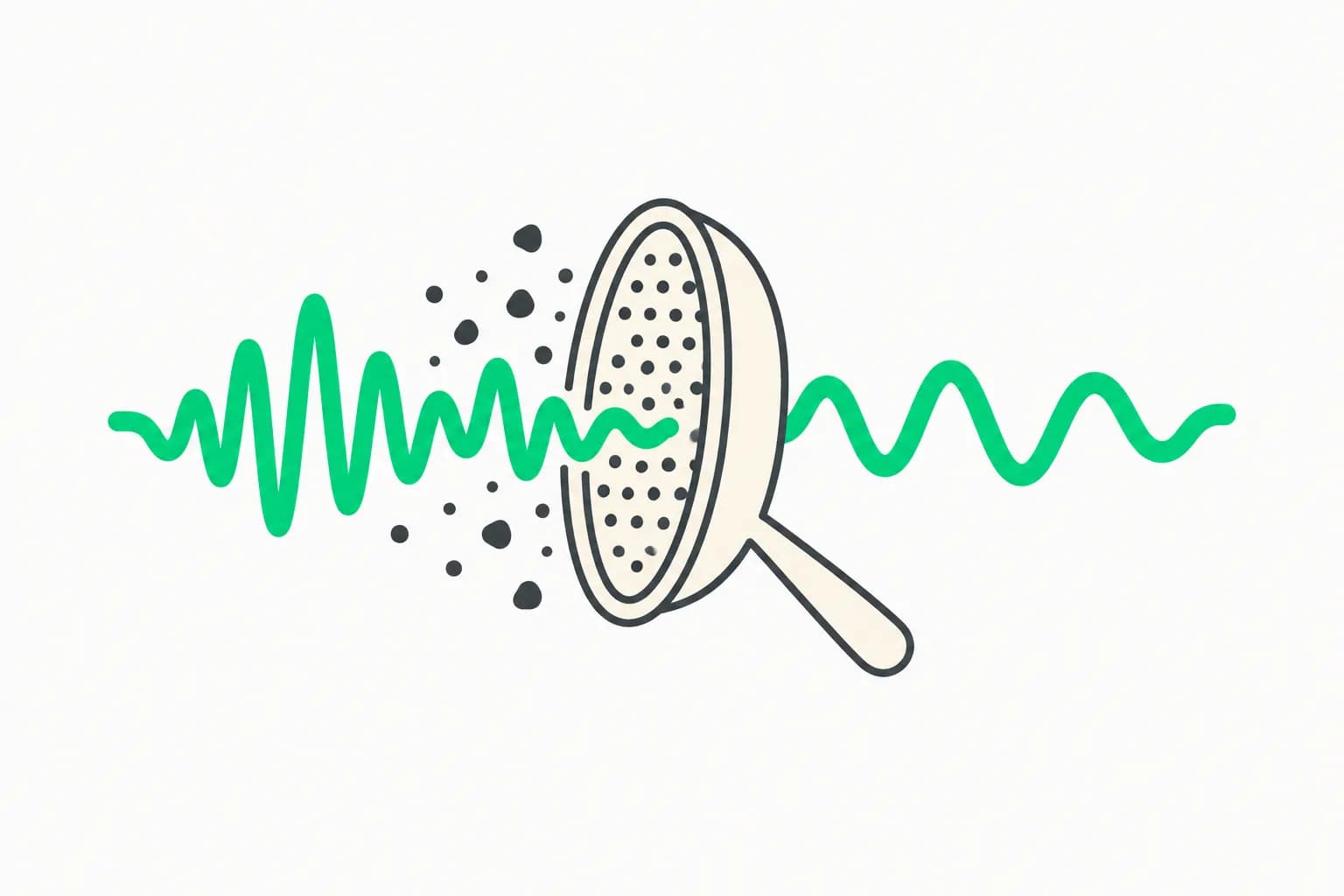
Inworld has published Voice Isolator v1, an Apache-2.0 model family that removes noise, music and background talkers from speech recorded at 48 kHz. It ships as two checkpoints: a 64M-parameter offline model and a 58M-parameter realtime model. Both are on Hugging Face, with code, a demo and a benchmark in the inworld-ai/voice-isolator GitHub repository.
The short version: it is a small, permissively licensed denoiser you can install with pip. It cleans a voice and keeps the speaker's identity. It does not repair a bad recording, and its headline benchmark is Inworld's own. This post covers what the model does, how to run it, how it works inside, and what to test before you put it in a product.
TL;DR: what readers ask first
| Question | Answer from the model card and repo |
|---|---|
| What does it do? | Isolates the foreground voice and removes noise, music, other voices and the late room tail |
| License? | Apache-2.0 for code and weights; third-party dataset credits in NOTICE |
| Sizes? | 64M parameters (offline), 58M parameters (realtime) |
| Sample rate? | 48 kHz, one channel in |
| Realtime latency? | 63 ms algorithmic at 20 ms look-ahead |
| Install? | pip install inworld-voice-isolation |
| Hardware tested? | NVIDIA A100, H100, B200, B300 and CPU; smaller GPUs not tested yet |
| What it is not | A speaker selector or a restoration model |
| Benchmark? | VIBE, built and scored by Inworld on a non-public set |
What is Inworld Voice Isolator?
Voice isolation means taking a mixed recording and returning only the speaker. Inworld describes the goal as returning the voice as it was recorded, removing everything that is not the speaker, keeping the speaker's own laughter, breaths and sighs, keeping level and timing, and inventing nothing.
That last clause matters. A generative "enhancer" can make a muffled recording sound crisp by synthesizing detail. Inworld's v1 does not. In speech-enhancement terms, the model card says, version 1 does denoising (noise suppression). It removes what surrounds the voice and restores nothing the recording lost.
The two checkpoints share one architecture:
- voice-isolator-v1 is two-sided. Every frame sees its whole 8-second chunk, and long files render in 8-second chunks overlapping by 2 seconds. Use it for recordings, podcasts and dataset cleaning.
- voice-isolator-v1-realtime is causal, with a trained look-ahead of 0, 20 or 40 ms. At 20 ms of look-ahead, its algorithmic latency is 63 ms. Use it for calls and live streams.
The model card also notes a handy trick. Subtract the isolated voice from the input and you get the removed background, which you can use as a noise residual or a rough backing track for vocals.
How do I run it?
The quick start from the repository is short. Install the package, then point the CLI at a file:
pip install inworld-voice-isolation
curl -LO https://raw.githubusercontent.com/inworld-ai/voice-isolator/main/demo/examples/sample_14.wav
voice-isolate sample_14.wav sample_14_clean.wav
The command writes the cleaned voice and, beside it, a file with the removed background. Both are float32 WAVs at 48 kHz with original levels preserved, and together they reconstruct the aligned mono input. Useful flags from the README: --output-sr 0 keeps the input sample rate, --no-background saves only the voice, and --mode streaming --lookahead 2 runs the realtime checkpoint.
In Python, the offline path is a few lines using voice_isolation.VoiceIsolator("inworld/voice-isolator"). For streaming, create the isolator with mode="streaming" and lookahead_frames=2, open a stream() session, and push audio in 960-sample pieces, which is 20 ms at 48 kHz. Each push returns the samples that are final, and flush returns the rest when the source ends.
Weights download on first use and are checked against registry checksums. Requirements are Python 3.10 or later and PyTorch 2.1 or later. An optional [fast] extra adds CUDA Mamba kernels. The code uses CUDA when present, Apple's Metal backend on Apple Silicon with PyTorch 2.6 or later, and the CPU otherwise.
The repository also ships agent files. Its README says that if you use a coding agent, you can point it at the setup section of AGENTS.md, and it installs the package, checks the machine with voice-isolate-doctor and cleans a first file. If you work with agent setups, our Claude Code commands reference shows the kind of workflow that fits this.
 Noise being separated from a voice signal in a speech pipeline for voice isolation
How does it work inside?
The architecture is documented in the model card, and it is more specific than most releases. It is a band-split dual-path network over the short-time Fourier transform (STFT):
- STFT settings: n_fft 2048, hop 480 at 48 kHz, so each frame is 10 ms.
- Each frame's spectrum is cut into 46 bands, narrow at low frequency and wide at the top. Each band in each frame becomes one token of width 512.
- Seven blocks refine the tokens, alternating two kinds. Four blocks run time attention with rotary position encoding and exclusive self attention, followed by attention across bands. Three blocks run Mamba along time, followed by Mamba across bands, with state size 16.
- Per-band heads output a bounded complex mask and a bounded per-bin residual, added to the input spectrum.
The offline model has 64.0M parameters, and the realtime model has 58.2M with causal blocks and a look-ahead embedding. Input is one channel at 48 kHz, and nothing is separated or synthesized beforehand.
In plain terms: the model works on the spectrogram, decides per band which energy belongs to the voice, and applies a mask. Mixing attention with Mamba state-space layers is a design choice aimed at keeping long-range context while staying cheap enough for streaming. The model card does not state why Inworld chose this mix, so that reading is ours. For another example of architecture choices that target inference cost, see Nvidia's sparse attention co-design work.
What was it trained on?
According to the model card, v1 was trained on approximately 10,000 hours of unique audio. The paired examples were built from recorded speech: read and conversational speech in many languages, expressive and character voices, whispered speech, singing, and non-verbal sounds such as laughter and sighs.
That speech was mixed with environmental and household noise, traffic, rain, wind, music, crowd sound, isolated transient events and competing talkers. The mixing used measured and simulated room responses and telephony and codec degradations. Real recordings of the same speech, captured clean and in rooms, complete the set.
Two practical readings follow. First, the "many languages" claim is encouraging, but the card gives no per-language results, so test your own language. Second, singing and character voices are in the training mix, which hints the model is meant to preserve expressive speech, not only office-call speech.
What does it not do?
The limits are stated plainly by Inworld, and they are the part to read before you adopt it.
- It is not a speaker selector. When two people speak at once, the louder voice is kept and one a few dB quieter is removed. Voices at similar levels are usually both kept. If you need "only the host," you need diarization or a target-speaker model on top.
- It does not restore. Missing bandwidth, clipping damage and codec losses stay. Restoration is planned for version 2.
- Hardware coverage is narrow. Inworld tested NVIDIA Ampere, Hopper and Blackwell GPUs (A100, H100, B200, B300) and CPU. Smaller GPUs are not tested yet, so laptop and edge GPU speed is unknown from the source.
- Input is mono. The model takes one channel at 48 kHz.
The VIBE benchmark: claimed versus verified
Inworld also released VIBE (Voice Isolation Benchmark and Evals), which ranks 48 kHz voice isolators on two boards. The denoising board ranks every system except those that put more than 10 dB more energy above a band-limited input's band than inside it. Those systems are ranked on restoration instead.
Here is what is confirmed and what is not:
| Item | Status |
|---|---|
| VIBE exists and ships in the repository | Confirmed on the model card and repo |
| Systems are ranked on a denoising board and a restoration board | Confirmed on the model card |
| Inworld scores every system on its internal evaluation set | Stated by Inworld |
| That evaluation set is public | No. The card says it is not distributed |
| An independent lab reproduced the ranking | Not found at the time of writing |
So the ranking is a vendor claim from a benchmark its author controls. That is normal for a first release, and the repo's bench folder lets you inspect the method. But for a buy or build decision, run the model against a folder of your own recordings, including the worst ones, and listen. Our open ASR leaderboard coverage on private data argues the same point for speech-to-text: public scores rarely match your audio.
Where does it fit next to other open speech releases?
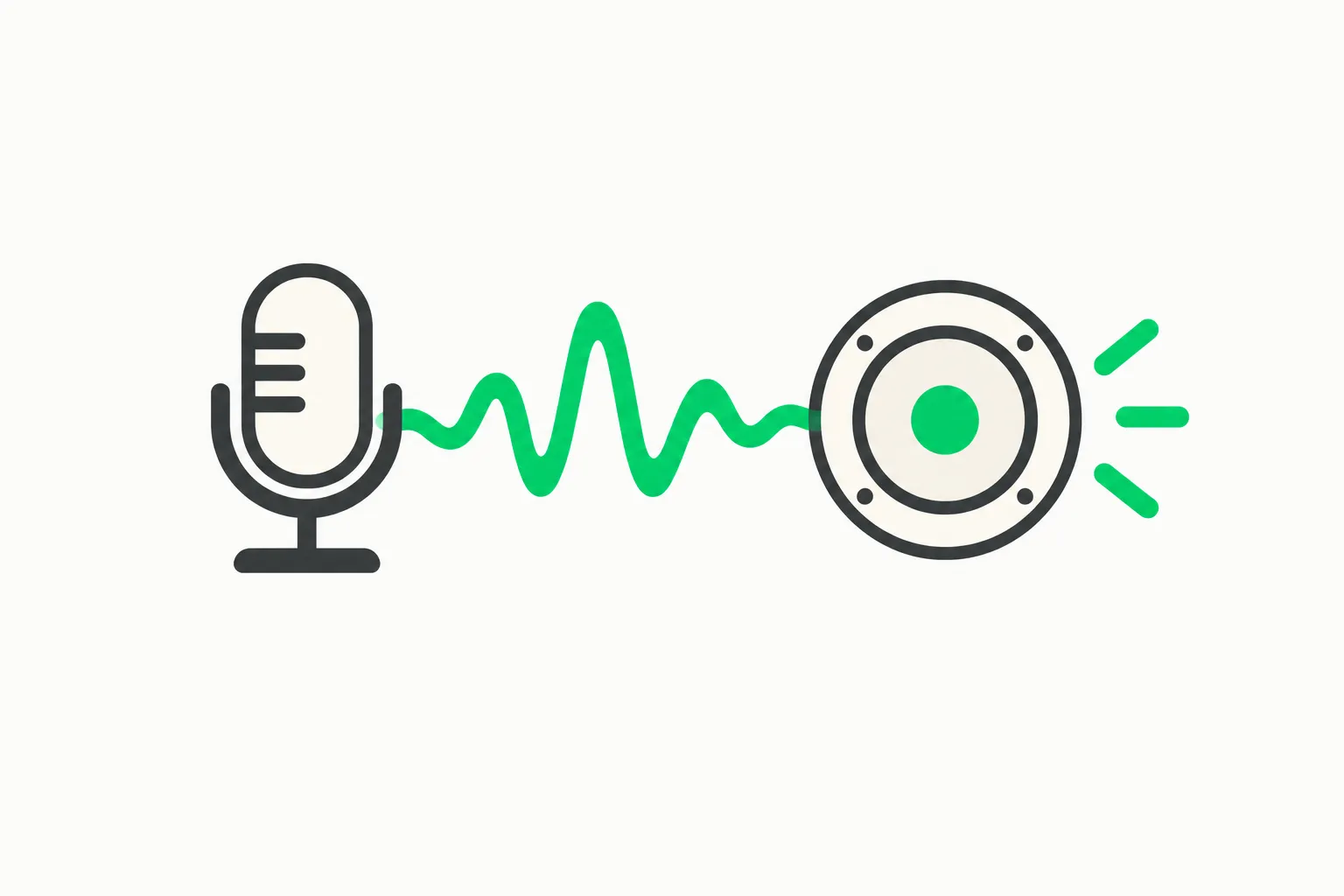 A microphone feeding a waveform into a speaker, showing where a voice isolator sits in a speech pipeline
Voice Isolator sits at the front of a voice pipeline, before recognition or cloning. Recent open or semi-open audio releases we covered fit around it:
- Reson8 Rumble 2 Flash is a 0.5B open speech recognizer covering 40 languages. Cleaner input is the obvious pairing, though no one has published a combined result.
- Edge0 Audio8 is an Apache-2.0 voice cloning model. Cloning quality depends on clean reference audio, which is where an isolator helps.
- Fish Audio Live 3 targets full-duplex voice agents, where background noise and echo hurt turn-taking.
- ElevenLabs Scribe v3 shows the hosted alternative path for transcription and turn detection.
Hosted voice isolators, such as the one ElevenLabs offers, are services you call through an account. An Apache-2.0 model changes the cost model: you pay in GPU or CPU time and engineering effort instead. Whether that wins depends on your volume and on how the quality compares on your audio, which neither Inworld nor we have measured against a hosted service here.
Who should try it, and how?
Builders of voice agents. Put the realtime checkpoint between the microphone and your speech recognizer, and measure end-to-end latency. The 63 ms figure is the model's algorithmic delay only. Audio capture buffers, network hops and your framework add more.
Dataset curators. Use the offline checkpoint to clean speech corpora, and keep the removed-background files so you can audit what was cut. The model card lists curating speech datasets as a target use. Spot-check for removed non-speech sounds you wanted, since the model deliberately removes music and other voices.
Podcast and video teams. Run the CLI over a folder of takes. Keep the originals. If a file sounds thin afterward, that is the denoise-only design: the model will not add back what the microphone never captured.
Founders. The license is the story. Apache-2.0 on weights and code is rare for a polished, documented speech component. Read the NOTICE file for dataset terms and run your own legal review before commercial use.
A simple evaluation recipe:
- Collect 20 clips: easy, hard, multi-speaker, music in the background, a non-English clip, and your noisiest real case.
- Run offline and streaming modes on each, and keep the residual files.
- Compare word error rate from your speech recognizer before and after isolation. Cleaner-sounding audio does not always give a better transcript, because denoising can clip quiet consonants.
- Check speaker similarity if you plan to clone or verify voices.
What people are searching for
Is Inworld Voice Isolator open source? Code and weights are Apache-2.0 according to the repository and model card. The VIBE evaluation set is not distributed, so the benchmark itself is only partly open.
Does it run without a GPU? The README lists CPU as a supported device, and CPU was among the hardware Inworld tested. Speed on a given CPU is not stated, so benchmark it yourself before you plan real-time use on CPU.
Can I use it on a Mac? The README says Apple's Metal backend (mps) is used on an Apple Silicon Mac with PyTorch 2.6 or later.
How does it compare with Demucs or other separators? The model card benchmarks against other voice isolators on VIBE, but we did not find an independent comparison. Treat any "better than X" claim as Inworld's until someone reproduces it.
What to watch next
Inworld says restoration is planned for version 2. That would move the model from "remove the noise" to "also rebuild what was lost," and it would change the risk profile. Generative restoration can alter how a voice sounds, which matters for evidence, journalism and consent. The v1 promise to "invent nothing" is a clean line, and it is worth watching whether v2 keeps it.
Also watch for outside tests on smaller GPUs and laptops, since the source only covers data-center GPUs and CPU, and for downloads and community fine-tunes. The Hugging Face page already lists one fine-tune and one quantization of the model in its model tree, which suggests early community activity.
If you build voice products, this is a low-cost experiment: install it, run twenty clips, and decide from your own results. For related voice-model coverage, see the links below.
Version details, parameter counts and repository facts are as published on the Hugging Face model card and GitHub README on November 19, 2026, and may change.
Related reading
- Reson8 Rumble 2 Flash: open ASR for 40 languages
- Edge0 Audio8: open Apache-2.0 voice cloning
- Fish Audio Live 3 and full-duplex voice agents
- ElevenLabs Scribe v3 and live speech-to-text
- Open ASR leaderboard and private-data testing
- Cloudflare Clairic open-weight models
- Official model card on Hugging Face and GitHub repository