



AWS published a Bedrock tokenomics data lake pattern on November 10, 2026 that turns per-account invocation logs into one org-wide Athena table — prompt text, responses, token counts, models, and IAM attribution included.
If you are the engineer who gets paged when Bedrock spend doubles, this sample is the difference between "finance says we spent $40k" and "team X''s retrieval prompt bloated to 18k tokens."
TL;DR
| Stage | Component |
|---|---|
| Source | Bedrock model invocation logging per linked account |
| Transport | CloudWatch subscription filters to central destination |
| Processing | Lambda unwrap + Firehose JSON → Parquet |
| Query | Athena view with flat token columns |
| Cost join | CUR 2.0 on IAM ARN |
| Viz | Optional QuickSight dashboard via cid-cmd |
Why tokenomics needs invocation-grade data
FinOps practitioners coined tokenomics — applying See / Save / Run / Plan to tokens, not VMs — at the 2026 FinOps Foundation conference (per AWS). Most AWS customers still live in monthly Bedrock invoices without prompt-level forensics.
That blind spot hurts agent fleets where one runaway tool loop can burn hundreds of thousands of cache-miss tokens. You cannot right-size models if you never see which agent role selected Claude vs Nova.
Compare with Perplexity''s numbat agent observability or the serverless MCP data lake guide we wrote for agent metadata. AWS''s sample is the Bedrock-native version: no third-party SaaS required.
Architecture walkthrough
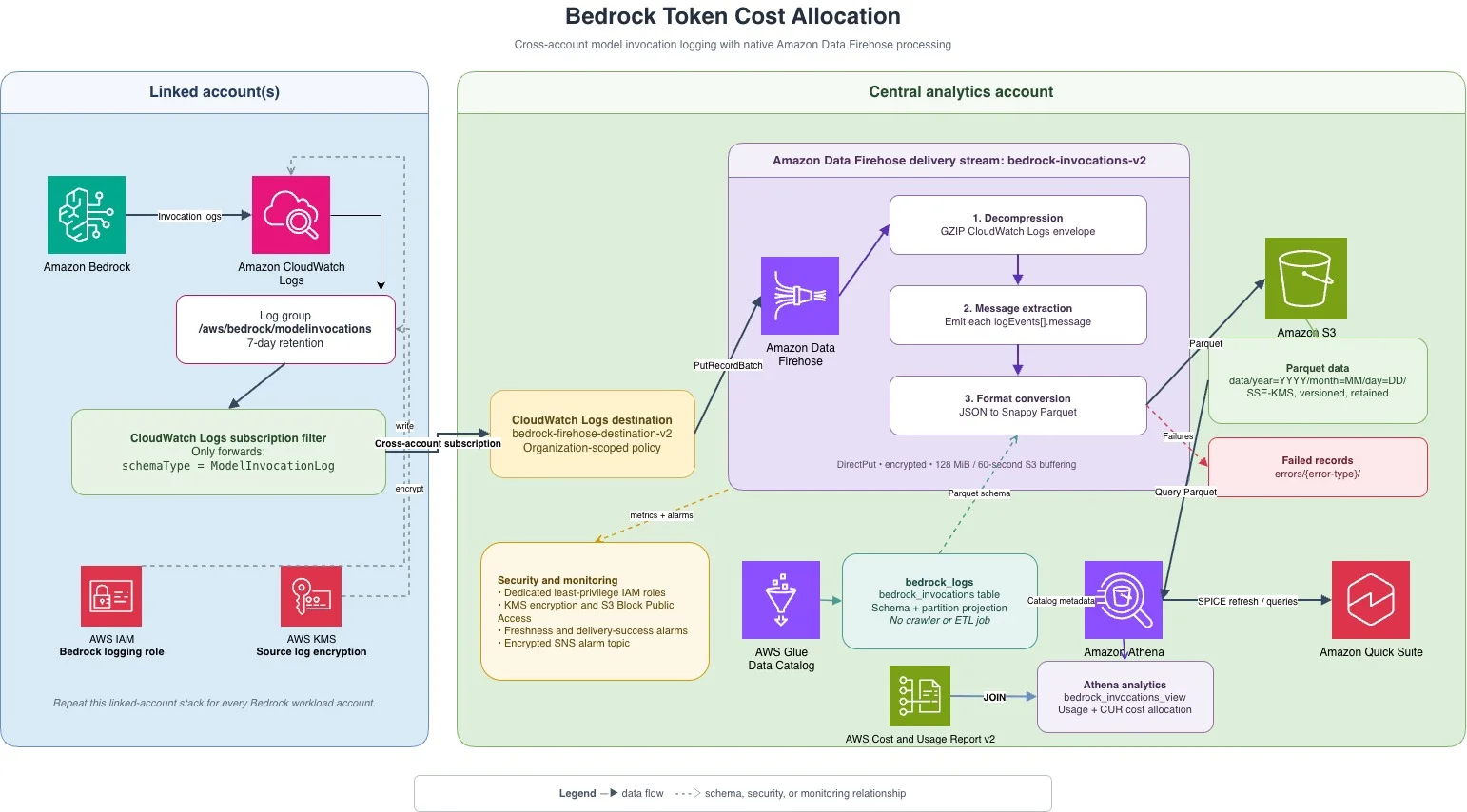 Bedrock invocation data lake architecture across linked and central accounts
Image: Amazon Web Services
AWS describes five stages:
- Enable invocation logging in each Bedrock account (API call, not CloudFormation).
- Subscribe CloudWatch log groups to a central destination ARN.
- Lambda decompresses batches, drops CloudWatch housekeeping noise, flattens IAM identity fields.
- Firehose buffers to S3 Parquet partitioned by date (
year/month/day). - Glue + Athena expose SQL views; optional QuickSight dashboard.
Two CloudFormation stacks deploy in order: central lake first, then linked-account forwarders. AWS stresses central-before-linked because destination ARNs are inputs to source stacks.
What you can query once data lands
AWS lists concrete investigations:
- Debug spikes by pulling exact prompt/response pairs.
- Find
stop_reason = max_tokensrows signaling truncated answers. - Compare
input_tokensvsoutput_tokensper team to spot bloated system prompts. - Attribute usage by account + IAM role for chargeback.
Joining to CUR yields dollars per prompt archetype — the missing link for semantic caching ROI math.
Governance: you are building a prompt warehouse
Because prompts may include PII, AWS recommends:
- KMS-encrypted S3 (enabled in sample).
- Least-privilege Athena workgroup policies.
- Bucket policies scoped to platform roles, not entire companies.
Review retention: full text in S3 may conflict with GDPR deletion unless you TTL partitions.
Deployment tips from the blog
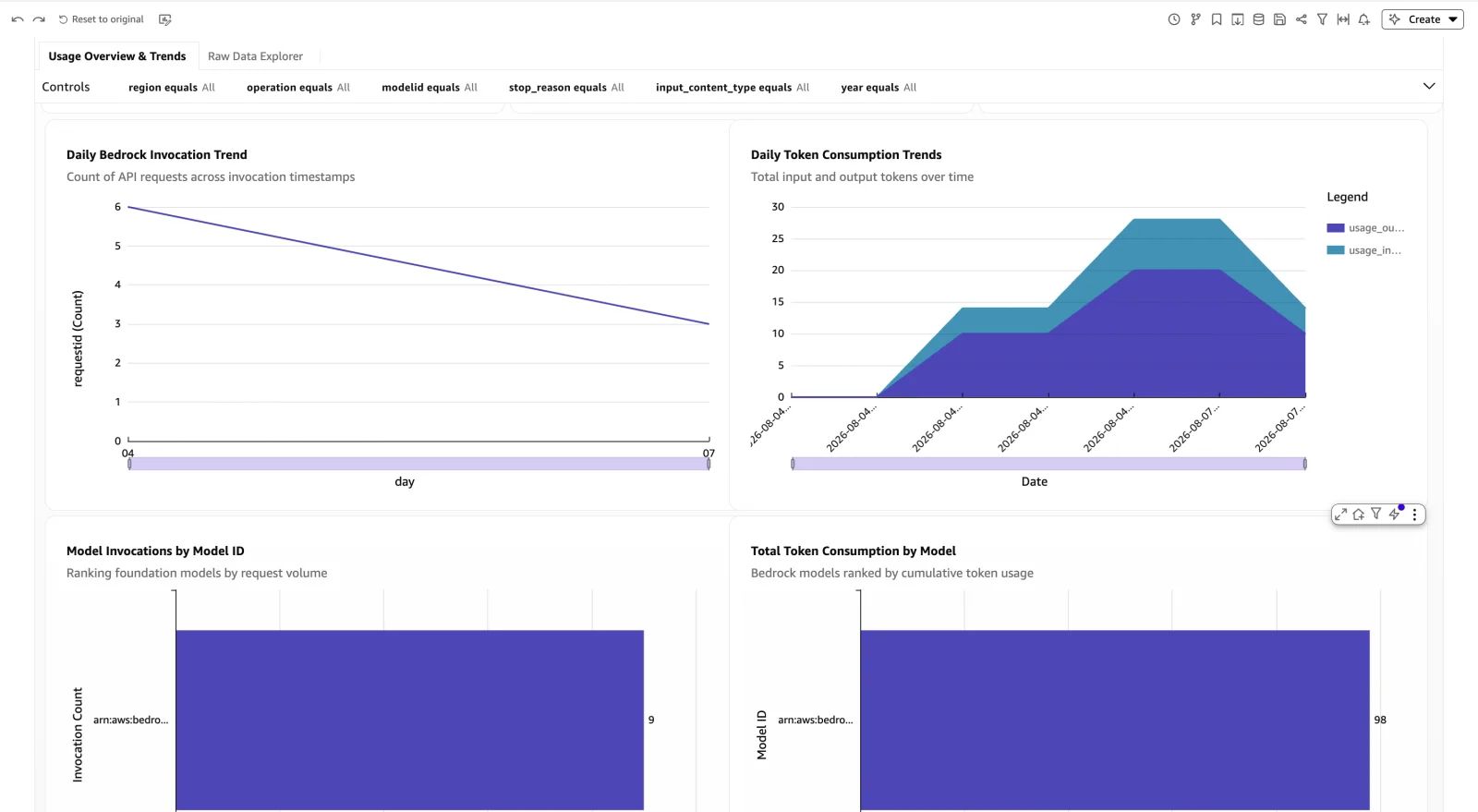 Amazon QuickSight dashboard for Bedrock token usage
Image: Amazon Web Services
- Start with one or two linked accounts, not the whole org on day one.
- Wait ~1 minute after test invocations for Firehose flush (sometimes longer).
- Run the saved Athena view query once to materialize flattened columns.
- Use repository SQL examples for CUR joins and inefficient invocation hunts.
- Deploy QuickSight via
cid-cmd deployonly after workgroup + datasource IAM is clean.
How this fits broader AWS agent work
The same week AWS published a TCS agentic test orchestrator story on Bedrock AgentCore — a customer case study, not a platform feature. This data lake post is directly actionable: clone the repo, enable logging, run SQL.
Combine with Quick Skills agent catalog when you want standard agent templates, but instrument before you scale templates.
Teams comparing Bedrock vs Vertex for Gemini 4 Carbon should still build vendor-neutral token dashboards — this pattern ports conceptually to any logging sink.
Stage-by-stage deployment checklist
Use this literal order from the AWS blog:
Central account
- Clone AWS Sample Bedrock Invocation Data Lake (URL named in AWS post).
- Deploy central CloudFormation with
CAPABILITY_NAMED_IAM. - Record destination ARN and QuickSight role ARN outputs.
Each linked account
- Deploy linked stack with destination ARN parameter.
- Run enable logging API call — stacks alone do not flip Bedrock logging on.
- Fire a test InvokeModel and wait for Parquet objects under
data/year=....
Analytics account
- Execute saved Athena view creation query once.
- Run sample SQL: top 10 IAM roles by
input_tokenslast 24h. - Optional: deploy QuickSight kit via
cid-cmdafter IAM smoke tests.
Document rollback: delete stacks only after emptying S3 buckets; delete Athena workgroups manually per AWS warning.
Example questions Athena should answer day one
| Question | SQL pattern (conceptual) |
|---|---|
| Who blew the budget Tuesday? | Group by iam_role_arn, sum tokens |
Which prompts hit max_tokens? | Filter stop_reason |
| Is team A over-using Opus-class IDs? | Filter model_id, group by account |
| Cache effectiveness | Compare input_tokens on repeated prompt hashes |
AWS includes concrete queries in the repository SQL file — port those before writing bespoke joins.
CUR join caveats
Joining to CUR 2.0 on IAM ARN sounds clean, but:
- Cross-account roles may collapse identities if roles share names.
- Bedrock pricing mixes on-demand and provisioned lines — filter
lineItem/ProductCode. - Credits and refunds appear days later — run weekly, not hourly, finance reports.
Align with finance on cost allocation tags before you promise per-team dollars to engineering managers.
Agent-specific observability patterns
When AgentCore orchestrations fan out:
- Tag invocations with session_id in prompt metadata where Bedrock allows.
- Correlate tool-call spans from your tracer with invocation log timestamps.
- Alert when single session exceeds N invocations per minute — classic runaway tool loop signature.
This lake does not replace distributed tracing; it supplies ground-truth token accounting tracers lack.
FinOps tokenomics rituals
Adopt weekly tokenomics reviews alongside infra FinOps:
- See: Athena dashboard of token growth WoW.
- Save: Identify top 5 prompt templates to rewrite or cache (semantic caching guide).
- Run: Switch models on low-risk paths after MKA-style evals or internal rubrics.
- Plan: Forecast spend when new agents launch (Quick Skills catalog).
Multi-cloud honesty
This sample is Bedrock-specific. Teams also invoking Gemini on Vertex or OpenRouter should build a vendor-neutral metrics layer above each logging sink. The tokenomics pillars still apply — only the ingestion code differs.
Failure modes we have seen in similar lakes
- Forgot to enable logging in account 3 while stack deployed — silent hole.
- Lambda throttled on burst traffic — missing invocations without CloudWatch alarm.
- PII in prompts exported to QuickSight public embed — governance failure.
Add alarms on Firehose delivery errors and S3 object count drops.
Why AWS published this as a sample, not a product
AWS already sells CloudWatch, Athena, and Bedrock — but no one-click tokenomics SKU exists yet. The sample repository is AWS''s way to socialize FinOps best practices before native consoles catch up.
Treat it like early Well-Architected labs: you operate the pipelines, AWS provides patterns. Product teams should expect managed observability SKUs later; until then, clone the sample and iterate internally.
Platform engineers should align with security reviewers early: this lake is more sensitive than typical VPC flow logs because prompt bodies may include secrets pasted by users.
Connecting to enterprise procurement
When finance asks "what are we buying with Bedrock?", this lake answers with IAM-attributed prompt classes instead of hand-wavy headcount estimates. That is the same narrative TSMC strategic AI investment posts use at chip scale — show unit economics, not vibes.
FAQ deep dive
Does logging slow inference? Bedrock logging is asynchronous to callers, but volume costs hit CloudWatch and S3. Model the telemetry tax in FinOps.
Can we redact prompts at ingest? You can extend the Lambda processor to strip regex PII before Parquet — not in the vanilla sample, but the hook point is there.
Is QuickSight mandatory? No. Athena CSV exports to your BI stack work fine for engineering teams.
What about Guardrails invocations? If Guardrails runs as separate calls, ensure logging is enabled there too or attribution gaps appear.
Can startups skip this? If you run one Bedrock account and sub-$500/mo spend, CloudWatch per account may be enough. Past dozens of linked accounts, this pattern pays for itself in one prevented incident.
Version-control your CloudFormation parameters in the same repo as application prompts so finance can diff infra and behavior together during incident review. Tag releases with FinOps week numbers so leadership can map spend spikes to deploys. Add a pager threshold when any IAM role doubles 7-day token volume without a matching product launch announcement. Pair that alert with a runbook link to the Athena query that lists the top prompts for that role. FinOps champions should present one saved Athena dashboard in every monthly business review. Export a CSV snapshot after each review for auditors. Keep the first rollout small: one linked account, one saved dashboard, and one named owner who answers questions when a spend spike appears. Expand to more accounts only after that owner can explain a real spike from prompt-level rows.