



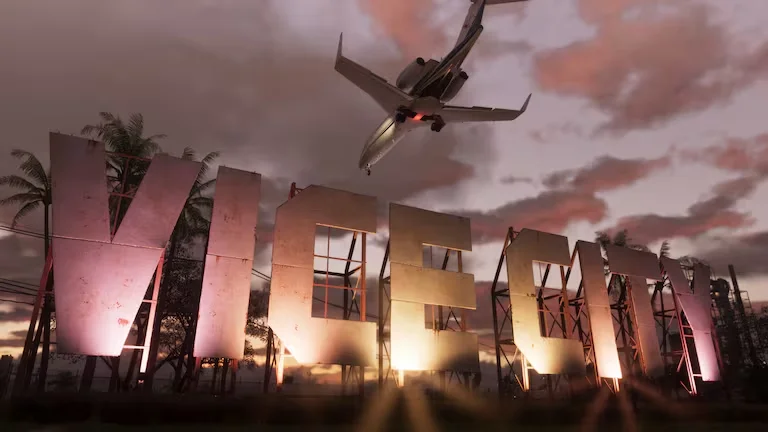
 GTA 6 Vice City sign at dusk with plane flying overhead
On June 25, 2026, Rockstar opened pre-orders for Grand Theft Auto VI, launching November 19, 2026 on PS5 and Xbox Series X/S. The same week, the internet exploded with a question that has two very different answers: did Rockstar use AI to build GTA 6?
The short answer is no — and yes.
No, generative AI wrote none of the dialogue, generated none of the world, and designed none of the characters. Take-Two CEO Strauss Zelnick was unambiguous: "Generative AI has zero part in what Rockstar Games is building." Every building, every street, every neighbourhood in GTA 6's version of Vice City was handcrafted by a human.
Yes, the game runs some of the most sophisticated AI systems ever shipped in a consumer product — a physics engine that simulates a nervous system for every NPC on screen, rule-based decision trees that produce genuinely emergent city behaviour, procedural animation blending that makes no two moments of movement identical, and a volumetric water simulation that treats every wave as an object with mass.
Understanding the difference — between AI as a content generator and AI as a real-time simulation layer — is the key to understanding what GTA 6 actually is. We did a similar breakdown for AI in the FIFA World Cup 2026 — GTA 6 is a more extreme version of the same question, applied to an open world instead of a tournament simulation. Here is every concept, explained.
The Headline: No Generative AI in GTA 6's Creative Pipeline
Before going into what the AI does, it is worth understanding what it does not do — because the distinction is meaningful for anyone who cares about how games are made.
Take-Two's Strauss Zelnick has been unusually direct on this topic. His position: "There is no creativity that can exist by definition in any AI model, because it is data-driven." GTA 6 is built "from the ground up, building by building, street by street, neighborhood by neighborhood" by Rockstar's team.
The backstory: Take-Two quietly closed its dedicated internal AI division before the November launch window, laying off that team while keeping AI tools integrated at the productivity level across the company. The roughly 200 internal projects that Take-Two runs using enterprise ChatGPT and Claude are support tools — for QA testing, productivity workflows, bug detection, and developer assistance — not content generators. (Claude's enterprise capabilities are explored in our Claude for Work guide.)
This is a deliberate line. Rockstar's position: procedural content generation at the scale of GTA 6 is not possible without degrading quality in ways that matter. The density of narrative, environment, and character detail in a Rockstar game requires human authorship. AI at this capability level cannot produce it.
What that means practically: every line of dialogue Jason and Lucia speak, every building facade in Vice City, every ambient sound cue was crafted by a person. That is not a marketing line — it is the reason GTA 6's development reportedly cost over $2 billion and took more than a decade.
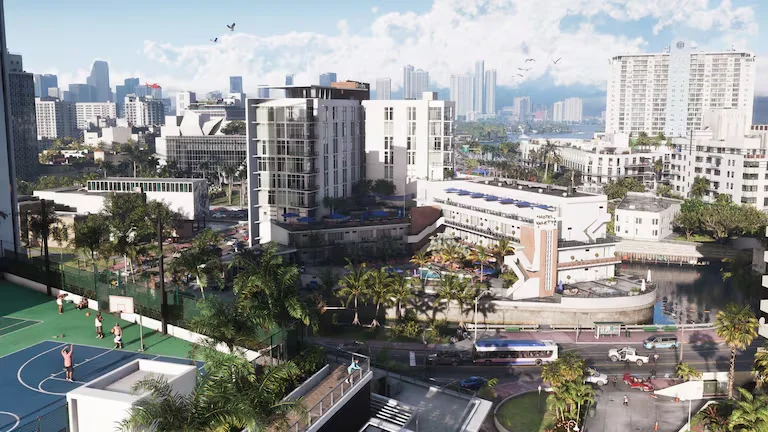 GTA 6 Vice City aerial skyline view showing the city density and simulation scale
RAGE 9: The Engine That Makes AI Possible at This Scale
The Rockstar Advanced Game Engine 9 (RAGE 9) is the technical foundation under everything else described in this article. Without it, none of the AI systems below could run in real time.
RAGE 9 represents a generational leap from what powered GTA V. The key upgrades relevant to AI:
- Physics bone calculation — every character on screen has physics bones that calculate how soft tissue responds to momentum, gravity, and impact in real time, every frame. Not just the player character. Every NPC.
- Streaming conditional dialogue — the engine streams tens of thousands of contextual NPC dialogue lines based on weather, time of day, your recent actions, and proximity — without pre-loading everything at once.
- Volumetric simulation — physics is no longer a flat approximation. Water has mass. Vehicles interact with liquid volumetrically. Rain affects surface friction in ways that propagate through the simulation.
The significance for AI specifically: RAGE 9 performs per-character physics and behaviour calculations for every active entity simultaneously, rather than cutting corners on background NPCs. This is what makes emergent city simulation possible — you can't fake a city that reacts to itself if you're only running full physics on the nearest ten characters.
Euphoria 2.0: Simulating a Nervous System for Every NPC
Euphoria was already the most physically realistic character simulation engine in gaming when Rockstar used it in GTA IV in 2008. GTA 6 ships with Euphoria 2.0, and the upgrade is significant enough that it changes how the game feels at a fundamental level.
The concept: instead of playing a pre-authored animation when a character is hit, pushed, or falls, Euphoria simulates what a body with a nervous system would actually do.
How It Works
When an NPC is shot, the system does not select a "shot reaction" animation from a library. It calculates:
- The point of impact on the body
- The force and direction of the hit
- The character's current momentum and stance
- Their proximity to nearby surfaces they could grab
From these inputs, the engine computes in real time what the character's muscles would do. The result: an NPC shot in the shoulder does not fall down — they stumble, reach for the wall, try to stay standing, and clutch the wound. An NPC shot in the leg buckles specifically on that side. No two reactions to the same event are identical.
Inverse Kinematics in Combat
Hand-to-hand combat uses Inverse Kinematics (IK) — a technique where the system works backward from the desired contact point to figure out how the limbs should move to get there. When you punch someone, the fist connects with their jaw at the geometrically correct point, and the head response is calculated from the force vector. No canned animation. No "punch lands six inches from the jaw but the reaction plays anyway."
This is not a new concept in computer graphics — IK has been used in animation and robotics for decades. What is new is running it for every NPC simultaneously in a real-time open world. If you want a broader understanding of how AI and machine learning differ from traditional physics engines, our AI vs machine learning vs deep learning guide covers these distinctions clearly.
Why This Is an AI Concept
Euphoria 2.0 is a physics simulation with learned parameters — the "decisions" about muscle response are derived from biomechanical models, not from a designer scripting each reaction. It is a narrow form of AI (specifically a physics-based animation system with procedural output) operating at a scale that distinguishes GTA 6 from every prior open-world game.
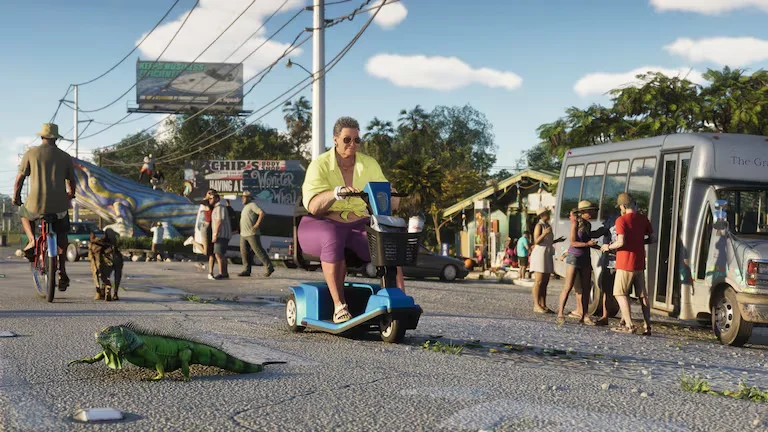 GTA 6 NPC on mobility scooter with iguana crossing the street — emergent AI behavior
Emergent NPC Behavior: A City That Runs Itself
The most publicly visible AI system in GTA 6 is what Rockstar calls emergent behavior — NPCs that interact with each other and the world without being scripted for specific scenarios.
Rule-Based Decision Systems
GTA 6's NPCs operate on rule-based decision trees where behaviour is driven by context: location, time of day, weather, nearby events, and risk level. Rockstar is not running large language models for NPC dialogue or behaviour. Instead, they have built a layered simulation where characters evaluate their environment and make decisions from a defined set of rules and responses.
What this produces:
- Traffic accidents where drivers get out, exchange details, or start arguments — without a designer scripting "traffic accident scenario"
- NPCs filming incidents with their phones when something unusual happens nearby
- Weather-driven shelter-seeking — rain changes pedestrian routing without any specific instruction
- Wildlife creating cascading reactions — an alligator wandering into a gas station causes NPCs to panic, flee, or (in true Florida fashion) attempt a selfie, depending on their character parameters
- Police coordination scaling tactically based on threat level, with units communicating and surrounding rather than all running directly at the player
Simulated Daily Routines
NPCs in GTA 6 have destinations and purposes, not random walk patterns. The system simulates schedules — so a character you see at a coffee shop at 8am is somewhere else at noon. This creates a city that feels populated by people with lives, rather than by actors waiting for the player to arrive.
The technical term for this is agent-based simulation — each NPC is an agent with its own state, goals, and decision rules, interacting with a shared environment. If you want to understand the agent concept more deeply, our complete guide to AI agents covers how state machines, goals, and decision loops work in production systems. At scale, the sum of individual agent decisions produces city-level emergent patterns that no designer explicitly authored.
Procedural Animation: Motion Matching at Character Level
GTA 6 uses a modular motion matching framework for all character locomotion — one of the more technically sophisticated animation systems in commercial game development.
What Motion Matching Is
Traditional game animation works by blending between pre-authored states: idle, walk, run, sprint, with crossfade transitions between them. The problem: transitions feel mechanical, especially when direction changes or terrain shifts mid-motion.
Motion matching replaces the state machine with a search problem. At each frame, the system searches a database of captured motion data for the pose that best matches the character's current velocity, direction, and body state — and transitions smoothly to it. The result is character movement that blends continuously rather than switching between discrete states.
Rockstar extends this with a modular decomposition: movement is broken into components — stance, posture, locomotion type, weapon handling, environmental contact — each evaluated and blended independently. A character walking while looking over their shoulder while carrying a pistol while stepping over debris is not a single authored animation. It is a combination of simultaneously evaluated motion components.
Why This Matters
The practical result is that no two moments of movement feel identical — even during routine navigation. Jason running through a crowd on a rainy street steps, dodges, and adjusts in ways that are situationally specific rather than visually repetitive. Lucia climbing or descending terrain adapts foot placement to actual surface geometry rather than sliding across it.
This is procedural AI in the animation domain — the system generates output (movement) from rules and data rather than playing back pre-authored sequences.
Water Physics: Volumetric Simulation as a World System
Water in GTA 6 is not a texture with a wave shader. It is a volumetric physical simulation — water has mass, behaves under gravity, generates foam at disturbance points, and interacts with objects that enter it.
This matters for AI because the water simulation is part of the same environment that NPCs and the player navigate. A vehicle entering water at speed creates a wake that propagates physically. NPCs near water react to disturbances in it. The world simulation is unified rather than siloed.
The RAGE 9 engine performs these calculations per-frame for all active water volumes — a significant compute achievement for a real-time consumer game.
Facial Animation and Motion Capture at Scale
GTA 6 represents the largest motion capture production in gaming history by reported scope. The facial capture system uses head-mounted cameras and dot-pattern scanning to record micro-expressions simultaneously with voice performance — so lip movement, facial expression, and dialogue are all captured in a single take rather than assembled from separate passes.
The significance: the captured data is not just played back. It feeds into a retargeting system that maps the captured performance onto the game character's geometry in real time, preserving the specific quality of the human performance rather than approximating it through procedural facial animation alone.
This is a data-driven AI system in the narrower sense: the model learns the mapping from captured human face geometry to game character output and applies it across thousands of captured performances.
The Behind-the-Scenes AI: What Take-Two Runs Internally
While none of it appears in the shipped game, Take-Two's internal AI tooling is worth understanding — because it is part of how a game this large gets made.
The company runs approximately 200 internal projects that use enterprise versions of ChatGPT and Claude across the organization. This mirrors a broader industry trend — Unreal Engine 5.8 is now integrating Claude and Codex MCP directly, and AI game creation startups like Astrocade raised $56M specifically to use AI in game development workflows. Key applications at Take-Two:
- Automated QA testing — AI agents running regression tests, flagging rendering errors, and identifying physics edge cases at a scale human testers cannot reach
- Developer productivity tools — code assistance, documentation generation, and debugging support for Rockstar's engineering teams
- Analytics and telemetry — machine learning models processing internal playtest data to surface difficulty spikes, pacing issues, and engagement drop-offs
The explicit line Take-Two draws: AI improves the process of making GTA 6 but generates none of the content in it. The distinction matters because it reflects a deliberate position about what AI is currently capable of at AAA quality — and what it is not.
Pre-Order Checklist: What to Know on June 28
Pre-orders for GTA 6 opened June 25, 2026, three days ago. Here is what matters before you commit.
The Basics
| Release date | November 19, 2026 |
| Platforms | PS5 and Xbox Series X/S only |
| PC version | Not announced |
| Digital preload | November 12, 2026 (one week early) |
| Physical editions | Available from retail November 12 for preloading |
| Standard Edition | $79.99 |
| Ultimate Edition | $99.99 |
Pre-Order Bonus: Vintage Vice City Pack
Everyone who pre-orders or buys before November 20, 2026 gets the Vintage Vice City Pack — a set of items that pull directly from the '80s Miami Vice era of the 2002 original:
- 1955 Vapid Stanier — a classic car with whitewall tires and a vintage yellow-and-white paint job
- Jason's linen suit — ice-cream pastels, Don Johnson energy
- Lucia's vintage outfit — era-appropriate, distinct from base game wardrobe
- Tommy Vercetti palm tree weapon pattern — applicable to most guns in the game
- One free month of GTA+ — includes $500,000 GTA Online cash monthly, access to the Vinewood Club car showroom, and free Rockstar back catalogue access
The Vintage Vice City Pack is explicitly a limited-time pre-order bonus, not a permanent purchasable DLC. After November 20, it disappears from storefronts.
Ultimate Edition: Is It Worth $20 Extra?
The Ultimate Edition ($99.99) adds on top of the Standard:
- Additional exclusive vehicles (specific models not yet fully detailed)
- Exclusive weapons
- Two story side missions unlocked chapter by chapter as you progress through the main game — not front-loaded content
The side missions are the most material difference. If you are a completionist or want the fullest first-playthrough experience, they are worth considering. If you are primarily a GTA Online player, the Standard Edition with the pre-order pack may be sufficient.
What to Check Before Buying
1. No PC version is announced. If you play primarily on PC, there is no release date to pre-order toward. Based on Rockstar's historical pattern (GTA V launched on console in 2013, PC in 2015), a PC version is likely but could be 12-18 months out. It is worth noting that PC gaming hardware prices have surged in 2026 due to AI data center demand — factor that into any console-vs-PC calculus. Buying the console version now locks you into console.
2. The free trial window for GTA+ counts from redemption, not purchase. If you pre-order now, the GTA+ month starts when you redeem, not when you buy — so you can time it to coincide with launch.
3. Digital vs physical matters for preload. Both let you preload from November 12. Physical copies are disc-in-box but contain a download code — you are not installing off the disc. File size expected to be very large; factor in your internet speed for preload planning.
4. The Vintage Vice City Pack deadline is November 20, not November 19. You have one day post-launch to buy and still get the bonus, if you want to wait for day-one reviews.
5. The Ultimate Edition side missions are chapter-gated. They do not unlock at game start. If you buy Ultimate Edition expecting Day 1 bonus content, you will be playing through the story to access it progressively — same as the base game structure.
The AI Concepts to Watch When You Play
When GTA 6 launches in November, here are the specific AI systems to pay attention to:
Watch Euphoria 2.0 in any combat scenario. Pay attention to how NPCs respond to hits — the stumbles, the wall-grabbing, the asymmetric reactions. Compare it to how GTA V NPCs responded to the same inputs. The difference is the system moving from scripted reactions to real-time physics simulation.
Watch emergent behavior in the open world. Find a traffic accident you did not cause and stand back. Watch what nearby NPCs do without your input. Follow an NPC for several in-game hours and observe whether their location changes. The routines and reactions are the agent-based simulation running at city scale.
Watch motion matching in locomotion. Observe how your character's movement adapts to terrain, crowd density, and direction changes. Notice whether transitions feel like animation state switches or continuous physical adaptation. The absence of visible transitions is what motion matching produces.
Watch procedural water during any storm or waterway sequence. Observe how vehicles interact with water surfaces — whether waves propagate from displacement, whether foam appears at disturbance points, whether the simulation feels physically unified with the rest of the world.
These are not marketing features. They are AI and physics systems of a specific technical class, implemented at consumer scale for the first time.
Bottom Line
GTA 6 is not an AI-generated game. The distinction Rockstar and Take-Two are drawing is genuine: generative AI did not build this. Human creative labour at extraordinary scale and cost did.
What GTA 6 is is a game that ships some of the most sophisticated real-time AI simulation systems ever put into a consumer product. Euphoria 2.0, the RAGE 9 emergent NPC layer, procedural motion matching, and volumetric physics simulation are each individually significant technical achievements. Running them simultaneously across an open world of this density is what the decade of development and the budget were buying.
Pre-orders are live now through the PlayStation Store, Microsoft Store, and Rockstar Games Store. The Vintage Vice City Pack deadline is November 20, 2026 — one day after launch. The game is not on PC. The preload window opens November 12.
If you are an AI practitioner or enthusiast watching the gaming industry: GTA 6 is one of the clearest case studies available in the distinction between generative AI (trained models producing creative content) and simulation AI (rule-based, physics-driven, emergent systems running in real time). Both are AI. They are doing fundamentally different things. GTA 6 uses the second category at a level the industry has not seen before.
For broader context on how AI is reshaping entertainment, see our guides on AI in creative hobbies, video generation AI, and the full AI benchmarks guide for how performance is measured across AI systems — including the simulation-class models powering games like this. For gaming platform news, see bunpav.com.
Update — August 21, 2026: Since this post published, leaked GTA 6 footage has surfaced from a hacker calling themselves Cyberleek — and most of the "leak" clips circulating online turned out to be AI-generated, not genuine. See are the GTA 6 leaks AI generated? for what's actually confirmed real.
Published June 28, 2026. GTA 6 releases November 19, 2026. Pre-orders are live. Pre-order bonus deadline: November 20, 2026.