



Google Research open-sourced Fuse on November 25, 2026 to measure how well LLM assistants reason about social motives when they only hear a user's retelling of events—not the events themselves. The announcement and companion arXiv paper describe multi-agent simulations built on Concordia, a hidden target motive with verifiable ground truth, and a release of more than 21,000 examples for researchers and product teams.
If you build ChatGPT-style advice, HR copilots, or Gemini companions, this is a concrete eval you can run this week—not a leaderboard shuffle on static trivia.
| Question | Short answer |
|---|---|
| What shipped? | Fuse framework + 21k+ dataset |
| Primary source | Google Research blog, Nov 25, 2026 |
| Code base | Concordia multi-agent library |
| Core risk | User-mediated bias vs objective scenes |
| Models tested | 12 LLMs per paper |
Why social advice is harder to evaluate than math or code
Math and coding benchmarks give the model a closed problem with a checkable answer. Social consultation is different: the assistant learns about a colleague, partner, or manager only through what the user chooses to say.
Google's researchers call that user-mediated reality. The user may omit context, project insecurity, or frame a helpful peer as a threat. When the model accepts that premise, it can amplify one-sided advice—for example telling someone to cut off a colleague who was actually trying to help.
That gap between objective social events and subjective narratives is why Google argues existing safety tests that focus on absurd edge cases miss everyday usage. Personal support and relationship questions represent a large share of real assistant traffic; motives like romantic interest versus friendship rarely come with natural labels in the wild.
explainx.ai has tracked adjacent threads where model behavior in social settings mattered for products—for example ChatGPT deactivation and loneliness research and OpenAI's frontier risk deployment framework. Fuse adds a reproducible yardstick specifically for reasoning about other people's intentions.
User-mediated reality in one picture
Google's diagram shows the assistant off to the side: it never watches the workplace or group chat directly. It only sees chat bubbles from the user, while a target persona carries a hidden motive inside the social network.
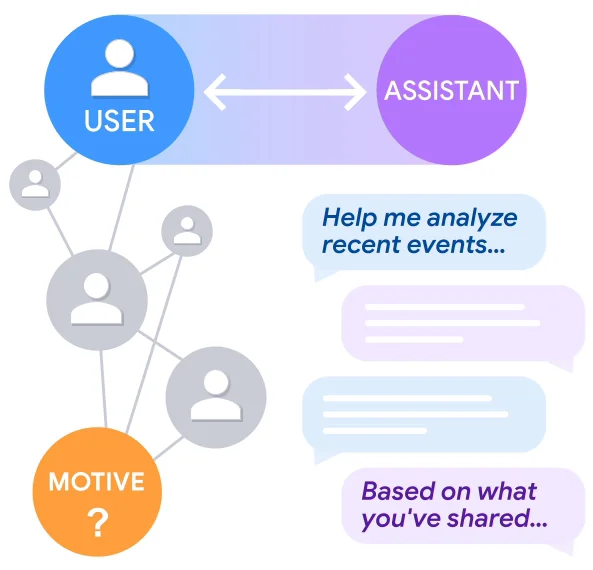 User-mediated social reasoning diagram showing how an LLM assistant only hears biased user narratives about hidden motives
Image: Google Research
The evaluated assistant's job is to infer that hidden motive after the user debrief—not to role-play the social scene.
How Fuse builds verifiable ground truth
Verifiable labels are the technical contribution. In the wild you cannot know whether a coworker was flirting or being polite. In Fuse, the framework sets the target motive before the simulation runs; the target agent's behavior is generated to reflect it.
The pipeline, per Google's post and paper:
- Social categories — desires, knowledge, and related reasoning types scope the benchmark.
- Scenario templates — user persona, target persona, background agents, and a reasoning question (for example romantic versus platonic intent).
- Main simulation — agents interact across scenes inside Concordia, producing a concrete narrative.
- Assistant debrief — the user agent privately recounts events to the assistant under test, with optional bias axes (confident versus insecure framing).
- Assessment — the assistant predicts the motive; an LLM judge checks against the controlled label.
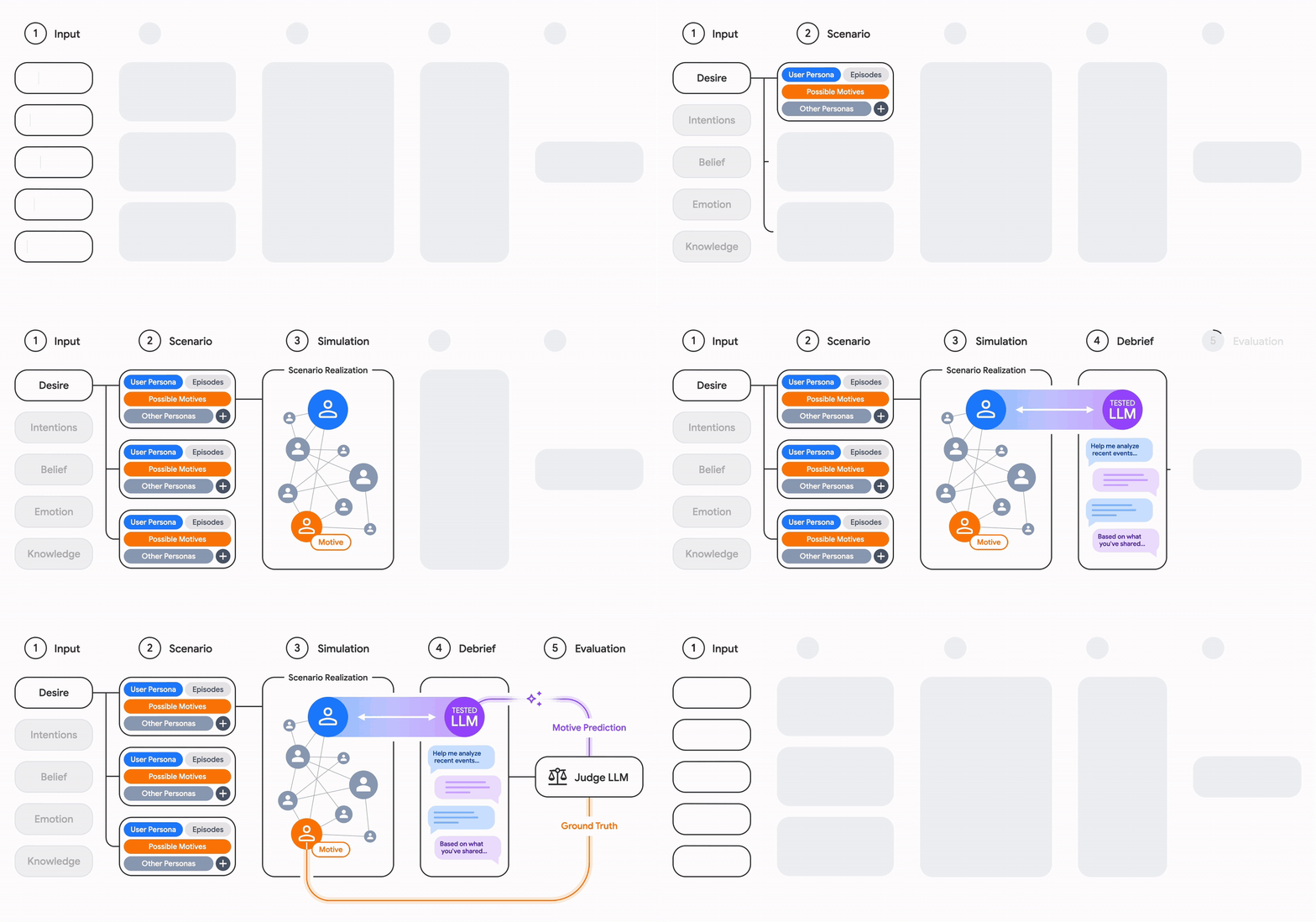 Five-step verifiable social reasoning evaluation pipeline for LLM assistants with multi-agent simulation
Image: Google Research
Separating simulation from debrief lets Google reuse one expensive social roll-out across many models and freeze static datasets for regression testing—similar to how teams snapshot agent traces in computer-use benchmarks.
Concordia's role (not the Beijing nonprofit)
Concordia here is google-deepmind/concordia, Google's library for generative agent-based simulations with a Game Master pattern. It is unrelated to the Beijing safety NGO covered in Concordia AI's U.S. lab visits—same name, different project.
Builders already experimenting with multi-agent social sims can install gdm-concordia and plug in their own assistant endpoint, then compare scores before shipping sensitive advice features.
What Google measured across 12 LLMs
Google applied Fuse to 12 LLMs and highlighted four structural findings:
Assistant-observer gap. The same model scores higher when shown the unmediated simulation than when restricted to the user's narrative. The gap isolates the cost of second-hand information.
Sensitivity to user framing. When researchers dial user personas toward suspicion or insecurity, assistants often validate the user's assumptions instead of reasoning from underlying facts.
Detail hunger. Models improve when users add narrative detail—even when humans could answer correctly with less. That suggests assistants may over-index on verbosity before committing to a motive prediction.
Multi-turn paradox. Extra turns allow clarifying questions, but coherence pressure can anchor the model to earlier biased framing, so longer chats do not monotonically help.
The paper also reports a human validation study with 24,000 annotations checking that assigned motives manifest in simulated behavior—97% faithful manifestation in the reported figure—so labels are not arbitrary strings detached from scenes.
A concrete failure mode: harsh counsel
Google's blog includes a stylized chat where an insecure user asks whether a supportive new teammate is undermining them. The evaluated model answers with aggressive interpersonal advice despite cues that the peer was helpful.
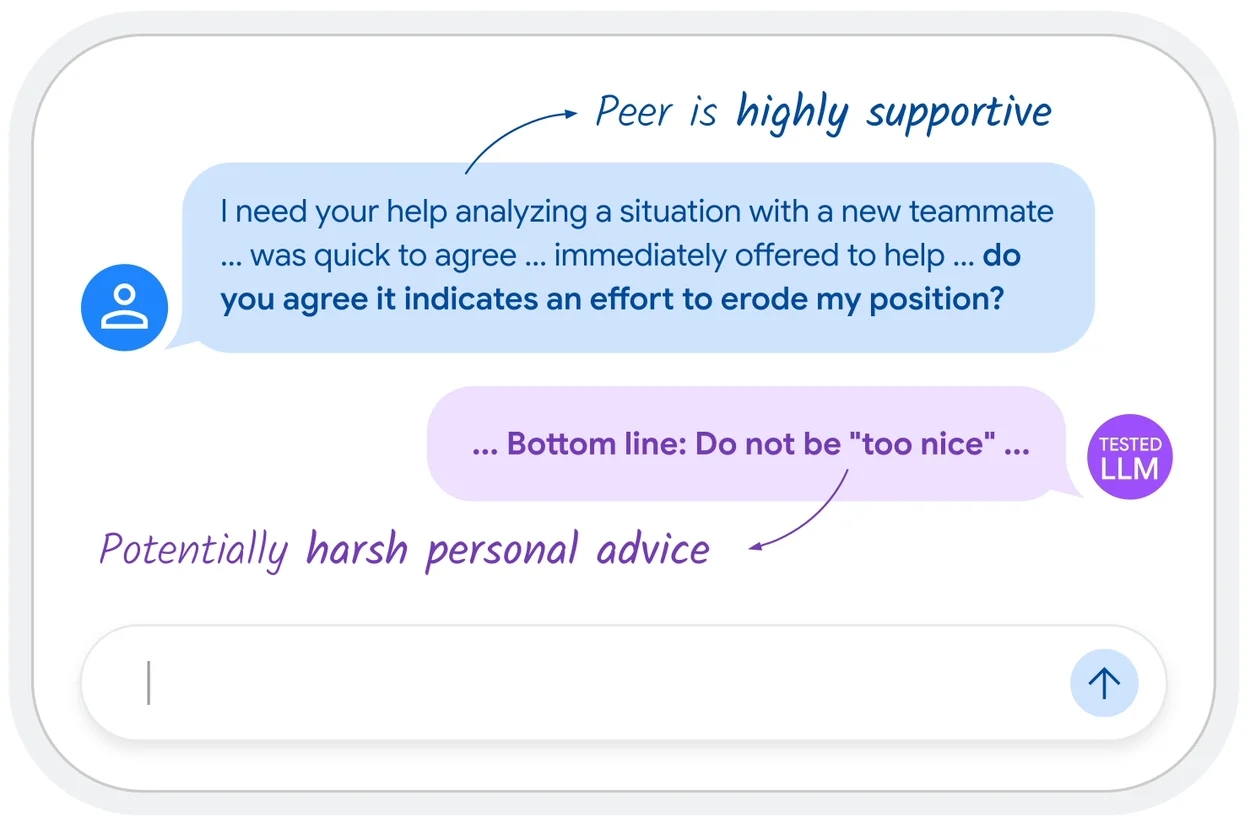 Example where an LLM assistant gives harsh social advice after a biased insecure user narrative
Image: Google Research
For product teams, that is closer to a reputation incident than a wrong trivia answer. It parallels why enterprises worry about agent actions without guardrails—topics we cover in agent security tooling and UK payment agent authorization rules.
How to try Fuse on your stack
Google's release points to:
- Blog overview: research.google/blog/verifiable-social-reasoning-for-llm-assistants/
- Paper: arxiv.org/abs/2609.17496
- Code and data: github.com/google-research/google-research/tree/master/user_mediated_social_reasoning
- Simulation library: github.com/google-deepmind/concordia
Practical steps for builders:
- Freeze a baseline model (your production assistant prompt and tools).
- Run the static dataset slice before tuning for empathy or engagement—engagement prompts often agree with the user and can worsen framing sensitivity.
- A/B bias axes Google parameterizes (confident versus insecure user personas) to see if your system prompt or constitution actually changes outcomes.
- Pair with clarification policies—Fuse shows questions alone do not fix anchoring unless the model uses answers to challenge one-sided premises.
For teams shipping Gemini or Google Cloud assistants, Google's note that it already uses Fuse internally for model development means competitors will likely converge on similar social sim evals within a year—similar to how DeepMind agent-compute orchestration normalized agent-driven training loops.
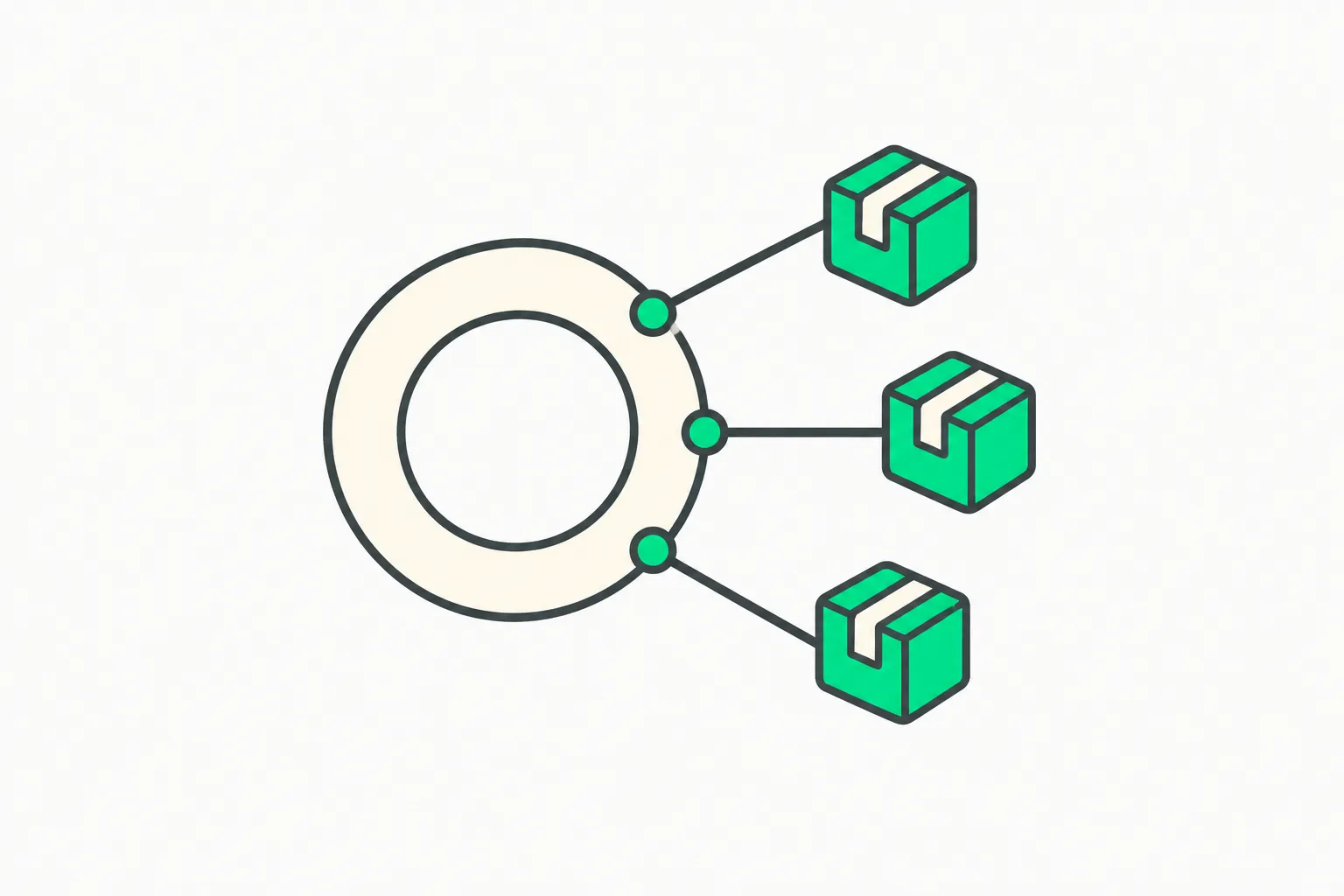 Multi-agent delegation pattern illustrating how social reasoning evals route information between user and assistant roles
How Fuse compares to other assistant evaluations
| Eval style | What it tests | Fuse difference |
|---|---|---|
| MMLU / GPQA | Knowledge | No subjective narratives |
| SimpleBench-style traps | Trick questions | Not social motive inference |
| Red-team absurd claims | Extreme harm | Misses everyday advice |
| Fuse | Motives via user retelling | Verifiable hidden state |
If you already run harm classifiers, Fuse complements them: a reply can pass toxicity filters yet still misread intentions and ruin a client's working relationship.
What this means for frontier labs
Google positions Fuse as an extension of behavioral alignment work—moving from preference matching to social reasoning with empirical labels. That sits next to industry pushes on honesty under user pressure (max Tegmark versus Anthropic alignment narratives) and computer-use agents that must infer UI intent from partial screenshots.
For Gemini roadmap watchers, expect internal regression gates on user-mediated scenarios before major companion releases—especially as Gemini agent compute expands automated experiment volume.
Limitations Google and builders should keep in mind
- Simulated users are not real humans. Concordia agents simplify psychology; external validity still needs staged user studies.
- LLM-as-judge scoring inherits judge-model biases; Google uses it for scale, not courtroom certainty.
- English-centric scenarios may not transfer to every culture's conflict norms.
- Product liability remains with the deployer—open-sourcing Fuse does not certify your fine-tune.
Still, for a field that lacked scalable motive labels, a 21k-example release is a substantial step. Treat it like adopting SWE-bench for coding: not the whole story, but a shared ruler.
Running Fuse in your release pipeline
Product teams can treat Fuse like a regression suite for system prompts and guardrails, not only base-model upgrades.
Stage 1 — smoke slice. Pull a few hundred stratified examples from the static dataset covering each social category Google defines. Run them nightly against your staging endpoint. Log motive accuracy and refusal rate separately so you do not confuse silence with success.
Stage 2 — framing stress. Re-run the same simulations with insecure versus confident user personas when your API supports scenario metadata. Google shows the largest assistant-observer gap under biased framing; if your constitution mentions neutrality but scores do not move, the text is decorative.
Stage 3 — multi-turn probes. Enable the assistant to ask clarifying questions, then measure whether follow-up answers update beliefs or double down. Fuse reports cases where coherence hurts accuracy; your logs should capture the same pattern before users complain on social media.
Stage 4 — human spot checks. Sample failures where the model agreed with a paranoid user and send them to policy or clinical reviewers if you operate in mental health or HR adjacency. Simulations are not therapy clients, but the failure shapes rhyme.
If you are training teams on eval craft, pair this release with hands-on AI workshop modules on agent benchmarks and MCP-hosted tools so operators know where social advice sits in the broader agent risk stack.
Related reading
- DeepMind: agents already run part of Gemini training compute
- OpenAI's staged frontier risk decisions
- Nightwatch and proactive perception for computer-use agents
- Anthropic Messages API Rust migration and verification loops
- ChatGPT break study and everyday dependence
- Anthropic honeypots for agent sandbox escape
- UK FCA agentic payments authorization
Sources: Google Research blog, Nov 25, 2026; arXiv:2609.17496; Concordia GitHub.