



Heavy ChatGPT users who quit AI assistants for two weeks reported feeling less lonely and talking to more people in person — even though most said they used ChatGPT for productivity, not companionship. In AI Deactivation Reduces Loneliness and Increases Social Interaction, Dora Zhao, Grace Wang, Yutong Zhang, Lujain Ibrahim, Robert E. Kraut, and Diyi Yang (Stanford, Oxford, Carnegie Mellon) describe a preregistered randomized trial with N=625 active U.S. ChatGPT users. Two weeks off 30+ blocked AI tools beat a one-day control on loneliness (β=-0.099, p=0.028). Gains on in-person interaction and social support showed up during the pause; loneliness improvements persisted two weeks after participants resumed ChatGPT.
What question the study asks
Most AI wellbeing research focuses on people who deliberately use bots for emotional support. Yet large-scale ChatGPT conversation taxonomies suggest practical guidance, information, and writing dominate traffic — relationship talk is a tiny slice.
This team asks a sharper question: if you remove general-purpose AI from everyday instrumental work, do people reconnect with humans?
That is closer to how enterprise adoption studies frame Cowork and copilot tools: AI as shortcut, not friend.
Study design in plain language
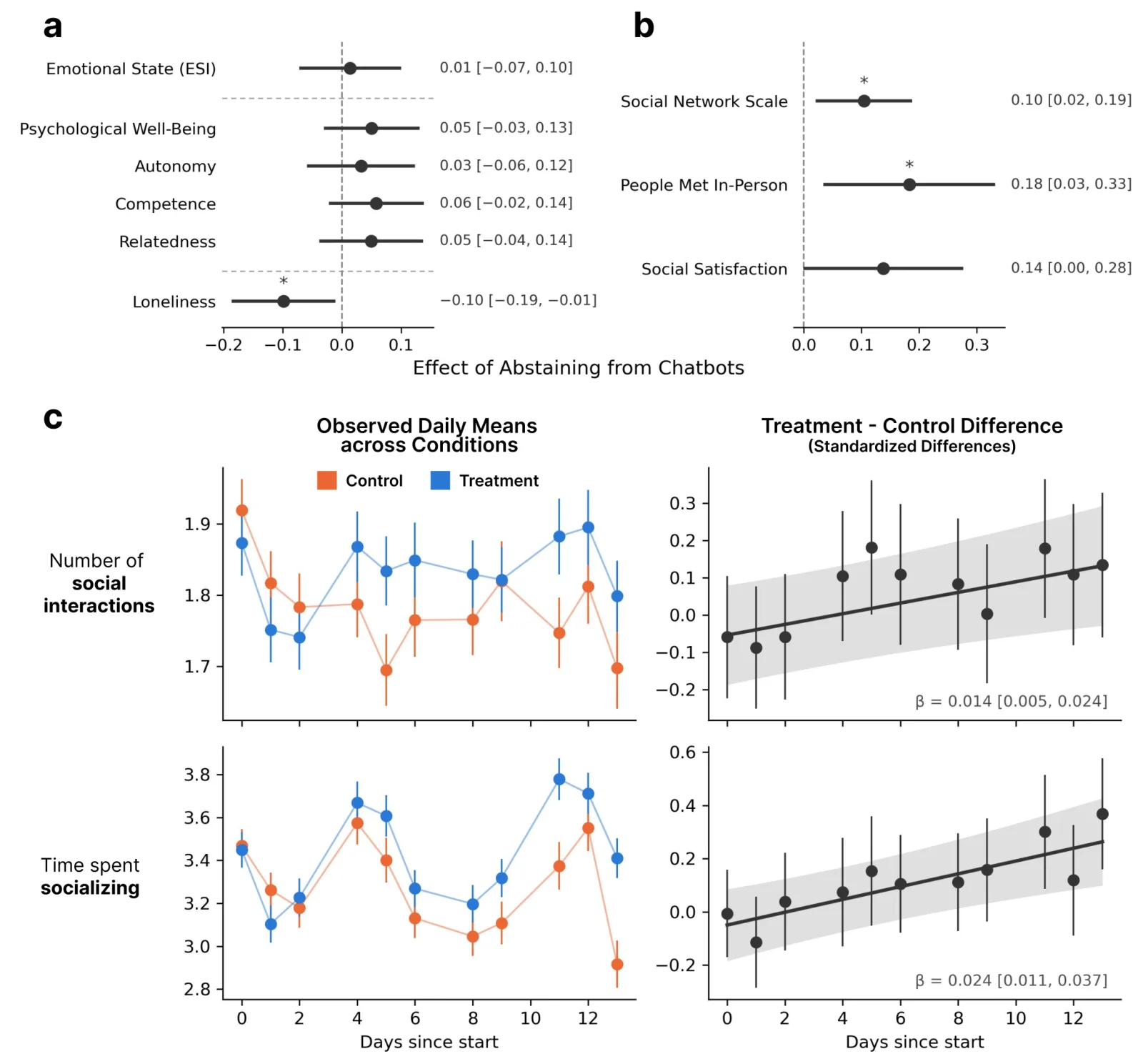 ChatGPT deactivation study chart showing loneliness drop after two-week AI break
Image: Zhao et al., arXiv 2611.25263
| Element | Detail (from paper) |
|---|---|
| Eligibility | ≥15 min/day ChatGPT, account ≥1 month, Chrome, accept $40/week pay to abstain |
| Arms | 14-day deactivation (treatment) vs 1-day deactivation (control) |
| Enforcement | Blocked 30+ AI assistants via study tooling |
| Measures | Five survey waves, daily experience sampling, usage metadata |
| Follow-up | Day 35 post-intervention survey |
The one-day control mirrors prior social-media deactivation randomized trials (the paper cites Allcott et al., 2025) to cut demand effects and differential dropout.
Headline results
Loneliness and social outcomes during the pause
During the two-week intervention:
| Outcome | Treatment vs control change (β, paper) | Significance |
|---|---|---|
| Loneliness | -0.099 | p=0.028 (preregistered directional) |
| Social support | +0.104 | p=0.015, Q=0.037 |
| In-person interactions | +0.183 | p=0.019, Q=0.037 |
| Social satisfaction | +0.137 | p=0.053 (not significant after Q) |
Experience sampling showed treatment participants logged more social interactions per day (β=0.153, p=0.007), with the gap widening over the fortnight.
No broad mood swing, no work collapse
The team did not find significant shifts in general emotional state or overall psychological well-being during the two weeks — consistent with other short-horizon AI wellbeing studies they cite.
Work time did not meaningfully drop. That undercuts a simple story that people only socialized because they stopped working.
After AI came back
Two weeks post-intervention, treatment participants still reported lower loneliness (β=-0.164, p=0.016). Competence and autonomy gains appeared at follow-up, not during the pause — suggesting some psychological effects may need longer to surface.
Open-ended responses, analyzed with LLM topic modeling, describe participants asking humans for help on tasks they would have delegated to ChatGPT and redirecting attention to offline relationships.
How this fits earlier explainx.ai coverage
This paper is causal in a way Gallup's 16-country youth survey is not. Gallup found correlations between AI companionship and loneliness among 15–22-year-olds; authors there stressed association ≠ causation.
The Stanford-led trial instead randomizes abstention among existing power users. That is the right tool when critics ask "does daily ChatGPT displace humans?" without confounding preexisting isolation.
It also complements Dario Amodei's claimed-vs-verified interview narratives about AI and jobs: here, productivity AI nudged social behavior without a measured work-hours crash in 14 days.
What the study does not prove
Readers should keep four limits in mind:
- Self-report — loneliness and social time are participant estimates, not passive sensing.
- Paid abstention — $40/week may attract people willing to comply, not every Plus subscriber.
- Chrome gate — excludes mobile-only or enterprise-locked users.
- Effect size — the loneliness β is modest in standardized units; still statistically significant at p=0.028 in the paper.
"ChatGPT deactivation" searchers often mean account bans or workspace shutdowns — this study is voluntary research abstention, not OpenAI enforcement.
Implications for builders and teams
| Stakeholder | Takeaway |
|---|---|
| Consumer app PMs | Track offline social proxies (invites sent, calls started) if you market productivity AI, not only DAU. |
| HR / IT | A company-wide AI pause is not studied here; do not extrapolate 625 paid volunteers to mandates. |
| Health researchers | Deactivation arms are a template to study instrumental AI without confounding companion personas. |
| Parents / educators | Pair with South Korea CSAT cheating fallout — different harm vector, same theme: AI reshapes daily routines. |
If you run workshops, see explainx's AI agent workshop formats guide for measurement habits that avoid treating chat time as success.
How to read the preprint
Primary source: arXiv:2611.25263 and the HTML version with figures.
Key sections:
- Figure 1 — design and baseline productivity-first usage.
- Figure 2 — treatment effects on loneliness and social outcomes (embedded above).
- Figure 3 — exploratory mediation through social interaction.
- Figure 4 — post-intervention usage and persisting loneliness drop.
Correspondence emails in the PDF: dorothyz@stanford.edu, diyiy@stanford.edu.
Baseline usage: productivity-first, not companion bots
Before anyone turned ChatGPT off, the team characterized how people actually used it:
| Baseline fact (paper) | Why it matters |
|---|---|
| 84.4% named productivity as top use | Loneliness shift is not driven mainly by AI girlfriend personas |
| 52.8% used productivity features daily | Sample is heavy instrumental use |
| 20.2% never used AI for social purposes | A fifth of the panel may have low companion exposure |
| Conversation topics | Practical guidance and information-seeking dominate logged topics |
That profile separates this RCT from companion-app incident posts or romance-bot regulation threads. The mechanism story is displacement: when ChatGPT answers "how do I format this spreadsheet?", you may not ping a coworker or roommate who would have helped before.
Experience sampling: loneliness moved day by day
Survey waves capture weekly-ish moods; daily pings capture social quantity:
- Treatment participants reported more social interactions per day (β=0.153, p=0.007).
- The treatment-minus-control gap widened as the 14 days progressed (β=0.014, p=0.004 on the trend term).
- Time socializing trended up for treatment vs control, though the level difference at endline was not significant at p=0.077.
So the team sees behavior change accumulating, not a single Sunday reset. That pattern fits habit disruption: the first 48 hours without AI may feel like friction; by day ten, help-seeking networks may reboot.
Persistence after ChatGPT returned
The Day 35 follow-up is the surprise for builders who assume effects vanish when the icon returns:
| Follow-up outcome (paper) | Estimate |
|---|---|
| Loneliness vs control | β=-0.164, p=0.016, Q=0.047 |
| Competence | β=0.181, p=0.004 |
| Autonomy | β=0.181, p=0.025 |
Competence and autonomy were not significant during the pause but emerged later. One reading: people needed time after re-learning human help before they felt capable without defaulting to bots. Another reading: small-N follow-up attrition — the paper notes 442 completers on post-survey vs 625 enrolled.
Usage metadata for 172 treatment participants shows messages and sessions remained below pre-study baselines two weeks after the intervention, hinting habit change, not only reported mood.
Mechanism: mediation is suggestive, not definitive
Figure 3 runs exploratory mediation: shifts in time spent socializing and social satisfaction at midline partially align with endline loneliness. The authors do not claim a locked causal chain — mediation with self-report mediators is fragile.
Open-ended LLM topic models add qualitative color: people describe asking friends for tech help, meeting in person, and noticing how often they had outsourced small questions to ChatGPT.
Pair that qualitative layer with Anthropic's enterprise adoption study, which measures how teams embed AI in workflows — this paper measures what happens to offline graphs when workflows lose AI.
What product teams should measure
| Metric today | Metric to add |
|---|---|
| DAU / session length | Human handoffs triggered (Slack, SMS, calls) per 100 tasks |
| Thumbs-up on answers | Repeat human contacts after AI resolution |
| Companion mode retention | Instrumental task share vs relationship share (per Chatterji-style taxonomies) |
If you ship ChatGPT-class integrations, a two-week off switch is unrealistic for customers — but you can run opt-in research panels like this team did, or A/B nudge users toward "ask a teammate" on low-risk tasks.
Policy and parenting: do not overclaim
Headlines will say "ChatGPT causes loneliness." The paper supports a narrower claim: randomized deactivation among paid heavy users reduced self-reported loneliness and raised in-person interaction over 14 days, with some persistence.
It does not:
- Estimate effects for teenagers specifically,
- Study school bans or CSAT cheating crackdowns,
- Prove long-term mental health outcomes.
Regulators crafting kids' chatbot rules should still lean on Meta age-estimation rollouts and platform-specific harm cases, not this adult sample alone.
Second library image: study design
 Longitudinal ChatGPT deactivation study design with control and treatment arms
Image: Library reference — multi-wave survey design resembles the paper's baseline-to-follow-up schedule.