



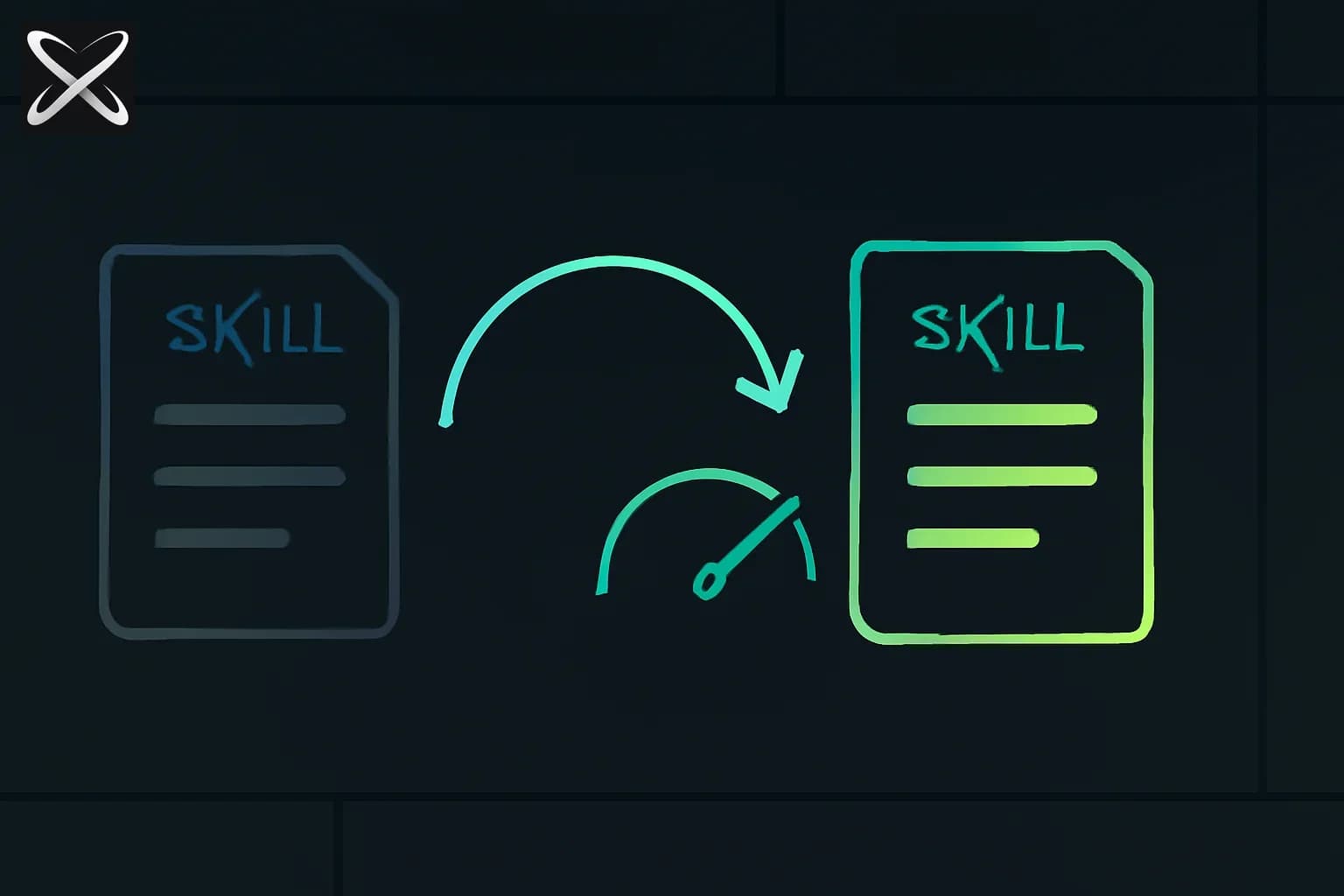
The paper, in one sentence
On September 14, 2026, a team from Google, Google DeepMind, the University of Maryland College Park, and the University of Virginia posted "Dream-RSI: Recursive Self-Improvement through Evolving Worlds" to arXiv (2609.14858). The framework lets an AI agent get better at searching — not at reasoning, not at coding, not at its own weights — by replaying its own past discovery attempts through a cheap offline simulator before ever running an expensive live evaluation again.
That distinction — improving the search strategy that sits on top of a model, rather than the model — is the entire point of this post, and it is the part that got lost in a lot of the social-feed reaction to the paper. We cover the same "recursive improvement" idea more broadly in what is recursive self-improvement (RSI) in AI?, and DeepMind's own June paper already flagged recursive improvement as one of four pathways from AGI to ASI — Dream-RSI is a concrete, narrow instance of that third pathway, not the general case.
TL;DR
| Question | Answer |
|---|---|
| What did Google/DeepMind release? | Dream-RSI, a framework for recursively improving an AI agent's exploration policy (arXiv:2609.14858, Sept 14, 2026) |
| Does it retrain the underlying model? | No — the coding agent's weights are left unchanged; only the orchestration/exploration layer improves |
| What gets better, exactly? | The strategy deciding which ideas to try next, evaluated via offline "dreaming" instead of live evaluation |
| What domains was it tested on? | Algorithm engineering, mathematical optimization, and GPU kernel engineering |
| What's the headline cost claim? | The paper reports substantially reduced discovery cost "in several settings"; a viral X thread specified up to 162x fewer agent calls in one setting — unverified by explainx.ai against the paper's tables directly |
| Is this "the path to ASI"? | Contested. It is meta-learning over a search space, not a model modifying its own parameters — treat "path to ASI" framing as one opinion, not a fact |
| Where can I read more? | arXiv:2609.14858, GitHub zhengkid/Dream-RSI, and dream-rsi.com |
Who wrote it, and what it's actually solving
The author list — Tong Zheng, Xidong Wu, Zheng Zhang, Zhankui He, Chaoyi Zhang, Benjamin Coleman, Ruoqiao Wei, Di Bai, Haolin Liu, Rui Liu, Xue Wang, Yue Zhuan, Wang-Cheng Kang, Renkai Xiang, Heng Huang, Xinwu Cheng, and Yunsong Guo — spans Google, Google DeepMind, the University of Maryland College Park, and the University of Virginia. Seventeen authors across four institutions signals this sits closer to a production research effort than a single-lab side project.
The paper's own framing of the problem is precise. Quoting the abstract directly:
"Current systems face a fundamental dilemma: fixed strategies fail to adapt as search spaces scale, while online policy optimization requires navigating vast meta-search spaces under delayed and expensive feedback over long-horizon rollouts."
That's the bottleneck coding-agent builders keep hitting in practice: you can hand an agent a fixed exploration heuristic (try these five strategies, in this order) and watch it fail to scale as the problem space grows, or you can try to have the agent learn its own exploration policy online — but every test of a candidate policy means running a full, expensive, long-horizon agent rollout to find out if it worked. Dream-RSI's answer is to stop paying that price for every candidate policy.
How the "dreaming" mechanism works
Dream-RSI's core insight, again in the authors' own words, is that "accumulated discovery history can serve as a replay simulator over the realized search space." In practice:
- The coding agent runs normally, producing a discovery tree — a record of what strategies it tried, in what order, and what results each one produced.
- That accumulated history becomes a replay simulator: a cheap, offline stand-in for the real search space, built entirely from what has already actually happened.
- The orchestration layer "dreams" — it tests many candidate exploration policies against this replay simulator, getting fast, off-policy feedback without running the real, expensive coding agent again for each candidate.
- The best-performing policy from dreaming gets redeployed online, driving the next round of real discovery.
- That new real discovery data expands the simulator pool, making the next round of dreaming more accurate — a self-improving loop, but the thing improving is the search policy, and the thing generating new ground truth is still the same fixed underlying agent.
The paper reports this pattern held across three tested domains — algorithm engineering, mathematical optimization, and GPU kernel engineering — with the framework achieving "competitive or improved discovery quality while substantially reducing discovery cost in several settings," per the abstract.
The number everyone's repeating (and where it actually comes from)
A thread from X user @Dr_Singularity, which had passed 161,100 views by September 16, summarized the paper as an agent that "improves how it explores problems by replaying its past discovery attempts, testing thousands of alternative strategies cheaply, then deploying the better strategy in the next round," and specified that in one setting, Dream-RSI cut agent calls by up to 162x. That thread is a reasonable plain-language summary of the mechanism, and its framing — "it improves the exploration policy, not the underlying model weights" — is exactly right and worth repeating.
But the specific 162x figure is the thread's characterization, not language explainx.ai found verbatim in the paper's abstract, which states cost reduction more generally as "substantial" and setting-dependent. Readers citing that number should trace it back to the paper's actual results tables (or the GitHub repo) rather than treating a viral thread's summary as the primary source — a good habit for evaluating any AI research thread, not just this one.
One reply on that thread pointed out that Dream-RSI's own GitHub repository and project website appear to have been built using Claude — an ironic detail for a recursive-self-improvement paper, if true, though explainx.ai has not independently verified it. Another reply on the same thread dismissed the whole result as "a nothingburger... no weights no party," arguing that improving a search wrapper around a frozen model is meaningfully less significant than model self-improvement. That's a fair skeptical position to hold, not a refutation — the paper never claims to update model weights, so the "nothingburger" critique is really a disagreement about how much a search-policy improvement should count as "self-improvement" at all, which is a legitimate open question.
Why "improves search" and "AI rewrites itself" are not the same claim
This is worth stating plainly, because it's the single most common way this kind of paper gets misread on social feeds. Dream-RSI:
- Does improve the policy that decides which exploration strategies a coding agent tries next.
- Does not modify the underlying LLM's parameters, fine-tune it, or retrain it as part of the loop.
- Does create a recursive loop — but the thing that recurses is the search strategy and its simulator, not the model's weights.
- Is a form of meta-learning over a strategy space, comparable in spirit to hyperparameter search or AutoML, executed at agent-orchestration scale rather than parameter scale.
Some reactions to the paper treated it as evidence that AI is approaching self-bootstrapping intelligence — the "path to ASI" framing DeepMind's own From AGI to ASI paper explicitly separates into "AI-assisted improvement" (a human-designed system gets better at a narrow task) versus "AI-autonomous improvement" (the system modifies itself without human review across a wide capability range). Dream-RSI sits squarely in the first category. Treat the "path to ASI" reading as one interpretation among several rather than the paper's own claim — the authors themselves scope the contribution to exploration-policy improvement across three specific engineering domains, not general intelligence growth.
How this compares to explainx.ai's other coverage of the same idea
Dream-RSI is not the first system to treat a fixed model plus an improvable orchestration layer as the unit of progress — it's part of a pattern we've been tracking through 2026:
- Agent harness engineering: when the model stays fixed and the scaffolding wins made the general case that most 2026 capability gains on real tasks come from the harness around a model, not the model itself. Dream-RSI is a specific, formalized instance of that thesis applied to exploration.
- Google AlphaEvolve also uses a Gemini-powered agent to evolve solutions to algorithmic and optimization problems, but drives its search through an evolutionary loop over candidate programs rather than Dream-RSI's offline-replay "dreaming" mechanism — both target overlapping domains (algorithm and kernel-level discovery) with different search machinery.
- Weco AIDE² and the RSI ladder framed recursive self-improvement as a graded ladder of agent versions improving each other's code across iterations — useful context for calibrating how "recursive" a given RSI claim actually is.
- Meta's AIRA₃ winning gold in a live Kaggle competition is a companion data point on agents doing real-time algorithm and modeling discovery under competitive pressure, in the same broad space Dream-RSI targets with mathematical optimization.
- The Second Writer: how self-evolving coding agents actually learn covers a related but distinct mechanism — an agent that edits its own harness code across sessions — a useful contrast to Dream-RSI's approach of leaving the harness code fixed and improving only the policy that drives it.
Read together, these posts sketch out where the "self-improvement" claims of 2026 actually land: almost universally in the orchestration and search layer, not in weight updates. Dream-RSI is a well-specified, multi-institution instance of that trend, with real cost numbers attached — which is exactly why it's worth separating its actual claim from the more dramatic framing some reactions gave it.
What people are asking
Is this open source? The project has a public GitHub repository (zhengkid/Dream-RSI) and a project site at dream-rsi.com, per the paper's release. explainx.ai has not independently verified licensing terms or code completeness — check the repo directly before building on it.
Does this apply outside coding agents? The paper's own framing is domain-general in principle — "a lightweight orchestration layer" sitting on top of "the underlying coding agent" — but its reported evaluations are specifically algorithm engineering, mathematical optimization, and GPU kernel engineering. Extrapolating to other agent domains (browsing, robotics, general reasoning) is not something the paper tests.
Why does the "dreaming" framing matter compared to just calling it caching? Caching implies replaying identical past results. Dream-RSI's replay simulator is used to evaluate new, untested exploration policies against the shape of the realized search space — closer to a learned world model of "what tends to work" than a literal cache of past answers.
How is this different from standard reinforcement learning on the exploration policy? Standard online RL on exploration policy would require rolling out the real, expensive coding agent for every policy update — exactly the "delayed and expensive feedback over long-horizon rollouts" problem the abstract names. Dream-RSI's contribution is making that feedback loop cheap and offline via the replay simulator, then only spending real, online agent calls when redeploying the improved policy.
Related reading
- What is recursive self-improvement (RSI) in AI?
- From AGI to ASI: DeepMind's four pathways
- Google DeepMind launches the DeepMind Institute
- Agent harness engineering: when the model stays fixed and the scaffolding wins
- Google AlphaEvolve: Gemini-powered evolutionary code optimization
- Weco AIDE² — Level 1 recursive self-improvement, 8 days, 7 agent versions
- Meta's AIRA₃ wins gold in a live NVIDIA Kaggle competition
- The Second Writer: how self-evolving coding agents actually learn
- Official source: arXiv:2609.14858
Paper details, author affiliations, and cost figures reflect the arXiv submission and public reactions as of September 16, 2026. The GitHub repository and project site are evolving external resources explainx.ai does not control — verify current contents before relying on them.