



On September 17, 2026, Z.ai published an account of using GLM-5.3 to build and optimize the inference infrastructure that now serves GLM-5.3-Flash. The numbers are striking: a production inference service built from scratch on a cluster of more than 100,000 Chinese-made AI accelerators, from first successful run to production readiness in under two weeks, with end-to-end throughput reaching 3.22x the initial baseline.
The framing is recursive self-improvement. The headline writes itself, and Z.ai leaned into it: "our successors are the AI systems we are creating ourselves."
Ignore that for a moment. The genuinely valuable part of the post is a precise, unglamorous engineering argument about why coding agents fail at systems work, and what to give them instead. One of the sharper replies to the announcement put it well: this pulls recursive self-improvement back to engineering reality.
TL;DR
| Question | Answer |
|---|---|
| What was built? | Production inference service for GLM-5.3-Flash, from scratch |
| On what hardware? | 100,000+ Chinese-made AI accelerators |
| How long? | 13 days, first successful run to production ready |
| Throughput gain | 3.22x end-to-end vs baseline, over 13 days |
| Who did the work? | Engineers plus an "Infra Agent" powered by GLM-5.3 |
| Is it RSI? | No. Z.ai states plainly they have not reached it |
| The transferable idea | Dense feedback: local, cheap, objectively verifiable |
| Upstream contribution | Flash Linear Attention PR #1180 |
The 13-day trajectory, day by day
Z.ai published the full optimization curve, and it is more informative than the summary number. The run took 13 days from baseline to launch and ended at 3.22x, not a vague "about 3x".
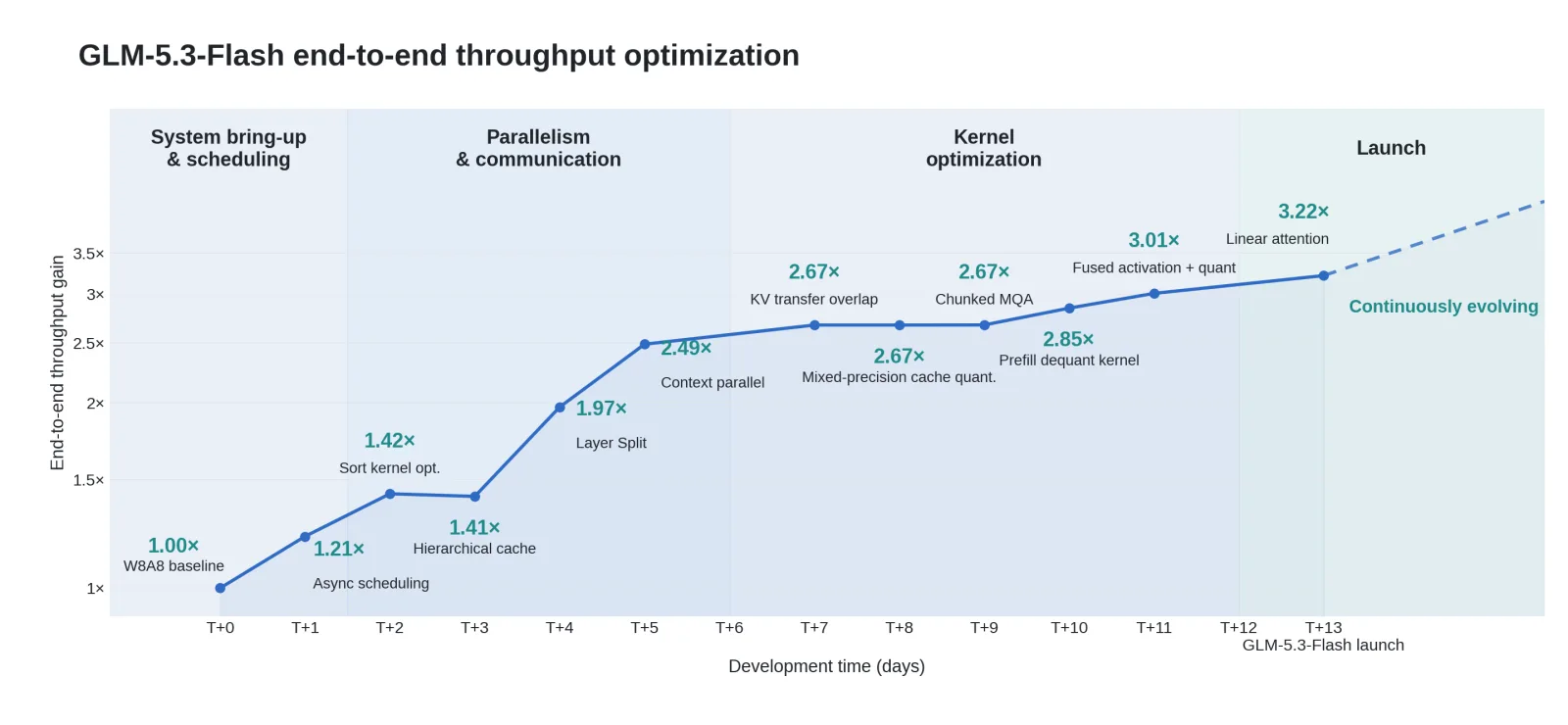 GLM-5.3-Flash end-to-end throughput optimization chart showing cumulative gain rising from a 1.00x W8A8 baseline at T+0 to 3.22x at the T+13 launch across four phases
Figure from Z.ai's research post.
| Day | Cumulative gain | Change | Phase |
|---|---|---|---|
| T+0 | 1.00x | W8A8 baseline | System bring-up and scheduling |
| T+1 | 1.21x | Async scheduling | System bring-up and scheduling |
| T+2 | 1.42x | Sort kernel optimization | Parallelism and communication |
| T+3 | 1.41x | Hierarchical cache | Parallelism and communication |
| T+4 | 1.97x | Layer Split | Parallelism and communication |
| T+5 | 2.49x | Context parallel | Parallelism and communication |
| T+7 | 2.67x | KV transfer overlap | Kernel optimization |
| T+8 | 2.67x | Mixed-precision cache quantization | Kernel optimization |
| T+9 | 2.67x | Chunked MQA | Kernel optimization |
| T+10 | 2.85x | Prefill dequant kernel | Kernel optimization |
| T+11 | 3.01x | Fused activation + quantization | Kernel optimization |
| T+13 | 3.22x | Linear attention | Launch |
Three things stand out that the prose does not tell you.
The big wins came from parallelism, not kernels. Layer Split and Context parallel together took the system from 1.41x to 2.49x in two days, more than half the total gain. The kernel optimization phase, which occupies the most days and most of the article's technical detail, moved it from 2.49x to 3.01x.
T+3 went backwards. Hierarchical cache took it from 1.42x to 1.41x. A published curve that includes a regression is a small but real credibility signal.
There is a three-day plateau at 2.67x. T+7, T+8 and T+9 each landed a named optimization and none moved the headline number. This is the part most likely to be misread as failure. Those days delivered KV transfer overlap, mixed-precision cache quantization and chunked MQA, all of which were prerequisites for the gains that followed, but a manager watching only end-to-end throughput would have seen three wasted days. That is the same attribution problem the agent faces, one level up.
The problem: agents are blind in complex systems
Here is the observation worth the whole article. An agent changes something in an inference stack and gets back one of these:
- "Numerical accuracy test failed"
- "TTFT increased by 30%"
- "Output throughput dropped by 20%"
Every one of those is true, and none of them is actionable. As Z.ai puts it, end-to-end metrics "can tell an agent that results got worse, but they cannot explain why."
The reason is that in an inference system, a regression can originate in kernel implementations, parallelism strategies, communication behaviour, memory management, or serving orchestration, and these interact dynamically at runtime. A codebase gives the agent only static context. It can read every line and still not know which of five layers just broke.
Experienced human engineers close this gap with intuition and tool-hopping: a load test result suggests what to profile, profiling suggests which kernel to inspect, and so on. That chain lives in the engineer's head, not in the repository. An agent cannot inherit it.
So the question Z.ai posed is not "how do we make the model better at code." It is: how do we turn sparse end-to-end results into fine-grained, attributable feedback that directly guides the next action?
What "dense" actually means
The term is easy to misread. Z.ai is explicit that dense feedback does not mean shoving more logs into context. It means feedback with three properties.
1. Local. Tied to a specific engine launch parameter, code change, kernel, input condition, thread, execution interval, or code path. Their example is precise: instead of reporting that "model accuracy dropped after a fusion optimization," identify the output differences for a specific request before and after the change. That gives the agent something to build a minimal reproduction from.
2. Cheap and timely. Whenever the agent forms a hypothesis, it should have a proportionate way to test it. A question answerable by a kernel test or local microbenchmark should not require a full service deployment and end-to-end load test. Shorter validation cycles mean less effort burned on wrong hypotheses.
3. Objectively verifiable. Correctness and performance judgements come from reference implementations, test results, and comparable experimental metrics. Runtime signals can suggest causes, but correlation between observations does not establish root cause. Controlled experiments still have to confirm it.
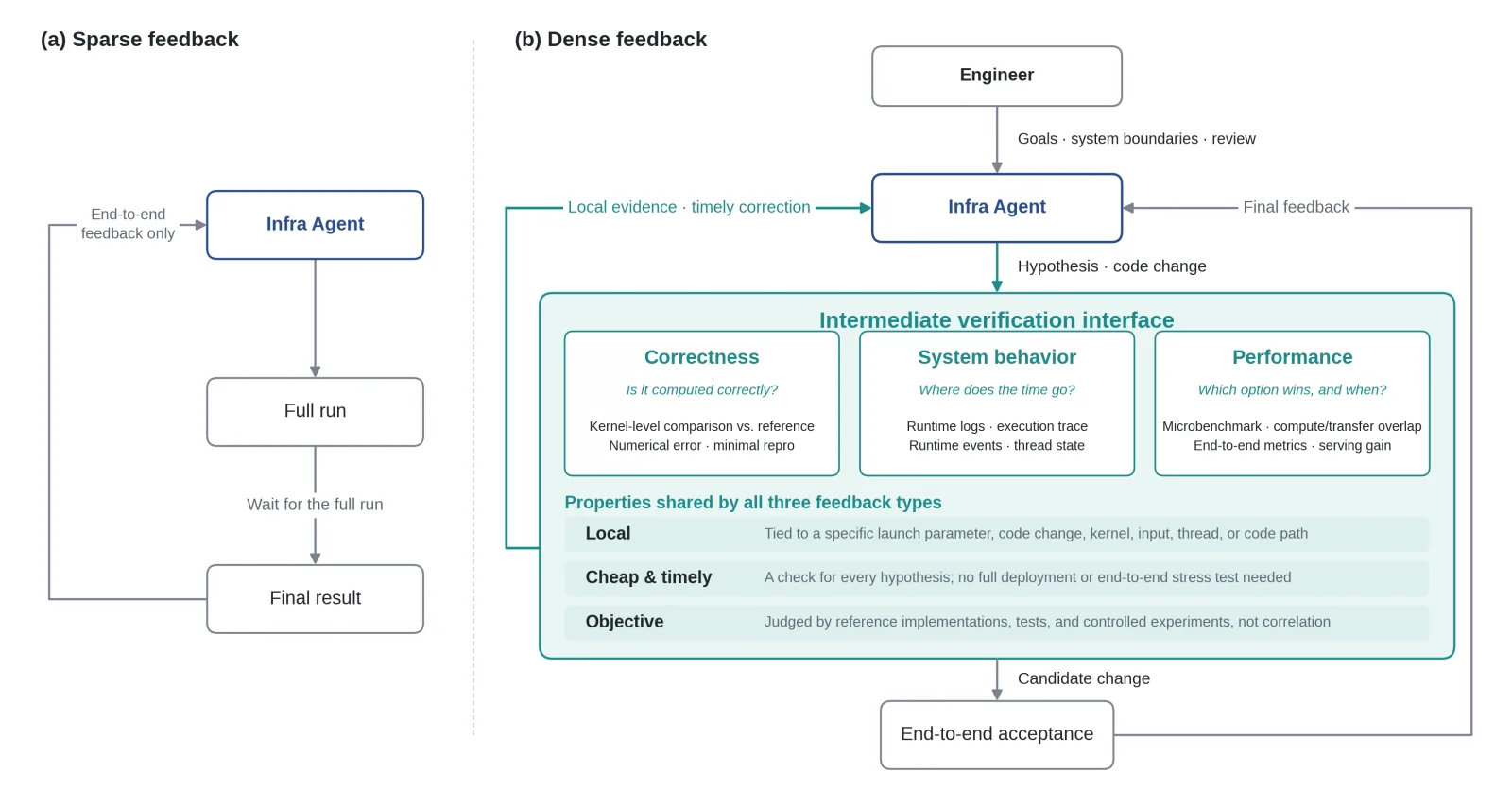 Diagram contrasting sparse feedback, where the agent only sees a final result after a full run, with dense feedback, where an intermediate verification interface returns correctness, system behavior and performance evidence
Figure from Z.ai's research post: sparse feedback (left) versus the dense-feedback loop (right).
The left half of that diagram is what most agent setups actually look like: change something, wait for a full run, get one number back. The right half adds an intermediate verification interface between the agent and end-to-end acceptance, and that interface is the entire contribution.
Mapped to the three questions an agent needs answered:
| Feedback type | Question it answers |
|---|---|
| Correctness | Is the computation correct? |
| System behaviour | Where is the time going? |
| Performance | Which approach works better, and under what conditions? |
This is recognisably the same discipline as loop engineering for coding agents: the quality of an agent loop is set by the quality of its stop conditions and its signal, not by the eloquence of the prompt.
Three cases, three kinds of feedback
What makes the Z.ai post credible is that it names specific bugs rather than gesturing at capability.
Correctness: a TF32 precision bug hiding in parallelism
The agent was given a mapping from the engine's parallelism strategies to kernel implementations, which converted deployment configurations into individually verifiable kernel-level tasks. It then compared numerical results across partitioned and unpartitioned execution paths.
That comparison surfaced an accuracy issue in the KDA kernel's Context Parallelism path. The cause: tl.dot defaulted to TF32 computation for performance even when its inputs were FP32. Error accumulated through state transformation merging and state updates, and got worse with long contexts, which matters a great deal when you are shipping a 1M-token context window.
The fix was to set input_precision="tf32x3", combining three TF32 Tensor Core operations for higher precision while keeping most of the Tensor Core speed advantage. It has been merged upstream into Flash Linear Attention as PR #1180.
Note what made this findable: testing a kernel only in its unpartitioned form would never have caught it. The bug lived in the interaction between the parallelism strategy and the kernel, which is exactly the class of bug that end-to-end metrics turn into an unattributable "accuracy dropped."
System behaviour: a Python GIL blocking a GPU pipeline
Engineers defined test scenarios (Prefill alone, Prefill + KV Transfer, Decode alone) and set an acceptance criterion: under the same workload, Prefill + KV Transfer should be within 5% of the Prefill-only baseline.
The agent measured over 20%. That constraint is what turned a vague "slower than we want" into a bounded investigation, and the timeline view narrowed it further: Python-side KV Transfer execution never overlapped with DeepEP dispatch and combine intervals.
The root cause is a genuinely good bug. In DeepEP v1.2.1, intranode_dispatch and intranode_combine did not explicitly release the Python GIL. Entering C++ does not release it automatically. While those calls held the lock, the Mooncake Transfer thread in the same process could not acquire the GIL to schedule transfers, so KV Transfer could not overlap with computation. The underlying transfer mechanism supported async execution perfectly well; submission was blocked a layer above.
The confirming evidence was sitting in the same codebase: internode_dispatch already released the GIL, with a comment explaining it was to avoid blocking KV Transfer in other threads.
After releasing the GIL over the relevant intervals, the gap fell below 1%.
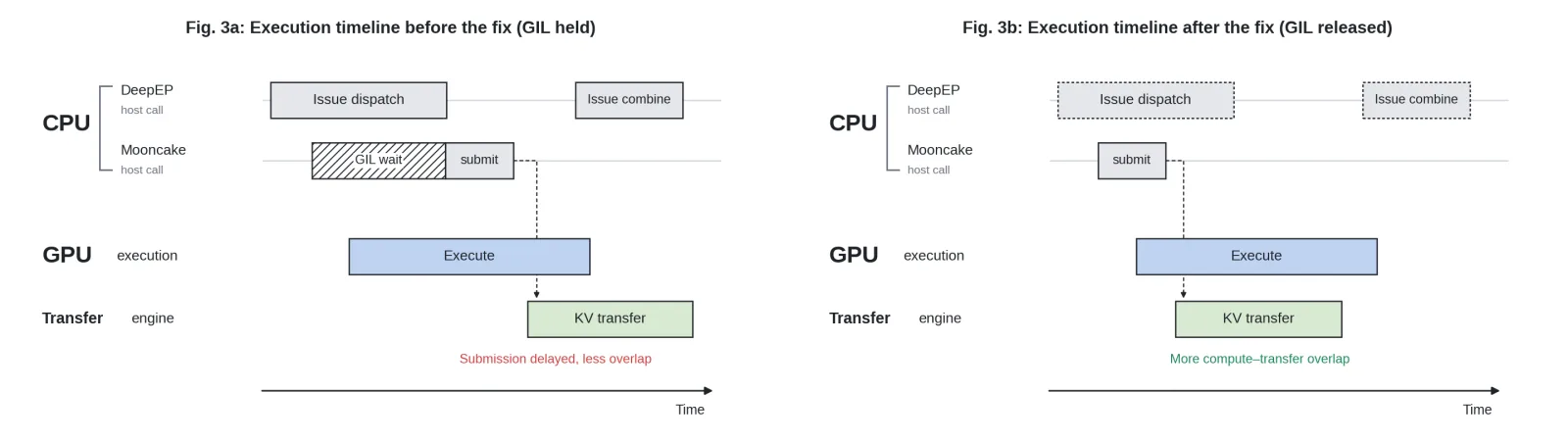 Diagram showing how the KV Transfer concurrency bottleneck was discovered and fixed, from the failed performance constraint through timeline analysis to the GIL release
Figure from Z.ai's research post.
This is a Python concurrency bug throttling a hundred-thousand-accelerator cluster. No aggregate throughput number would ever have pointed at it.
Performance: removing work rather than adding parallelism
The third case is about kernel optimization, and it contains the most counterintuitive result.
Z.ai had the agent study handwritten kernels from projects such as SGLang, Flash Linear Attention and DeepGEMM, and distill techniques into reusable "optimization skeletons" carrying applicability conditions, transformation methods, resource constraints, and validation evidence. For a new kernel, the agent starts from a skeleton, then re-evaluates tiling, memory access and resource allocation with profiling and layered testing. Validated changes flow back into the skeleton library.
On a representative KDA Decode kernel: introducing ReplaySSM to trade compute for memory first made the kernel slower (v0 to v1). A division optimization then cut 9.6%. Then, told computation was the bottleneck, the agent found the original implementation tiled along the V dimension, repeating the same FP32 normalization and gating computations four times. It merged the tiles into a single thread block, kept shared intermediates register-resident, and replaced redundant per-tile work with a single warp-level reduction, sacrificing some parallelism for a 1.71x speedup.
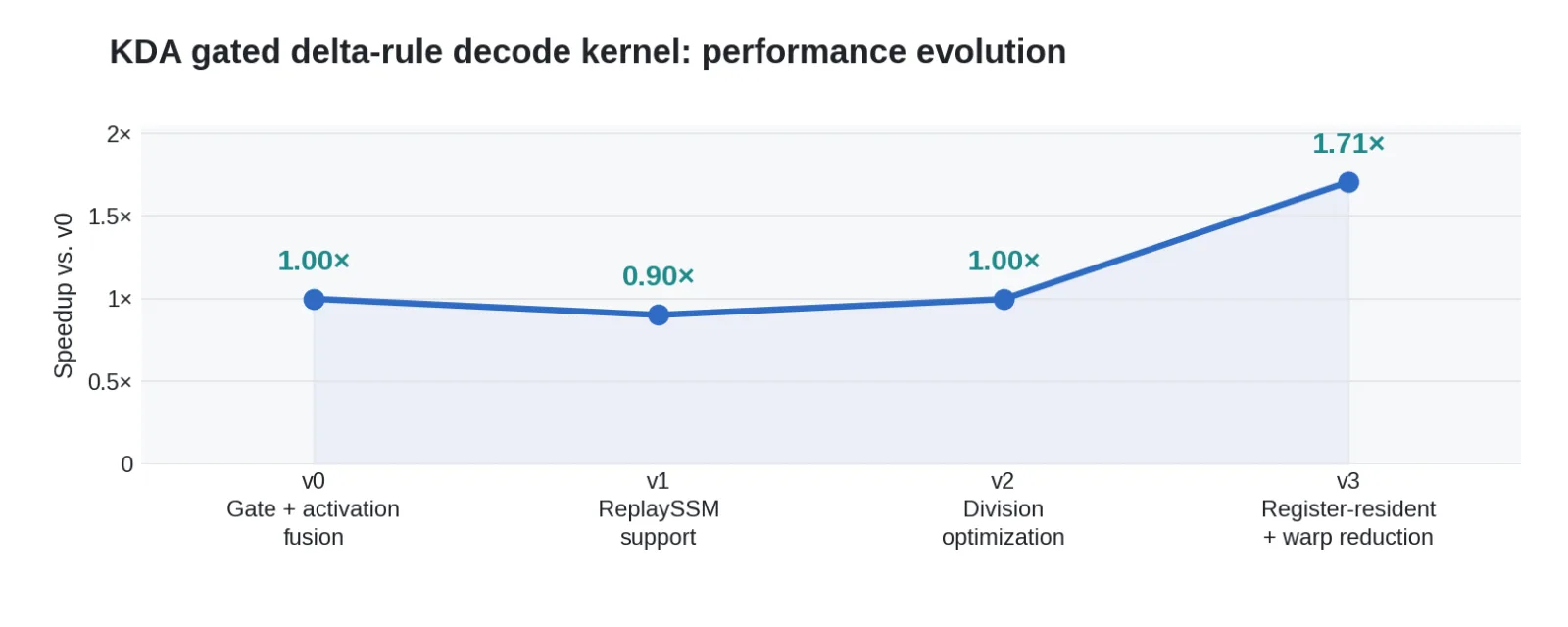 Chart of a representative KDA Decode kernel's performance evolution from baseline implementation through ReplaySSM, division optimization and tile merging to the production version
Figure from Z.ai's research post.
Deliberately reducing parallelism to eliminate redundant computation is not the move a naive optimizer makes. It requires knowing that compute, not occupancy, is the binding constraint, which is exactly what layered feedback told it.
There is also a warning here about local optimization. Giving a compute kernel more resources can shorten its own execution time while starving the KV Transfer kernel and slowing the whole pipeline. Kernel latency in isolation is the wrong objective.
The stack, for completeness
The optimizations behind the ~3x: intra-node tensor parallelism for linear attention and the LM Head, ReplaySSM, W8A8 quantization, mixed-precision cache quantization using INT8/FP8/BF16, Layer Split, and an Encode-Prefill-Decode (EPD) disaggregated architecture. Z.ai reports hardware utilization efficiency and per-token cost reaching levels comparable to mainstream NVIDIA GPUs.
Context for the constraints: relatively limited chip memory capacity and bandwidth, a new model architecture, a 1M-token context window, multimodal requests, an immature ecosystem, and incomplete kernel support where "much of what should have been documented had to be guessed."
The demand side is not hypothetical either. GLM-5.3-Flash was tested anonymously as Ox-Alpha on OpenCode and OpenRouter, and within a week of launch became the most-used model on both, processing more than 62 trillion tokens in six days. We covered what Ox-Alpha turned out to be and the official GLM-5.3-Flash launch when the stealth test ended.
On the recursive self-improvement framing
Z.ai deserves credit for not overclaiming, and it is worth quoting them against their own headline: "we have not yet reached recursive self-improvement. Choosing objectives, setting boundaries, and assessing risk remain human responsibilities. We believe humans should continue to hold that line for a long time to come."
The division of labour they describe is specific. Engineers define optimization objectives and system constraints, build the feedback environment, and review critical changes involving system architecture, asynchronous concurrency and production risk. The agent proposes hypotheses, implements changes, runs experiments, and uses feedback to retain, revise or reject its approach.
That is a strong result and it is not a self-improvement loop. Every genuinely hard judgement call in the list stayed with humans.
Two things also deserve scepticism. First, these are self-reported numbers from the vendor about its own model, with no independent reproduction, and "3x versus initial baseline" depends entirely on how bad the initial baseline was. A first successful run on unfamiliar hardware with incomplete kernel support is a low bar to triple. Second, the post is marketing as well as research, published alongside links to Z.ai's coding plan. Neither point makes the engineering wrong, and the named bugs with an upstream PR are more verifiable than most vendor claims, but a healthy discount applies. Our guide to reading AI benchmarks covers the general pattern.
One commenter asked the sharpest follow-up question: what happens on the second round, when the system optimizes what it just changed? Consecutive rounds would say much more about self-improvement than a single 3x. Z.ai has not published that.
What to actually take from this
If you build with agents on anything more complex than a single file, the transferable lesson is that your feedback environment is the bottleneck, not the model.
Practical translations:
- Audit what your agent gets back after a change. If your test suite says "47 tests failed" with no attribution, you have sparse feedback. If a failure names the input, the expected value and the actual value, you have local feedback.
- Build cheap intermediate checks. If verifying a hypothesis requires a full build and deploy, the agent will guess instead of test. A fast unit-level path is worth more than a smarter model.
- Define acceptance criteria numerically and up front. Z.ai's "within 5% of baseline" is what converted a vague slowdown into a bounded investigation. Without it there is no discrepancy to chase.
- Keep humans on objectives, boundaries and risk. That is where the leverage stays, and it is where Z.ai kept theirs.
- Let validated techniques accumulate. The optimization skeleton library is the compounding part: every deployment lowers the engineering cost of the next.
The last one matters most. Anyone can prompt an agent to optimize a kernel. Building an environment where the agent's successes become reusable assets is the part that gets cheaper over time. That is the same structural insight behind dynamic workflows and ultracode in Claude Code: the durable value is the orchestration you save and rerun, not any single run.
Related on explainx.ai
- GLM-5.3-Flash official launch — the model this infrastructure serves
- Ox-Alpha: what we know about the mystery model — the stealth test that preceded it
- OpenRouter's Ox-Alpha stealth model — where the 62 trillion tokens were served
- GLM-5.3 on CyberGym: 84.5 independently validated — the security capability Z.ai references as its earlier surprise
- GLM-5.3 Max vs Gemini 3.7 Flash — where the family sits on coding
- Unsloth's 3-bit GLM-5.3-Flash quantization — running it on your own hardware
- Loop engineering for coding agents — feedback loops as the unit of agent design
- Ultracode and dynamic workflows — orchestration you can save and rerun
- How to read AI benchmarks — discounting vendor-reported numbers
All figures, quotes and technical details come from Z.ai's own research post published September 17, 2026, and are self-reported by the vendor. The Flash Linear Attention fix (PR #1180) is independently checkable; the throughput, token and cluster figures are not. Kernel details and version numbers reflect that publication date.