




October 12, 2026 — A headline circulating today says US regulators blocked a proposal that would have let utilities disconnect AI data centers during grid emergencies. The part you can verify: on October 9, 2026, the Federal Energy Regulatory Commission (FERC) rejected most of PJM Interconnection's large-load plan, including a service under which new data centers could connect to the grid sooner in exchange for being curtailed before other customers. A separate, anonymously sourced report says Entergy warned Amazon that its Mississippi data centers could be cut off, and that AWS responded with a system called Project Falcon.
This post separates the three threads, confirmed order, reported warning, and viral summary, and explains what it means for anyone who depends on cloud AI capacity. For the wider fight over siting and cost, see our coverage of the Senate probe into hyperscaler data center costs and the New York moratorium debate.
TL;DR: claimed versus verified
| Question | Answer |
|---|---|
| Did FERC act? | Yes. Order issued Friday, October 9, 2026, per Utility Dive |
| What did it reject? | Most of PJM's large-load package, including the Interim Resource Adequacy Service (IRAS) and "bring your own new capacity" rules |
| What did it keep? | PJM's definition of a large load and a large-load registry |
| Was a "petition" dismissed? | We found no FERC document matching that wording; the verified action is the PJM order |
| Did Entergy warn Amazon? | Reported by The Information via anonymous sources; not confirmed on the record |
| What is Project Falcon? | Reportedly an AWS automation that moves data centers to backup power on a utility signal |
| What happens next? | PJM is reviewing; FERC urged states to lead on who gets curtailed |
What FERC actually decided
According to Utility Dive's report on the order, FERC rejected the core of PJM's proposal for connecting data centers and other large loads. The centerpiece was IRAS. Under it, a large load could connect without first lining up matching new capacity, as long as it agreed to be curtailed ahead of other pre-emergency demand response.
FERC's reasoning, as reported, is jurisdictional. It said several IRAS provisions "appear to place obligations directly on eligible new large loads," which are mostly retail customers, that other provisions appear to dictate which retail customers would be curtailed, and that the compensation framework "appears to establish a retail rate." FERC found IRAS intrudes on state authority over retail rates and appears to discriminate against large loads.
Two pieces survived: PJM's definition of a large load and a registry that would track each facility's location, ramp schedule, capacity supply and other details. The ruling came about five weeks after FERC rejected key parts of PJM's backstop procurement auction proposal, per the same report.
Why the viral summary is not quite right
The summary spreading on social media describes federal officials "dismissing a petition" that would have let providers disconnect AI hubs at peak stress. We searched for a matching FERC order and found none described that way. The closest verified event is the PJM order above. It is reasonable to read the viral line as a loose description of that ruling, but the precise legal framing, a petition dismissed, is not supported by what we could check. If you cite this, cite the order and Utility Dive, not the headline.
This matters because the practical meaning differs. A rejected curtail-first service is not a ban on curtailing data centers. It is a ruling about who has authority to set the rules and how the deal was structured.
What Commissioner Rosner said
Utility Dive reports that Commissioner David Rosner issued a concurring statement. He said non-critical data centers should be shut off before ordinary customers such as homes, hospitals and schools in a grid emergency, but that states should set curtailment priorities, and that curtailment should happen only when necessary for reliability and after voluntary demand response is exhausted. He also warned that excluding IRAS loads from PJM's capacity auction demand curve could distort the market, signaling surplus capacity while the region sheds demand involuntarily, which he called "economically inefficient."
PJM spokesman Jeffrey Shields said PJM is reviewing the order and wants to meet FERC's requirements while respecting state responsibilities and protecting existing customers from unfair cost or reliability burdens. Jefferies analysts said the ruling could keep capacity prices high for longer, and that a minimally revised proposal could return, likely driven by states such as Ohio and Pennsylvania.
 Power meter with a green needle, illustrating data center curtailment and grid strain after the FERC PJM ruling
The Entergy and Amazon report
The second thread comes from reporting by The Information, whose article on how Amazon rewired its data centers after a Mississippi power warning is paywalled. Secondary summaries of it say that, according to people familiar with the matter, Entergy told Amazon its Mississippi data centers could be taken off the public grid during peak demand, and that AWS then overhauled an automated system, called Project Falcon, so a utility can switch facilities to backup power without calling AWS first.
We could not read the original, and we found no on-the-record statement from Entergy or Amazon. Several outlets repeat the same single report, so the number of independent sources is small. Dates also differ across summaries, with one aggregator tying the news to October 9 and others describing the warning as earlier in 2026. Treat the warning and Project Falcon as reported, not confirmed.
There is public context that makes the account plausible. Entergy Mississippi's CEO told Mississippi Today in 2025 that during a capacity shortfall the data centers would be curtailed and would probably run their backup generators, though such periods are usually brief. That is the same operating idea Project Falcon is said to automate.
What people are asking
Why would a data center accept being curtailed? Because waiting for new generation and transmission can take years. A curtail-first deal trades reliability for speed: connect now, accept that you may be switched to backup power or shut down when the grid is tight. That is the bargain IRAS tried to formalize for PJM, which spans the region where much US data center demand is concentrated.
Who decides who goes dark first? This is the crux of the FERC order. Wholesale grid operators and FERC deal with wholesale markets, while states regulate retail customers and rates. By choosing which retail customers are cut and setting a compensation scheme, PJM's plan strayed into state territory, as FERC reads it. That is why the commission pushed the question back toward states rather than saying data centers can never be curtailed.
Does this raise my cloud bill? Nothing in the order sets a cloud price. Analysts quoted by Utility Dive expect capacity prices to stay elevated longer, which feeds into what utilities and data center operators pay for power. Whether that reaches customers depends on each provider's contracts, so treat it as a cost pressure, not a price change.
Is Project Falcon an admission that the grid cannot cope? We would not read it that way. Switching to backup power on a utility signal is a standard demand-response idea. The notable part, if the report is accurate, is that the largest cloud operators are now automating it because utilities are asking.
Why this matters for AI builders
AI demand is colliding with a grid that was not built for 24/7 loads of this size. Three consequences follow for people who build on cloud AI:
- Siting is now a reliability variable. Where a provider runs your workload affects how exposed it is to grid events. Our look at Amazon's data center NDA change shows how local opposition and utility terms are reshaping where capacity gets built.
- Backup power becomes part of the product. Automation like the reported Project Falcon, plus batteries and on-site generation, is how operators hedge. Nvidia's open designs for grid-resilient AI factories point the same way.
- Power is the real bottleneck. The scale of the constraint is visible in Elon Musk's 15 GW compute claim and in the China versus US gigawatt comparison.
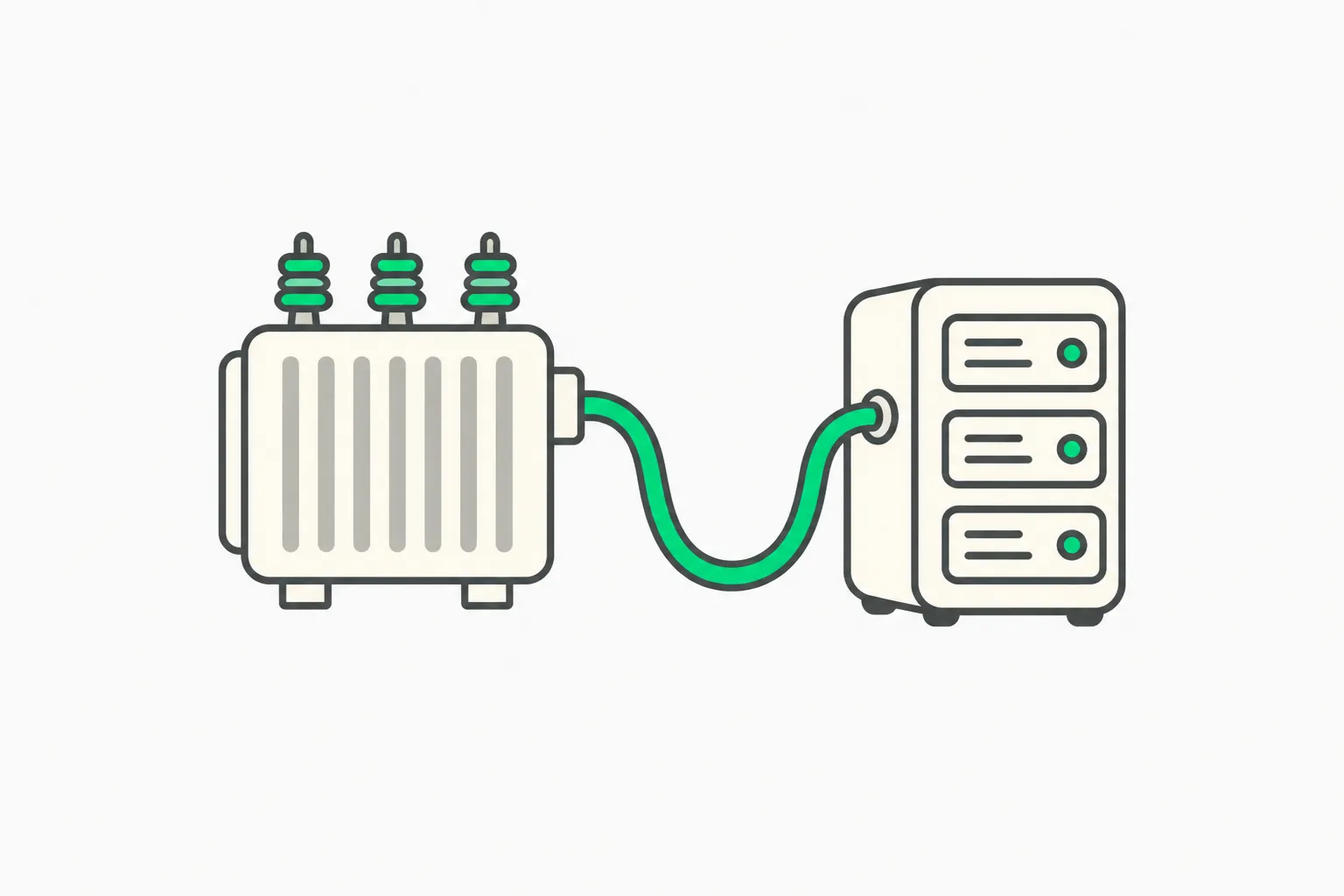 Green cable linking a transformer to a server cabinet, showing how a data center power grid connection works
What you can do
If you run production AI workloads, ask your cloud provider which regions rely on constrained grids and how they handle utility curtailment signals. Design for multi-region failover on anything with an uptime commitment, and keep batch jobs checkpointed so a brief shift to backup power does not cost you a long run. For the generation side of the equation, our explainer on orbital AI compute covers one radical response to terrestrial power limits.
What to watch next
Three things will settle where this goes: PJM's response to the order, whether Ohio, Pennsylvania or other states write curtailment priority rules, and any on-the-record confirmation from Entergy or Amazon about Mississippi. We will update this post if any of them land.
Facts reflect public reporting as of October 12, 2026 and may change as filings and statements appear.