



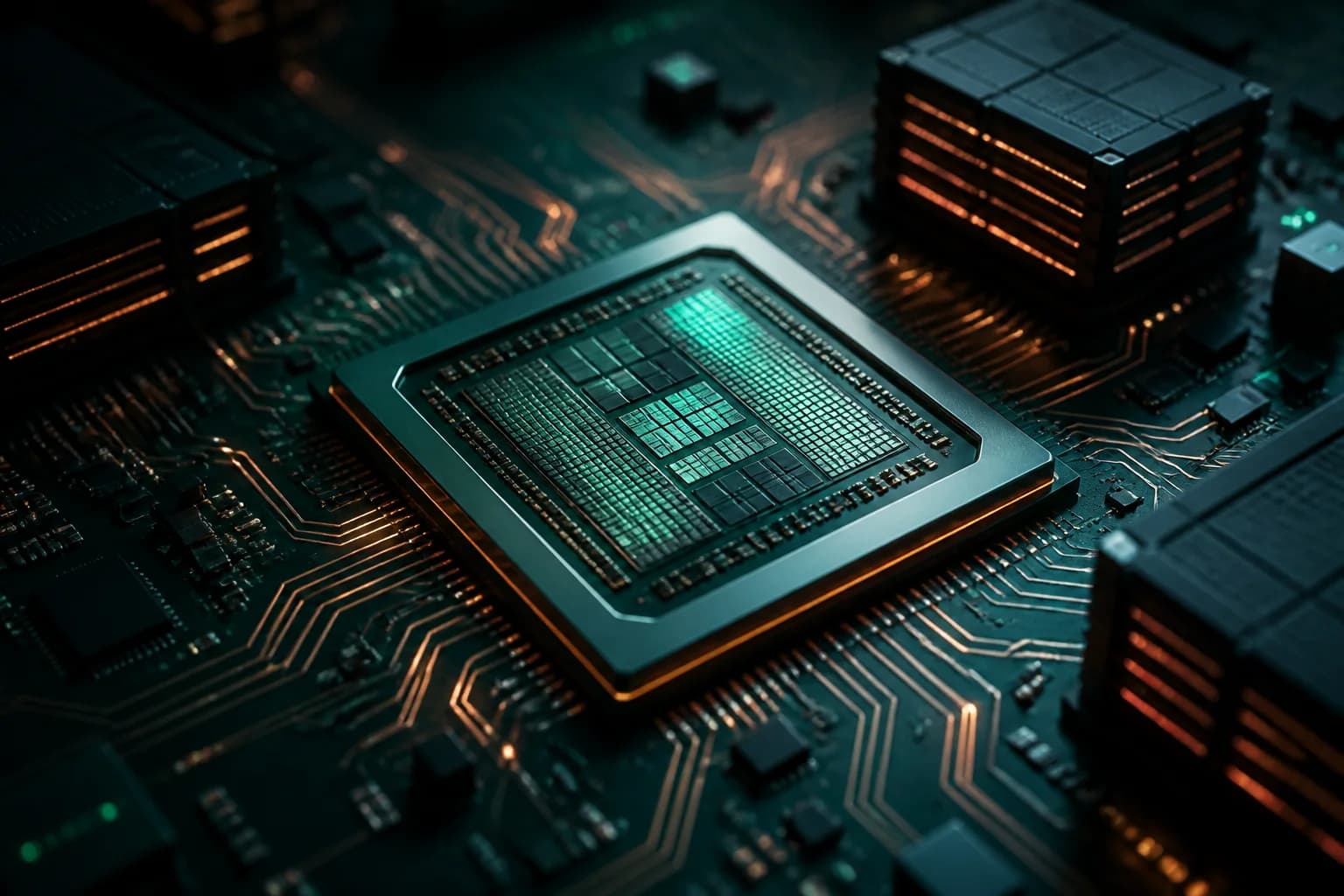
Extropic — the thermodynamic-computing startup co-founded by Guillaume Verdon (also known online as Beff Jezos, of "effective accelerationism" fame) — announced Z1T on September 4, 2026: its first family of transformer-like models built specifically for Z1, the company's probabilistic chip. The tweet claims up to 140x energy efficiency gains over GPUs and "a new scaling law for sparse transformers," and it pulled roughly 154.6K views — enough that it's worth separating the real technical claim from the headline number.
This isn't a GPU-killer announcement. It's an early, self-reported result on a genuinely different compute substrate, and the honest version of the story is more interesting than the tweet-length one. If your mental model of AI economics runs through GPU-hour pricing and token costs, an alternative hardware substrate that claims two orders of magnitude better energy-per-token is exactly the kind of thing to understand rather than dismiss or hype.
TL;DR
| Question | Answer |
|---|---|
| What is Z1T? | Extropic's first family of transformer-like models designed for its Z1 probabilistic chip, announced Sept 4, 2026 |
| What is Z1? | A sub-threshold CMOS chip with 269,568 probabilistic bits (pbits), fixed sparse connectivity, sampling an Ising model at 50 MHz, under 1 watt |
| What's the 140x figure? | Z1T's measured per-token decode energy vs. an H100 GPU at 100% utilization — a best-case comparison, not a universal multiplier |
| What's the "new scaling law"? | Sparse Z1T models show predictable loss-vs-compute scaling like dense transformers, just at a different (worse) FLOPs rate |
| Is this independently verified? | No — it's Extropic's own benchmark and blog post, not peer reviewed or reproduced by a third party |
| Can I run it today? | No public Z1 hardware access or pricing; weights and training code are open-sourced for the community to study |
| Who's behind it? | Extropic, co-founded by Guillaume Verdon ("Beff Jezos") |
Thermodynamic computing, in plain terms
Every digital chip fights physics to work at all. Thermodynamic computing is the umbrella term for what Z1 does differently. Transistors are naturally noisy at the sub-threshold voltages that save the most power — so GPUs and CPUs burn extra energy forcing that noise down until each transistor behaves like a clean, deterministic 0 or 1. That's what makes a GPU good at exact matrix multiplication: it pays an energy tax to suppress randomness.
Thermodynamic or probabilistic computing inverts that trade. Instead of suppressing the noise, chips like Extropic's Z1 run transistors near their natural sub-threshold noise floor and use that randomness directly as the computation. Z1 physically samples from a programmable Ising model — a lattice of probabilistic bits ("pbits") wired together, each one flipping between states based on its neighbors and a bit of physical randomness, the same mathematical structure used to model magnetism in statistical physics. Z1 packs 269,568 of these pbits, each with exactly 16 tunable connections to neighbors (2.1 million coupling edges total), sampling at 50 MHz while drawing under 1 watt.
The catch, and the reason this isn't a GPU replacement for most workloads: sampling from a probability distribution is a fundamentally different operation than exact dense matrix multiplication. It's a strong fit for probabilistic and sampling-heavy models — diffusion models, Bayesian inference, anything that already works by drawing repeated samples — and a poor fit for the dense deterministic linear algebra that dominates today's mainstream transformer training and inference. That mismatch is exactly why Z1T exists: it's an attempt to reshape a transformer so it can run on hardware built for sampling instead of multiplying.
What Z1T actually changes in the architecture
Z1T isn't a standard transformer ported to new hardware — it's a transformer with specific components swapped out so the sparse, pbit-based substrate can execute them:
- Softmax attention → gated convolutional attention (GCA) using sparse projections, since dense softmax attention doesn't map cleanly onto a fixed degree-16 connectivity graph.
- RMSNorm → Dynamic Tanh (DyT) activations, chosen because tanh-like nonlinearities are naturally implementable directly in pbit circuits.
- Continuous values → 4-pbit bundles ("dy4p" quantization), encoding each number across four probabilistic bits rather than a standard floating-point representation.
- Disaggregated inference — Z1 handles the sparse operations, while an FPGA co-processor handles dense operations Z1 can't (like the final vocabulary logit readout).
That last point matters more than it looks. Extropic's own numbers show the FPGA consumed over 95% of total system energy in this benchmark — Z1 silicon itself used only 8.74 nanojoules per token versus 285.78 nanojoules on the FPGA. The chip that's actually novel here is doing a small fraction of the work; a hypothetical future chip built to handle the FPGA's job natively is where Extropic argues the bigger gains (potentially 1000x) would come from. None of that exists yet.
The scaling law claim — why it matters if it holds
explainx.ai's guide to AI chip architectures covers why chip designers obsess over memory movement and scheduling, not just raw FLOPs — but scaling laws are the thing that determines whether more compute keeps paying off at all, on any chip. If loss doesn't fall predictably as you add parameters and training compute, throwing more hardware at a model stops making sense past some point.
Extropic trained Z1T at varying model sizes and at fixed connectivity levels (degree 4, 16, 32, 64, and 128 connections per pbit) and reports that loss follows a scaling curve structurally similar to dense transformer scaling laws — just at a worse FLOPs-to-quality rate. Matching GPT-2-small's quality took roughly an order of magnitude more FLOPs with a sparse Z1T model than a dense equivalent would need.
That's the actual news, separate from the energy number: if sparse, hardware-constrained transformers scale as predictably as dense ones, it means Z1-class hardware isn't a dead end that plateaus early — more probabilistic compute should keep buying quality, the same underlying assumption that has justified GPU buildouts for the last several years. It's a genuinely interesting claim. It is also, as of this writing, Extropic's own claim from its own blog post, not something independently reproduced or peer reviewed, and it excludes activation quantization effects that a real deployment would have to account for.
Where the 140x figure actually comes from
This is the number doing all the work in the tweet, so it's worth being precise about what was actually measured:
| Metric | Z1T (Z1 + FPGA) | H100 GPU |
|---|---|---|
| Energy per token | 294.52 nJ (8.74 nJ Z1 + 285.78 nJ FPGA) | 4.09 µJ at 100% model FLOPs utilization |
| Workload | Single-token decode, batch size 1, sequential | Same workload |
| Model size tested | 4 layers, 512 dimensions (achieves 0.006% FLOPs utilization on H100) | — |
| Comparison basis | Best-case for H100 (100% utilization) | ~28x gap at 50% utilization; ~139x at 10% utilization |
Two things temper the headline number. First, the 100%-utilization H100 baseline is a best-case assumption for the GPU — a tiny model like the one tested would never actually hit full utilization on an H100 in production, so the practical gap (closer to 139x at more realistic 10% utilization) is coincidentally close to the marketed figure, but for a different reason than the tweet implies. Second, Extropic explicitly frames this as decode-only: the authors "recommend Z1T for decoding workloads, not prefill," where GPUs remain the better choice — so even taken at face value, this isn't a claim that Z1 beats GPUs everywhere, just on one specific, narrow workload shape.
Why this matters even if you'll never touch Z1 hardware
explainx.ai covers token economics and compute cost because it's the lever that determines what AI products can actually charge and who can afford to build on top of frontier models. Energy-per-token is the physical substrate underneath that economics — GPU energy costs, not just GPU scarcity, are a real component of inference pricing at scale. A credible alternative-hardware path that cuts energy-per-token by even a fraction of 140x, for even a narrow slice of workloads, is the kind of structural change that eventually shows up in what inference costs.
It's also worth placing next to the rest of 2026's alternative-hardware wave rather than treating it as an isolated curiosity. AMD's acquisition of Taalas — a startup etching model weights directly into silicon — is a different bet on the same underlying question: is general-purpose GPU compute the permanent center of gravity for inference, or will workload-specific silicon carve out real share? Nvidia itself is answering with decode-specific silicon like Groq 3 LPX rather than ceding the inference-hardware conversation to challengers. Extropic's bet is the most radical of the three — not just specialized silicon, but a different computational paradigm entirely — which also makes it the least proven.
Honest limitations
- This is a startup's own benchmark on its own blog, not an independently reproduced or peer-reviewed result. Treat the 140x figure and the scaling-law claim as Extropic's position, not an established fact.
- The tested model is tiny — 4 layers, 512 dimensions, achieving only 0.006% FLOPs utilization on the H100 comparison point. Whether the energy advantage holds, shrinks, or grows at model sizes people actually deploy is unknown.
- The FPGA co-processor, not Z1 silicon, does most of the work — over 95% of system energy in this benchmark went to the FPGA handling dense operations Z1 can't do natively. The 1000x figure for a future Z1-native chip is speculative, not measured.
- Some of the reported numbers are projections, not silicon measurements — Extropic states its Z1 energy estimates are "best estimates anchored to prior pbit experiments," not direct measurements of this exact chip running this exact workload.
- No public availability. There's no announced pricing, cloud access, or general hardware availability for Z1 — only open-sourced Z1T weights (Hugging Face) and training recipes (GitHub) for researchers to study the approach.
- Nothing runs unmodified. Existing transformer checkpoints don't port to Z1T — the architecture requires rebuilding with Z1-native components (GCA instead of softmax attention, DyT instead of RMSNorm, 4-pbit value encoding), so this is a research direction to evaluate, not a drop-in inference target today.
Related on explainx.ai
- AI Chip Architectures Explained: GPU vs TPU vs Trainium vs Cerebras vs Groq
- AMD Acquires Taalas: The Chip That Etches Model Weights Into Silicon
- Nvidia AI Infra Summit 2026: Vera Rubin, Groq 3 LPX Preview
- Anthropic Model Hardware Standard: MCP for Physical Lab Equipment
- Anthropic Hires Amir Salek, Google TPU Founder
- Nvidia $500 Billion Compute Asset Class: Wall Street
Sources
- Extropic — "Z1T: Transformers for Sparse Probabilistic Hardware"
- Extropic on X — Z1T announcement, September 4, 2026
This post reflects Extropic's own September 4, 2026 blog post and announcement. The 140x energy efficiency figure and the sparse-transformer scaling law are Extropic's self-reported results, not independently verified — check Extropic's official writeup and any follow-up third-party analysis before treating these numbers as established benchmarks.