



Jensen Huang's pitch is that a GPU cluster should be financeable the way a toll road is. The credit market's response, three weeks earlier, was to push Nvidia's default swaps to a record.
On August 10, 2026, Nvidia announced a partnership with six of the largest capital allocators in the world — Apollo Global Management, Blackstone, BlackRock, Brookfield Asset Management, Goldman Sachs, and KKR — targeting $500 billion in AI infrastructure financing. Huang's framing was explicit: Nvidia compute is "an investable infrastructure asset."
Both facts are true at once, and holding them together is the only honest way to read this story.
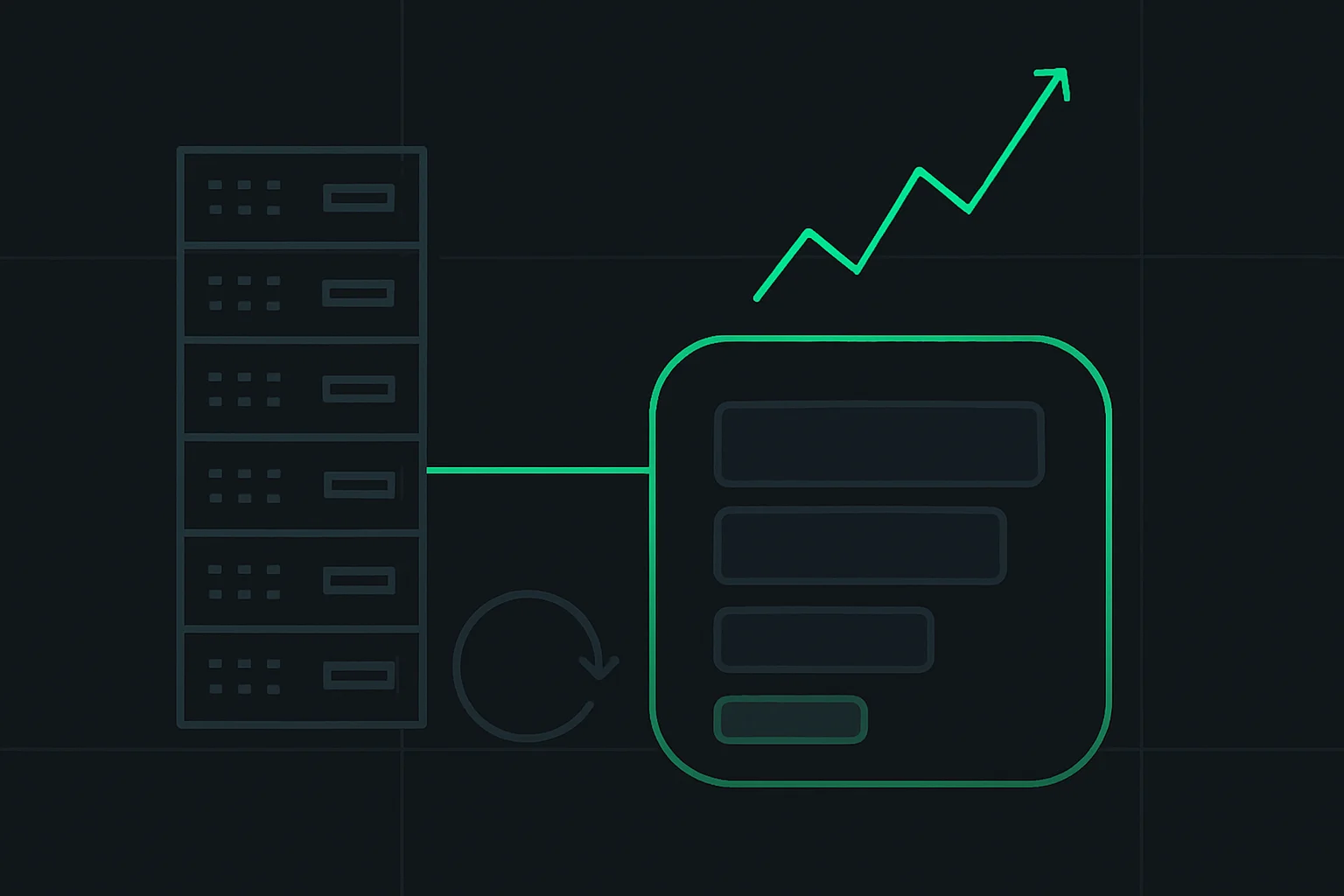 Diagram of AI compute capacity used as collateral for infrastructure debt with a rising risk indicator and a circular financing loop
TL;DR
| Question | Direct answer |
|---|---|
| What's the deal? | $500B target for AI infrastructure financing across six independent platforms |
| Who's in? | Apollo, Blackstone, BlackRock, Brookfield, Goldman Sachs, KKR |
| Is it signed? | No — memorandums of understanding; each project needs a final agreement |
| Structure | Special-purpose entities issuing private placements and bonds |
| Collateral | The compute capacity itself |
| Nvidia's role | May provide financing support on up to 25% of opportunities |
| Goldman's role | Only bank in the group; positioned as lead bookrunner on public deals |
| Market signal | Nvidia 5-yr CDS hit ~82 bps on July 27 — record territory |
| Timeline | Deals "expected within months"; no named first project |
What is actually being built
This is not a $500 billion fund. Each of the six firms establishes independent financing platforms that route institutional capital — pension money, insurance float, private credit — to developers and operators building Nvidia-based AI infrastructure. Individual vehicles could issue tens of billions in debt simultaneously.
The mechanism matters more than the headline number. By moving GPU and data center purchases onto special-purpose entity balance sheets funded by institutional credit, buyers get capacity without carrying the capex themselves. Huang's own words: "We are bringing the world's leading long-term capital providers together to independently underwrite AI infrastructure."
BlackRock's Larry Fink pitched it to the buy side as "high credit quality" paper offering yield to investors "overinvested in equities." Goldman's David Solomon read it as evidence that capital markets have "lots of capital available to support" the buildout.
Two structural details deserve attention:
Nvidia may support up to 25% of opportunities. That is not arm's-length. It means the chip vendor is a participant in the credit structure financing purchases of its own chips — the exact pattern that has the debt market uneasy.
The liquidity argument rests on reallocation. The pitch to lenders is that if an operator fails, compute capacity can be redeployed to a different buyer, so recovery is high. That holds only while demand exceeds supply. In a downturn — the scenario collateral exists for — every distressed cluster hits the market at once, into softer demand, with hardware that depreciates faster than a toll road ever has. We covered that depreciation asymmetry in detail in the circular-revenue and GPU-depreciation piece.
The credit market already voted
The financing announcement did not arrive into a calm market. On July 27, 2026, Nvidia's 5-year credit default swap widened 14 basis points intraday to roughly 82 — the largest single-day move since the contract became actively traded in November 2025.
What the spread is pricing is circular financing. Nvidia has announced more than $540 billion in deals during 2026 where it takes equity stakes in or guarantees debt for customers who then buy Nvidia hardware — including reported discussions of a guarantee of up to $250 billion to help OpenAI lease compute from a US data center project, which we covered in the Ohio 10-gigawatt financing story.
Hedgeye's Felix Wang put the economic effect precisely: this cheapens Nvidia's product without cutting GPU prices, and in doing so makes "future demand more sensitive to credit conditions." That is the sentence to keep. Vendor financing converts a demand question into a credit question.
Both the IMF and the Bank for International Settlements have flagged AI circular financing as a systemic downside risk. Worth stating plainly: 82 basis points is not a default signal. Nvidia generates enormous free cash flow. What the spread reflects is that the market now sees Nvidia's credit as entangled with its customers' credit — a genuinely new fact about a company that used to simply sell chips for cash.
The capex numbers, checked
A figure circulating alongside this story puts hyperscaler AI infrastructure commitments at $2.6 trillion. That number does not match what the primary sources support, and it is worth correcting rather than repeating.
| Metric | Verified figure |
|---|---|
| 2026 hyperscaler capex (Microsoft, Alphabet, Amazon, Meta, Oracle) | $660B–$700B |
| Share of that which is AI-related | ~75%, roughly $450B–$500B |
| 2025→2026 growth | Close to double |
| 2025–2027 cumulative cycle | Trillion-dollar range |
So: the annual figure is roughly $700 billion, and multi-year cumulative estimates run into the trillions. A single "$2.6 trillion committed" headline conflates a multi-year projection with a signed commitment. The real number is large enough without inflation — it is the largest technology investment cycle since the 1990s internet buildout, and that is the accurate claim.
What people are asking
Is this a bubble signal? It is a financialisation signal, which is related but distinct. Bubbles are about price; this is about funding structure. Moving an asset from cash purchases to leveraged special-purpose vehicles doesn't change whether the asset is worth it — it changes what happens if it isn't. Leverage converts a bad investment into a credit event. Zuma Wealth's Terri Spath framed it moderately: "AI isn't necessarily a bubble, but the market needs an earnings reality check." Our fuller treatment of the bear case is in the Ed Zitron collapse-prediction retrospective.
Why would pension funds want this? Because they need duration and yield, and infrastructure credit has been a reliable source of both. The pitch — long-dated, collateralised, contracted cash flows — is genuinely familiar to that buyer. The unfamiliar part is the collateral. A toll road still exists in fifteen years. An H100 in fifteen years is scrap. The tenor of the debt and the useful life of the asset are the thing to scrutinise in any of these deals.
Does this affect what I pay for tokens? Eventually, yes. If buildouts become credit-financed rather than cash-financed, then the cost of capital enters the price of inference. Cheap tokens have so far been subsidised by cash-rich balance sheets and competition. Debt-financed capacity has to service its debt, which puts a floor under pricing that didn't previously exist — relevant to anyone whose product economics assume prices keep falling, as covered in our enterprise token-cost governance piece.
Isn't more demand just Jevons paradox? Partly — cheaper compute genuinely does induce more usage, as Thariq's argument on mathematics and AI demand lays out. But Jevons describes what happens when something gets actually cheaper through efficiency. Vendor financing makes something feel cheaper by deferring the cost. Those produce similar demand curves in the short run and very different ones when the credit cycle turns.
Where does this leave the local-datacenter fights? More capital chasing sites intensifies them. Anthropic's reported $9.1 billion, 191MW Riot Platforms lease at Rockdale, Texas — signed the day after this announcement — and Google's $15 billion Texas campus are exactly the kind of project this machinery exists to fund — and exactly what's driving the local moratorium wave and OpenAI's letter to Governor Abbott.
What to watch next
Three concrete markers will tell you whether this is real infrastructure finance or a press release:
- A named first project with a signed agreement, not an MOU. Until then, $500 billion is an aspiration.
- The tenor and covenants on the first SPE issuance — specifically how the documents handle GPU obsolescence and residual value. That is where the sophistication of the underwriting will be visible.
- Whether Nvidia's CDS narrows as deals are formalised. If spreads tighten, the market is buying the "independent underwriting" framing. If they widen further, it is reading Nvidia's 25% participation as more entanglement, not less.
Update — September 3, 2026: NVIDIA is also buying the distribution layer, not just financing the compute — NVIDIA acquires Hugging Face for $12.9 billion.
The takeaway
Nvidia is trying to convert a capex bottleneck into a capital-markets product, and it has recruited the six firms best equipped to do it. If the underwriting is genuinely independent and the collateral is honestly valued against a short hardware life, this is a legitimate expansion of who can fund AI infrastructure.
The risk isn't that it fails; it is that it works. Making compute easy to finance guarantees more of it gets built — and pushes the question of whether the demand was real from Nvidia's income statement into somebody's credit portfolio, a few years later, at scale.
Related on explainx.ai:
- Update — September 7, 2026: Anthropic has reportedly matched this compute-commitment scale — see Anthropic's reported $517B compute commitments, explained. A separate viral X thread claims NVIDIA's own equity-stakes book has grown tenfold to $99B — see NVIDIA's $99B equity book and the Berkshire-Alphabet claim, explained.
- Nvidia AI Infra Summit 2026: What to Expect From Ian Buck's Keynote — the Vera Rubin platform, Groq 3 LPX inference hardware, and the infrastructure case for agentic AI
- Ed Zitron's AI Predictions, Fact-Checked: What Dan Luu Found — a worked example of separating a commentator's confidence from their actual hit rate, relevant to weighing circular-financing warnings like this one
- NVIDIA guarantees OpenAI's PORTS-Pike AI factory in Ohio — the official LPS deal
- Nvidia's $250B OpenAI Financing and the Ohio 10-Gigawatt Project
- Microsoft, OpenAI, Circular Revenue and GPU Depreciation
- Google's $15B Anthropic Texas Data Center
- Ed Zitron's OpenAI Collapse Prediction, Two Years Later
- The AI Data Center Backlash Map
- AI Token Costs Surge: Enterprise Finance Governance
- Jevons Paradox, Mathematics and AI Demand
Deal terms are memorandums of understanding as of August 10, 2026 and are not final agreements. CDS levels reflect July 27, 2026 trading and move continuously. Capex figures are 2026 estimates from published hyperscaler guidance and may be revised.