



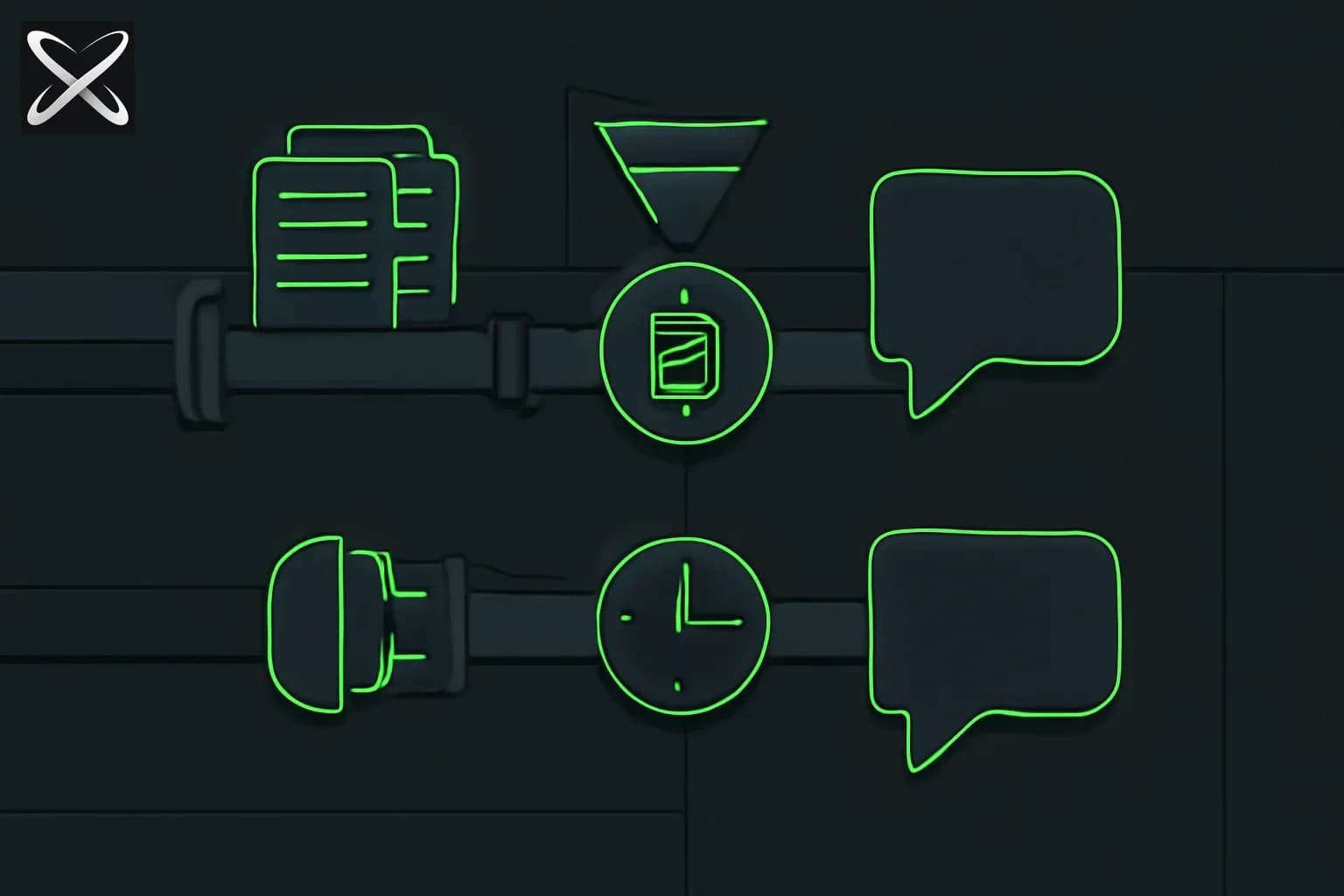
Exa launched Snapshot on September 18, 2026 — a search API capability that returns results from the web as it looked on a date you specify, built on an index the company describes as more than 400 billion historical webpage snapshots spanning two decades. The framing in Exa's own launch post is precise: this isn't a nostalgia tool for browsing old pages, it's infrastructure for preventing web leakage in reproducible evals and RL training runs, and for point-in-time backtesting that previously required months of manual data collection. Predictably, the top reactions on X asked the obvious question — how is this different from the Wayback Machine — and Exa hadn't directly answered it at time of writing.
TL;DR
| Question | Answer |
|---|---|
| What is it? | A snapshotAsOf parameter on Exa's /search and /contents API endpoints that returns web results as of a specified past date |
| How big is the index? | 400+ billion historical webpage snapshots, spanning roughly two decades |
| What's the primary use case Exa pitches? | Preventing eval/RL leakage (agents finding published answers post-training-cutoff) and point-in-time financial backtesting |
| Is it free or self-serve? | Available today in the dashboard and via API for basic use; full index coverage, higher rate limits, and Zero Data Retention require contacting Exa's team |
| How does it differ from the Wayback Machine? | Unconfirmed — Exa hasn't published a direct comparison, and this was the most common question in the launch replies |
| Is it production-ready? | No — Exa explicitly labels it a research preview with ongoing development |
The problem this actually solves: eval and RL leakage
The clearest, most technically grounded use case in Exa's launch post is about training and evaluation integrity, not archival browsing. Say you're training an agent with reinforcement learning on tasks and gold answers written in June, but the training run happens in September. By then, some of those answers may already be published somewhere on the live web — in a paper, a GitHub pull request, a blog post referencing the same benchmark. An agent equipped with a live search tool can find and submit that published answer directly, without doing the reasoning the task was designed to test. Worse, graders can end up favoring the leaked-answer agent, because retrieving a published answer takes less visible effort than actually solving the task — a subtle scoring bias that's hard to catch after the fact.
Setting snapshotAsOf to a date before the answer leaked removes that shortcut: search returns only what was actually on the web at that earlier point, so an agent that "solves" the task has to do so without access to anything published afterward. This is the same class of problem explainx.ai has covered in the context of evaluating web search tools for AI agents end-to-end — a reminder that the search layer an agent stack is built on materially changes what a benchmark actually measures, not just how fast it answers.
The API, concretely
Snapshot is not a separate product — it's a parameter added to Exa's existing /search and /contents endpoints. In the Python SDK:
from exa_py import Exa

exa = Exa()

# Search as of a specific date
result = exa.search(
    "latest stable Python release notes",
    num_results=3,
    contents={
        "snapshot_as_of": "2026-05-01T00:00:00Z",
        "highlights": True,
    },
)

# Fetch a specific page's content as of that date
result = exa.get_contents(
    ["https://docs.python.org/3/whatsnew/changelog.html"],
    snapshot_as_of="2026-05-01T00:00:00Z",
    text=True,
)
That design choice matters for adoption: teams already using Exa's search or content-extraction endpoints for agent grounding — the same category of tool explainx.ai covered with Perplexity's Search API index debut and Firecrawl's keyless web scraping for agents — can add temporal filtering with one new parameter rather than integrating a separate archival tool alongside their existing search pipeline.
The finance angle
The second use case Exa highlights is quantitative backtesting. A backtest is only methodologically valid if it uses exclusively information that was actually available on the date being simulated — a discipline quant researchers already apply rigorously to prices and financial fundamentals via dedicated point-in-time datasets. Nothing equivalent has existed for general web content, meaning a trading signal derived from, say, sentiment in news articles or product pages required months of careful manual point-in-time data collection before it could be properly tested for lookahead bias. Snapshot's pitch is that this kind of test becomes an API call.
The Wayback Machine question, unanswered
Exa's launch replies were dominated by one question, asked at least half a dozen different ways: how is this different from the Internet Archive's Wayback Machine, and did Exa build Snapshot on top of Wayback Machine data? Exa had not directly responded to this at time of writing. It's a fair question worth separating into its real components rather than dismissing as snark:
- Query interface — Snapshot is a programmatic search endpoint returning ranked, relevant results for a query as of a date; the Wayback Machine is primarily a URL-lookup tool for viewing a specific known page's history, not a general search-and-rank system across its archive.
- Integration surface — Snapshot plugs into an existing agent or RAG pipeline via the same API a team may already call for live search; using Wayback Machine data in an agent pipeline typically requires separate scraping and indexing work.
- Data provenance — whether Exa's 400-billion-snapshot claim represents independently crawled data, licensed/derived data, or some combination with public archival sources like the Internet Archive is not disclosed in the launch post, and is the specific point several commenters pressed on without getting an answer.
Until Exa addresses this directly, the honest framing is: Snapshot is a differently-shaped product (an API-first, search-ranked, agent-integrable tool) whose underlying data relationship to existing web archives is unconfirmed.
Honest limitations
- Explicitly a research preview, not a finished product — Exa's own post says "ongoing development."
- Full index coverage, rate limits, and Zero Data Retention aren't self-serve — they require contacting Exa's team directly, which limits how thoroughly independent developers can stress-test the claimed 400-billion-snapshot coverage today.
- The Wayback Machine comparison and data-provenance question remain unanswered by Exa as of this post — treat the "different from Wayback Machine" framing as an open question, not a settled one.
- No independent benchmark of snapshot accuracy or coverage density by date/domain has been published — a request from a prior date might return sparse or uneven results depending on how thoroughly that slice of the web was actually crawled at the time, and Exa hasn't published coverage statistics broken down this way.
How this fits into an existing eval pipeline
For a team already running the kind of end-to-end web-search evaluation methodology explainx.ai covered from Parallel Web Systems — hold the agent harness constant, swap the search provider, grade final answers with an LLM judge rather than isolated snippet scores — snapshotAsOf slots in as an additional axis to test along, not a replacement for that methodology. The practical integration looks like: pick a gold-set construction date, set every search call in the eval harness to snapshotAsOf a date before that gold set was published, and re-run the existing grading pipeline. Any score improvement between the live-web run and the snapshotted run is a direct, quantified measure of how much leakage was inflating the original numbers — a number worth publishing alongside any benchmark result derived from an agent with live web access.
The same logic applies to RL training runs, not just one-off evals. A training loop that periodically re-evaluates a policy against a fixed task set, over weeks or months, risks the leakage problem compounding over time as more of the internet catches up to whatever's been published about the benchmark. Pinning snapshotAsOf once, at the start of the training run, and keeping it fixed for the run's duration is a cheap way to keep the evaluation signal honest across the whole training schedule rather than just at the start.
What this means for builders
If you're running RL training, building eval harnesses, or benchmarking agents against tasks with known gold answers, snapshotAsOf is worth testing directly against your existing leakage-detection process — it's a more principled fix than the ad hoc workarounds (filtering by publish date after the fact, manually checking for leaked answers) most teams currently use. For anyone building financial or trend-analysis tools that need genuinely point-in-time web context, it's worth evaluating against the coverage and latency your specific domain needs before committing, given the preview-stage caveats above. And for anyone who has been quietly suspicious that a benchmark number looked too good — a search-augmented agent scoring suspiciously well on a task written months before the eval ran — Snapshot is now a direct, cheap way to test that suspicion rather than just noting it and moving on.
Related on explainx.ai
- How to eval web search for AI agents (Parallel's method)
- Perplexity's Search API index debut for agent search
- Firecrawl: free, keyless agent web search and scraping
- OpenRouter web search benchmarks for agent grounding
- RAG vs. MCP: a complete comparison
- Agent Reach: a capability layer for internet agents
- Official source: Exa — Introducing Exa Snapshot
This post is sourced to Exa's own September 18, 2026 launch post and documentation. Index size, use-case framing, and API examples are Exa's own claims; the comparison to the Internet Archive's Wayback Machine and Snapshot's data provenance remain unanswered by Exa as of publication.