



ClawDOS is an open-source agent harness that runs on FreeDOS inside an IBM PC XT class machine while calling Claude''s Messages API through a TLS bridge. Maintainer Ricapar documents the stack on ricapar.net/ClawDOS and ships source under Ricapar/ClawDOS (GPLv3). Hacker News thread 50586292 surfaced it on November 21, 2026 with builders asking for agents on legacy Windows next.
If you follow agent harness experiments beyond Mac and Linux IDEs, ClawDOS is the extreme constraint datapoint: 4.77 MHz, 640 KiB, CGA, and still tool loops.
TL;DR
| Question | Answer |
|---|---|
| Hardware target | 8088 at 4.77 MHz, 640K, CGA (86Box or real 5160) |
| Main binaries | HARNESS.EXE (~176 KB) + CLAWDOS.EXE launcher |
| API | Anthropic Messages API with streaming and tool use |
| TLS | tunnel/tunnel.py (or socat/stunnel) on a modern PC |
| Compilers on disk | Turbo C 2.0 (you supply floppies), assemblers, GW-BASIC |
| License | GPLv3; mTCP is GPLv3-linked |
| Offline test | tunnel/mockapi.py mock server |
What ClawDOS actually runs
The project page says HARNESS.EXE is a DOS program that writes HTTP requests, parses SSE replies, executes tools, and stores conversation history on disk. The 8088 does everything except TLS.
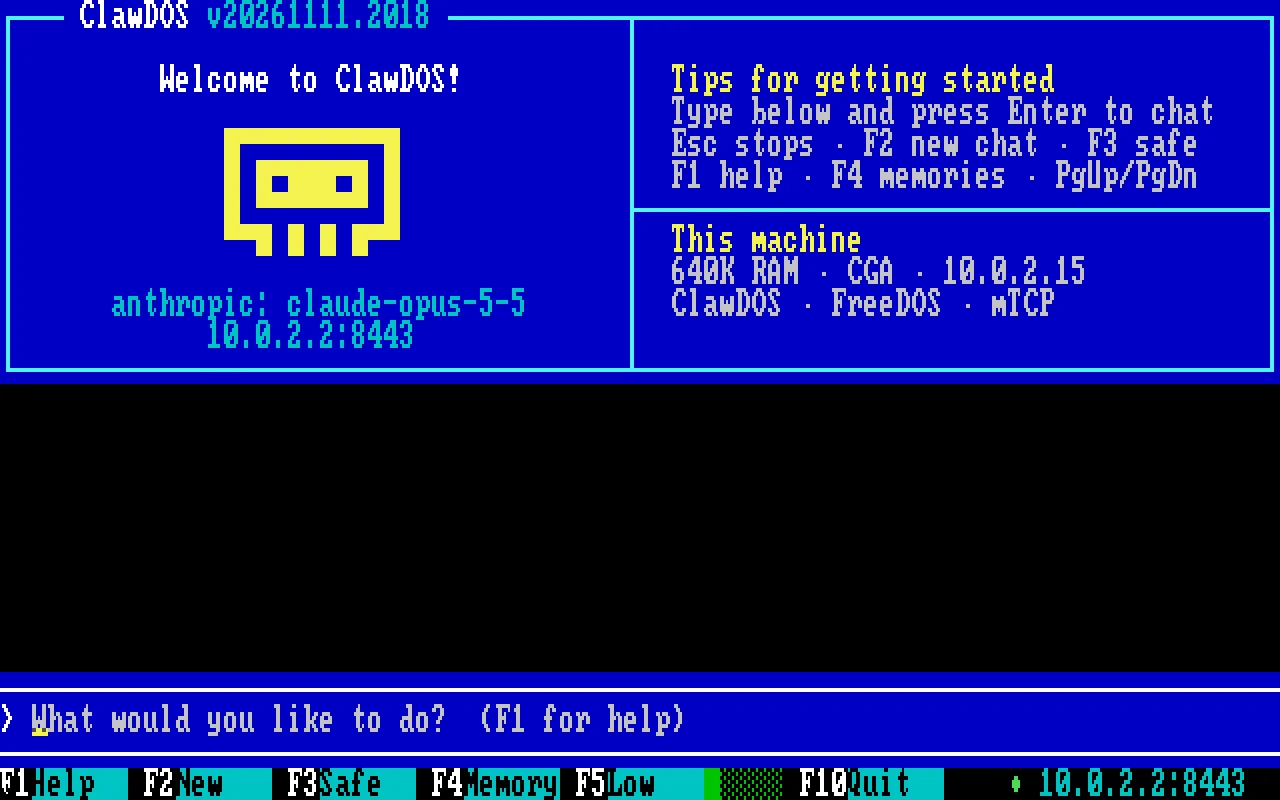 ClawDOS opening chat screen on CGA DOS for the retro AI agent harness
Image: ClawDOS project (ricapar.net)
Typical demo flow from the official page:
- You type a natural-language goal at the
C:\>prompt. - Claude streams a reply into an 80-column CGA transcript with retrace-timed writes to avoid snow.
- Tool calls compile Turbo C, run DOS batch files, or capture 320x200 CGA PNGs on the PC.
- Results return upstream with prompt caching so later turns upload only deltas (~500 bytes per tool result, per project docs).
The WarGames tribute demo—vector map, missile arcs, tic-tac-toe ending—was authored on the XT as five Turbo C files (~15 KB) producing WG.EXE under 10 KB. The maintainer published a YouTube walkthrough filmed from a real 5160 monitor.
Architecture: DOS agent plus TLS bridge
8088 PC --plain HTTP--> tunnel.py --HTTPS--> api.anthropic.com
The README lists FreeDOS 1.4, mTCP, and a packet driver on the vintage side. Open Watcom builds 13,000 lines of C and C++ targeting 8086. Memory budgeting matters: ~200 KiB beside the harness for guest programs, or ~450 KiB when the harness relinquishes RAM during Turbo C compiles.
That relaunch pattern is a lesson for any resource-starved agent host: save transcript state, exit to free memory, run the heavy toolchain, resume the same conversation with stdout captured.
Compared with Poki''s on-iPhone agent, ClawDOS optimizes for nostalgia and brutally low specs, not daily phone automation. Compared with Pocketdev phone-driven agents, ClawDOS is the opposite end of the compute curve.
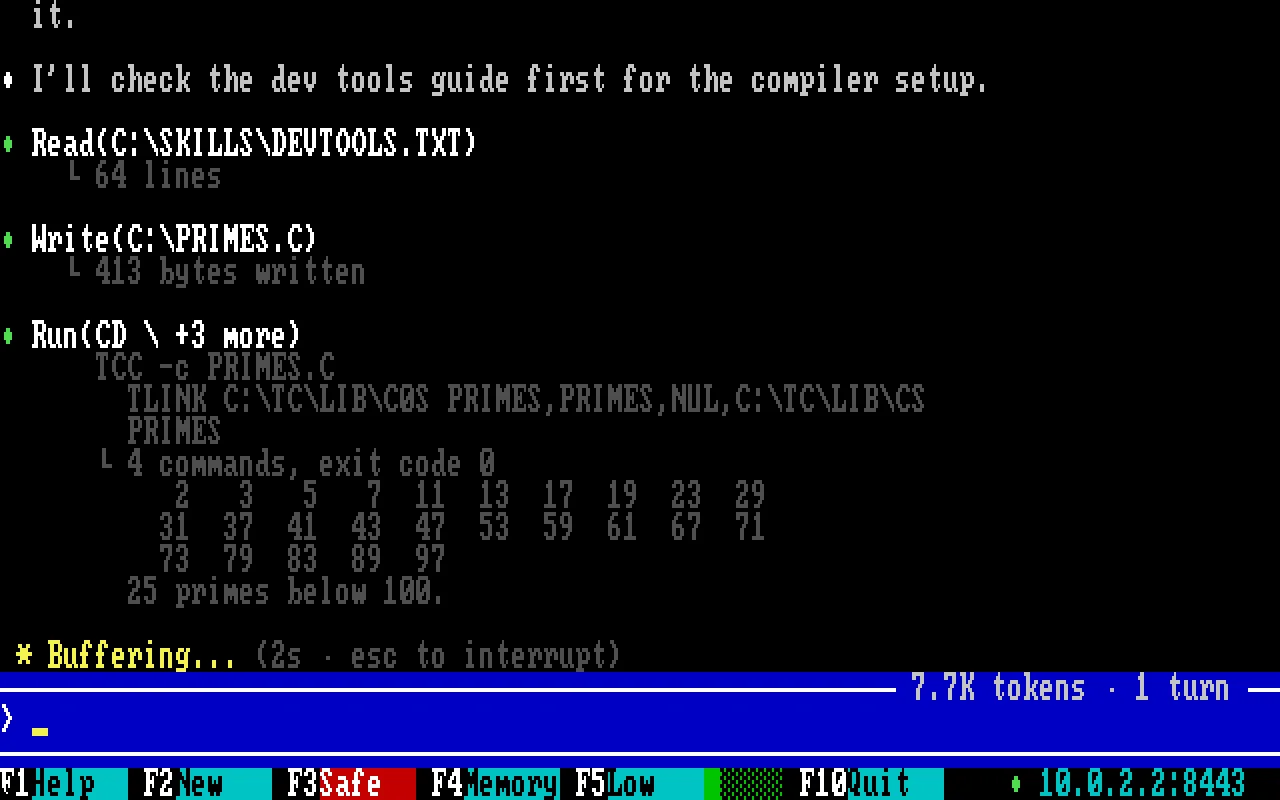 ClawDOS compiles and runs PRIMES.C on emulated DOS hardware with the AI coding agent harness
Image: ClawDOS project (ricapar.net)
The eighteen tools (and why they matter)
| Group | Tools | Builder takeaway |
|---|---|---|
| Filesystem | dir, read, search, write, edit, delete, mkdir, rename | Full project editing without a host OS agent |
| Execution | run (batch, screenshots) | Closed-loop compile-run-check like modern CI agents |
| Machine | peek, poke, port | Dangerous; gated by safe mode |
| UX | play, textart | Speaker and CP437 art in-transcript |
| Memory | memory_* | Persistent notes in C:\MEMORY, listed in system prompt |
Safe mode defaults on: destructive operations prompt Allow ...? (y/n). F3 disables it. That mirrors common approval patterns in agent tools, minus enterprise policy servers.
Skills and memories are plain text on disk, injected into the system prompt—similar philosophically to agent skills on modern stacks, but edited with DOS file tools.
 Green cursor in a minimal terminal window, echoing ClawDOS DOS prompt agent control
Image: Library reference — command-line agent loop on constrained hardware.
How to try it without vintage hardware
Official quick start from ricapar.net/ClawDOS:
python3 scripts/setup-tools.py
echo ANTHROPIC_API_KEY=sk-ant-... > .env
python3 scripts/build.py
python3 tunnel/tunnel.py
python3 scripts/run86box.py
At C:\>, type CLAWDOS.
No API key? python3 tunnel/mockapi.py serves a fake Messages API; boot with CLAWDOS 10.0.2.2:18023 and send !help per docs.
Tests: The repo claims 31 boot tests in DOSBox-X against a mock API plus DOSUNIT.EXE unit tests—useful if you fork the harness and need regression signal.
Costs, latency, and limits
Documented round-trip for PRIMES.C (primes under 100): 64 seconds end-to-end on emulated 5160, 26 seconds in compile/link/run while the harness steps aside. TTFT and token lines land in CLAWDOS.LOG (example on the project page shows claude-opus-5-5 with cache read stats).
Constraints builders should expect:
- Throughput: single-digit MHz CPU; not a daily driver IDE.
- Networking: depends on tunnel host uptime; dropped links retry per README.
- Turbo C redistribution: disk images must not ship proprietary Turbo C; you install from your own floppies into
external/. - Model spend: you pay Anthropic (or configured provider) per token like any API client.
Keyboard and CLI ergonomics
The harness is not only mouse-free; it is built for DOS keyboard culture. Official docs list:
| Key | Action |
|---|---|
| Enter | Send message |
| Esc | Stop reply or clear input |
| Up / Down | Message history |
| PgUp / PgDn | Scroll transcript via CRTC tricks |
| F2 | New chat |
| F3 | Toggle safe mode |
| F4 | Browse memories |
| F5 | Effort preset (low through max) |
| F6 | Prior chats |
| F10 | Quit |
Slash commands include /model, /chats, /memories, /new, and /quit. Power users can launch CLAWDOS -m "..." for one-shot tasks or -c NAME to resume a saved thread from the shell—handy when you script demos from AUTOEXEC.BAT in a classroom lab.
That surface area matters because many agent eval harnesses assume a web UI. ClawDOS proves you can still expose tool transparency (each call printed in the transcript with results) when the only graphics mode is four-color CGA.
Real hardware versus 86Box
The maintainer targets a maxed IBM PC 5160 with PicoMEM (SD-backed disk, WiFi as NE2000, EMS, battery clock). Build flow for metal:
python3 scripts/build.py --tunnel 192.168.1.10:8443
Copy CLAWDOS.IMG to the PicoMEM card, select it in firmware, boot, type CLAWDOS. Incremental refreshes use:
python3 scripts/build.py --update /path/to/CLAWDOS.IMG
so memories and chats persist across image updates—a detail production agent hosts should copy when they ship stateful disks instead of ephemeral containers.
86Box remains the low-risk path: snapshot before you disable safe mode, and point the tunnel at localhost without exposing DOS to the public internet.
How ClawDOS compares to modern coding agents
| Dimension | ClawDOS | Typical Claude Code / IDE agent |
|---|---|---|
| Host OS | FreeDOS on 8088 | macOS, Linux, Windows |
| API client | Custom in HARNESS.EXE | Vendor CLI or IDE plugin |
| TLS | External tunnel | OS trust store |
| Tool count | 18 fixed tools | Dozens via MCP and bash |
| Vision | CGA PNG screenshots | Full desktop or browser |
| Compile | On-disk Turbo C | Modern gcc/rustc on host |
| Goal | Constraint demo plus retro fun | Daily shipping velocity |
Neither column wins outright; they answer different questions. ClawDOS is a portability test for the Messages API plus tools contract defined in docs/API.md on the repo—worth reading if you implement a minimal client in another embedded environment.
Flight recorder and observability
CLAWDOS.LOG lines encode time to first token, upload bytes, token in/out counts, cache read and write stats, and whether a round ended in tool_use or end_turn. Example from the project page:
api anthropic claude-opus-5-5 round=1 ttft=2750 total=4015 up=165 len=1784 stop=tool_use in=2 out=221 cr=5543 cw=739 th=cont
relaunch: program 61.5 s, CLAWDOS away 82.3 s
For builders tuning agent SLOs, that split between model latency and relaunch time (harness unloaded while Turbo C runs) is the kind of metric cloud dashboards often bury. ClawDOS makes it visible because on DOS there is nowhere to hide.
Screenshot pipeline on four-color hardware
When run requests a screenshot, a timer interrupt hook copies CGA video memory, the 8088 encodes PNG, and the bytes ride along with the tool result to Claude. The official page shows a 320x200 capture the model described (map, arcs, explosions) after a WarGames run.
That path is slower than forwarding a GPU framebuffer on a Mac, but it is honest computer use: the model sees what the virtual machine actually drew, not a stitched browser canvas. Teams building evals for legacy SCADA or industrial HMIs might borrow the pattern even if they never ship a DOS disk.
What developers are saying
On Hacker News:
- sans_souse wrote, “I love what I see!”
- Tiberium called unusual environments (DOS, feature-phone Linux, Windows 95) a fun place to test how agents behave.
- linzhangrun argued the market lacks agents for WinXP and Win7 debugging, not just greenfield dev on modern OSes—useful product signal adjacent to ClawDOS.
Those comments are opinion, not benchmarks of ClawDOS security or reliability.
Risks and license notes
- GPLv3 on HARNESS means forks that distribute modified binaries must share source under the same license; read LICENSE before you ship a hosted wrapper.
- peek/poke/port can brick emulators or confuse real hardware if safe mode is off.
- API keys on the tunnel host are only as safe as that machine; prefer mockapi for classroom demos.
- The author disclaims that 100% Claude authorship is entertainment; you still need to read 13k lines before trusting it in production paths.
How ClawDOS fits the agent harness landscape
explainx.ai covers harnesses from Claude Code commands to Kimi Code on Bedrock. ClawDOS is not competing on velocity; it competes on pedagogy and stress-testing:
- How small can a Messages API client be?
- Can tool JSON and SSE parsing survive on 16-bit CPUs?
- Does safe mode UX work when the screen is four colors?
If those questions match your research, clone Ricapar/ClawDOS before the repo stars fade from the front page.
Related reading
- Loop engineering for coding agents
- What are agent skills
- Poki open-source iPhone GUI agent
- OpenAI computer use in healthcare workflows
- Claude Code team code review process
- Agentes Chat self-hosted Slack alternative
Commands, versions, and file paths match Ricapar/ClawDOS and ricapar.net/ClawDOS as of November 21, 2026.