



Tim Gerhard's November 14, 2026 write-up Agentic AI Designs an Analog Synthesizer documents Touchsynth — a mixed-signal board where Claude Opus 5.5 inside Claude Code handled circuit architecture, ngspice benches, KiCad layout scripts, firmware, and SSH-controlled lab bring-up. Hacker News surfaced the story as one of the first public, reproducible examples where an agent crossed schematic → simulation → PCB → audio with only floorplan and touch-key fixes left to a human.
If you build with Claude Code commands daily, Touchsynth is the hardware mirror of Cinecode film skills — agent ownership of multi-file artifacts, not a single README summary.
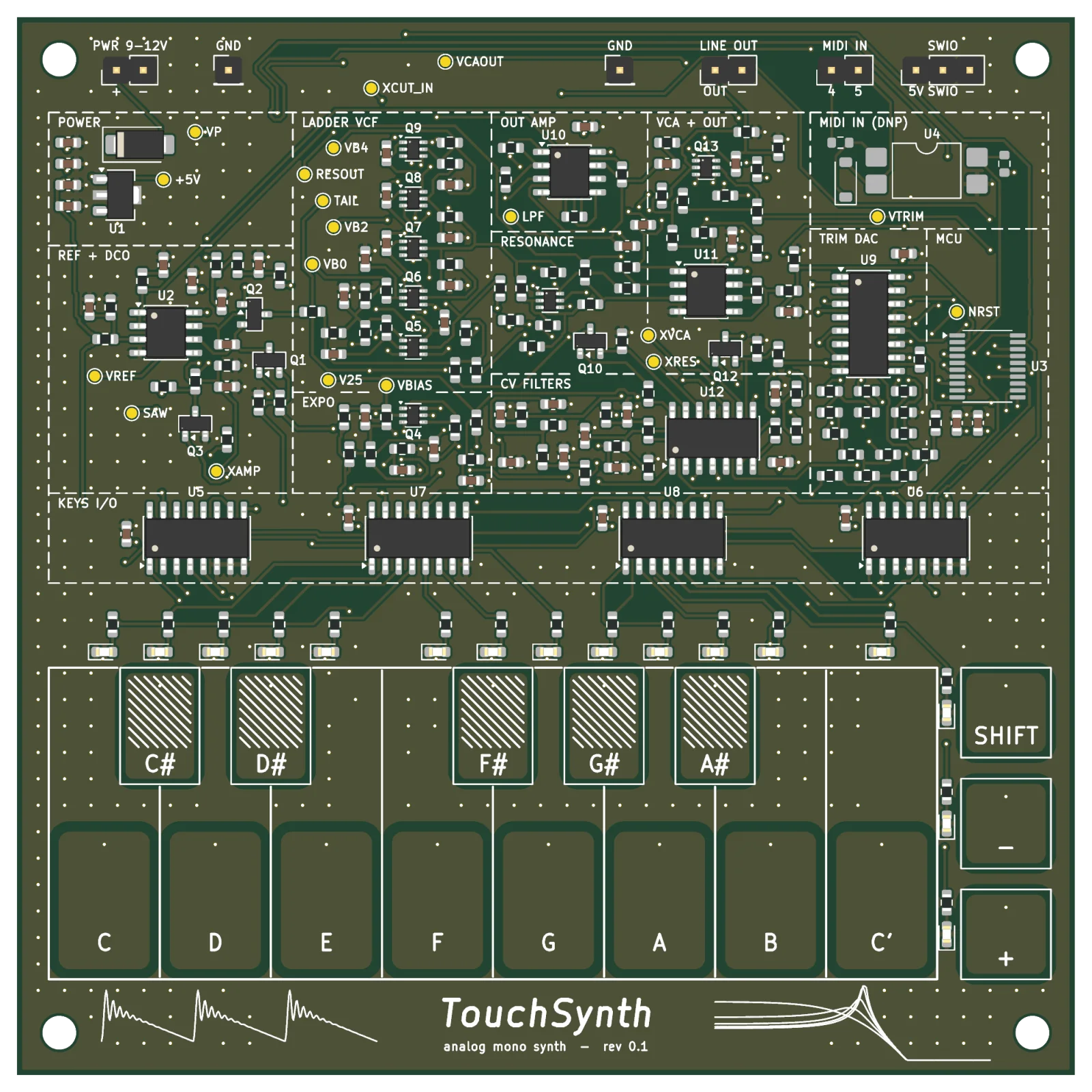 Claude Opus Touchsynth PCB 3D render of agent-designed analog synthesizer board
Image: Tim Gerhard
TL;DR
| Question | Answer |
|---|---|
| MCU | CH32V003 RISC-V |
| Architecture | Juno-style DCO, Moog ladder VCF, VCA, touch keys |
| Tooling | Claude Code (Opus 5.5), KiCad 10, ngspice, Freerouting, Python glue |
| Calendar time | ~19 h prompt → PCB order (per author log) |
| Human edits | PCB floorplan, 4-layer routing strategy, touch sensitivity |
| Primary source | Gerhard blog and TouchSynth GitHub repo |
Why this post matters for AI builders
Most agentic coding benchmarks stop at LeetCode or web apps. Touchsynth forces physical constraints:
- JLCPCB free parts cap op-amp and capacitor choices — the agent could not spec a fantasy OTA.
- ngspice either passes or smokes the ladder filter — no hiding behind TypeScript mocks.
- DRC and routing fail loudly when analog blocks crowd digital touch sensors.
That is the same maturity jump Edward Witten lattice paper with Opus hints at in math, but here the proof is audio on a scope.
 Claude Opus Touchsynth agent flow covers analog PCB design from ngspice to KiCad routing
Gerhard methodology: spec-first, not patch-first
Gerhard states he follows a V-model discipline:
- Let the agent propose concepts from the JLCPCB parts CSV (1,586 lines pulled via JSON API).
- Lock a written specification (Juno DCO + ladder VCF).
- Generate ngspice test benches S1–S7 and a simulation report.
- Build a Python behavioral model, calibrate against SPICE, render audio demos.
- Only then export KiCad sheets and Python placers + Freerouting.
He argues iterative netlist hacking fails because context windows drown in partial edits — a lesson that transfers to loop engineering for coding agents when you let agents rewrite half a monorepo without tests.
Circuit highlights the agent chose
Gerhard's review (without changing nets) calls out:
DCO integrator — TL072 integrator, 10 nF X7R 50 V cap, LM324 V-I stage, PWM pitch control — chosen for leakage and linearity within free parts.
Transistor ladder filter — 24 dB/oct Moog-style ladder built from matched NPN pairs, tail current exponential converter, instrumentation amp output pickoff — Gerhard links classic Moog ladder explainers for readers who want theory beyond the agent report.
VCA — differential pair with 74HC595 + R-2R trim DAC because PWM outputs were exhausted after filter and resonance control.
Touch keys — CD4051 muxes and 74HC595 chains because CH32V003 pins ran out — classic agent pin-budget story.
Layout: where humans still steer agents
Gerhard's largest intervention was PCB floorplanning:
- Initial agent placement bunched analog blocks; routing failed on two layers.
- Switching to four layers plus functional-block floorplan unlocked Freerouting.
- Gerhard moved blocks to open routing channels between analog sensitive sections and digital touch strips.
That matches how Claude bughunter skills still need human threat models — agents propose, humans enforce separation of concerns.
Bring-up: agents closing the loop on real hardware
After JLCPCB assembly (~two weeks), Gerhard:
- Connected a lab PC over SSH to Claude Code.
- Fed audio loopback into the MCU ADC.
- Read Rigol MSO5074 traces over Ethernet while the agent stepped calibration scripts.
SPICE benches S1–S4 matched Board1 captures closely — Gerhard notes surprise because second-source transistor models often diverge.
Only fixes: manual MCU solder bridge removal and touch recalibration (keys too hot).
Demo tracks on the project site are sheet-music-driven, multitracked by recording one voice at a time — honest about monophonic hardware limits.
 Touchsynth mixed-signal PCB design with Claude Code spans simulation validation and automated oscilloscope bring-up
What developers are saying on Hacker News
The Hacker News thread was thin at fetch time (single early comment), so there is no substantive What developers are saying section yet. Worth revisiting if hands-on builders post distortion measurements or BOM cost breakdowns.
Limits and safety notes
- Analog design agents can still over-componentize when the parts library is narrow — Gerhard notes excess Moog-era circuitry because no OTA/JFET sat in the free list.
- Touch keys on bare PCB are hard to play; Gerhard drives via MCU scripts instead of performance MIDI.
- Export and ITAR are not in scope — this is hobby/education scale, not defense electronics.
- Do not point agents at export-controlled EDA flows without legal review; Touchsynth stays open BOM + JLC.
Toolchain specifics worth copying
Gerhard's post lists concrete versions — rare in hype threads:
- KiCad 10 on Windows with WSL for Linux CLI tools.
- ngspice test benches named S1–S7 with downloadable reports.
- Freerouting attempted on two layers, abandoned until four-layer stack-up.
- CH32V003 firmware built with the RISC-V toolchain Gerhard already uses on other projects.
The 19-hour log table is a realistic agent calendar cost: most hours were unattended autorouters, not token streaming. Budget similar wall time if you replicate — and compare that to human-only ladder-filter weeks from analog forums.
Audio demos came from the behavioral Python model before boards arrived — exactly the digital twin pattern Sophon realtime voice pursues in software, but here grounding is SPICE, not mel spectrograms.
Safety, export, and lab discipline
Touchsynth is bench-scale, but teams in defense-adjacent EDA should note:
- Automated SSH scope control is powerful — treat lab PCs like CI runners with network segmentation.
- Agent-written firmware still needs manual power-on smoke tests before loudspeakers face humans.
- JLCPCB assembly is not ITAR-aware; this BOM is consumer hobby, not munitions.
For software-only readers, the moral is identical to Claude desktop Linux telemetry fixes: agents touch real side effects once they leave the chat box.
How to try the pattern yourself
- Mirror Gerhard repo structure — separate
spec/,sim/,pcb/,fw/folders so Claude Code can resume deterministically. - Force simulation gates before layout — refuse KiCad export until ngspice reports attach to the commit.
- Give the agent instrument APIs — SSH to scope and programmer like connect fitness MCP patterns but for lab gear.
- Budget human hours for floorplan — agents still miss return current paths on two-layer budgets.
Compare to NVIDIA SkillEvaluator for agent skills — different domain, same meta-lesson: evaluate end-to-end outcomes, not single-file diffs.
BOM economics and reproducibility
Gerhard constrained parts to JLCPCB's free list — a contrived but repeatable teaching lab. Readers replicating should expect:
- BOM cost in tens of dollars at hobby scale, plus MCU programmer and scope.
- Four-layer boards beat two-layer for mixed signal, but raise Fab minimums — the agent only succeeded after layer bump.
- Sound examples on the project site were pre-silicon from behavioral models — audition those before ordering boards to hear filter sweeps.
Compare total calendar time (~19 h agent + two-week fab) to hiring a consulting EE for ladder filter tuning; the post's value is documentation density, not guaranteed cheaper hardware.
Failure modes Gerhard does not glamorize
The blog is candid about touch keys proving unplayable at human scale and about excessive analog circuitry because JLC lacked OTAs. Those are the wrinkles marketing threads skip:
- Agents over-spec passives when pin mux runs out — watch BOM creep.
- Autorouters burn hours without human floorplan hints — budget calendar, not just tokens.
- SSH scope control can damage gear if scripts clip supply rails — keep manual estops.
Treat Touchsynth as R&D lab notes, not a product roadmap for music hardware startups.
If you file Issues against Claude Code hardware skills, cite Gerhard's V-model commit boundaries — future maintainers will thank you when KiCad netlists stop drifting from SPICE goldens.
Handoff tip: archive ngspice log hashes beside Gerber ZIPs in release tags so the next agent session cannot claim DRC clean without reproducing S3 filter gain sweeps first. Hardware CI is sparse today; treat these artifacts as your regression suite until open EDA agents mature. Screenshot scope FFTs too — audio regressions hide in harmonics, not Git diff stats.
Related on explainx.ai
- Claude Code commands reference
- Loop engineering for coding agents
- Edward Witten Opus lattice paper
- Claude Fable 5 simulated painting engine
- OpenAI GPT-6 Astra science blog context
- Google Stitch skills for agent installs
Hardware claims follow Gerhard November 14, 2026 primary post. Audio and BOM live in the linked project repository.