



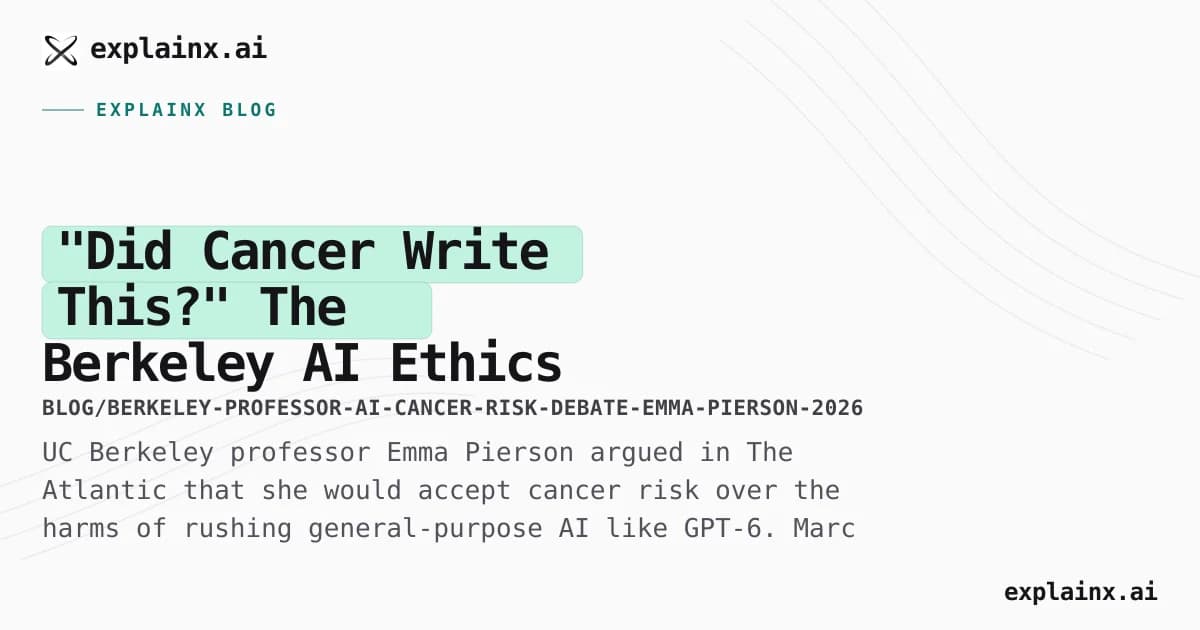
The essay was published on June 21, 2026 in The Atlantic.
UC Berkeley assistant professor Emma Pierson made a simple-to-state, hard-to-dismiss argument: she would rather accept some personal cancer risk than live in a world where general-purpose frontier AI — GPT-6-class systems — is rushed to market without adequate attention to its broader social consequences.
Marc Andreessen replied: "Did cancer write this?"
Matthew Berman replied: "Psychopath."
A chemo patient said the argument was selfish. The tweet went viral in the way that AI arguments usually go viral — with overwhelming volume and very little engagement with the actual claim.
The intensity of the reaction tells you something. Arguments this heated usually sit on top of a genuine underlying tension that neither side wants to resolve carefully.
What Pierson Actually Argued (The Part People Skipped)
The headline summary — "professor prefers cancer risk over fast AI" — is accurate but loses most of the argument.
Pierson's essay is not anti-AI. She specifically praised:
- AlphaFold — a genuine contribution to drug discovery via protein structure prediction
- Diagnostic AI tools — improved accuracy for specific cancer detection tasks
- Narrow, purpose-built AI applications in medicine and science
Her target was the race to deploy frontier general-purpose models as fast as possible. Her argument, reconstructed carefully:
-
Cancer's complexity limits how fast AI can help. Tumor heterogeneity, metastasis, treatment resistance, and microenvironment interactions are not primarily compute problems. AlphaFold-level breakthroughs compress specific bottlenecks. They don't collapse research timelines from decades to years for cancer as a category.
-
The distributional costs of rushed frontier AI are real and unequal. Mass displacement hits lower-income workers first. Surveillance infrastructure lands harder on already-marginalized communities. Autonomous weapons concentrate lethality in the hands of state actors with uneven governance. These costs are not speculative — they're playing out now in attenuated form.
-
Weighing these against faster cancer research is not incoherent. If GPT-6 shaves 3 years off a 30-year cancer research program while simultaneously accelerating mass unemployment and enabling authoritarian surveillance, you can coherently argue the net is negative — especially if the people who benefit from the cancer speed and the people who bear the employment/surveillance cost are different populations.
You can disagree with her weighting. But the structure of the argument is sound.
Why Andreessen's Response Is Not a Rebuttal
"Did cancer write this?" works as a rhetorical line because it implies the argument is so internally incoherent — from someone with cancer, arguing against the thing that might cure it — that it deserves no serious engagement.
But the implication doesn't hold.
People with cancer can coherently argue for policies that don't maximize their personal medical benefit if they believe the broader social costs are high enough. That's not a psychological failure — it's having a view about societal trade-offs that extends beyond self-interest. Philosophers have a name for this; it's called ethics.
The "Did cancer write this?" framing treats the argument as obviously wrong without engaging it. It works as a tribal signal — this person is on the wrong side — but tells you nothing about whether the argument holds.
That Andreessen's response was widely celebrated in AI acceleration circles, while most people seemed to agree it was devastating, suggests the acceleration community is more interested in the signal than the argument.
What the Acceleration Side Gets Right
The dismissal was emotionally wrong but not entirely factually wrong.
The cancer math has real content. AI is accelerating drug discovery, diagnostic accuracy, and research workflows in measurable ways. Every year of AI development delay is not neutral — it has a body count in slowed research and missed diagnoses.
The distributional argument cuts both ways. The workers most displaced by AI automation are often the workers most helped by cheaper medical care that AI-powered efficiency enables. The relationship between "AI disrupts labor" and "AI harms the vulnerable" is not as clean as Pierson implies.
Frontier model capabilities matter for medical breakthroughs. AlphaFold was a specific narrow breakthrough. GPT-class general reasoning capabilities applied to biology and chemistry may unlock different kinds of breakthroughs — multi-step reasoning about complex biological pathways, hypothesis generation at scale — that narrow models can't. The "just train narrow tools" response may be setting up a false dichotomy.
What the Acceleration Side Gets Wrong
The benefit math is too confident. "Frontier AI will cure cancer faster" elides massive uncertainty about which aspects of cancer research are actually bottlenecked by the kinds of capabilities frontier models have. Drug discovery timelines are multi-decade for reasons that include biology, not just information processing.
The cost math is too dismissive. Mass unemployment is not hypothetical. AI is already displacing jobs in white-collar sectors. The distribution of who gets displaced (lower-skilled, lower-income workers) and who benefits (capital holders, high-skill workers) is not even. Treating distributional concerns as "anti-progress" rather than "legitimate political questions" is motivated reasoning.
The "faster is always better" premise is not actually argued. In the AI acceleration worldview, there's an assumption that maximum speed of frontier model development is the correct policy by default, and any deviation requires justification. Pierson is pointing out that this assumption is doing a lot of work that no one has defended. The acceleration community mostly responds by reasserting the assumption.
The Real Debate
The actual underlying question — who benefits from accelerated AI, who bears the costs, and who decides — is a policy question. It belongs in the same category as "who sets interest rates" or "how fast should we allow nuclear plant deployment" — genuinely hard questions where technical expertise is necessary but not sufficient, and where democratic accountability matters.
The AI acceleration community has an implicit answer to this question: the engineers and founders who understand the technology should drive its development speed, and regulators and critics should step aside. Pierson's argument is a challenge to that answer — not because she thinks AI is bad, but because she thinks the governance model is missing something.
Whether you find her specific weighting compelling or not, the challenge to the governance premise is the part worth engaging.
The response she got instead — "Did cancer write this?" — is the response you get when a community has decided the challenge doesn't deserve engagement.
What's Worth Carrying Forward
Both things can be true simultaneously:
- AI is accelerating medicine in real and meaningful ways
- The distributional consequences of frontier AI deployment deserve more serious attention than they're currently getting from the deployment community
Pierson's essay is not a balanced treatment of this tension. It comes down harder on the second claim than most AI practitioners would accept. But the second claim is not wrong.
The acceleration community's instinct to dismiss anyone who raises distributional concerns as anti-progress is itself a form of motivated reasoning that will produce worse outcomes — because it forecloses exactly the political conversations needed to manage AI deployment in ways that generate broad-based benefit.
"Did cancer write this?" is a good line. It's not a policy.
Related
- Can AI cure cancer? A research-backed reality check — clinical evidence, discovery limits, and the AGI question
- AI model releases — tracking what's shipping in frontier AI
- Browse AI tools — practical AI applications across industries and use cases
- AI skills — AI workflows and capabilities for real-world applications