




On October 16, 2026, Anthropic published How employment is changing at Anthropic, an internal case study from its economics team. The headline numbers: the share of junior hires in technical roles fell from 27% to 9% in about a year, agents logged more work hours than employees starting in March 2026, and code commits per engineer rose to roughly 5x their level six months earlier. The authors frame Anthropic as a possible leading indicator for how AI reshapes hiring and work elsewhere. It is also a company grading its own homework, so the details matter.
This post walks through the findings, the methods behind them, and the caveats Anthropic itself lists. It is a companion to our coverage of the lab's matching survey on staff versus public expectations, which Anthropic released the same day in a summary post.
The report at a glance
| Question | Anthropic's answer |
|---|---|
| Are junior technical hires falling? | Yes: 27% of technical hires to 9% |
| Share of junior staff in technical teams | 21% down to 14% |
| When did agents out-work humans? | March 2026 (combined agent hours vs human hours) |
| Agent hours per employee hour, Aug 2026 | About 6 for interactive agents |
| Engineer output | Commits per engineer about 5x six months earlier |
| Did code quality drop? | Not on the tested proxies |
| Biggest bottleneck | Human attention: about 80% of interactive session time is idle waiting for people |
| Revenue per employee | 2-4x Meta and Google at the same stage of growth |
Why did junior technical hiring collapse?
The clearest result is about the entry level. Between early 2025 and the report date, junior employees fell from 21% to 14% of headcount in technical departments. The share of junior hires fell faster, from 27% to 9%, and junior postings dropped sharply after December 2025.
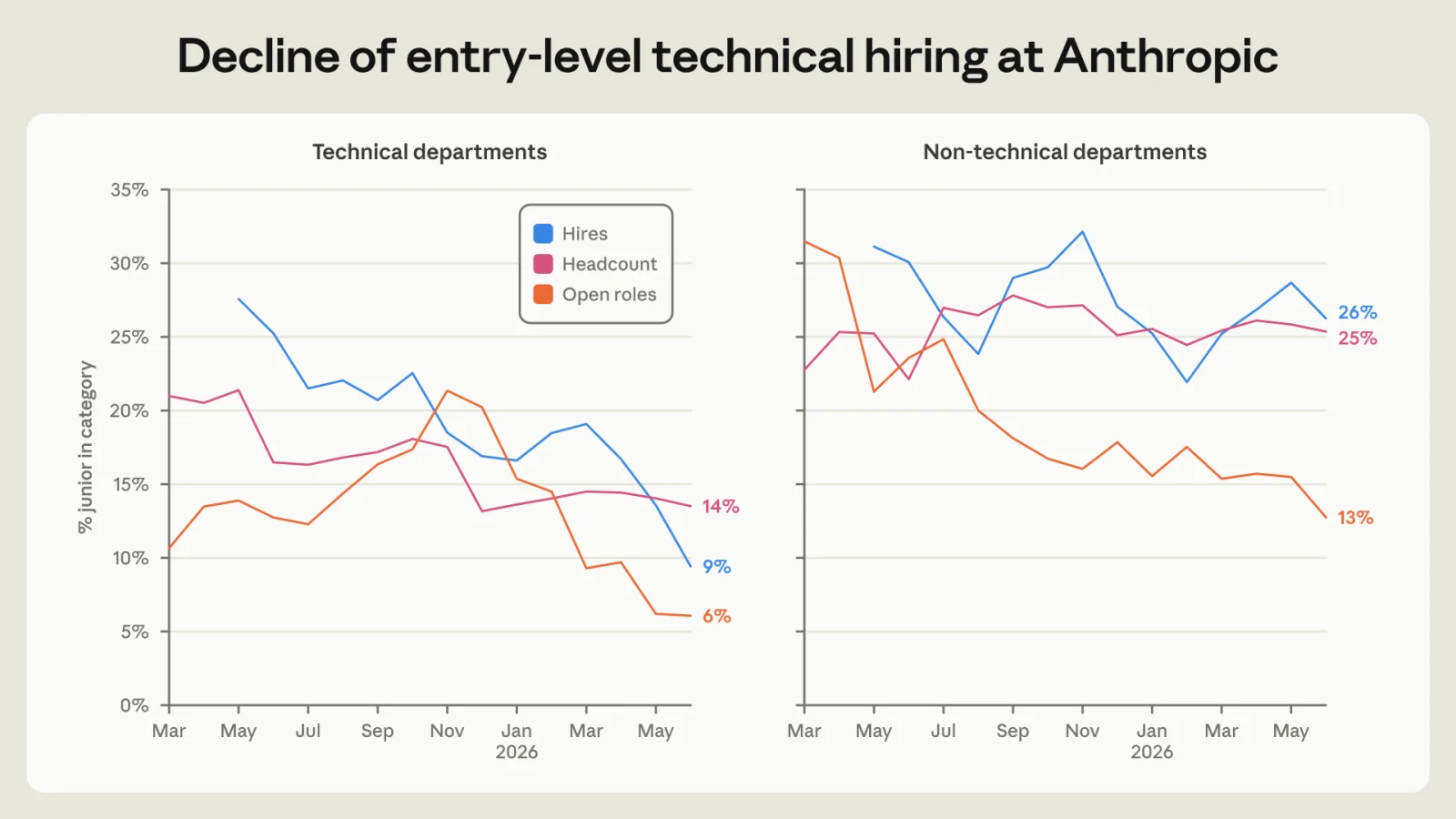 Chart of Anthropic employment trends showing the decline of entry-level technical hiring
Image: Anthropic
Chart of Anthropic employment trends showing the decline of entry-level technical hiring
Image: Anthropic
The company links this to AI directly. In an April 2026 survey, around a third of machine learning managers and a fifth of software engineering managers said they were hiring less because of AI. Total technical hiring still grew in absolute terms, but the technical share of overall employment slipped from 61% to 56%.
This matches the worry that readers have followed for months. Our look at what the data shows on India's IT freshers found that entry-level pressure is real while headline job-loss numbers are often inflated. Anthropic's numbers are narrower and more credible because they come from its own HR records, but they cover one fast-growing company.
One of the report's figures plots junior employment growth by how complex a job's Claude usage was before the decline. The authors use it to suggest that jobs where Claude was used for more complex work saw weaker junior growth, though the chart is a job-level regression and not a controlled experiment.
When did agents start out-working people?
The second striking claim is about volume. Using telemetry, Anthropic says combined autonomous and interactive agent work hours first exceeded human work hours in March 2026. By August 2026, interactive agents worked roughly six hours for every employee hour across employee-directed sessions.
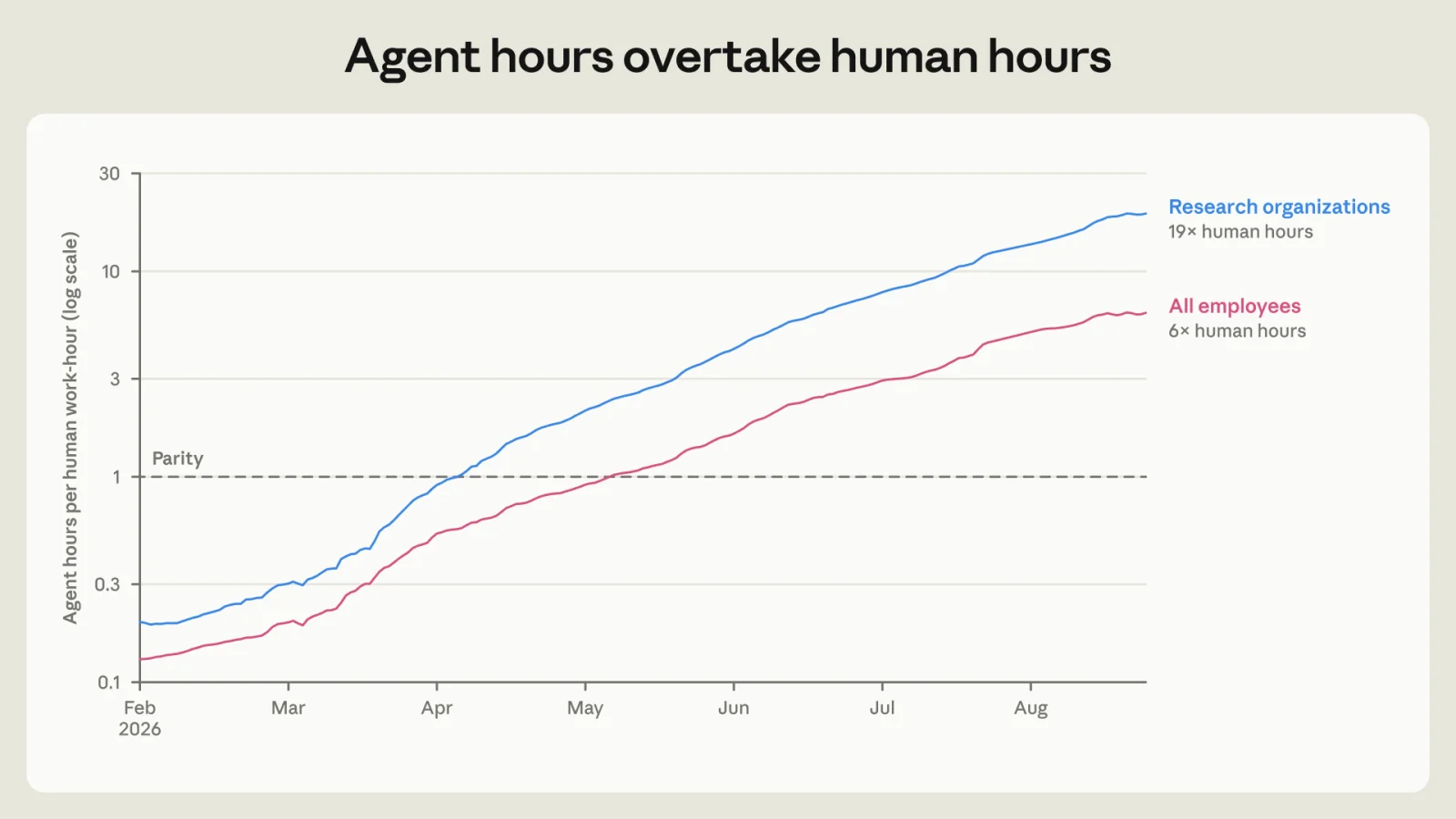 Chart of Anthropic employment: agent work hours overtaking human work hours
Image: Anthropic
Chart of Anthropic employment: agent work hours overtaking human work hours
Image: Anthropic
Read the method note before quoting this. Agent hours mean runtime, including inference and active tool use, with any wait longer than 30 minutes excluded, and subagents pooled. Human hours are headcount times an assumed 40 per week. So "six times more agents than employees" is a modeled ratio of machine runtime to a nominal workweek. It says agents are busy, not that they replace six people each. Anthropic's summary post phrases it as agents outnumbering employees, which is looser than the report body.
How much more productive are engineers?
Anthropic reports that code commits per engineer reached about 5x their level six months earlier, and that non-technical output rose too: lawyers processed more contracts, accounts payable handled more invoices, and salespeople closed more deals per rep. The summary post itself calls lines of code "a notoriously imperfect measure," which is fair.
The report also shows non-engineers moving into coding agents. Coding-agent sessions by non-technical employees rose from 2 per month in August 2025 to 90 per month in May 2026. Within technical departments, the share of employees not actively coding fell by almost half through April 2026. The engineer-to-product-manager ratio is about 17 to 1, and managers' commits have doubled.
How the productivity estimate was built
The team followed 192 engineers who adopted coding agents and 74 who did not, using person and calendar-month fixed effects, with adoption defined as a person's first month with at least five agentic sessions. That is a respectable design, but the authors warn about selection: people about to start big projects may adopt tools sooner, and adopters were already on a steeper output path before they adopted autonomous agents. Anthropic's rapid revenue growth could also confound comparisons.
Did quality suffer?
On the proxies tested, no. For the same person, month and directory, code written by a coding agent showed no difference in lines deleted within 90 days, bug-fix deletions, explicit reverts, lint suppressions, "needs fixing" notes or skipped tests, compared with code the person wrote directly. That is a useful data point for teams debating whether agent output creates hidden debt. It is not proof: these are proxies, 90 days is short, and Anthropic's reviewers and tooling may differ from yours. Pair it with sober views such as the Mercor benchmark map showing most working hours are barely measured.
The new bottleneck: human attention
The most practical finding may be that people, not models, are now the constraint.
- About 80% of interactive Claude session time is idle, waiting for human input.
- For non-technical groups, reading everything interactive Claude wrote would take more than half a work week (the estimate assumes 0.75 words per token and 250 words per minute).
- "Meta-work" such as building agent skills, plans and reviews for other agents, and dashboards for agent pipelines rose from 10% of interactive sessions in fall 2025 to 22% in spring 2026.
- Written standing instructions for agents grew from a few hundred in July 2025 to about 8,500 a year later.
- In an April 2026 open-ended survey, 20% of employees said their role was shifting from doing work to managing Claudes, and 27% described productivity gains.
Meetings did not disappear. The median employee's meeting time rose 20% year over year (16% for technical individual contributors), and agents now appear in nearly half of active public Slack channels, added to human communication rather than replacing it.
If you build with agents, this is the finding to borrow: review, supervision and instruction-writing become the job. Our guide to how the 81% jobs claim was actually sourced shows how easy it is to misread Anthropic's own workforce numbers, so quote the figures with their definitions.
Expectations rise as tools improve
After new model releases, the share of tasks above the 90th percentile of difficulty rose from 10% to 13% and stayed elevated for weeks, suggesting people hand agents harder work once they trust them. The share of employees agreeing their work processes make them as productive as possible climbed from 44% in late 2024 to 58% in November 2025 and 75% in April 2026, though the April wording dropped "as possible," so the last figure is not directly comparable.
Hiring criteria moved as well. Mentions of AI tool use in interview scorecards roughly tripled for technical roles and quadrupled for non-technical roles. For technical candidates, comments on autonomy and judgment grew most while discussion of domain expertise declined. For non-technical candidates, customer and mission orientation rose while execution skills declined.
What Anthropic proposes, and what it leaves open
The authors suggest three ideas:
- Shared ownership: broad employee stock ownership so workers hold a stake in AI-driven gains, compared to the mid-century bargain linking productivity and pay.
- An early-warning system: monitoring role-level demand and productivity against AI capability, to flag roles in transition and guide internal moves.
- Public policy: retraining and income support, since the authors concede internal reallocation does not fix the slowdown in junior hiring.
They also flag a tradeoff: promising to reallocate current staff could make hiring new workers riskier, though it might push firms to create new tasks instead of cutting costs, what economists call "so-so" automation when it goes the other way.
What to be skeptical about
- One company, and an AI lab. The authors say it adopts AI differently from traditional businesses, so generalizing is uncertain.
- Telemetry and survey definitions. Agent hours, meta-work and task difficulty all rely on Claude-based automated coders or modeling assumptions. Meta-work estimates used a sample of 2,000 one-line chat summaries, and 17 employee interviews added color.
- A changed survey question in April 2026 breaks the productivity-perception trend line.
- The revenue-per-employee comparison (2-4x Meta and Google at similar age) is a company-vs-company snapshot and depends on Anthropic's extraordinary growth.
- Anthropic has an interest in showing AI is productive. Independent replication would be better than a self-report.
Context from earlier Anthropic economics work helps: the September GDP scenarios for 2030 set the frame that the new survey uses, and skeptics like Acemoglu's bearish forecast argue for far smaller effects.
What this means for what you build or hire
- If you manage engineers, expect the review burden to rise. Budget time for agent supervision, test infrastructure and written instructions before you budget for more headcount.
- If you are early in your career, the junior-role squeeze is the piece of this report that looks most durable. Autonomy, judgment and ability to direct agents are what interviewers now note.
- If you run agents in production, the idle-time finding suggests designing for asynchronous review, not constant chat.
- If you evaluate vendors' productivity claims, ask for the same things Anthropic disclosed: the unit of measure, the comparison group and the caveats. The fuller adoption picture is covered in our piece on why most households barely use AI.
Agent-heavy workflows also raise safety questions. If your agents run with broad permissions, see AgentBeam, the agent security platform from the explainx.ai team that stops AI agents before they take dangerous actions.
Related reading
- Anthropic's staff vs public AI expectations survey
- Anthropic AI GDP scenarios for 2030
- Fact check: Anthropic's "81% of US jobs" claim
- Acemoglu's bearish AI forecast
- Mercor benchmark map of working hours
- India's IT freshers and AI: data vs claim
- Why 98% of households do not pay for AI
Figures are accurate as of October 16, 2026, and come from Anthropic's published report; they may be revised.