



Update — September 1, 2026: A viral X thread and a 1.1K-upvote r/Anthropic post ("More Drama," u/Borat_2020) revived the Max pricing fight with a sharper claim: Anthropic's checkout UI shows Max 20x with a "Save 50%" badge while the $200 tier delivers only ~1.7× the weekly Sonnet hours of the $100 Max 5x tier — not the 4× the "5x → 20x" labels imply. Users report Anthropic support confirming the multipliers apply to the 5-hour session window, not the weekly cap that actually gates Claude Code marathons. Workarounds circulating: two Max 5x accounts ($200 total) beat one Max 20x on weekly headroom; some builders are switching to Codex or local models (Qwen 3.8). The September 14 limit cut adds urgency. Lawsuit status unchanged: motion to dismiss filed August 19, hearing November 6, 2026.
Update — August 31, 2026: Anthropic filed a motion to dismiss the amended complaint on August 19, 2026; a hearing is set for November 6, 2026 (Case No. 3:26-cv-05763, N.D. Cal.). The core allegation unchanged: Max 20x subscribers pay for twenty times Pro usage but, per the complaint's math on Anthropic's own weekly-hour emails, receive roughly 6–8× Pro on Sonnet and only 1.1–1.6× the Opus hours of Max 5x despite costing twice as much. A separate user-reported failure mode — exhausting ~15% of the weekly allotment inside a single 5-hour session when running flat-out — is what makes the "20x per session" marketing collide with weekly caps for Claude Code power users. Related G20 context: FSB names frontier AI cyber risk.
Update — August 30, 2026: ClaudeDevs announced the 50% promo ends September 14, replaced by a permanent 25% raise — a net ~17% cut vs today's meter. Full math, Theo draft, and trust backlash: Claude Code limits drop 17% on Sept 14.
Update — July 8, 2026: Anthropic also filed a trademark suit against Abnormal AI on July 1, 2026 — see Abnormal vs Anthropic trademark lawsuit for Abnormal's July 7 public response.
Update — July 5, 2026: For the full dated history of every Claude usage-limit change, including the March 2026 off-peak promo and the May 6, 2026 permanent doubling, see Claude Usage Limits in 2026: Every Change Explained.
On June 14, 2026, a plaintiff identified as Kahn filed a proposed class-action lawsuit against Anthropic in California federal court. The target: the company's Claude Max subscription plans, specifically the $100/month Max 5x and $200/month Max 20x tiers. The core allegation is straightforward but damaging—Anthropic marketed these plans with usage multipliers (5x and 20x over Claude Pro) that the company allegedly never delivered.
The timing is notable. The suit was filed the same week Anthropic quietly walked back a separate billing change for the Agent SDK—a one-two punch that has shaken confidence among the power users Anthropic most needs to keep.
TL;DR — What people are asking
| Question | Answer |
|---|---|
| Does 20x mean 20× weekly usage? | No. Anthropic's Max plan help article defines 5x/20x as per 5-hour session capacity vs Pro. Weekly Sonnet hours scale to only ~1.7× from 5x to 20x (140–280 → 240–480). |
| Is the "Save 50%" badge honest? | Not on weekly economics. You pay 2× the price for ~1.7× weekly Sonnet hours — and more per Sonnet hour at 20x than 5x at the published midpoints. |
| Two Max 5x vs one Max 20x? | Same $200/mo spend; two 5x accounts ≈ 2× combined weekly buckets vs one 20x bucket. |
| Lawsuit status (Sep 2026)? | Motion to dismiss filed Aug 19; hearing Nov 6, 2026 (N.D. Cal., 3:26-cv-05763). |
| What should builders do? | Audit Settings → Usage weekly bars, model the Sept 14 cut, compare Codex vs Claude Code, consider BYOK or local models for burst work. |
Session limits vs weekly caps — the math that broke trust
Anthropic runs Claude Max on two independent meters:
-
Rolling 5-hour session window — resets on a sliding clock from when you start heavy use. This is where the 5× and 20× labels apply: Max 5x gets five times Pro's per-session capacity; Max 20x gets twenty times.
-
Fixed weekly cap — resets on a day/time assigned to your account (visible under Settings → Usage). This is the ceiling that stops full-time Claude Code users mid-week regardless of how fresh their 5-hour window is.
Anthropic published illustrative weekly ranges in its Claude Code + Max plan guide (July 2025 figures, still cited in September 2026 threads):
| Tier | Monthly price | 5-hour session multiplier vs Pro | Weekly Sonnet hours (published range) | Weekly Opus hours (published range) |
|---|---|---|---|---|
| Pro | $20 | 1× (baseline) | Lower than Max; shared Sonnet+Opus pool | Shared with Sonnet |
| Max 5x | $100 | 5× per session | 140–280 | 15–35 |
| Max 20x | $200 | 20× per session | 240–480 | 24–40 |
The viral complaint in one line: session math says 20÷5 = 4× more capacity; weekly Sonnet math says 480÷280 ≈ 1.7× at the top of the range (240÷140 ≈ 1.7× at the bottom). You pay 2× the subscription price to gain 1.7× weekly Sonnet headroom.
Cost per Sonnet hour at the published midpoints:
- Max 5x: $100 ÷ 210 h ≈ $0.48/h
- Max 20x: $200 ÷ 360 h ≈ $0.56/h
So the higher tier is more expensive per included Sonnet hour, not less — the opposite of what a "Save 50%" badge suggests.
The "Save 50%" badge — debunked
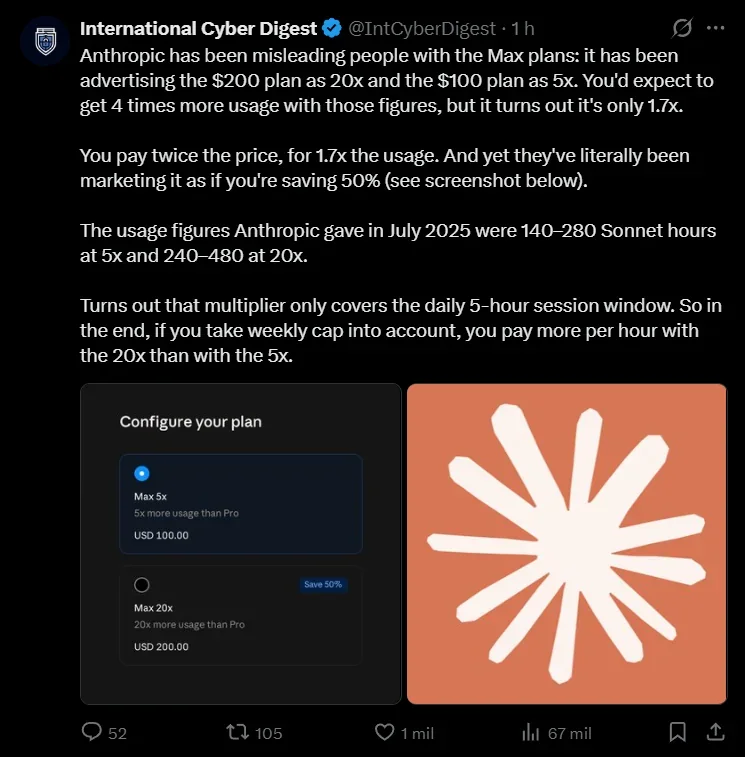 Anthropic Claude Max plan checkout UI showing Max 5x at $100 and Max 20x at $200 with a Save 50% badge on the 20x tier
Screenshot from a September 2026 viral X post showing Anthropic's Max plan selector with a "Save 50%" badge on the $200 Max 20x tier.
The badge compares session multipliers (20× vs 5× Pro = 4× the per-session allowance) to imply a volume discount. But the weekly cap — what determines whether you can run agents all week — does not scale 4×:
| What the UI implies | What the weekly meter delivers |
|---|---|
| Pay 2× → get 4× usage | Pay 2× → get ~1.7× weekly Sonnet hours |
| "Save 50%" vs buying 4× the 5x tier | Higher $/Sonnet-hour at 20x than 5x at mid-range published figures |
| 20× sounds like 20× Pro overall | Complaint + user math: ~6–8× Pro weekly on Sonnet, not 20× |
Reddit's September 2026 thread framed this as false advertising — paying double for less-than-double weekly capacity while the checkout badge suggests the opposite. That aligns with the June 2026 complaint's California UCL/CLRA theories and adds a concrete UI element ("Save 50%") for discovery.
Plan comparison — two Pro accounts vs Max tiers
Use this table for procurement decisions, not legal advice. Weekly figures use Anthropic's published ranges; your account may differ.
| Option | Monthly cost | Session capacity vs Pro | Approx. weekly Sonnet (Anthropic range) | Best when |
|---|---|---|---|---|
| 2× Claude Pro | $40 | 2× separate Pro pools | ~2× one Pro weekly bucket | Light/moderate use, strict budget, can split workloads across accounts |
| Max 5x | $100 | 5× Pro per 5h window | 140–280 h | Daily coding, one identity, priority access |
| Max 20x | $200 | 20× Pro per 5h window | 240–480 h | You hit session walls on 5x, not weekly — rare for most devs |
| 2× Max 5x | $200 | Two 5× session pools | ~280–560 h combined (two accounts) | Same spend as 20x but ~1.2–1.4× more weekly Sonnet at mid-range vs one 20x |
explainx.ai's read: unless you routinely exhaust the 5-hour window on Max 5x and still have weekly headroom left, Max 20x is a session-size upgrade, not a proportional weekly upgrade — and two Max 5x accounts at the same $200 price point often win on total weekly Sonnet hours. Some teams also run Pro + Codex or local Qwen 3.8 for overflow instead of upgrading to 20x.
What the Lawsuit Specifically Alleges
The complaint zeroes in on a gap between marketing promise and real-world delivery.
Claude Max 5x ($100/month): Advertised as providing five times the usage of Claude Pro ($20/month). The lawsuit alleges actual delivered usage is closer to 3.5x Pro—a shortfall of roughly 30% from what's on the tin.
Claude Max 20x ($200/month): Marketed as twenty times the Pro tier. The complaint claims real-world delivery lands at 6-8x Pro—meaning subscribers may be getting as little as a third of what they're paying for.
The suit doesn't just argue about math. It specifically calls out two structural issues with how Anthropic implements limits:
-
Rolling five-hour windows: Rather than a clean daily or monthly usage reset, Anthropic employs rolling five-hour windows that replenish capacity on a sliding basis. For a developer in the middle of an extended Claude Code session, this can feel like hitting a wall mid-task with no clear visibility into when capacity returns.
-
Weekly "conversation budget" caps: The lawsuit alleges that Max plans carry weekly caps on usage—reportedly 24 to 40 hours of conversation budget for heavier models like Claude Sonnet and Opus. These caps were apparently not clearly disclosed at the point of sale, constituting a material omission.
The relief sought is concrete: refunds for US-based buyers of Claude Max plans since April 2025, the month Anthropic launched the Max tier.
The Legal Theory: False Advertising and Breach of Contract
While the full complaint details aren't yet public, proposed class-actions of this type typically plead two primary theories:
False advertising under California's Unfair Competition Law (UCL) and the Consumer Legal Remedies Act (CLRA) — statutes that prohibit misleading statements in product marketing. The "5x" and "20x" labels on Anthropic's pricing page are promotional representations; if they're materially misleading about what customers receive, that's squarely within these statutes' reach.
Breach of contract — when you purchase a subscription, the plan description forms the basis of a contract. If Anthropic's terms don't clearly define what "5x" means (5x token throughput? 5x conversation turns? 5x uptime?), and the delivered experience falls short of a reasonable subscriber's expectation, there's a plausible breach argument.
Consumer protection beyond California: The September 2026 backlash adds a checkout UI angle — the "Save 50%" pill on Max 20x — that maps cleanly onto:
- United States: FTC Act Section 5 (deceptive acts), state UDAP statutes, and the California UCL/CLRA theories already in the complaint. A badge that implies a volume discount while weekly $/hour rises is classic "net impression" litigation fodder.
- European Union: The Unfair Commercial Practices Directive (UCPD) bans misleading "price advantages" when the real economic comparison (here, weekly included hours) doesn't support the claim. EU subscribers who purchased on claude.ai may have parallel national consumer-authority routes independent of the US class action.
The wrinkle here is definitional. Anthropic has not, to public knowledge, published a precise technical definition of what "5x" entails. That ambiguity cuts both ways: it gives Anthropic wiggle room to define the multiplier however it chooses, but it also means subscribers were making purchasing decisions on a metric that was never clearly specified. Courts have historically disfavored sellers who exploit definitional vagueness to their advantage.
If you're evaluating the true cost of AI subscriptions, the lawsuit highlights a broader issue across the industry: usage multipliers and "unlimited" claims are rarely as simple as they appear.
Does the Lawsuit Have Merit?
Honestly? The core claim is plausible.
The 20x plan is the more compelling case. If a $200/month plan delivers 6-8x Pro usage rather than 20x, that's not a rounding error—it's a factor of 2.5 to 3x underdelivery. The gap is large enough that a reasonable subscriber would not have agreed to those terms had they been disclosed upfront.
The 5x plan is closer to the line. A 3.5x versus 5x delta is meaningful (~30% shortfall), but courts will want to see clear evidence that Anthropic's marketing created a specific, measurable expectation rather than a general sense of "more."
The rolling window and weekly cap disclosures are arguably the strongest part of the complaint. Changing usage mechanics "without notice" after someone has already subscribed is a well-established no-no under consumer protection law—especially in California, which has some of the most aggressive consumer fraud statutes in the US.
However, class-action certification is its own hurdle. Anthropic will argue that each subscriber's experience varies based on their usage patterns, model selection, and session length—making a class of "everyone got the same harm" difficult to establish. Expect that to be a major battleground.
The Agent SDK Walkback: Same Week, Same Pattern
The lawsuit didn't land in a vacuum. In the same week it was filed, Anthropic paused a planned billing change for its Agent SDK that would have altered how programmatic usage credits were applied to Claude-powered agents. After developer backlash, Anthropic reversed course.
Our coverage of the Claude programmatic usage credits change captures that incident in detail. The pattern that emerges from both events: Anthropic has been making consequential changes to how usage is measured and billed, sometimes without adequate advance disclosure, and then walking them back when the response is loud enough.
This creates a credibility problem. Power users—the very customers spending $100-200/month on Max plans—are also the ones most likely to notice when usage behavior changes mid-subscription and most capable of calculating exactly what they're getting versus what they were sold.
What This Means for Claude Max Subscribers — and builders
If you're currently on a Max plan, here's what's practically relevant:
The lawsuit is in early stages. Class certification alone could take 6-12 months, and a full resolution could stretch years. You're not getting a check in the mail next week. But the filing does serve a signaling function—it tells Anthropic that the gap between marketing language and delivered experience has reached the threshold where courts get involved.
Audit before the September 14 cut: The permanent 25% weekly raise (net ~17% below today's 50% promo meter) lands the same week this story went viral. Open Settings → Usage now, screenshot your weekly bars, and model post–Sept 14 capacity before renewing Max 20x.
On the usage limit realities: The Claude Code pricing guide covers this in depth, but the short version is that Claude Max plans are designed for heavy interactive use, not unlimited programmatic throughput. Developers running long agentic coding sessions—precisely the use case Anthropic markets Max toward—are the users most likely to hit rolling window limits. If your workflow depends on sustained multi-hour Claude Code sessions, know that you may hit caps mid-task and plan your sessions accordingly.
On the "5x" and "20x" framing: Treat session multipliers and weekly caps as separate contracts. Anthropic's Max plan article states both limits explicitly; the Claude Code usage guide lists the Sonnet/Opus hour ranges. Until checkout copy matches weekly economics, assume marketing multipliers are session-only.
Alternatives if 20x math doesn't work:
- Stay on Max 5x and enable usage credits for overflow instead of doubling subscription price.
- Split workloads — second Pro or second Max 5x account for batch jobs; keep primary identity on one subscription.
- Dual harness — Codex vs Claude Code split (plan in Claude, execute in Codex) or local open-weight models for offline bursts.
- BYOK API — pay per token when subscription buckets are the wrong shape; see true cost of AI subscriptions.
On refund requests: If you feel materially misled about what you purchased, you don't need to wait for litigation. Contact Anthropic's support directly. Companies under active legal scrutiny tend to handle refund requests from individual subscribers more generously than usual—the calculus around refunding one subscriber versus becoming a named example in discovery generally favors the refund.
The Broader Stakes for Anthropic
The practical financial exposure here may be limited—Anthropic can point to its terms of service and the inherent variability of AI workloads. But the reputational stakes are higher.
Anthropic has deliberately positioned itself as the "trustworthy" AI company—safety-focused, transparent, reliable. A lawsuit alleging that its most committed subscribers were systematically misled about what they were buying is precisely the kind of story that undermines that positioning. It also arrives as competitors—including Google's Gemini, which was among the first accounts to amplify the news—are watching closely.
The community reaction (@0xgaut's wry take that "Anthropic sells thousands of dollars worth of compute for $200 a month and gets sued anyway" captures the absurdity from one angle) suggests some sympathy for Anthropic's position. But sympathy doesn't negate the legal obligation to clearly describe what you're selling.
The Bottom Line
The Claude Max lawsuit filed June 14, 2026 is a serious challenge to how Anthropic markets its premium subscription tiers. The core allegations—that the 5x and 20x multipliers are materially misleading and that rolling windows and weekly caps weren't adequately disclosed—are plausible and supported by accounts from frustrated power users.
The September 1, 2026 viral wave adds a sharper, UI-level claim: the "Save 50%" badge on Max 20x is hard to reconcile with Anthropic's own 140–280 vs 240–480 weekly Sonnet ranges. Session multipliers scale 4×; weekly Sonnet scales ~1.7×; price scales 2×. That's the gap Reddit, X, and the original complaint keep circling.
Whether it ultimately succeeds in court depends on certification, definition of damages, and how Anthropic's terms are construed. But it's already forcing a conversation that needed to happen: in an era where AI subscriptions are priced on usage multipliers and vague capacity language, customers deserve precise, measurable, legally defensible descriptions of what they're actually buying.
For Anthropic, the path forward is clear even if inconvenient: publish a precise definition of what "5x" and "20x" mean per meter (session vs weekly), surface both limits prominently at checkout, remove or reword "Save 50%" until weekly economics support it, and stop making billing changes without advance notice to subscribers. That won't make the lawsuit disappear, but it would demonstrate that the company heard the message.
Related on explainx.ai
- Claude Code limits drop 17% on Sept 14 — promo vs permanent math
- Claude usage limits 2026 — every change, dated
- Claude Code pricing guide — Pro vs Max 5x vs Max 20x
- Codex vs Claude Code — harness comparison for switchers
- True cost of AI subscriptions — ChatGPT, Claude, Gemini
- AI and law — consumer protection context for AI products
- Claude Max INR pricing — India checkout parity
Primary sources:
- Anthropic Help Center, What is the Max plan?
- Anthropic Help Center, Using Claude Code with your Pro or Max plan
- Anthropic Help Center, Choose a Claude plan
- Case No. 3:26-cv-05763, N.D. Cal. — motion to dismiss filed August 19, 2026; hearing November 6, 2026
- r/Anthropic, "More Drama" thread (u/Borat_2020), ~September 1, 2026
- X post on Max "Save 50%" pricing (@IntCyberDigest), ~September 1, 2026
Pricing figures, weekly ranges, and lawsuit status are accurate as of September 1, 2026. Check Anthropic's help center and your Settings → Usage dashboard for current limits.
Have you hit Claude Max usage limits unexpectedly? We'd like to hear about your experience—reach out via the explainx.ai community.