




Update — July 7, 2026: ID verification is going live in the product. Community reports (BridgeMind and others) describe a phased KYC rollout — users upgrading to Claude Pro or Max now hit a "Quick identity check" modal before checkout completes. Requirements match the support page: government-issued photo ID, mobile camera, handoff to Persona. Anthropic's updated privacy policy takes effect July 8. Fable 5 has been live globally since July 1; leaked app strings still tie usage credits to verified identity. Fable status · Redeploying Fable safeguards
Anthropic published identity verification requirements for Claude months ago on its support page — government-issued photo ID, optional live selfie, processed by Persona Identities. Until July 2026 that read mostly as policy language for edge cases. Now the modal appears in the subscription upgrade path (claude.ai/upgrade/max), which changes the user experience from "maybe someday" to paywalled behind KYC for new paid signups in the rollout cohort.
The combination still produces a polarised reaction. Privacy advocates warn that connecting an AI company's identity infrastructure to a Peter Thiel-backed vendor is a structural risk regardless of stated data-deletion policies. Industry observers counter that ID gating for high-capability AI access is the direction the entire sector is moving — especially after distillation bot farms and export-control fights over Fable. Both camps are right about different things.
TL;DR — what people are asking (July 7, 2026)
| Question | Answer (sourced) |
|---|---|
| Is this live or still just a help page? | Live in phased rollout — users report the modal at Pro/Max subscription checkout. Not every account sees it yet. |
| What does the modal ask for? | Government-issued photo ID + mobile camera; ~2 minutes; handoff to Persona (per in-app copy and support page). |
| Existing subscribers too? | Unconfirmed. Reports focus on "before you start your subscription" — retroactive prompts for current Max/Pro users not verified publicly. |
| Why now? | Official: abuse prevention, policy enforcement, legal compliance. Community theories: bot/sub-account farms, US-first model access, Fable/Mythos tier gating — not confirmed by Anthropic. |
| Same as Co-Scientist / OpenAI? | Different product — but industry pattern matches OpenAI ID checks on high-risk API tiers. |
| Can I use multiple sub accounts? | KYC ties one identity to one verified account — multi-account arbitrage gets harder if rollout expands. |
| Persona / Thiel concerns? | Persona holds ID/selfie; Anthropic is data controller. Persona section below unchanged. |
Live rollout — subscription checkout (July 7, 2026)
Users upgrading to Claude Max (and related paid tiers) are reporting a blocking step before payment:
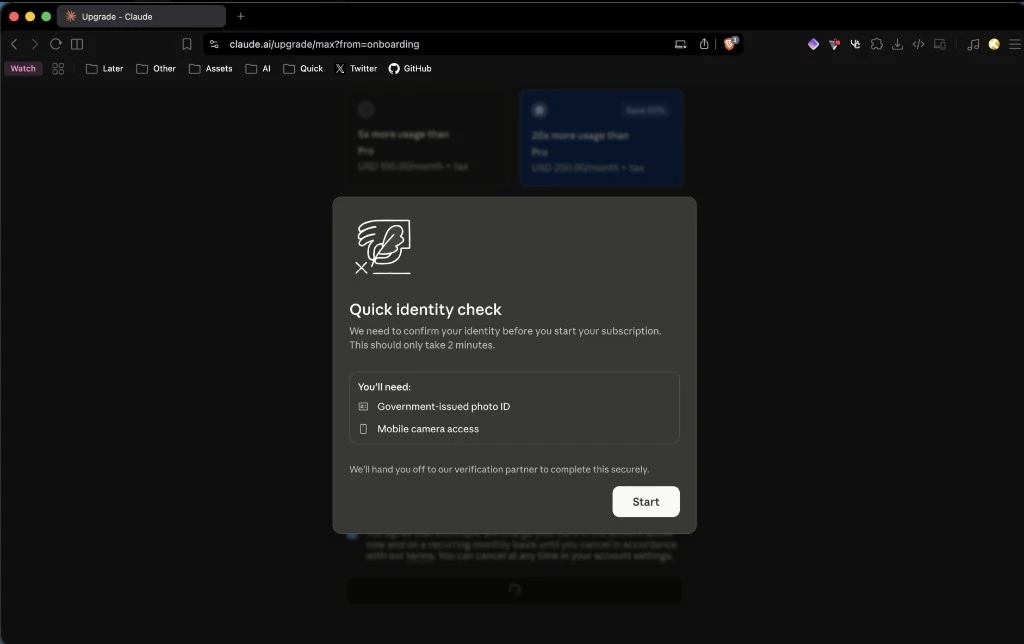 Claude Max upgrade Quick identity check modal — government photo ID and mobile camera required before subscription starts
What the modal says (verified from user screenshots):
- Title: "Quick identity check"
- Copy: "We need to confirm your identity before you start your subscription. This should only take 2 minutes."
- Requirements: Government-issued photo ID · Mobile camera access
- Footer: "We'll hand you off to our verification partner to complete this securely."
- URL pattern:
claude.ai/upgrade/max(and similar upgrade paths)
This is stronger than the support page's vague "certain capabilities" framing for users who hit it — subscription is itself the capability being gated. Anthropic has not issued a press release or blog post naming subscription checkout as a trigger; this section reflects July 7 community reports plus screenshot evidence, cross-checked against the existing Identity verification on Claude requirements.
Privacy policy timing: Anthropic's widened consumer privacy policy — explicitly covering government ID and biometric data — is effective July 8, 2026 (consumer Free/Pro/Max only; Team/Enterprise/API governed separately, per reporting on the policy update).
What Anthropic's Support Page Actually Says
The official page is straightforward. Anthropic frames verification around three justifications: preventing abuse, enforcing usage policies, and complying with legal obligations. The rollout is described as selective—users will see a verification prompt "when accessing certain capabilities, as part of our routine platform integrity checks, or other safety and compliance measures."
The verification process requires:
- A valid government-issued photo ID — passport, driver's licence, or equivalent — physical document in hand, not a photo of a photo.
- A phone or a computer with a camera — you may be asked to take a live selfie via phone or webcam.
- A few minutes — Anthropic estimates the process takes under five minutes.
The selected partner is Persona Identities, chosen according to Anthropic "based on the strength of their technology, privacy controls, and security safeguards."
On data use, Anthropic's language is unambiguous: "We only use your verification data to confirm who you are and not for any other purposes." What the page does not specify is the retention window before deletion, the data-sharing terms between Anthropic and Persona, or which specific capabilities will trigger a prompt.
The Persona Question
Persona Identities is a well-regarded identity infrastructure company used by fintechs, crypto exchanges, and regulated industries. It is not a fringe vendor. Its technology powers KYC flows for companies in categories where identity verification is legally required. On technical merit, the choice is defensible.
The controversy centres on investor lineage. Peter Thiel, whose political views and intelligence community ties have made him a recurring flashpoint in tech policy debates, is among Persona's backers. For users already uncomfortable with data flowing to AI companies, the addition of a Thiel-affiliated verification layer raises questions about:
- Data isolation: Is Persona's identity graph strictly siloed from its other customers and investors?
- Government requests: Thiel's relationships with US intelligence and national security apparatus lead some critics to ask whether a government subpoena to Persona would indirectly expose Claude users.
- Prompt correlation: If Anthropic shares a session identifier alongside an identity verification event, could that link a real-world identity to a specific conversation thread?
Anthropic has not addressed these questions publicly beyond the support page language. Persona, for its part, publishes standard SOC 2 compliance materials and states that biometric data is deleted after verification — matching Anthropic's claim.
The critics are raising structurally valid questions. The supporters are also right that OpenAI, Google, and other frontier providers have moved toward similar verification requirements for their highest-capability access tiers. The novelty here is not the mechanism — it is the timing.
Fable 5, Mythos, and the Export Control Context
To understand why the timing matters, it helps to know where Anthropic is right now.
Fable 5 launched June 9, 2026, was suspended June 12–30 under US export controls, and restored globally July 1. Fable 5 and Mythos remain subject to safeguard and rate-limit changes as of July 2026.
The stated rationale for the ban is not a narrow software vulnerability. The NSA Director reportedly told a Senate Intelligence Committee briefing that Mythos, in a red-team exercise, autonomously breached nearly all of the NSA's classified systems within hours. Senator Mark Warner quoted the briefing publicly on June 11 — one day before the ban — saying: "It would have been irresponsible to not impose export controls on it." Separately, Amazon — Anthropic's largest investor — reportedly flagged a jailbreak of Fable to the Commerce Department, though the precise sequence of events remains disputed.
Anthropic's updated privacy policy (effective July 8, 2026) explicitly enumerates government-issued ID and biometric data among data categories it may collect on consumer accounts. Read alongside the July 7 subscription-checkout rollout, analysts still see a plausible thread: verified identity as a prerequisite for frontier model access, usage credits, or Mythos-tier capabilities — whether or not export controls fully lift for all geographies. X speculation that ID verification could unlock Mythos for verified users is community theory only; Anthropic has not confirmed it.
What the Verification Covers (and What It Doesn't)
Anthropic's language is deliberately vague about scope. "Certain capabilities" is not defined on the support page — but July 7 reports add a concrete trigger: starting a paid subscription (Pro/Max upgrade flow).
Based on community reports and the structure of the support page, likely candidates include:
- New Pro/Max subscriptions — live in phased rollout (screenshot above)
- Fable 5 usage credits — leaked strings tie credits to verified identity even after July 1 restore
- High-compute agentic tasks — long-running autonomous agent workflows
- Platform integrity flags — accounts flagged for abuse, unsupported regions, or policy violations
What may not require verification (yet): standard free-tier Claude.ai chat for users who never hit a gated flow. Existing subscribers' experience is unclear until Anthropic documents retroactive checks.
For enterprise and API customers, the picture is less clear. Enterprise agreements may handle verification differently, potentially through corporate identity attestation rather than individual ID submission.
The Privacy Risk Framework
Users evaluating whether to complete verification should think through three distinct risk categories:
1. Data-at-rest risk: The ID document and selfie are transmitted to Persona. Even if Persona deletes them post-verification per policy, there is a window of exposure. Any data breach at Persona during that window could expose your government ID details. This is the same risk that exists when verifying identity for a bank, a crypto exchange, or a healthcare portal — not novel, but real.
2. Identity-to-session linkage: If verification creates a persistent linkage between your real identity and your Claude session history, that changes the threat model for sensitive conversations. Professional users — lawyers, journalists, security researchers, therapists using Claude for administrative work — may have legitimate reasons to prefer pseudonymous access. Whether Anthropic creates or maintains such linkage is not stated.
3. Third-party data requests: Any entity holding your verified identity data can receive government requests (subpoenas, national security letters). Both Anthropic and Persona are US entities subject to US legal process. This has always been true for Claude account data. Verification adds biometric data and a higher-confidence identity assertion to the package.
For most users, these risks are comparable to existing identity verification flows at other services. For users with specific threat models — journalists in sensitive reporting situations, security researchers, users in countries with difficult US diplomatic relationships — the calculus is different.
Industry Precedent: Is This Actually Standard?
Supporters of Anthropic's move frequently cite OpenAI. That comparison is accurate in substance. OpenAI requires government ID verification for:
- Certain o-series reasoning model access
- API operator accounts above specific volume thresholds
- Features that interact with payment systems or sensitive data categories
Google has similar verification flows for Gemini Ultra access in regulated enterprise contexts. The direction of travel across frontier AI companies is clearly toward higher identity assurance for higher-capability access. The trend predates the Fable 5 ban by at least a year.
What is somewhat new is biometric verification (the live selfie component) as a consumer-facing requirement. Document-only verification is common; liveness checks are more typically reserved for financial services, age verification for adult content, and similar regulated categories. If Anthropic is moving toward liveness checks for AI access, it is slightly ahead of where the broader AI industry has landed — though not outside the range of what regulated-industry precedent suggests is coming.
What Should Users Do?
If you use Claude Free and never upgrade: You may never see verification — unless flagged for integrity checks.
If you are upgrading to Pro or Max in July 2026: Expect the Quick identity check modal. Have a physical government ID and phone camera ready; digital/mobile IDs are rejected per the support page.
If you are already on a paid plan: Watch for retroactive prompts — not confirmed as of July 7. Check Anthropic emails and in-app notices.
If you are a developer on Claude's API: Team/Enterprise/API may follow different rules. Review the July 8 consumer privacy policy only if it applies to your account type.
If you want Fable 5 / Mythos-tier access: Prepare to verify. Usage credits may still require identity even with Fable live.
If you have specific privacy concerns: Opting out means opting out of gated capabilities — increasingly including new paid subscriptions in the rollout cohort.
The Bigger Picture
Anthropic's verification rollout is a signpost for where AI access is heading: capability and identity assurance are converging. The most powerful models will not be freely accessible to anonymous users. This is partly driven by government pressure, partly by genuine safety considerations, and partly by the commercial incentive to create premium access tiers that are defensible to regulators.
For users who came to Claude precisely because it felt like a capable AI without the surveillance overhead of consumer tech platforms, this shift is disorienting. For regulators and national security officials who have watched Mythos demonstrate autonomous offensive cyber capability in a classified exercise, some form of access gating seems, at minimum, understandable.
The Persona choice remains the most legitimate unresolved question. Anthropic's rationale — "strength of technology, privacy controls, and security safeguards" — describes the vendor accurately on technical terms. Whether the investor network attached to that vendor belongs in the threat model for an AI company's identity infrastructure is a question Anthropic has not engaged with publicly.
Read next: Token relay market — why KYC only moves abuse · Leaked Claude App Strings — Fable Credits + ID Verification · Anthropic Redeploying Fable 5 — July 2026 · Is Fable 5 Back? · 25,000 Fake Accounts & Distillation · Will Fable 5 Only Be Available in the USA? · France and UK social media age-verification laws for minors
This article reflects the situation as of July 7, 2026. ID verification rollout is phased — your account may or may not see prompts yet. Verify directly with Anthropic's support page and privacy policy before making decisions based on any specific claim here.