



84% of high school students say they've used generative AI for schoolwork. Most schools responded by buying detection software — and most of that software isn't actually detecting what they think it's detecting. This is the gap that matters most in the AI-and-education conversation right now: real statistical watermarking, the kind Anthropic and Google actually build into their models, is almost entirely absent from classrooms today. What's there instead is a different, older, and far less reliable technology wearing the same name.
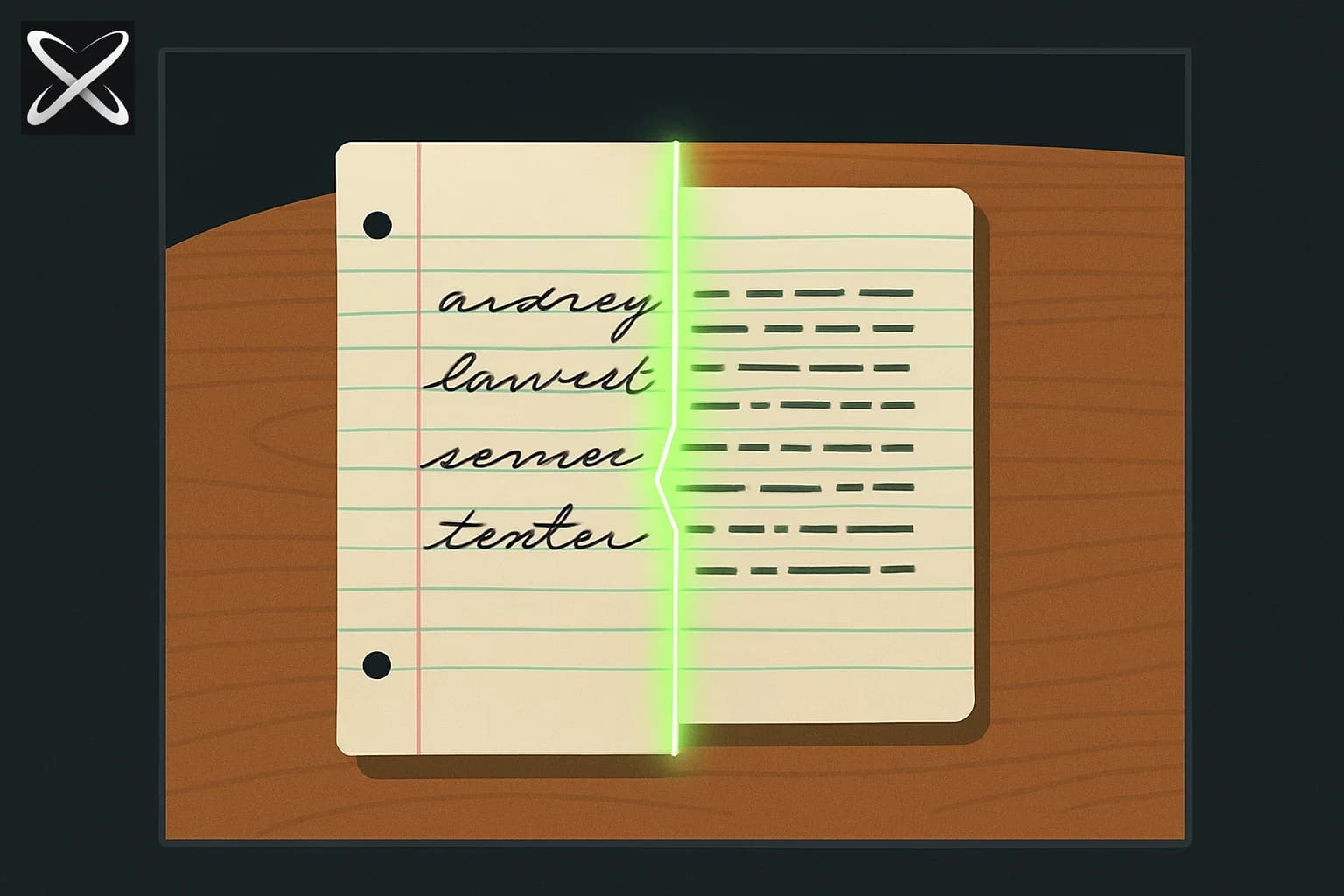
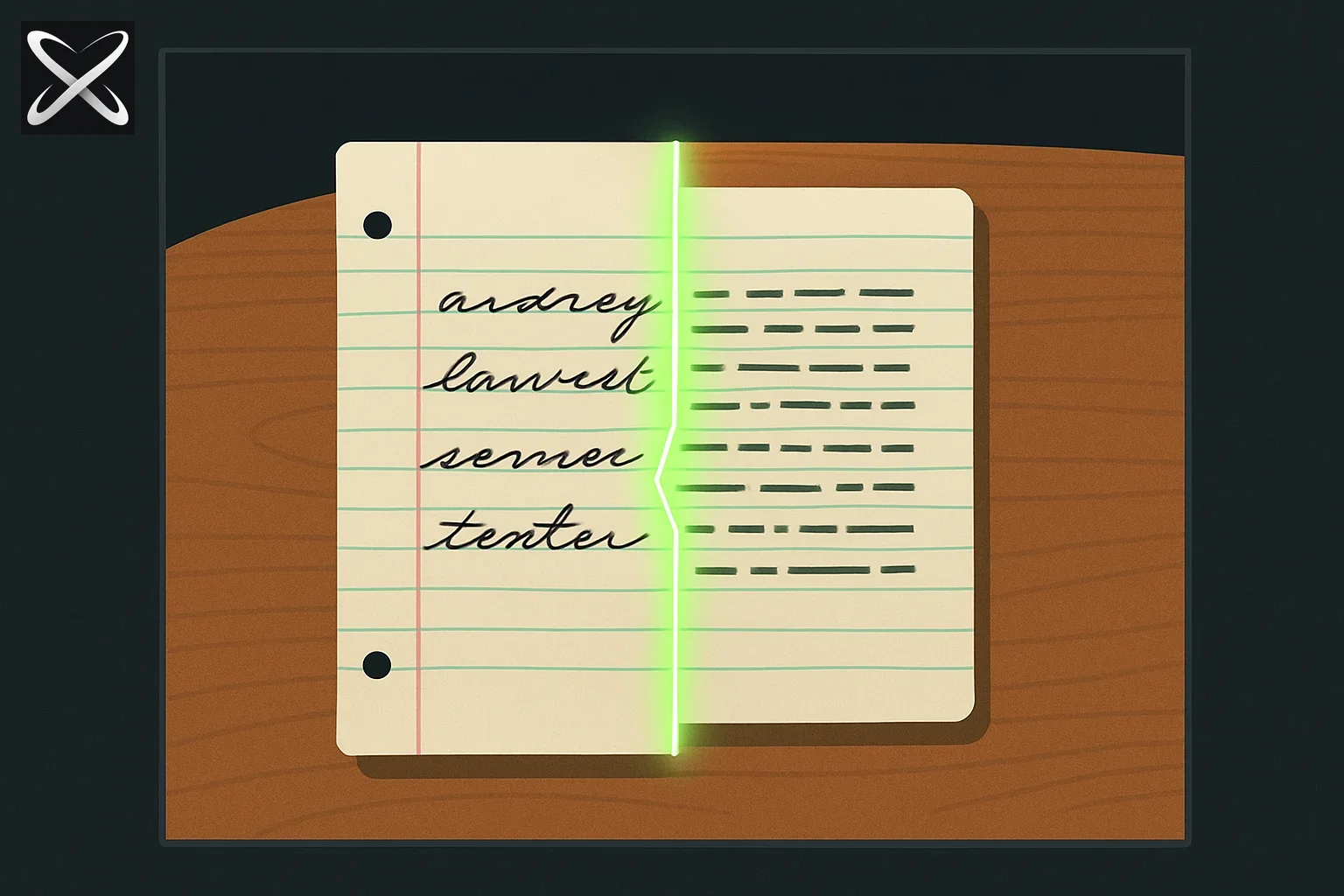 Handwritten text blending into typed text on a single page, symbolizing the blurred line between student and AI-assisted writing
How much schoolwork is actually AI-assisted now
The numbers moved fast, and they keep moving:
| Metric | Figure | Source |
|---|---|---|
| High schoolers who used AI for schoolwork in 2025 | 84% | College Board |
| Middle-school+ students using AI for homework, May 2025 | 48% | RAND American Youth Panel |
| Same figure, December 2025 | 62% | RAND American Youth Panel |
| College students using AI daily/weekly for coursework | 64% | RAND |
| College students using AI to check homework answers | 60% | RAND |
| Schools with an actual AI-use policy | ~30% (3 in 10) | Fortune, July 2026 |
| Students who believe heavy AI use harms critical thinking | 67% (up from ~56% ten months earlier) | RAND, December 2025 |
The most common uses, per the same RAND data, aren't wholesale essay generation — they're getting better explanations of assignments (38%), brainstorming (35%), looking up facts (33%), and drafting or revising writing (33%). Teachers, separately surveyed, say students are most likely to lean on AI specifically for generating essays and written assignments — a gap between what students report doing and what teachers suspect is happening that's itself a source of friction.
That gap matters for policy design. If teachers assume most AI use is wholesale essay generation, but most students report using AI for explanation and brainstorming instead, then a detection policy built around catching generated essays will both miss a lot of what's actually happening and flag legitimate, arguably beneficial uses (asking an AI to explain a confusing homework prompt, for instance) as if they were the same violation as submitting a fully generated paper. The RAND finding that 67% of students now believe heavy AI use harms their own critical thinking — up sharply from roughly 56% less than a year earlier — suggests students themselves are increasingly ambivalent about their own usage patterns, which is a more nuanced starting point for classroom policy than a blanket ban-or-allow framing captures.
The structural problem underneath all of this: only about 3 in 10 schools have any formal AI-use policy at all, which means most classrooms are improvising rules in real time, often built around detection tools whose accuracy claims don't hold up.
The tool schools use is not the watermark you think it is
This is the distinction that gets lost constantly, and it's worth stating plainly: Turnitin, GPTZero, and Originality.ai are not watermark detectors. They're classifiers — statistical models trained to guess whether a piece of text "sounds like" AI output, based on writing style, sentence-length patterns, and vocabulary choices. They have no connection to any specific AI lab's models, no cryptographic key, and no way to verify their guesses against ground truth. explainx.ai's own coverage of classical ML text detection covers how these systems actually work under the hood — TF-IDF features and SVM classifiers, the same family of technique that predates modern LLMs entirely.
Real watermarking — the mechanism Anthropic and Google DeepMind actually build — works completely differently. It biases a model's own token choices at generation time using a secret cryptographic key, and detecting it requires that same key. It cannot be reverse-engineered from writing style, and it produces a mathematically derivable false-positive rate rather than an empirically estimated one. Neither Anthropic nor Google currently offers a public detector schools can actually use — Anthropic has said a detection API is "forthcoming," and Google runs a limited early-access portal for SynthID. Until that changes, what's deployed in classrooms today is almost entirely the older, unreliable classifier technology, not the watermarking this whole story is nominally about.
The real cost of getting this distinction wrong
Because schools are relying on classifiers rather than real watermarks, the accuracy problems are severe and unevenly distributed:
- Overall false-positive rates of 10-30% on genuinely human-written text, across multiple independent studies of popular detection tools.
- A 61.3% mean false-positive rate for TOEFL essays written by Chinese students, versus 5.1% for essays from US students — a massive disparate-impact gap that penalizes non-native English writers for using more formal, less idiomatic phrasing patterns that happen to correlate with AI-generated text in these classifiers' training data.
- 20% of Black teens falsely accused of using AI on an assignment, compared with 7% of white teens and 10% of Latino teens, per survey data on student experiences with detection tools.
- Real, named consequences: a 17-year-old student, Ailsa Ostovitz, was accused of academic misconduct after a detector flagged her original work with a 30.76% AI-probability score — a number a teacher initially treated as damning despite representing meaningful uncertainty, not proof.
None of this is a watermarking problem in the technical sense this blog usually covers — it's a classifier-accuracy and institutional-trust problem, wearing watermarking's name because schools, parents, and students conflate the two. That conflation matters because it shapes expectations: a parent told "the school uses AI detection" reasonably assumes something closer to the cryptographic certainty watermarking promises, not a style-guessing model with a documented one-in-three chance of being wrong on some populations of writers.
What would actually change if real watermarking reached schools
If Anthropic, Google, or OpenAI ever ship a school-usable watermark detector, the honest assessment is: better, but not a fix.
The good:
- A mathematically derivable false-positive rate is a real improvement over guessed classifier accuracy — schools could set a threshold with known, stated error rates instead of trusting a vendor's marketing claims.
- Detection tied to a specific model's actual output removes the "does this just sound formal" bias that drives the non-native-English false-positive gap, since the signal is about token statistics, not style.
- A positive result would mean something closer to "this text was very likely generated by this specific model," rather than a classifier's vaguer style-based guess.
The bad, which doesn't go away:
- Watermarking still requires enough unedited text to accumulate a statistical signal — short answers, heavily-revised drafts, and content from any non-watermarking model (which is most models students could plausibly use, including open-weight local models) would still produce no detectable result, which schools would have to interpret correctly as "unknown," not "clean."
- Only the provider holds the detection key, so a school would still be trusting a single company's black-box tool rather than gaining independent verification — the same secrecy critique explainx.ai covered in the debate over Gruber's watermarking critique applies just as much to a classroom use case as a newsroom one.
- A detected watermark proves a passage was processed by a model, not that a student authored the ideas dishonestly — a student who used AI to fix grammar in an otherwise original essay could still trigger a detectable signal on the edited portions, exactly the proofreading-exposure problem already documented for professional writers and developers.
What teachers and students should actually do right now
- Ask which technology a school's policy is actually referring to. "AI detection" almost always means a classifier today, not a lab's real watermark — knowing which one changes how much weight a flagged score deserves.
- Treat any single score as a conversation starter, never a verdict. Given documented 10-30%+ false-positive rates and severe bias against non-native English writers, a flagged assignment needs corroborating evidence — draft history, revision timestamps, or a direct conversation — before any consequence follows.
- Build policy around process, not just output. Schools with the fewest false-accusation problems tend to require visible drafting stages (outline, rough draft, revision) rather than relying on a single final-text scan — process evidence is far more reliable than any current detection technology.
- Students: understand what "using AI" actually covers. The RAND data shows most student AI use is explanation, brainstorming, and fact-checking — categories most policies don't intend to punish — rather than wholesale essay generation. Knowing where a specific school's policy actually draws that line matters more than avoiding AI tools altogether.
- Watch for the real watermark detectors, not the marketing claim of one. When Anthropic, Google, or OpenAI actually ship a public, school-usable detection tool, it will represent a genuine accuracy improvement over today's classifiers — but "AI detection" being used by a school right now almost certainly isn't that yet.
Related on explainx.ai
- How AI Text Watermarking Works (with interactive demo)
- Gruber vs. the Technical Rebuttal on Claude's Watermark
- What AI Watermarking Actually Changes for Developers
- What AI Watermarking Actually Changes for Marketers
- LLM Text Detection with Classical ML — TF-IDF + SVM That Still Works
- Will All AI Models Watermark Their Output?
- Los Angeles Reportedly Bans Student AI Use Across All K-12 — why blanket bans and unreliable detectors are two sides of the same enforcement problem
Figures reflect College Board, RAND American Youth Panel, and Fortune reporting on 2025-2026 AI-in-education survey data, and published research on classifier false-positive rates as of publication. Detection-tool accuracy and school policy both change quickly — verify current figures before relying on any specific number for a policy decision.