




"AI solved Navier-Stokes" was the headline in September. On October 2, Cambridge maths PhD student Ellie Sleightholm posted a two-minute video titled "No, AI didn't just solve the Navier-Stokes equations." It passed 340,000 views within two days, and the replies are a case study in how a narrow mathematical result turns into a very different story by the time it reaches a timeline.
This post gives you the full transcript of that video, the precise claim OpenAI made, and a practitioner's answer to the question that matters if you build with AI: what does this change for me?
TL;DR: the questions people actually ask
| Question | Short answer |
|---|---|
| Did AI solve Navier-Stokes? | It claims a proof of finite-time blow-up with smooth forcing. That is a narrow Millennium Prize variant, not "fluid dynamics solved." |
| Will my CFD or weather model improve? | No. Engineers have solved these equations numerically for decades; this result is about whether smoothness can fail in the idealized math. |
| Is it a $1M win? | No. The Clay Institute has not certified it and OpenAI says it will not claim the prize. |
| Is it peer reviewed? | Not independently. A Lean proof exists, which verifies the logic, not the framing. |
| Was it a simulation? | No. It is a written argument plus a formal Lean proof. |
| Is the "real" problem still open? | Yes. The unforced versions (Clay options A and B) are generally considered the deeper questions and remain unsolved. |
Full transcript of the video
The transcript below was generated from the original video with ElevenLabs Scribe and lightly cleaned for punctuation. The video is by Ellie Sleightholm, from her series "Mathematics in the Age of AI." Credit and rights remain with her; watch the original on X for the full presentation.
[0:00] No, AI didn't just solve the Navier-Stokes equations. Welcome back to my series on Mathematics in the Age of AI. I'm Ellie, a PhD student in mathematics at the University of Cambridge. The Navier-Stokes equations are the fundamental equations we use to describe how fluids move. They relate things like the fluid's velocity, pressure, and viscosity to the forces acting on it, allowing us to model how air flows over an aircraft, how water moves through a pipe, or how weather systems evolve, but they are still a model.
[0:30] You see, real fluids aren't continuous all the way down. Air and water are made of molecules, and the Navier-Stokes equations basically treat a fluid as a continuous medium, which is an extremely useful approximation at the scales that we normally care about. And it turns out that engineers have been solving these equations numerically for decades. It's the same reason we can see how aerodynamic a cow is.
[0:54] No, really. Now, what OpenAI claims to have solved is the Navier-Stokes Millennium Prize Problem, and this asks something much narrower. For the three-dimensional incompressible Navier-Stokes equations, if you start with a smooth flow, does the mathematical solution always remain smooth forever, or can it develop a singularity, essentially a blowup, in finite time?
[1:15] This is a profound mathematical question, but it's not the same question as asking if we can calculate the airflow over a wing. Engineers work with finite meshes, finite time intervals, and experimental data. They don't need to know whether an idealized continuous velocity field stays perfectly smooth at arbitrarily small scales forever. This announcement doesn't mean that your aircraft is suddenly going to become more aerodynamic, or that CFD is obsolete, or that the weather forecast is suddenly revolutionized.
[1:42] Yes, Navier-Stokes being solved is a great headline. It's just different to what most people think.
What Ellie's video gets right
Her argument rests on a distinction that gets lost in headlines: solving the equations and proving a statement about all solutions are different jobs.
Numerical solution. Computational fluid dynamics (CFD) discretizes the equations on a mesh and steps forward in time. It gives an answer for one geometry, one set of conditions, one time window. It is how aircraft wings, pipes and weather models already work.
Mathematical regularity. The Millennium Prize asks a universal question: for the idealized continuous equations in three dimensions, can a smooth starting flow ever develop infinite velocity in finite time? No finite number of simulations can settle a "for all" or "there exists" statement of that kind. It takes a proof.
That is why a result in this area, even a real one, says almost nothing about drag on a wing. Her line that the headline is great but "different to what most people think" is the core of the explainer.
What OpenAI actually claimed
On September 8, 2026, OpenAI released a written argument and a formalized Lean proof of finite-time blow-up for the three-dimensional Navier-Stokes equations with a smooth, compactly supported external force. Per DataCamp's explainer and Zvi Mowshowitz's write-up, the headline numbers are:
| Detail | Reported figure |
|---|---|
| Compute window for Navier-Stokes | 88 hours |
| Lean formalization and verification | 17 additional hours (Astra) |
| Parallel agents | About 10,000 |
| Messages for Navier-Stokes | About 2.7 million |
| Output tokens for Navier-Stokes | About 130 billion |
| Manuscript | 166 pages plus a Lean formalization |
| Clay options covered | C and D (the forced breakdown cases) |
Before the forced Navier-Stokes case, the agents reportedly proved blow-up for the simpler, frictionless Euler equations, which gave the conceptual template. The full cost of the multi-problem sprint was estimated around $22 million at API prices, though internal marginal cost was described as several million dollars. For the money mechanics, see why Lean formal verification got 10,000x cheaper.
Why "forced" matters
The Clay Institute describes four formulations. Options A and B ask whether smooth solutions always exist with no external force (on all of three-dimensional space, and in the periodic setting). Options C and D ask the opposite: can you find a smooth starting flow and a smooth force for which a solution breaks down? A proof that blow-up can occur with forcing settles C and D, and says nothing yet about A and B.
Many mathematicians consider A and B the deeper questions, which is why you see replies in the thread both defending the claim ("it solved it based on the Millennium Prize criteria, which is all they claimed") and dismissing it. Both are partly right. The claim fits one Clay formulation; it does not resolve the version most people picture when they hear "Navier-Stokes."
Ellie replied to that defense in the thread: the hype spread a lot of misinformation, and her video is an attempt to correct it.
What people are asking in the replies
The thread is a useful sample of how the claim lands with a general audience. Here is how each recurring reply holds up.
"It found approximations for specific cases, but a general proof is still unsolved." Half right. The result is a general existence proof of blow-up (for a chosen force and initial data), not an approximation. What remains unsolved is the unforced problem.
"It probably learned a surrogate for a specific flow regime, fast inference, not a proof." This describes a different kind of AI work (neural CFD surrogates). OpenAI's claim is a written proof plus a Lean formalization. Surrogates may speed up CFD; this result is not one.
"SpaceX engineers weren't impressed." Consistent with the video: nothing in a regularity proof changes mesh-based simulation workflows.
"Numerical solutions cannot compare to actual breakthroughs." True in spirit. A proof is a different class of object from a simulation. The caution is that a proof of a narrow variant is not a proof of the variant everyone cares about.
"It hints these equations are not the ultimate ones, since we don't see singularities in nature." A thoughtful reply. Blow-up in a continuum model is often read as a sign the model breaks down at small scales, which echoes Ellie's point that real fluids are molecules, not continua. Forcing also lets researchers engineer the blow-up, so the result does not claim nature does this on its own.
"Millennium Prize criteria is all they claimed." Mostly accurate: OpenAI said it does not intend to claim the $1 million. Still, a Millennium framing in the announcement drives expectations that the narrower content does not meet.
Verification: Lean proves the logic, not the framing
A recurring confusion is that a Lean-verified proof means the problem is closed. Lean checks that every step follows from the previous ones, given the formal statement. It does not decide whether that formal statement captures what mathematicians mean by the Millennium Prize problem, and the Clay Institute makes that call, usually after years of scrutiny. That is why "formally verified" and "certified for the prize" are separate milestones.
There is also a live credit and data dispute. NYU's Tristan Buckmaster and Anthropic's Levent Alpöge had independently worked for about a year on finite-time blow-up for related equations, and Buckmaster has publicly alleged problems with how OpenAI's effort was triggered and credited. OpenAI and Sebastien Bubeck dispute parts of that account. We covered it in OpenAI's Navier-Stokes proof is now a credit and data dispute, and the mathematics community's formal response in 25 Fields Medalists on AI math.
Update: what mathematicians and Clay have said since
Two later reports sharpen Ellie's point, and one nuance is worth correcting in how this story is usually told.
Clay's position is "apparently settled," not "rejected." Per The Tufts Daily, the Clay Mathematics Institute said the problem has "apparently been settled" while stressing that its review is deliberately unhurried: it recognizes a solution only after peer-reviewed publication and community vetting. So the forced formulation (option C) is a legitimate part of the official statement, and OpenAI's result may well satisfy it. What has not happened is formal certification.
The sharper critique is "right problem statement, wrong problem." Scientific American (September 21, 2026) reports mathematicians arguing the proof leans on the external force to create the blow-up. University of Chicago's Luis Silvestre is quoted saying the Clay problem is settled but the main problem for Navier-Stokes is not. Diego Córdoba counters that every real fluid sits under some external force, so allowing one is natural. The article also reports recent work indicating OpenAI's method cannot be extended to the force-free case.
The molecular-scale point. The Tufts Daily quotes Brown University's George Karniadakis noting the reported singularity forms at roughly 70 nanometers, where the continuum assumption already breaks down. That is Ellie's "real fluids aren't continuous all the way down" argument applied to the specific result.
Update (October 9, 2026): a new paper says the Lean proof does not match the written proof
On October 6, Alexander Bastounis (King's College London), Franca Circelli and Anders Hansen (both University of Cambridge) posted "Navier-Stokes Lost in Translation" (arXiv 2610.08144). Mathematician Valerio Capraro's thread on it passed 500,000 views on X. It adds a new caveat to the "Lean proves the logic" point above: a Lean-checked proof can differ from the natural-language (NL) proof it was meant to formalise.
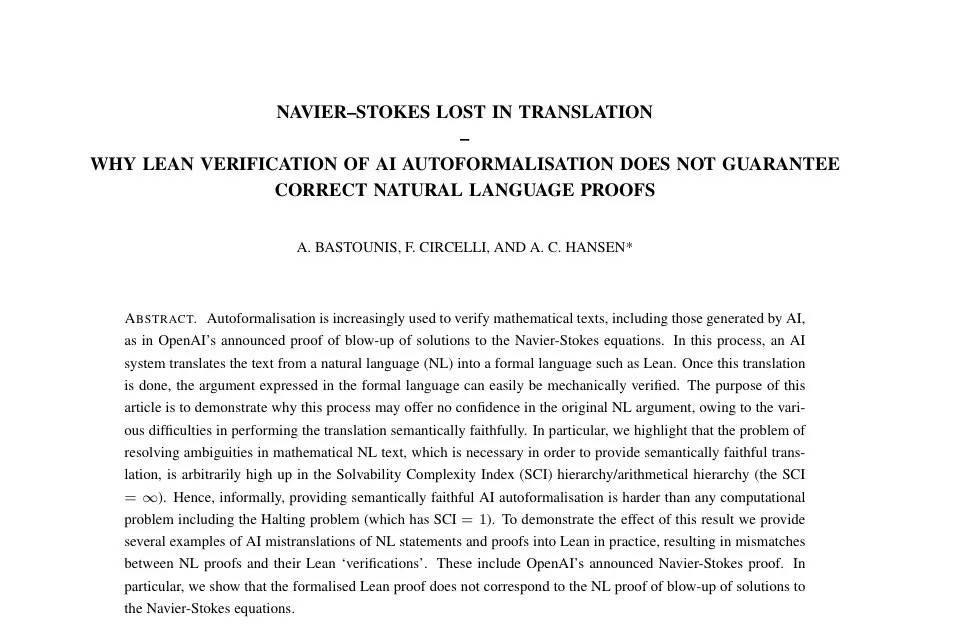 First page of the arXiv paper "Navier-Stokes Lost in Translation: Why Lean verification of AI autoformalisation does not guarantee correct natural language proofs" by Bastounis, Circelli and Hansen
What the authors found. They compare OpenAI's written paper, "Finite time blowup for Navier-Stokes," with the Lean code in the openai/NavierStokesAndEuler repository at commit f9e8bc5. They report two mismatches:
- Derivative count. Lemma 8.6, equation (8.19), says the inverse of the operator N needs m+4 derivatives of the input. The Lean theorem
norm_derivativeWord_inverse_leneeds m+5. The NL proof sums a series that converges with the exponent 3. The Lean code uses an exponent 4 series. So the Lean result is weaker than the written claim. The authors say the same m+5 pattern appears in other Lean theorems, such asinverse_finiteJets. - Pressure-flux bound. The bound in equation (10.19) and its proof differ from the Lean estimate (
exists_uniform_actual_pressure_flux_bound). The NL proof uses the L^(3/2) boundedness of Riesz transforms. The Lean proof uses a Sobolev embedding and L^2 boundedness instead, applies Hölder's inequality with different exponents, and ends with an extra term (A_R). The authors say the two bounds are hard to compare.
What the authors do not claim. They state plainly: "We do not make claims about the correctness of OpenAI's NL proof, we only make statements about mistranslations into Lean." The mismatches do not show the blow-up result is false. The Lean code could still prove the final theorem by a different route. The point is that the Lean check does not certify the written intermediate steps. They also say two examples are not a full audit, and that they only did a preliminary look at OpenAI's Euler blow-up paper, where they "predict" substantial mistranslations are likely. That prediction is not a finding.
The broader argument. The paper says an AI that is rewarded for any Lean proof that compiles can swap in a different argument. It gives small examples where ChatGPT-6 (Astra Ultra) turned a wrong NL proof into a correct Lean proof, and a correct NL proof into a different one. It also argues, using the Solvability Complexity Index hierarchy and Hilbert's tenth problem, that no AI can always tell when a statement is too ambiguous to translate faithfully. That is a theoretical claim from the authors, and we have not checked the logic. The paper also cites the Lean community's rebuttal of Meta's textbook formalisation claims.
What is still open.
- Whether OpenAI or independent Lean experts confirm the m+4 versus m+5 gap. We found no OpenAI response in the material we read.
- Whether the Lean statement of the final theorem faithfully captures the blow-up claim. The paper does not test this.
- We did not compile or inspect the Lean code ourselves. The details above are the authors' account.
For readers who build with AI proof tools, the practical lesson is to read the formal statement and check that it matches the claim, not just that it compiles. See also our look at what a Lean entry tells you in OpenAI's wider math release.
What this means for what you build or learn
If you build with AI rather than prove theorems, three takeaways follow from Ellie's framing.
- Do not change your simulation stack. If you use OpenFOAM, Fluent or a learned surrogate for fluids, nothing about this result gives you a better solver or tighter error bounds.
- Read claims by their quantifiers. "Solves X" often means "proves a specific statement about X." Check whether the claim is existence, universality, or approximation before you repeat it. The same lens helps with benchmark claims, as in OpenAI changed Astra's benchmark numbers after launch.
- The real shift is in verification. What is new is the pairing of massive parallel agent search with Lean checking at a fraction of historical cost. That workflow, not the Navier-Stokes headline, is what transfers to code verification and formal methods. For the mechanics, see how language models solve math.
How to talk about this accurately
A short checklist if you are summarizing the story for a team, a post or a class:
- Say "forced Navier-Stokes blow-up," not "Navier-Stokes solved."
- Mention that the Clay Institute has not certified it and independent peer review is pending.
- Mention that options A and B, the unforced questions, remain open.
- Separate the proof (existence of blow-up) from simulation (CFD) and from learned surrogates.
- Note that the Lean formalization verifies logic, not the match to the prize statement.
For the broader scoreboard, see The 7 Millennium Prize Problems: what AI has actually solved, and for the rumor that preceded the announcement, Did Claude solve Navier-Stokes?.
Why the video worked
Ellie's explainer succeeds because it does three things most coverage skipped. It starts with what the equations are for, so a non-specialist knows what is at stake. It separates the engineering problem from the pure-math problem with one concrete example (airflow over a wing). And it ends on the expectation gap instead of a hot take. In a feed where a wave of AI math claims arrives weekly, a clear definition of the question being asked is the most valuable thing a reader can get.
Related reading on explainx.ai
- OpenAI's Navier-Stokes Proof Is Now a Credit and Data Dispute — the dispute behind the announcement
- The Real Story in OpenAI's Navier-Stokes Proof: Formal Verification Got 10,000x Cheaper — the Lean economics
- The 7 Millennium Prize Problems: What AI Has Actually Solved — the full scoreboard
- Did Claude Solve Navier-Stokes? The Rumor, Fact-Checked — the earlier rumor
- 25 Fields Medalists Accuse AI Labs of "Severe Misalignment" in Math — the community response
- OpenAI's Math Advisory Group and the 100+ Problems Claim — what came next
- OpenAI's Math Repo: 8 Headline Results and Their Lean Status — what a Lean entry does and does not tell you
- Will AI Replace Mathematicians? The IEEE "Big Mathematics" Debate — the wider debate
Sources: Scientific American, "Did OpenAI Solve the Wrong Navier-Stokes Problem?" · The Tufts Daily, September 2026 · Ellie Sleightholm (@elsleightholm), video post and replies on X, October 2–4, 2026 · DataCamp, "Did AI Solve Navier-Stokes? OpenAI's Claim, Explained" · Zvi Mowshowitz, "Brand New AI Solves a Millennium Prize" · OpenAI, "On the Navier-Stokes Millennium Prize Problem," September 8, 2026
Figures and statuses in this post are accurate as of October 4, 2026 (last updated the same day with the Clay, Scientific American and Tufts Daily reporting). The OpenAI result has not been independently peer-reviewed or certified by the Clay Mathematics Institute, and the credit dispute remains unresolved. This post will be updated if that changes.