




Better chat models do not automatically make robots finish long household tasks — failure recovery still needs its own interface. That is the pitch of A²-MEAS (Toward the Era of Agentic Embodied Intelligence), posted as arXiv:2611.09124 and summarized on Hugging Face.
Shanghai Jiao Tong University's AutoLab-SJTU team pairs a vision-language-action (VLA) policy with learned correction codes that ingest diagnosis language, spatial cues, history, and proposed fixes. The design targets the gap between simulation leaderboard scores and contact-rich failures on real arms.
TL;DR
| Metric | Reported result |
|---|---|
| BEHAVIOR 2026 (100 public tasks) | 0.6411 Q-score, 45.40% task success (full system) |
| BEHAVIOR 50-task subset (pre online correction) | 0.5755 Q-score |
| Public-set comparison | 0.6411 Q-score tops the authors' self-reported BEHAVIOR 2026 table |
| RoboTwin 2.0 | 93.98% avg success (A²-WLA), 95.05% with full stack |
| Real household tasks (12 tasks) | 57.92% vs 26.67% for pi0.5 |
| Training throughput | 427.1 samples/s, 4.03× pi0.5 reference |
| Code | github.com/AutoLab-SAI-SJTU/A2MEAS (early repo) |
Architecture: correction codes on top of frozen skills
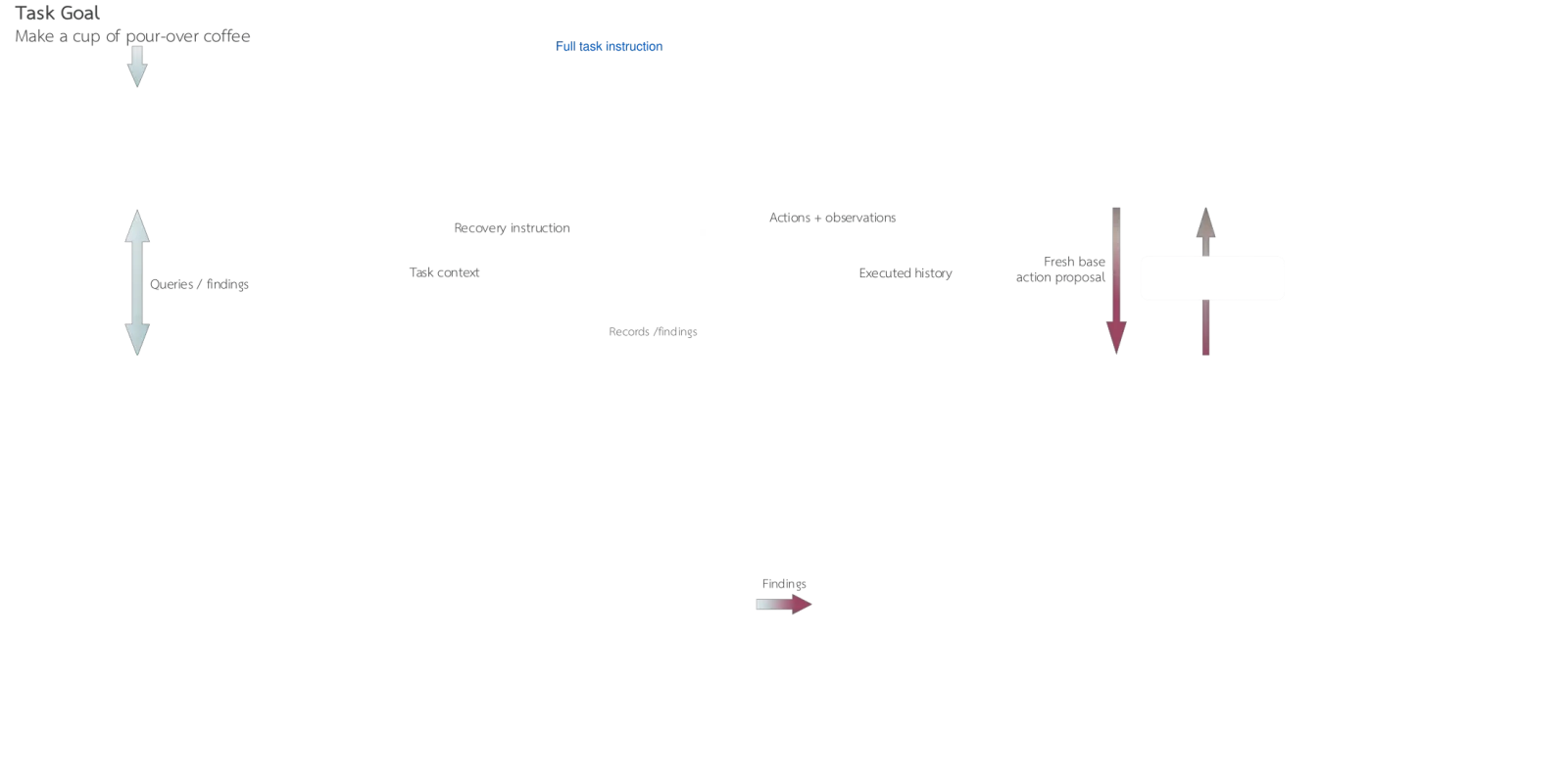 A²-MEAS embodied agent framework diagram showing correction paths for agentic embodied intelligence
Image: A²-MEAS authors (AutoLab-SJTU)
The framework has three ideas working together:
- A²-WLA action model — A VLA policy with motion-aware history and a latent world model for continuous control.
- Learned correction codes — Structured bundles of corrective language, spatial evidence, execution traces, and action proposals. A correction encoder/adapter bakes patterns into weights during training, while fresh codes can steer a frozen policy at deployment.
- MetaBrain — Training supervision and runtime guidance for when and how to issue corrections.
The authors describe code as a scaling interface: instead of rewriting the whole policy when a foundation model upgrades, you route failure context through a correction channel the action head already understands.
On Hugging Face, paper author Yufeng Sun summarized the ablation that sold us on the interface: with the action policy frozen on 12 BEHAVIOR tasks, runs succeeded 50/120 alone versus 63/120 with correction codes enabled — a concrete increment from metadata-rich feedback, not parameter finetuning alone.
Benchmark numbers and how to read them
The abstract's headline comparisons mix years and benchmark editions, so copy them carefully:
- 0.5755 Q-score on the 50-task BEHAVIOR 2026 public subset before online correction, compared against a cited 0.2605 figure from the 2025 winner — authors note different editions and training setups.
- 0.6411 Q-score and 45.40% task success on all 100 BEHAVIOR 2026 public tasks with the complete A²-MEAS stack.
They also report 93.98% average success on RoboTwin 2.0 for A²-WLA alone, rising to 95.05% with the full correction system — useful if you care about bimanual sim stress tests beyond BEHAVIOR's household long horizons.
For context on the benchmark family, see embodied coverage such as Berkeley–NVIDIA agentic robotics work and open humanoid datasets like Open Humanscale.
Real robots: households and pour-over coffee
Simulation wins are cheap; the project site emphasizes hardware.
Across 12 real-robot tasks in five household settings, the paper reports 57.92% average success for A²-WLA versus 26.67% for pi0.5 — more than double on their task set, though task counts are small and lab-specific.
The pour-over coffee demo is the narrative spine: long horizons, deformable filters, and repeated grasps.
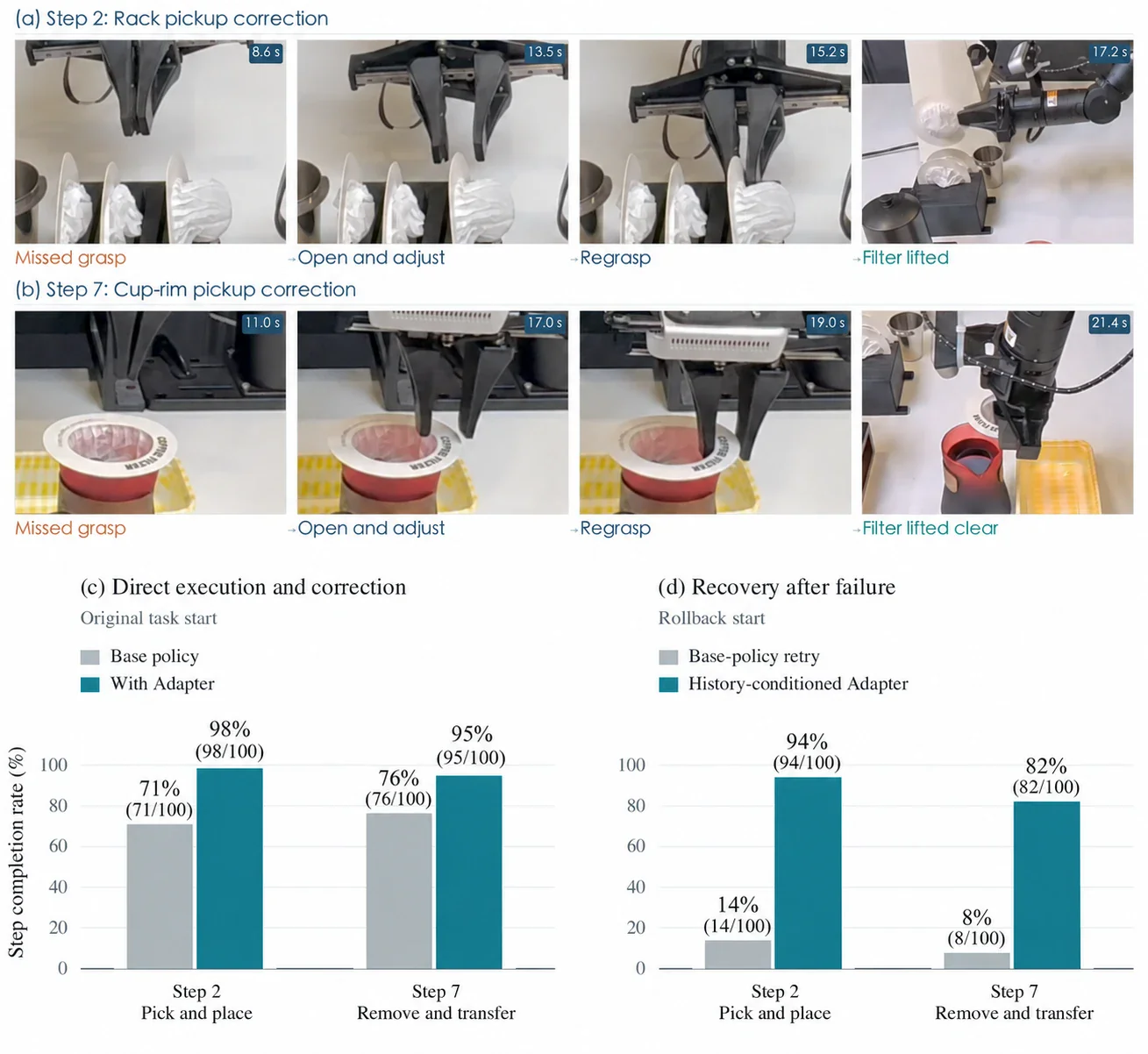 Pour-over coffee robot recovery rates after failed grasps in embodied agent testing
Image: A²-MEAS authors (AutoLab-SJTU)
Project figures claim a history-conditioned adapter raises post-failure completion on two filter-handling steps from 14% → 94% and 8% → 82%, versus bare A²-WLA retries, with 100 trials per step in their protocol.
That is the embodied lesson: retry loops without structured failure memory stall; correction interfaces that ingest what went wrong can unblock contact-heavy steps.
Training systems: why throughput claims matter
Robot learning teams often bottleneck on data pipelines, not GPU FLOPs. The project page publishes throughput engineering:
- Batch JPEG decoding, Apache Arrow caches, and prefetching cut data prep from about 1,300 ms to 28 ms in their chart narrative.
- Single-GPU step time drops from 3.03 s to 1.13 s in the same materials.
- Optimizations to computation paths, static caches, and Sharded Local Muon compound to 427.1 demonstration samples/s on eight GPUs, vs 106 for a π₀.₅ reference — 4.03×.
If releases match the paper, that infrastructure may matter as much as the architecture for labs reproducing results.
How A²-MEAS compares to other 2026 embodied lines
| Axis | A²-MEAS emphasis | Other recent lines |
|---|---|---|
| Failure handling | Learned correction codes + adapter | Retry policies, world models, doctor agents |
| Policy core | A²-WLA VLA + latent world model | π₀.₅, GR00T-family, monolithic VLAs |
| Training focus | Throughput + task specialization | Massive pretrain, sim-only scaling |
| Evidence mix | BEHAVIOR + RoboTwin + real pour-over | Often sim-heavy leaderboards |
Papers the Hugging Face Librarian bot links — LAW, OmniBrain-0, RoboDoctor — explore adjacent agentic physical intelligence ideas. A²-MEAS differentiates on explicit correction encoding with frozen-policy deployment tests.
Readers building household agents should also watch Skild Steel Solver physics open source and NVIDIA's GR00T / CrossnoKaYe physical AI deployments for contrasting stack choices.
What you can try when artifacts land
The authors promise release of system code, models, training scripts, and infrastructure. Today the GitHub org repo shows early traction; treat checkpoints as wait-for-tag unless a release notes file appears.
Practical steps once weights ship:
- Reproduce BEHAVIOR evaluation configs exactly — Q-scores move with task subsets.
- Run the frozen-policy + correction code ablation before full finetuning; it is the paper's cleanest story.
- Profile the data loader if training; their 4× claim is pipeline-heavy.
- Port correction interfaces to your VLA only if your failures produce structured traces (vision, language, history).
BEHAVIOR Challenge context
The 2026 BEHAVIOR Challenge leaderboard tracks long-horizon household rearrangement in simulation. In the paper's Table 6 self-reported comparison (scores accessed 31 October 2026), A²-MEAS's 0.6411 Q-score is highest among the listed entries — a signal that correction-centric stacks can compete with monolithic VLAs tuned only for Q-score.
When you reproduce leaderboard numbers:
- Confirm whether online correction was enabled for the headline 0.6411 score.
- Split public vs hidden task sets if you are mixing challenge years.
- Log per-task failure modes — correction codes help most when failures are diagnosable (grasp slips, collisions) rather than irrecoverable planning errors.
Household benchmarks also intersect policy conversations about robots in daily life; they are not isolated from the wider AI safety reporting moves governments are making, as in Australia's November 2026 frontier AI package, should embodied agents reach consumer deployments at scale.
Mapping correction codes to your stack
You do not need their exact encoder to experiment:
| Your component | A²-MEAS analogue | Minimal experiment |
|---|---|---|
| VLA policy | A²-WLA | Keep weights frozen for a week |
| Failure logger | Execution history channel | Save last-k images + proprioception |
| VLM diagnostician | MetaBrain / foundation model | Prompt: what failed and where |
| Structured fix object | Correction code | JSON schema: {hypothesis, action_delta} |
| Adapter | Correction encoder | Small MLP or LoRA on policy head only |
Run A/B on sim replay buffers before touching real arms. Measure recovery success conditioned on failure type, not aggregate success alone — their coffee demo metrics are conditional for a reason.
Energy and iteration economics
Long-horizon household tasks burn contact time on hardware. Faster training throughput — if the 4.03× figure holds for your cluster — changes how many correction-code variants you can evaluate per week. That matters because correction interfaces have hyperparameters (code dimension, adapter rank, history window) that are painful to tune on real arms.
Simulation-first labs should still budget real-robot confirmation weeks after leaderboard gains. BEHAVIOR success does not automatically transfer when camera mounts, calibration drift, and grasp friction differ from the project's lab setup.
If you already run π₀.₅ or similar VLAs, treat A²-MEAS as an architectural reference for where to spend parameters: keep the motor policy stable, invest compute in diagnosis and correction encoding when episodes are long and failures are sparse but costly.
Watch the AutoLab GitHub org for training config YAML and dataset manifests. Without them, reproduce Q-scores only after you match pretraining mixtures and task specialization schedules described on the project page.
The Hugging Face paper discussion thread is worth monitoring for author replies on release dates and checkpoint naming, especially if you plan side-by-side evals with Open X-Embodiment policies you already host in production today itself.
Limits to keep in mind
- Leaderboard comparisons across years need manual harmonization; treat 2.21× statements as author-reported, not audited by explainx.ai.
- Real-robot task counts are modest; coffee demo metrics are compelling but not a general household guarantee.
- Foundation model swaps are precisely what the intro questions — correction quality still depends on diagnosis quality from upstream VLMs.
- Release timing is "will release"; builders cannot independently verify weights at publication time.
Related reading
- Agentic robotics Berkeley NVIDIA — CORL-era embodied agent framing.
- Open Humanscale robot data — Datasets for manipulation scaling.
- Skild Steel Solver Newton physics — Physics engines for sim-heavy labs.
- CrossnoKaYe Bedrock physical AI — Industrial physical-AI orchestration contrast.
- Handshake AI RL training data — Data-centric robot policy training angles.
- Sakana MASS multi-agent self-supervision — Multi-agent learning patterns outside robotics.