



A headline circulating on aggregators says a Canadian publisher "dropped" Quebec author Thélyson Orélien over AI use in an award-winning novel. The reporting we could find says something different. The Académie Goncourt removed his novel C'était ça ou mourir from its prize selection after an AI-authorship accusation, and his Canadian publisher Boréal first suspended the promotional tour, then announced on October 14, 2026 that it was keeping the book on sale and standing by him. No court, prize jury or forensic review has established that the novel was written by AI.
This post separates what is confirmed from what is claimed, and uses the case to explain what AI detectors can and cannot prove. Sources include the Canadian Press via CTV News, AFP via Le Soleil and a summary on Let's Data Science.
TL;DR
| Claim | Status |
|---|---|
| Goncourt removed the novel from its selection on September 25 | Confirmed by multiple outlets |
| Canadian publisher "dropped" the author | Not supported. Boréal suspended the tour on September 25 and on October 14 kept the book in bookstores |
| The novel was written by AI | Unproven. Based on detector results cited by an anonymous account; author denies it |
| Pangram flagged the book "100% AI" | Claimed by the X account; accuracy figures it quoted are its own assertions |
| Orélien plagiarized earlier journalism | Admitted by him on October 13, per AFP |
| Sales fell | No. Per AFP, sales continued to rise, passing 100,000 copies |
Timeline
| Date (2026) | Event |
|---|---|
| September 12, 2025 | Boréal receives the manuscript (the earliest date its team can trace) |
| September 21 | Anonymous X account "Balance ton Claude" alleges massive AI use, citing Pangram tests |
| September 25 | Goncourt removes the novel; Boréal suspends the tour after La Presse reveals a 2013 column that was largely a lightly reworked translation of a Philippine Star article |
| Late September | Orélien interrupts his French tour and returns to Quebec, silent for about three weeks |
| October 13 | Orélien denies AI use to AFP and admits plagiarism in other writing |
| October 14 | Boréal says it keeps the novel on sale, lacking evidence to establish AI use |
What the Goncourt said
According to The Conversation as quoted by Let's Data Science, the Académie cited "consistent findings of analyses by credible researchers and journalists" that suggested the book was "in all likelihood, largely the product of artificial intelligence." That is a prize decision to protect the institution's integrity, not an adjudication. The Renaudot prize, by contrast, kept the book in its second selection of nine novels.
What the detector claim does and does not show
The accusation rested on the Pangram AI-text detector. The account said repeated tests returned 100% AI and quoted a very low false-positive rate for the tool. Those accuracy numbers are the account's description, and Let's Data Science notes they are not independently established in the reporting.
Detectors generally estimate whether text is statistically similar to machine-generated output. They have known limitations:
- Probabilistic, not forensic. A score is evidence of similarity, not proof of how text was produced.
- Sensitivity to style. Polished, regular prose, translated text or text edited with AI tools can score differently from raw human drafts.
- Base rates matter. With a large number of tests, even a small false-positive rate yields some false positives, and a single dramatic result can be cherry-picked.
- Adversarial context. Once an accusation is public, tests are selected and shared by people who want a particular outcome.
Detectors can still be a reasonable trigger for review. The problem arises when a score is treated as a verdict.
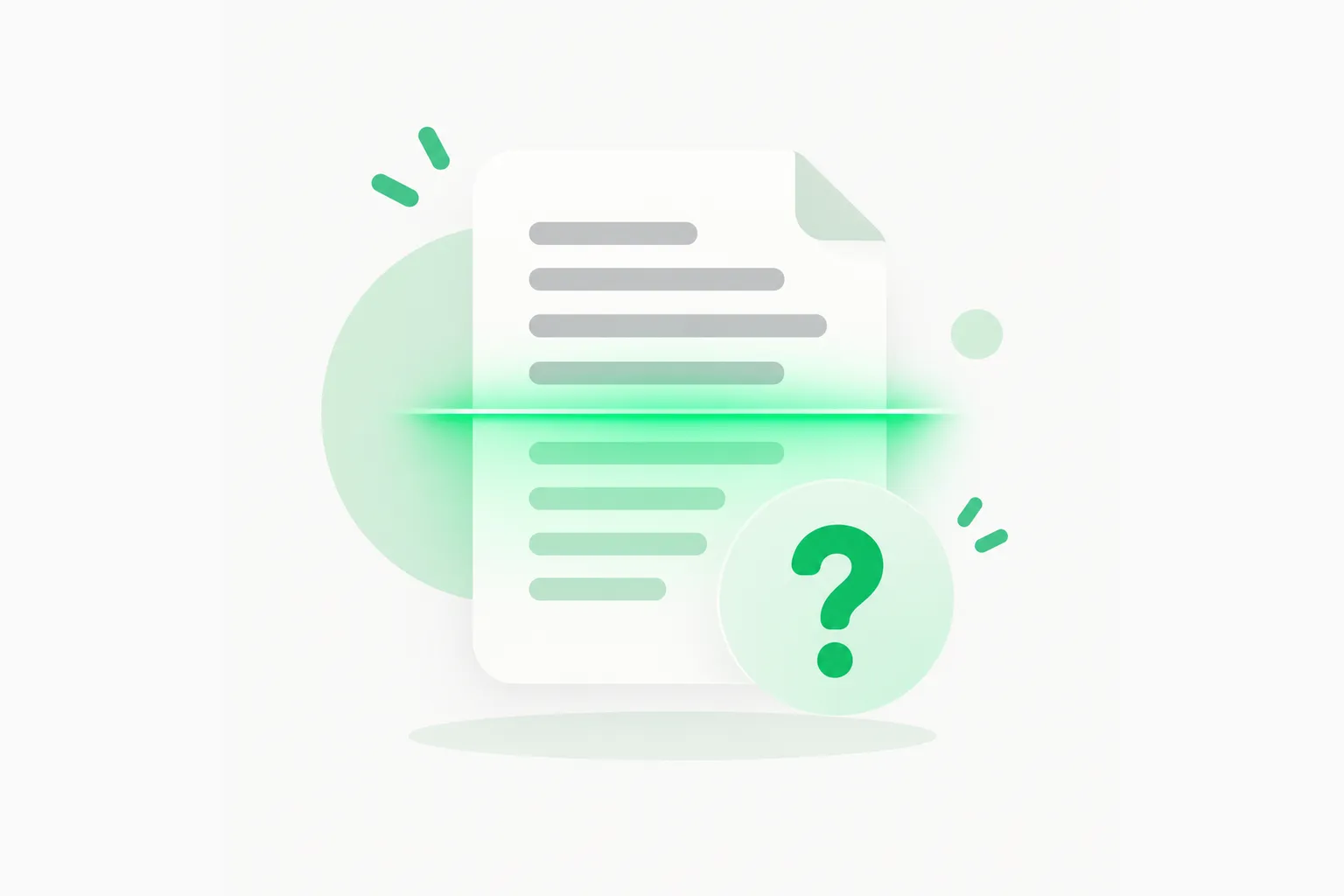 Sheet of paper under a scanning line with a question mark, showing an AI detector output that estimates similarity rather than proving authorship
What Orélien and his publishers say
Orélien told AFP that "no sentence of this book was created by a machine." He said he began writing in autumn 2017 "on a corner of a table" in Quebec, where he has lived since 2010 after leaving Haiti, and finished a first draft in 2019. AFP notes he provided no documents to support the timeline.
Boréal said a publisher "does not have to demand proof from authors but must stand beside them." It added that, aside from his word, it lacked records to trace the manuscript's history before September 12, 2025. It also said it would not let him become a scapegoat for fears about AI, and left readers to form their own view. French publisher Grasset, per The Conversation as relayed by Let's Data Science, says he started the novel in 2017 and completed a draft in 2019, before generative AI was commercially available; Euronews reported it initially dismissed the accusations while citing limits of detection tools.
On plagiarism the publisher is firm. Orélien admitted making "unacceptable mistakes" by reusing passages by recognized authors without attribution in texts published soon after he arrived in Canada, and Boréal condemned this "without reservation." This is separate from the AI allegation.
Why this case matters for AI
- Provenance is becoming a requirement. Without drafts, version history or editorial correspondence, neither side can prove its case. Authors, publishers and prizes now have a reason to keep auditable records.
- Detectors are entering institutions. A tool's output influenced a major cultural prize. Institutions need a process: who runs tests, how results are validated, how authors can respond.
- Accusations spread faster than evidence. An anonymous account triggered consequences within days. The same dynamic affects schools, newsrooms and hiring.
- Plagiarism is a different, older question. The reporting shows that proven plagiarism, which needs no AI tool to detect, drove the publisher's firmest statements.
For related verification work, see our coverage of Google's SynthID website for checking AI media, the Nikon Small World disqualification over AI-generated video, and what the video Turing test shows. Teams verifying agent output face the same problem, see AI verification tax and the source-aware verification MCP.
What is still unknown
Several important questions remain open as of the latest reporting we found.
- Whether AI was used at all. No independent review of drafts or process has been published. The author's account of a 2017 start and 2019 draft is unsupported by documents in public view, and Boréal says its own records begin on September 12, 2025.
- What Pangram actually returned. The tests were run by an anonymous account. Neither the full outputs nor an independent replication have been reported.
- What "credible researchers and journalists" found. The Goncourt statement refers to analyses it does not name in the coverage we read.
- Whether sales or reputation will recover. Sales rose past 100,000 copies, according to AFP, but the plagiarism admission and the Goncourt removal may still damage his standing.
- Whether prizes will adopt a standard. A separate story in the same period mentions a new literary prize for books written with AI, which suggests the sector is still deciding where the line is.
The stakes of a false positive
Every accusation test has a mirror image. If a detector wrongly flags a human writer, the harm is severe and hard to undo: removal from a prize, a suspended tour, and public harassment. The author describes "threats, media lynching and racist harassment" over several weeks, and his publisher said he should not become a scapegoat for anxieties about AI. If a detector rightly flags an AI-written book, the harm is to readers and honest competitors. Institutions that cannot tell the difference should weigh both errors, which is an argument for slow, evidence-based process rather than reacting to a viral thread.
A practical test for editors, teachers and hiring teams
Before acting on a detector score, ask five questions:
- Do we have the detector's full output and settings, not a screenshot?
- Has a second, independent method agreed, such as metadata, draft history or stylometric comparison with prior work?
- Has the person been given a chance to respond with evidence?
- What is the error rate of this tool on the kind of text in question, measured on known human-written samples?
- Is the decision proportionate if the score is wrong?
If the answer to any is no, treat the score as a lead, not a finding.
How to handle an AI-authorship dispute
- Preserve evidence early. Keep dated drafts, notes and files.
- Use multiple methods. Combine detectors with document metadata, style comparison against the author's earlier work and interviews.
- Publish methodology. If a prize or publisher acts, explain what evidence it relied on.
- Separate questions. AI use, plagiarism and false accusation are distinct issues with different standards of proof.
- Allow response. Give the author time and a structured way to reply.
Related reading
- Google SynthID website for AI media verification
- Nikon Small World winner disqualified over AI video
- What is the video Turing test?
- AI verification tax: rework surveys
- ProvenanceGuard: source-aware MCP verification
- Managers find AI-assisted work harder to evaluate
- Sources: Canadian Press via CTV News · AFP via Le Soleil · Let's Data Science
Based on reporting dated September 25 to October 14, 2026; the dispute is ongoing and facts may change.