



Headlines on November 19, 2026 claimed Samsung halted foundry work for Chinese computing chips after new US rules. The verified policy move is the Commerce Department BIS interim final rule reported November 17–18, 2026, which tightens exemptions for advanced AI chips and raises KYC burdens on foundries and OSAT houses—not a Samsung press release announcing a total stop.
Samsung denied halting all Chinese foundry clients in 2025 when similar pressure appeared, per SCMP reporting. Treat November 2026 halt headlines as aggregator inflation until Samsung or BIS posts matching language.
TL;DR: headline vs filing
| Claim | Status |
|---|---|
| Samsung issued Nov 2026 halt to all China foundry | Not verified |
| BIS IFR tightens advanced chip exemptions | Reported by ETNews, Seoul Economic Daily, Reuters |
| Samsung Foundry faces more diligence/licensing | CLSA quote via Reuters |
| Korean OSAT fast-track users affected | ETNews list of six firms |
| Rule effective timing Jan 1, 2027 for many paths | Reported in ETNews summary |
What the BIS rule actually changes
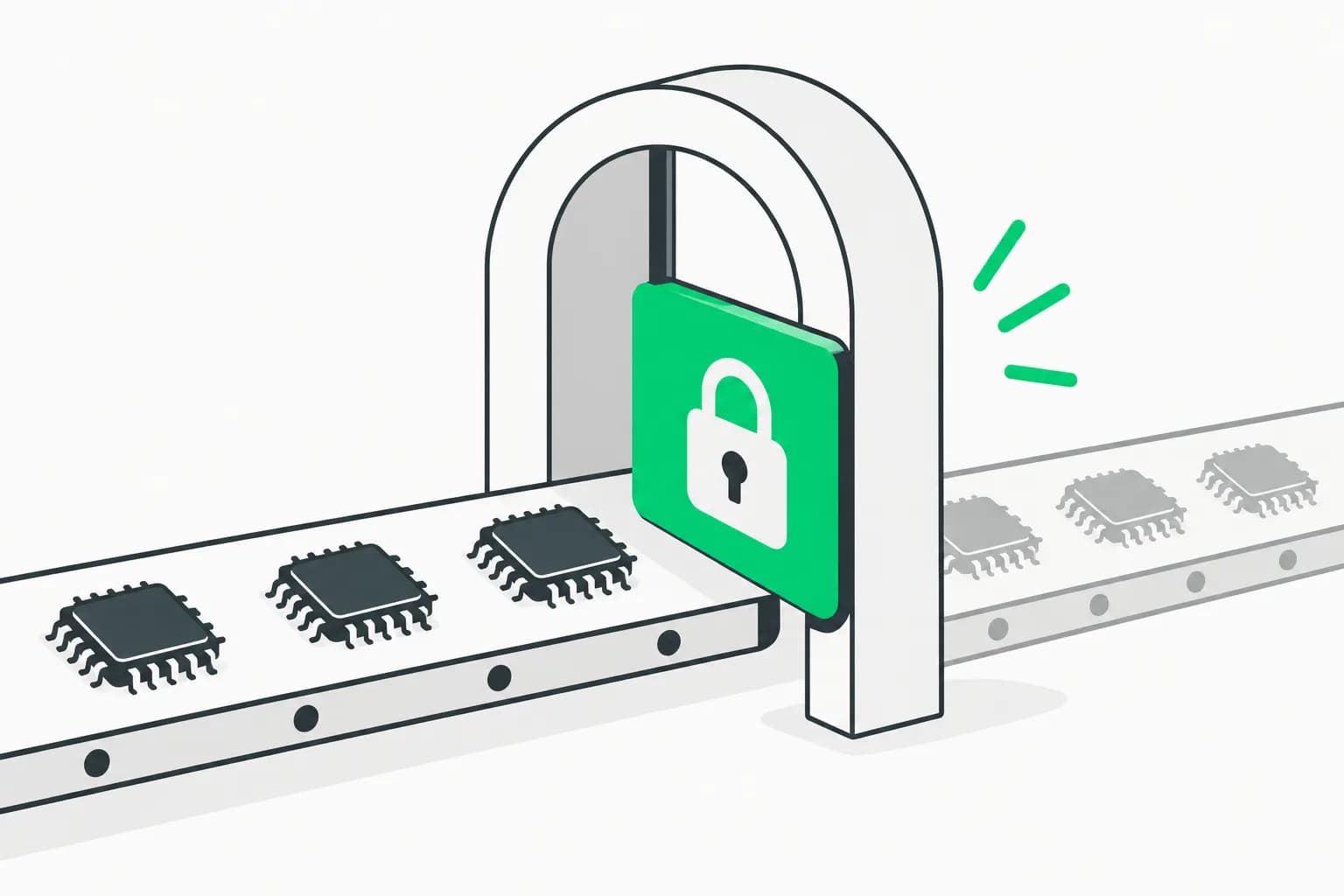
 Advanced chip behind a closed export gate, evoking narrower OSAT and foundry exemptions
Electronic Times English coverage describes the November 17 BIS interim final rule as amending EAR presumption exemptions for advanced computing chips (ECCN 3A090.a). Previously, foundry self-verification (paragraph b) and approved OSAT packaging below transistor thresholds (paragraph c) let many shipments proceed without separate US authorization.
The IFR reportedly ends those exemptions when the designer or ultimate parent is headquartered in China, Russia, or other D-group countries, and extends restrictions to designers in Singapore, Malaysia, Indonesia, Thailand, and Brazil—countries named as circumvention hubs where Chinese capital might split designs to stay under transistor caps.
After January 1, 2027, designers in those countries may need approved designer status or transaction-specific licenses, per ETNews. Violations risk Entity List or denial orders blocking US tooling and software updates.
That is compliance architecture, not Samsung factory switches flipped off.
Why Korean foundries care
 Wafer grid at a fab, evoking foundry diligence before advanced AI lots ship
ETNews notes six South Korean OSAT firms—including Samsung—were among 24 global approved OSAT providers using paragraph (c). Their order books leaned on Southeast Asian fabless customers. The IFR raises ownership verification work: KYC, transistor attestations, and potential license waits.
Seoul Economic Daily ties the same rule to SK hynix HBM demand anxiety—Samsung foundry and memory sit in different businesses but share export counsel.
Reuters market reaction
Reuters via Investing.com recorded share moves after the announcement. CLSA's Sanjeev Rana said Samsung Foundry might face additional customer due diligence and licensing—language consistent with slower orders, not instant blanket halt.
Compare to Nvidia's zero China DC outlook on the GPU vendor side the same week—one policy wave, multiple business models.
What builders and fabless teams should do
- Map beneficial owners before engaging Samsung, TSMC, or Korean OSAT.
- Document transistor counts and process nodes with legal review—self-attestation paths narrowed.
- Plan lead times for Commerce licenses if you are Singapore/Malaysia HQ with China-linked parents.
- Do not assume OSAT fast track after Jan 1, 2027 without paragraph (a) approved designer status.
- Track congressional investigations for penalty escalation.
How this connects to AI demand stories
Advanced AI accelerators need leading-edge foundry and HBM base dies—themes in Samsung Taylor HBM reporting. Export rules do not cancel US demand; they re-route who may legally buy wafers.
Open-weight model labs in Southeast Asia should read this alongside Trump Chinese-model disclosure rumors—Washington is tightening both compute access and disclosure.
Verified negative: no Samsung halt press release located
We searched Samsung newsrooms and major wires for a November 2026 halt announcement matching aggregator copy and did not find one. Until Samsung confirms customer-specific pauses, describe the situation as heightened compliance, not embargo.
Paragraph (a), (b), and (c): the exemption ladder explained
Export-control summaries are easier when you picture three rungs:
Paragraph (a) — approved designer. The gold path: a fabless company earns US government certification that its ownership and products are clean enough for repeat shipments without per-lot drama.
Paragraph (b) — foundry self-verification. The foundry attests process node and performance stay below advanced AI thresholds. The November IFR reportedly removes this shortcut when parents tie back to China or other countries of concern.
Paragraph (c) — approved OSAT transistor counts. Packaging houses below ~30 billion transistors could certify finished chips and ship. Korean Samsung, Doosan Tesna, LB Semicon, Nepes, SFA Semicon, STECO used this channel per ETNews. The IFR closes paragraph (c) under the same parent-country tests.
After the change, paragraph (a) becomes the default survival path for advanced parts—which means legal teams, not floor operators, become the bottleneck.
Remote-access and neocloud rules in the same window
The Seoul Economic Daily piece in our research bundle ties the IFR to remote GPU access restrictions—Chinese firms renting US chips abroad—overlapping explainx.ai's remote access commerce rule coverage. Foundry and neocloud policy are one chessboard:
- Wafer supply slows if fabless shells cannot prove clean cap tables.
- Already packaged GPUs in Singapore racks face TPP limits and licensing when serving China endpoints.
Builders renting Asian neocloud should demand written end-user attestations and archive BIS classification worksheets the way foundries archive KYC packs for every advanced-node customer.
TSMC symmetry
Reuters paired Samsung and TSMC share reactions. TSMC faces the same diligence language even though headlines name Samsung Foundry because aggregators chase the word "halt." Both need licenses for some advanced flows where paragraph (b)/(c) used to suffice.
If you procure custom AI ASICs, treat 2027 lead times as including Commerce review, not just mask tooling.
Entity List and denial-order stakes
ETNews warns unauthorized shipments can land firms on the Entity List or trigger denial orders that cut off EDA and fab tools. For startups, that is an existential risk worse than one lost lot. Document who signed each end-user statement.
Historical Samsung–China context
SCMP's 2025 denial matters because it shows Samsung's public stance: continue serving Chinese clients lawfully while complying with US rules. November 2026 halt rumors contradict that stance without a new primary quote.
When you cite Samsung halts China, ask: halt for whom, which node, which customer legal name? Without answers, use compliance tightening language.
FAQ for procurement teams
Will my 12nm AI accelerator tape-out pause? Unknown case-by-case; depends on parent HQ, transistor count, and January 2027 license status.
Does this block Samsung HBM? Memory packaging rules differ from logic foundry paragraphs; read SK hynix exposures separately in Samsung HBM earnings posts.
Should US labs still use Samsung Foundry US sites? Taylor, Texas projects continue in Samsung messaging; export rules affect customer mix, not necessarily US campus construction—see Taylor HBM base-die reporting for US footprint context.
What to monitor next
- Federal Register publication with exact paragraph text.
- Samsung 8-K or earnings Q&A on foundry order trends.
- Commerce press releases naming enforcement actions against shell fabless.
- Customer advisories from TSMC and Samsung to US tool vendors.
Scenario planning for AI hardware startups
Scenario A — license delays. Your SEA-headquartered fabless partner misses January 2027 paperwork. Mitigation: second source on mature node for bring-up, defer leading-edge tape-out.
Scenario B — OSAT queue inflation. Korean packagers prioritize customers with paragraph (a) paperwork complete. Mitigation: pre-pay legal review of cap tables before GDSII.
Scenario C — headline-driven FUD. Partners cite "Samsung halt" to renegotiate price. Mitigation: send them this BIS summary and demand Samsung or Commerce citations.
How explainx.ai covered earlier Samsung export scares
We previously separated lease economics rumors from verified earnings in Samsung Q3 profit and HBM contracts and Taylor fab booking claims. The pattern repeats: trade press exaggerates certainty; filings and rules text lag headlines by days.
Why this is not the same as Nvidia Hopper shipments stopping
Nvidia's licensed Hopper halt to China came from Kress on an earnings call about GPU export licenses already executed. Samsung November halt headlines did not cite an executive on record or 8-K in the materials we reviewed. Keep those stories separate when you brief your board.
Policy teams should also track Speaker Johnson China chip consensus votes that may harden penalties beyond this IFR text.
Foundry legal should save every customer questionnaire starting November 2026; auditors will ask whether you relied on paragraph (b)/(c) after the IFR published.
If your cap table includes Chinese limited partners, assume foundries will ask for structure charts even when HQ displays a Singapore flag. Budget extra weeks now in tape-out schedules for that review, legal sign-off, and license filings if required.
Update (November 19, 2026, 06:15 UTC): Chinese AI chip designers look to SMIC as Samsung diligence tightens
After the November 17 BIS interim final rule, TrendForce and Reuters-syndicated market coverage say Samsung Foundry and peers face stricter customer diligence and possible licensing delays on Chinese fabless programs—pushing more tape-out conversations toward domestic lines such as SMIC. We did not find a Samsung press release announcing a blanket halt to Chinese customers; the pivot story is compliance economics, not a factory switch-off.
Reported example: TMTPOST (July 2026) describes Baidu's Kunlun Core moving production workloads away from Samsung Electronics toward domestic foundries under tightening export rules—one documented pattern teams may repeat after the Nov. 17 IFR.
SMIC's November 12–13 earnings commentary—via Reuters on tight AI supply through 2027 and the Q3 2026 earnings call transcript on 97.3% utilization and 90.8% China revenue share—shows domestic capacity under heavy load just as Korean and Taiwanese foundries demand stricter KYC and licenses for D:5-linked parents or Southeast Asian shell designers.
| Question | What sources say |
|---|---|
| Did Samsung confirm stopping all China foundry work? | No statement found; headlines exceed verified filings |
| Are Chinese fabless teams talking to SMIC more? | Inferred from BIS IFR diligence plus Kunlun/Samsung migration reporting (TMTPOST); not a Samsung headcount survey |
| Does SMIC close the performance gap vs Samsung on cutting-edge AI? | Still no in public benchmark filings; see Huawei Ascend leak context |
| When do BIS paragraph (b)/(c) fast tracks end for many paths? | January 1, 2027, per ETNews IFR summary already cited in this post |
Practical read for founders: If your cap table includes Chinese HQ or LPs, expect Samsung questionnaires first and SMIC quotes second. Document end users, transistor counts, and packaging partners before November 2026 RFPs turn into January 2027 license deadlines. The shift reinforces why TSMC cash-upfront rumors and Congress NDAA chip votes belong in the same board deck as foundry POs.