



TL;DR: Three months ago, Sam Altman outlined a future where AI becomes a metered utility like electricity—you receive monthly bills based on token consumption. Light users pay pennies, heavy users millions. The goal: AI abundance where intelligence is "too cheap to meter." The reality: Critics see dystopian gatekeeping with forced minimums, while Uber exhausting its 2026 AI budget in 4 months proves we're far from cheap abundance. Is this the inevitable evolution of AI pricing, or a troubling consolidation of intelligence behind paywalls?
The Vision: Your Monthly AI Utility Bill
Sam Altman's pitch is deceptively simple: AI should work like electricity.
You don't buy "electricity subscriptions" with tier limits. You use what you need, get billed monthly based on consumption, and pay accordingly. Light users (phone charging, occasional appliances) pay $30-80/month. Heavy industrial users pay tens of thousands.
Altman's AI utility model:
- Light users (occasional ChatGPT queries, email drafting): $5-20/month
- Medium users (daily AI coding, content creation): $100-500/month
- Power users (businesses, AI-augmented workflows): $1,000-10,000/month
- Enterprise (training models, massive automation): $100,000-$5,000,000/month
Instead of "ChatGPT Plus" or "API credits," you'd receive an AI utility bill showing:
- Daily compute power consumption (MMW - Million Megawatts)
- Model training hours (GPU hours)
- Resource allocation breakdown (inference, storage, network)
- Total amount due based on token usage
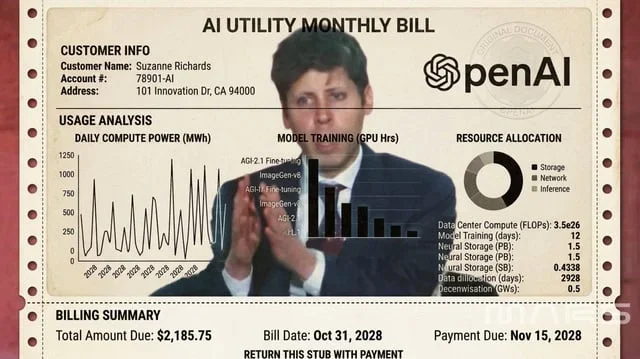 AI Utility Monthly Bill Meme
Satirical AI utility bill showing $2,185.75 monthly charge for compute power, model training, and resource allocation. This meme captures both the absurdity and plausibility of Altman's metered vision.
AI Utility Monthly Bill Meme
Satirical AI utility bill showing $2,185.75 monthly charge for compute power, model training, and resource allocation. This meme captures both the absurdity and plausibility of Altman's metered vision.
The Three-Part Vision Explained
Altman's utility framework has three components:
1. Intelligence as Commodity (Tokens = Kilowatt-Hours)
How electricity works:
- You consume kilowatt-hours (kWh)
- Meter tracks usage
- Monthly bill reflects consumption
- Price per kWh varies (peak/off-peak, region)
How AI tokens would work:
- You consume intelligence tokens (processing queries, generating code, training models)
- API tracks token usage
- Monthly bill reflects consumption
- Price per token varies (model size, complexity, real-time vs batch)
Altman's key insight: AI companies already do this with API pricing (GPT-4: $10/1M input tokens, $30/1M output tokens). The vision just extends it to all AI consumption with utility-style billing.
2. The "Too Cheap to Meter" Goal
Altman's ultimate vision: AI abundance so extreme that metering becomes unnecessary.
Historical parallel: In the 1950s, nuclear advocates predicted electricity would be "too cheap to meter" due to abundant nuclear power. This never materialized—electricity is still metered.
Altman's argument for AI:
- Compute costs drop exponentially (Moore's Law continues)
- Model efficiency improves (GPT-5 does more with less compute than GPT-4)
- Massive data center buildout creates oversupply
- Competition drives prices toward zero
The goal: By 2030, intelligence is so cheap that:
- Basic AI access is effectively free (like tap water in developed nations)
- Only premium/specialized services require payment
- Everyone has baseline access to powerful AI
3. The Infrastructure Warning
Altman tempers the utopian vision with a critical caveat:
"Without enough chips and data centers, scarcity will drive prices UP, not down."
The constraint: AI compute demand grows faster than supply.
Current reality (2026):
- Global GPU shortage continues
- NVIDIA H100s backordered 12+ months
- Data center power consumption limits expansion
- Inference costs remain high for cutting-edge models
Implication: The "too cheap to meter" future only happens if massive infrastructure investment occurs. Otherwise, we get the opposite—expensive, metered AI gatekept by scarcity pricing.
The Criticism: Dystopian Gatekeeping or Pragmatic Pricing?
Twitter reactions ranged from cautious optimism to outright hostility. Let's analyze both sides.
The Dystopian Interpretation
1. Forced Monthly Minimums ("Connection Fees")
Critic argument (Tsa Rin):
"Let me guess. You'll have a monthly minimum you're forced to pay just because you're 'hooked up' to the service just like electricity and water too."
Real-world parallel: Utility bills include:
- Connection fees ($15-30/month even if you use zero)
- Infrastructure maintenance charges
- Regulatory fees
Fear: OpenAI implements:
- $15/month "AI Network Access Fee" (even if you don't use it)
- $10/month "Model Maintenance Surcharge"
- $5/month "API Connection Fee"
- Total: $30/month baseline before any usage
Counter: Utilities justify fixed costs (grid maintenance, metering infrastructure). AI has lower fixed costs per user—mostly serving API requests.
2. Paying for Others' Usage
Critic argument (Wetterschneider):
"But he wants us to pay for other people's use. He wants us to pay him for something we're not using."
The concern: Metered utility pricing includes:
- Infrastructure buildout costs (everyone pays for the data center, even if you use 0.01% of it)
- Peak capacity costs (billing structure subsidizes heavy users via connection fees)
Comparison to electricity: Your $80 electric bill includes $20 in charges that subsidize grid expansion for industrial users consuming 1000x more than you.
Fear: AI utility billing becomes:
- 40% actual usage charges
- 60% infrastructure subsidies (paying for Uber's million-dollar AI bills)
3. Gatekeeping Intelligence After Scraping Free Data
Critic argument (Gideon Devin Rex):
"So AI companies stole everything they needed to build themselves and now want to charge people for being forced to use it. He is evil."
The controversy:
- OpenAI trained GPT on web scraping (books, articles, code, social media)
- Most training data wasn't explicitly licensed
- Now they want to charge for access to intelligence derived from freely available data
Philosophical question: If AI companies built models using humanity's collective knowledge (scraped without permission), should they be allowed to meter access to that intelligence?
Counter-argument:
- Training costs billions (compute, researchers, infrastructure)
- Ongoing inference costs are real
- Someone has to pay for the service
Socialist critique (ecosocialist musician):
"No one wants this. This doesn't help workers."
Class dimension: Metered AI creates tiered access:
- Wealthy individuals/corporations: Unlimited AI (afford $10K-1M/month bills)
- Middle class: Moderate AI access (budget $50-500/month)
- Poor/Global South: Minimal AI access (can't afford beyond free tier)
Result: Intelligence inequality mirrors wealth inequality.
The Pragmatic/Supportive Interpretation
1. Fair Pay-Per-Use Model
Supporter argument: Current subscription tiers are inefficient.
Today's problem:
- ChatGPT Plus: $20/month unlimited (within rate limits)
- Light user (10 queries/week): Pays $20, uses $2 worth of compute
- Heavy user (500 queries/day): Pays $20, uses $80 worth of compute
- Subsidization: Light users subsidize heavy users
Metered solution:
- Light user: Pays $3/month for actual usage
- Heavy user: Pays $85/month for actual usage
- Fairness: Pay for what you use
2. Reflects True Costs
Economic reality: AI inference costs money.
- GPT-4 query: ~$0.01-0.03 in compute costs
- Claude Opus query: ~$0.015-0.04
- Image generation (DALL-E 3): ~$0.04
- Video generation (Sora): ~$0.50-2.00
Current disconnect: $20/month ChatGPT Plus users can generate 1000+ queries/month, costing OpenAI $20-40 in compute. This only works if:
- Most users underutilize their subscription (subsidizing power users)
- OpenAI loses money on power users (unsustainable long-term)
Metered billing aligns costs with consumption, making the business sustainable.
3. Enables AI-First Infrastructure
Utility model benefits:
- Predictable revenue for AI companies (like utilities get)
- Incentivizes infrastructure buildout (if demand is metered, companies invest in capacity)
- Transparent pricing (users see exactly what they consume)
Parallel to cloud computing: AWS/Azure/GCP use metered billing successfully.
- Compute: Pay per CPU-hour
- Storage: Pay per GB-month
- Network: Pay per GB transferred
- Result: Enabled massive cloud adoption, despite initial "too expensive" criticism
4. Early Uber Example Validates the Model
Real-world data point: Uber exhausted its entire 2026 AI budget in 4 months.
What this means:
- Uber budgeted ~$X million for full-year AI costs
- By April 2026, they'd spent it all
- Reason: Flat-rate or tier-based pricing didn't account for actual consumption
If Uber had metered billing:
- Transparent costs from day 1
- Could optimize usage based on actual ROI
- Pay for value delivered, not arbitrary tiers
Real-World Analogs: How Other Industries Handle Utility Billing
To understand where AI metered billing could go, look at existing utility models.
Electricity: The Original Metered Utility
Pricing structure:
- Base charge: $15-30/month (connection, meter reading, infrastructure)
- Energy charge: $0.10-0.30 per kWh consumed
- Peak pricing: 2-3x higher during 4-9pm high-demand hours
- Capacity charges: Industrial users pay for peak demand, not just total consumption
Applied to AI:
- Base charge: $10/month API access + account maintenance
- Token charge: $0.000015 per token (scales with model size—GPT-4 more expensive than GPT-3.5)
- Peak pricing: Real-time inference 3x more expensive than batch processing
- Capacity charges: Enterprise users pay for reserved compute capacity
Water: Tiered Consumption Pricing
Many cities use tiered water pricing:
- First 5,000 gallons: $0.003/gallon (basic needs)
- 5,001-15,000 gallons: $0.006/gallon (moderate use)
- 15,001+ gallons: $0.012/gallon (heavy use, penalized)
Goal: Encourage conservation by penalizing excessive consumption.
Applied to AI:
- First 100K tokens/month: $0.00001/token (encourages basic adoption)
- 100K-1M tokens: $0.00003/token (standard pricing)
- 1M+ tokens: $0.00006/token (heavy users pay premium)
Critique: Creates perverse incentives—companies fragment usage across multiple accounts to stay in lower tiers.
Cloud Computing (AWS/GCP/Azure): Metered Everything
Cloud already works like Altman's vision:
- Compute: Pay per second of CPU/GPU usage
- Storage: Pay per GB-month
- Network: Pay per GB transferred
- Database: Pay per read/write operation + storage
Success factors:
- Transparent pricing calculators (estimate costs before using)
- Pay-as-you-go (no upfront commitment)
- Reserved instances (commit to 1-3 years, get 40-60% discounts)
Why it works: Developers accept metered billing because:
- Scales to zero (only pay when using)
- Transparent (know exactly what costs what)
- Competitive (multiple providers drive prices down)
Applied to AI: OpenAI could adopt AWS model:
- On-demand: $0.00003/token (pay-as-you-go)
- Reserved capacity: $0.00018/token with $500/month minimum (40% discount)
- Spot instances: $0.00010/token for batch jobs that can be interrupted
The Meme That Captures the Absurdity (and Reality)
The viral AI utility bill meme perfectly encapsulates the tension:
AI Utility Monthly Bill Detail
What the meme shows:
- Customer: Suzanne Richards, 101 Innovation Dr, CA 94000
- Usage breakdown:
- Daily Compute Power (MMW): Fluctuating usage graph
- Model Training (GPU Hrs): AGI-2.1, ImageGen-v5, VoiceGen+, AudioGen-4
- Resource Allocation: Data Center (3.5026), Model Training (0.9174), Network (1.5), Inference (0.4328), Storage (0.4338), Conversation (0.5)
- Total Amount Due: $2,185.75
- Bill Date: Oct 31, 2028
- Payment Due: Nov 15, 2028
Why it's funny:
- Absurd granularity (tracking "Conversation" as 0.5 units)
- Dystopian branding (OpenAI logo on a utility bill)
- Realistic pricing ($2,185 is plausible for medium-heavy AI user)
- Details mirror real electric bills (graphs, resource breakdowns, payment terms)
Why it's also plausible:
- This COULD be the future if metered AI becomes standard
- Pricing is actually reasonable for someone doing daily model training + heavy inference
- The bill format is exactly how utilities present charges
Community reaction: Mix of horror and inevitability—"This is a joke, but also... this is probably real in 5 years."
The Math: What Would You Actually Pay?
Let's calculate realistic monthly AI bills under metered pricing.
Scenario 1: Casual User (Sarah, Marketing Manager)
Usage:
- 20 ChatGPT conversations/week (80/month) @ 500 tokens/query avg = 40K tokens
- 5 image generations/week (20/month) @ 1,000 tokens equivalent = 20K tokens
- 2 document summaries/week (8/month) @ 2,000 tokens = 16K tokens
- Total: 76K tokens/month
Metered pricing (assuming $0.00003/token):
- 76,000 × $0.00003 = $2.28/month
- Plus $10 base charge = $12.28/month
Comparison to today:
- ChatGPT Plus: $20/month
- Savings: $7.72/month (38% cheaper)
Scenario 2: Power User (Marcus, Software Engineer)
Usage:
- 50 coding sessions/week (200/month) @ 3,000 tokens avg = 600K tokens
- 30 code reviews/week (120/month) @ 2,000 tokens = 240K tokens
- 10 architecture discussions/week (40/month) @ 4,000 tokens = 160K tokens
- Total: 1M tokens/month
Metered pricing:
- 1,000,000 × $0.00003 = $30/month
- Plus $10 base charge = $40/month
Comparison to today:
- GitHub Copilot: $10/month (limited to coding)
- ChatGPT Plus: $20/month (limited rate)
- Total: $30/month but with frustrating rate limits
- Metered: $40/month, no limits
Verdict: Power users pay 33% more, but get unlimited access (no more rate limit frustrations).
Scenario 3: Business User (TechCorp, 50 employees)
Usage:
- 50 employees × 30K tokens/month avg = 1.5M tokens (general use)
- Custom model fine-tuning: 500K tokens/month
- Customer support chatbot: 2M tokens/month
- Total: 4M tokens/month
Metered pricing:
- 4,000,000 × $0.00003 = $120/month
- Plus $50 enterprise base charge = $170/month
Comparison to today:
- 50 × ChatGPT Team @ $30 = $1,500/month
- API costs for chatbot: ~$60/month
- Total: $1,560/month
- Metered: $170/month
Savings: $1,390/month (89% cheaper!)
Why?: Current subscription model forces companies to buy per-seat licenses even for light users. Metered billing charges only for actual consumption.
Scenario 4: Enterprise Heavy User (Uber-scale)
Usage (hypothetical based on Uber exhausting budget):
- Rider support AI: 50M tokens/month
- Driver support AI: 30M tokens/month
- Routing optimization: 20M tokens/month
- Fraud detection: 15M tokens/month
- Total: 115M tokens/month
Metered pricing:
- 115,000,000 × $0.00003 = $3,450/month
- Plus $1,000 enterprise base charge = $4,450/month
- Annual: $53,400
Uber's reported situation: Exhausted full-year budget in 4 months.
- If they budgeted $200K for the year:
- They spent $200K in 4 months = $50K/month
- Projected annual: $600K
Disconnect: Current pricing models (API tiers, volume discounts) still cost $50K/month for Uber's usage. Metered pricing might actually be CHEAPER at $4,450/month IF OpenAI prices competitively.
Key insight: Metered billing benefits both extremes—light users save money, but ALSO mega-enterprises could save money if priced efficiently.
The Infrastructure Reality: Are We Headed for Scarcity or Abundance?
Altman's vision hinges on whether AI compute becomes abundant or scarce.
The Scarcity Scenario (Dystopian Path)
If compute growth < demand growth:
- Chip shortages continue (NVIDIA can't scale fast enough)
- Data center power limits hit (grids can't support AI load)
- Inference costs remain high ($0.01-0.03 per GPT-4 query)
Metered billing in scarcity:
- Prices INCREASE due to demand (peak pricing goes to 5-10x off-peak)
- Monthly minimums required to reserve capacity
- Dynamic surge pricing (like Uber)—prime business hours cost 3x more
Example dystopian bill:
- Base charge: $25/month (up from $10)
- Off-peak tokens: $0.00003/token
- Peak tokens (9am-6pm): $0.00015/token (5x surge)
- Result: Same usage as 2026 costs 3-4x more in 2028
Winner: OpenAI and AI oligopoly—scarcity pricing = massive margins
Loser: Everyone else—AI becomes gatekept by price
The Abundance Scenario (Utopian Path)
If compute growth > demand growth:
- Chip manufacturing scales (TSMC/Samsung expand capacity)
- Model efficiency improves 10x (GPT-6 is 10x cheaper to run than GPT-4)
- Competition drives prices down (Anthropic, Google, Meta, open-source)
Metered billing in abundance:
- Prices DECREASE due to oversupply
- Base charges drop to $0 (like Gmail—free with optional premium)
- Token costs drop 90%: $0.000003/token
- Eventually "too cheap to meter" for basic use
Example utopian bill:
- Base charge: $0 (ad-supported or freemium)
- All tokens: $0.000003/token
- Power user (1M tokens): $3/month
- Result: AI effectively free for 90% of users
Winner: Everyone—universal AI access democratizes intelligence
Loser: OpenAI margins compress—becomes low-margin utility business (like ISPs)
Which Path Are We On? (June 2026 Analysis)
Current indicators:
✅ Signs of abundance:
- Competition intensifying (Claude Opus 4.5, Gemini 3.5, Llama 4, GPT-5 coming)
- Open-source models improving rapidly (Llama 4 approaching GPT-4 quality)
- Inference optimization (quantization, distillation reducing costs)
❌ Signs of scarcity:
- NVIDIA H100 backorders still 12+ months
- Data center power constraints in key regions
- Uber exhausting budget = demand outpacing pricing expectations
- Altman warning about chip/data center shortages
Verdict: Currently on scarcity path (demand > supply). Metered billing in 2026-2028 would likely mean HIGHER costs, not lower.
Long-term (2028-2030): Could flip to abundance IF:
- Massive data center buildout occurs (Microsoft/Google/Amazon investing $300B+)
- TSMC/Samsung scale chip production
- Model efficiency gains continue
What This Means for You: How to Prepare
Whether metered AI becomes reality or not, here's how to position yourself:
If You're a Light User (Casual AI Consumer)
What to do:
- Track your current usage (queries per month, image generations, etc.)
- Calculate metered cost using $0.00003/token estimate
- Compare to current subscription ($20/month ChatGPT Plus)
- Decision: If metered would be cheaper, advocate for the option
Likely outcome: Metered billing BENEFITS you—pay $5-10/month instead of $20.
If You're a Power User (Daily AI Workflows)
What to do:
- Document all AI usage (coding, content, analysis, etc.)
- Estimate token consumption (use OpenAI tokenizer for accuracy)
- Budget for 2-3x current costs if scarcity pricing hits
- Explore alternatives (self-hosted open-source models like Llama 4)
Likely outcome: Metered billing could COST MORE unless you optimize usage or switch to cheaper models.
If You're an Enterprise (Business AI Deployment)
What to do:
- Audit current AI spend across all departments
- Model metered pricing scenarios (scarcity vs abundance paths)
- Negotiate reserved capacity (lock in pricing before metered transition)
- Build internal AI infrastructure (own models for cost control)
Likely outcome: Metered billing SAVES money if negotiated well, but exposes you to price volatility.
If You're an AI Builder (Developing AI Products)
What to do:
- Design for cost efficiency from day 1 (cache results, batch requests, use smaller models)
- Build pricing models that pass costs to end users (you can't absorb 10x cost increases)
- Diversify providers (don't depend solely on OpenAI—use Anthropic, Google, open-source)
- Plan for metered world (your SaaS pricing may need to become metered too)
Likely outcome: Your business model must adapt—either pass metered costs to customers or get squeezed on margins.
The Uncomfortable Truth: Metered AI Is Probably Inevitable
Despite criticism, metered AI billing is likely the future. Here's why:
1. Economic Sustainability
Current model (subscriptions) doesn't scale:
- Heavy users subsidized by light users (unsustainable)
- Free tiers lose money (can't last forever)
- Flat-rate pricing disconnects costs from value
Metered model aligns incentives:
- Users pay for value received
- Providers cover costs sustainably
- Market finds efficient pricing
Historical precedent: Every utility-scale infrastructure (electricity, water, internet bandwidth, cloud computing) evolved to metered billing. AI is following the same path.
2. It's Already Happening
OpenAI API: Already metered ($10/1M tokens input, $30/1M output)
Anthropic API: Already metered ($3/1M tokens input, $15/1M output)
Google Gemini API: Already metered
What's changing: Extending metered billing from APIs to consumer products (ChatGPT, Claude, Gemini).
Next step: Consumer apps show detailed usage/billing (like the meme bill) instead of flat $20/month.
3. Consumer Demand for Transparency
Frustration with current model:
- "I barely use ChatGPT but pay $20/month"
- "I hit rate limits constantly on Plus—not worth it"
- "Why am I subsidizing heavy users?"
Metered billing solves this: Pay exactly for what you use, no rate limits, transparent costs.
Parallel to phone plans: US phone carriers moved from "unlimited minutes" (with hidden caps) to transparent data plans. Users initially resisted, then embraced clarity.
4. Competition Will Force It
If OpenAI stays subscription-only:
- Anthropic offers metered consumer tier
- Google offers metered Gemini
- Users switch to better pricing model
OpenAI must respond or lose market share. Race to the bottom on pricing = metered billing becomes standard.
The Bigger Question: Who Owns Intelligence?
Beyond pricing models, Altman's metered utility vision raises philosophical questions:
If AI is Like Electricity, Should it Be Regulated Like a Utility?
Utilities are regulated because:
- Essential public service (everyone needs electricity/water)
- Natural monopolies (infrastructure costs create barriers to competition)
- Consumer protection needed (prevent price gouging)
Should AI be regulated similarly?
Arguments FOR regulation:
- AI becoming essential (like electricity was in 1930s)
- Tendency toward oligopoly (OpenAI, Google, Anthropic control most advanced models)
- Consumer protection needed (prevent exploitative pricing, ensure access)
Arguments AGAINST regulation:
- AI still rapidly evolving (regulation might stifle innovation)
- Competition still possible (open-source alternatives exist)
- Not (yet) a human necessity like water/electricity
Likely outcome: By 2028-2030, if metered AI becomes dominant, calls for regulation will intensify—especially if pricing creates access inequality.
Should AI Companies Profit from Training Data They Scraped?
The core controversy:
- OpenAI trained GPT on books, articles, code, social media (often without permission)
- Now they want to charge for intelligence derived from that data
- Is this legitimate business or digital enclosure of the commons?
Capitalist defense: Training costs billions, ongoing costs are real, someone must pay.
Socialist critique: Knowledge should be public good, not commodified and metered.
Compromise position: Basic AI access should be free (funded by taxes on AI companies), premium services can be metered.
Conclusion: Utopia, Dystopia, or Just... Capitalism?
Sam Altman's metered AI utility vision is simultaneously:
- Utopian (intelligence too cheap to meter, universal access)
- Dystopian (gatekeeping, forced minimums, digital inequality)
- Pragmatic (sustainable business model, fair pricing)
The outcome depends entirely on whether we get AI abundance or scarcity.
Best case (Abundance Path):
- Compute costs plummet due to scale + efficiency
- Metered billing results in $3-10/month for most users
- Universal access becomes reality
- AI democratizes opportunity
Worst case (Scarcity Path):
- Chip shortages persist, costs stay high
- Metered billing results in $50-200/month for regular users
- Intelligence inequality mirrors wealth inequality
- AI entrenches existing power structures
Most likely (Hybrid Path):
- Metered billing becomes standard by 2027-2028
- Pricing decreases slowly (down 20-30% by 2030, not 90%)
- Tiered access emerges (free basic, paid premium, expensive enterprise)
- Regulation debates intensify
What's certain: The current subscription model won't last. Metered AI is coming. The question is whether it empowers or gatekeeps.
Your move: Track your usage now, budget for transition, diversify AI providers, and advocate for policies that ensure access isn't just for the wealthy.
The future of intelligence shouldn't be rationed like water in a drought. But if we're not careful, that's exactly what metered AI could become.
Related Resources
- Your Job in 2027: How AI Will Transform Every Domain - How AI pricing affects your career trajectory
- Anthropic Engineer: Stop Prompting Claude, Build Loops - Why heavy AI users like developers will hit metered costs first
- AI Cited in Record 97,006 Job Cuts May 2026 - Economic pressures driving AI cost optimization
- Sam Altman & Dario Amodei: AI Jobs Apocalypse Walkback 2026 - Tech leaders' evolving AI vision
What do you think? Is metered AI the fair, sustainable future—or dystopian gatekeeping? Calculate your projected monthly bill and decide if you're ready for intelligence-as-a-service.
Last updated: June 8, 2026 | Sources: Sam Altman interviews, X/Twitter community reactions, OpenAI API pricing, Uber AI budget reports, utility pricing analysis