



Sam Altman’s AI family podcast idea landed as a productivity trick and was heard as a proposal to automate parenting. In a post circulating across X on July 31 and August 1, 2026, the OpenAI CEO described a ChatGPT Work setup that would connect family calendars, learn the children’s interests, and generate a personalized audio show for the drive to school. It could mention a soccer game that afternoon, an upcoming birthday, and some news.
The first viral reply cut through the feature list. Gravity Falls creator Alex Hirsch asked: “What if you just talked to your children.” Writer Eli McCann widened the objection, urging people not to outsource their agency to robots. The replies were not really arguing about whether software can summarize a calendar. They were arguing about which human moments should remain deliberately inefficient.
The accompanying X summary attributed an even harsher “sociopathic” assessment to writer Helen Lewis. That underlying post was not included in the supplied timeline excerpt, so this article treats it as an attributed summary rather than a verified direct quotation.
That distinction matters. An AI briefing that helps a tired parent remember the right question can support connection. A synthetic host that fills the car so nobody needs to speak can displace it. The same technology can do either, depending on where the family puts the machine.
TL;DR — what people are actually asking
| Question | Direct answer |
|---|---|
| What did Altman suggest? | Connect calendars + children’s interests, then generate a personalized morning podcast for the school drive |
| Was this a product launch? | No. It was a proposed ChatGPT Work use case, not a dedicated “family podcast” announcement |
| Why did it provoke backlash? | The example appeared to automate a conversation parents and children could have directly |
| Is every version of the idea bad? | No. AI can prepare prompts, reminders, quizzes, or a shared story without becoming the family’s substitute speaker |
| What is the privacy issue? | Calendars and children’s interests reveal routines, relationships, locations, and sensitive family context |
| What is the better design? | Let AI brief the parent before the drive; let people conduct the conversation |
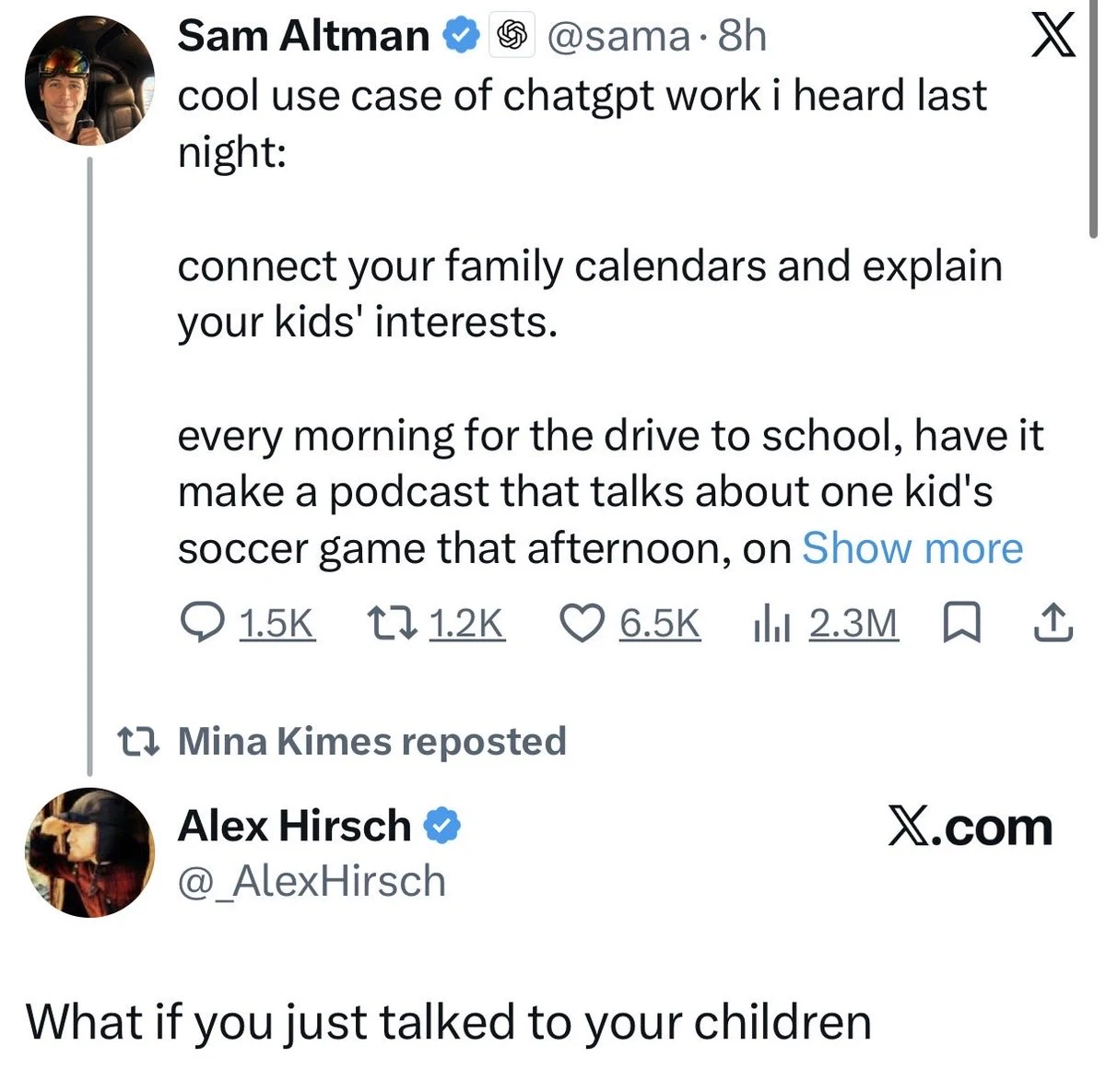 Sam Altman AI family podcast post and Alex Hirsch reply asking parents to talk to their children
The supplied X screenshot captured the post at 2.3 million views, with roughly 1,500 replies, 1,200 reposts, and 6,500 likes. Those counts are a moment-in-time snapshot, not final totals.
What Sam Altman proposed — and what he did not
Altman’s post described a workflow, not a new standalone product. The ingredients already fit the broader ChatGPT Work and connected-app direction:
- A parent connects one or more family calendars.
- The system receives a description of each child’s interests.
- Every morning, it selects timely events and relevant news.
- It turns those inputs into an audio program for the commute.
This is a smaller cousin of Altman’s earlier ChatGPT Work group-trip demo. That example used prior context, a coordination site, Gmail, and deferred reservations. Both pitches frame the assistant as a personal operations layer: it gathers scattered context, selects what matters now, and produces a finished artifact.
The important caveat is that the family-podcast post did not specify a released template, setup screen, child-consent flow, or special privacy model. It showed a use case. Treating it as a formal feature announcement would overstate the evidence.
Why “just talk to your children” hit so hard
The criticism worked because the proposed output occupies the same space as an existing human behavior. On the school run, a parent can already say: “You have a game this afternoon — how are you feeling about it?” A child can answer, change the subject, complain, joke, or stay quiet. That unpredictable response is not a defect. It is the relationship.
A generated podcast reverses the interaction. The calendar and interests go into a system; a polished narration comes out; the family becomes the audience. The machine may mention the right topics, but it cannot know which detail the child wants to discuss, avoid, reinterpret, or challenge in that moment.
Harvard’s Center on the Developing Child describes serve-and-return interaction as responsive back-and-forth between a child and a caring adult. Its research is focused especially on young children, so it does not prove that an AI podcast on a school commute causes developmental harm. It does support the broader principle behind the backlash: human development depends on responses, not merely exposure to relevant information.
The sharpest reading, then, is not “audio is bad” or “families should ban AI.” It is this:
A system that knows what a family could discuss should help them begin the conversation, not perform the conversation for them.
The idea still contains something useful
The backlash can obscure the real problem Altman’s example tries to solve. Family logistics are fragmented. One parent may manage school notices, another the sports calendar, while birthdays live in a shared calendar and a child’s newest obsession exists only in half-heard conversations. Morning is rushed. Important details are easy to miss.
Calendar synthesis can genuinely reduce that coordination burden. The product-design mistake is making the podcast the default endpoint. A private, thirty-second parent briefing is often better:
Before the school drive, review today's connected family calendar.
Give me three short conversation starters, one per child.
Do not write a script or generate audio.
Do not infer feelings, private motives, or facts not in the calendar.
Flag anything sensitive so I can decide whether to mention it.
That prompt leaves the difficult and valuable work with the parent: noticing tone, asking a follow-up, accepting silence, and letting the child steer. The AI handles recall, not intimacy.
The same principle appears in explainx.ai’s AI homework house rules: use the model as a tutor rather than a ghostwriter. For family life, the equivalent rule is briefing, not bonding. Let the tool prepare; do not let it impersonate the relationship.
The privacy question is bigger than “it is only a calendar”
A family calendar is not trivial metadata. Over time, it can reveal:
- school names, sports teams, medical appointments, and regular locations;
- custody arrangements, caregivers, relatives, and social relationships;
- when a home may be empty or when a child travels without both parents;
- birthdays, interests, anxieties, and important upcoming events;
- the rhythms that make a family identifiable even without a full address.
OpenAI’s current Google app data controls FAQ says ChatGPT accesses a selected Google account only after permission is granted. It also says connected Google content may be indexed and synced to provide relevant results, and that an indexed copy is deleted within 30 days after disconnection. The same page warns that Google app data may be sensitive and tells users to connect it only if they are comfortable with ChatGPT using it.
The broader Apps in ChatGPT guide explains that permissions control when an app may read or act, while Memory, retention, and model-improvement choices are separate settings. In other words, “I clicked Connect” is not the end of the privacy review.
| Before connecting | Question to answer |
|---|---|
| Whose account is this? | Is it a parent-owned calendar, a shared family calendar, or a child’s account? |
| What can the app read? | Which calendars and OAuth scopes are included? |
| What will be stored? | Is sync enabled, is an indexed copy created, and how is it deleted? |
| Is Memory enabled? | Could information retrieved today personalize later chats? |
| Who consented? | Did every person whose schedule or interests appear understand the use? |
| What is unnecessary? | Can school names, locations, medical entries, or full event descriptions be excluded? |
Children’s consent cannot be reduced to a checkbox accepted by an adult. A child may happily choose topics for a one-off quiz yet dislike a system continuously mining their schedule and interests. The respectful default is minimum data, explicit purpose, and easy opt-out.
OpenAI’s own family guidance points back to conversation
There is an irony in the backlash: OpenAI’s published family-safety guidance is more cautious than the viral use-case framing.
Its parental controls announcement quotes Common Sense Media’s advice that safety tools work best alongside ongoing conversations, clear family technology rules, and active parental involvement. OpenAI’s parental controls FAQ also says linked parents cannot read a teen’s chats and that either side can unlink the accounts.
Those are sensible boundaries. They treat technology as support for a family relationship, not a replacement for one. The family-podcast idea becomes much stronger when held to the same standard.
A five-part test for family AI
Before bringing an AI-generated experience into a routine with children, ask five questions.
1. Does it create a conversation or consume its time?
A two-minute quiz that leads to twenty minutes of discussion is augmentation. A twenty-minute generated show that fills the entire drive is substitution. Measure what happens after the AI speaks.
2. Is the child a participant or a data subject?
Choosing the topic, correcting the model, and deciding when to stop gives the child agency. Quietly compiling their interests and schedule turns them into input. Shared creation is more defensible than passive personalization.
3. Could the same benefit use less personal data?
“Ask about today’s game” needs the event title and time. It does not need years of chat history, the school address, sibling medical appointments, or a detailed profile of the child. Data minimization improves both privacy and output quality.
4. Can the family disagree with the machine?
Generated audio can sound authoritative even when it invents a detail or misreads a calendar entry. A parent should frame it as a draft: “The AI says your game is at four — is that right?” Better still, keep uncertain facts off the audio and let the parent verify them first.
5. Is there a no-AI version of the ritual?
Families should be able to skip the tool without making the morning feel incomplete. If silence becomes awkward because a synthetic host usually fills it, the technology has stopped assisting the ritual and started owning it.
What a genuinely good AI school-run experience could look like
The best version would not be one endlessly personalized broadcast. It would offer small, optional modes:
- Parent brief: three reminders and questions shown privately before leaving.
- Child-picked quiz: the child chooses a topic and competes with the parent.
- Family story lab: everyone supplies one sentence; AI only stitches or illustrates after the human ideas exist.
- News explainer: one child selects a story, the system gives a short neutral primer, and the family discusses what it missed.
- Silence mode: no content at all — an explicit reminder that attention does not need to be optimized.
This is close to the appeal of software for one: technology shaped for a single household rather than a mass audience. But family software raises a higher bar than a personal fitness dashboard. It serves several people with different ages, privacy expectations, and power inside the household.
Voice also changes the social cost. As our ChatGPT desktop voice guide explains, speaking can make an agent feel less like a tool and more like a participant. That makes voice convenient, but it also makes replacement easier to miss. A pleasant synthetic host can dominate a room without anyone deliberately deciding it should.
The backlash is a product-design warning, not a ban
Altman’s post identified a real capability: connected context can turn scattered family information into a timely, useful artifact. The public reaction identified the missing product requirement: protect the human exchange the artifact enters.
Alex Hirsch’s reply went viral because it made that requirement legible in eight words. The answer does not have to be “never generate a family podcast.” A child might love making a weekly show about dinosaurs, football, or space with a parent. The difference is whether they are creating something together or listening while a system performs awareness on the parent’s behalf.
The durable rule is simple:
Use AI to remember what matters. Use the drive to ask the child what it means.
Related on explainx.ai
- Sam Altman’s ChatGPT Work trip demo — is personal AI here?
- Software for one: personal apps built with AI coding agents
- AI and homework: family house rules that actually work
- Teach kids to spot AI fakes
- ChatGPT Voice on desktop, GPT-Live, and ChatGPT Work
- AI focus and followthrough: protect human attention
Sources: Sam Altman and Alex Hirsch posts shown in the supplied X screenshot, July 31–August 1, 2026 · OpenAI Google app data controls · Apps in ChatGPT · OpenAI parental controls · Harvard Center on the Developing Child — Serve and Return
The post, reply counts, and product documentation reflect the public record available on August 1, 2026. X engagement changes continuously, and ChatGPT app permissions, retention, and family-safety controls can change by plan and region. Verify current settings before connecting a family calendar.