



Ramp Labs says a single 2.35-billion-parameter model can translate the internal state of any of seven language models into the format of another, keeping 96.9% of base accuracy and cutting prefill latency by up to 7.5x on long documents. The claim comes from Ramp Labs' own X post introducing speculative encoding, with an article by researchers Ben Geist and Thomas Villeneuve. Weights have appeared on Hugging Face under RampPublic. The numbers are the lab's own. We have not seen an independent test.
This post explains the idea in plain language, separates what is confirmed from what is claimed, and lists what to check before you build on it.
TL;DR: claimed versus verified
| Question | Answer |
|---|---|
| What is it? | One 2.35B MoE that translates hidden states between models (Ramp Labs' description) |
| Headline claim | 96.9% of base accuracy kept, prefill latency cut up to 7.5x on long documents, across 7 models |
| Who says so? | Ramp Labs, in its own pinned post and article |
| Do weights exist? | Yes: a RampPublic/speculative-encoding repo with translator and compressor-128x folders |
| Is there a model card? | Not at the time of writing: the repo page says "No model card" |
| Independent test? | None found |
| Baseten involvement? | Mentioned in secondary summaries only; unconfirmed |
| The "4x, 96%" figure | Appears in aggregator summaries; differs from the lab's own numbers |
What problem does speculative encoding try to solve?
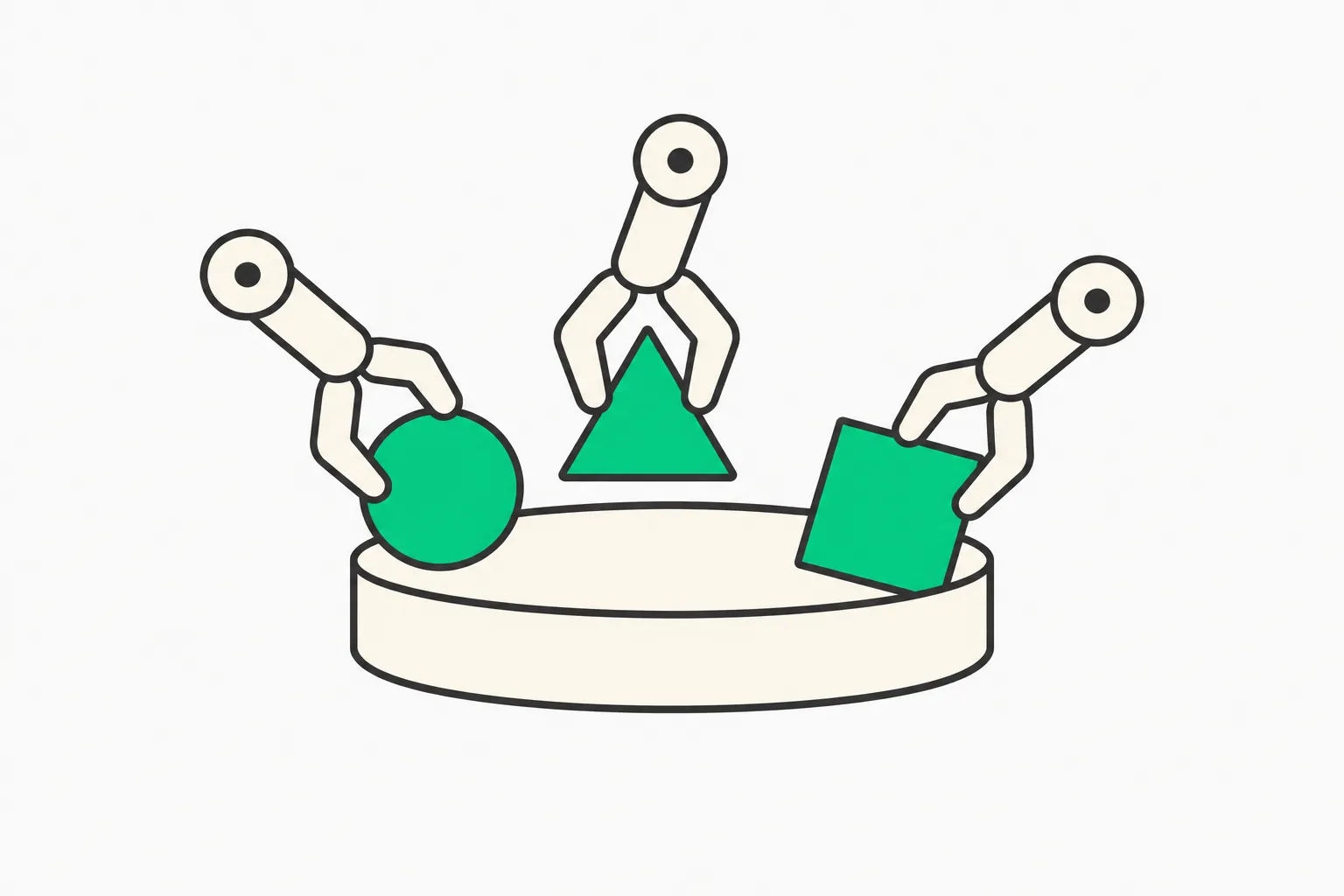 Three grippers placing shapes into one shared tray, showing speculative encoding sharing context across agents
When an AI agent reads a long document, the model first runs a "prefill" step. It processes every input token and builds an internal memory of the text, the key-value cache. That step is expensive for long inputs. If three agents in a swarm run on three different models, each one repeats the work on the same document, because one model's cache cannot be reused by another.
Ramp Labs' post frames it this way: agents no longer act in isolation, and routers and multi-agent swarms increasingly pass work between models of different sizes and families. Their proposal is to read the context once and translate the result into whichever model needs it. Our earlier explainer on what a KV cache is covers the basics, and MIT's swarm telepathy research on KV cache transfer across model families describes a related idea from academia.
Why is it called speculative encoding?
The name echoes speculative decoding, where a small model drafts tokens and a larger one checks them. The lab's one-line summary says a single translator handles "any model's hidden states" in a many-to-many fashion. The lab's public summary and the repository layout do not describe how a speculation or verification step works. Do not infer a mechanism from the name.
What does the Hugging Face repo actually contain?
The repository page lists two folders and a git attributes file. The translator folder is labelled "8-stream decoder (L' = 8), seed 1, stage-2 step 8,000". The compressor-128x folder is labelled "Learned question-mix compressors, 2,400 steps: 128x seed 1". The commits are from the account bgeist and appeared within the last day.
Two things follow. First, the files are checkpoints with training-step labels, which suggests an early research release rather than a packaged model. Second, the repo has no model card, so license, intended use, supported models and loading code are not documented there yet. Do not assume a permissive license.
What is confirmed and what is not
Confirmed from primary pages
- Ramp Labs published a post claiming a 2.35B MoE that translates between any model's hidden states, with 96.9% base accuracy kept and up to 7.5x lower prefill latency on long documents across 7 models.
- The researchers named are Ben Geist and Thomas Villeneuve.
- A RampPublic/speculative-encoding repository with translator and compressor folders exists on Hugging Face.
Not confirmed
- Which seven models were tested, and from which four families (one summary says four families; the lab's summary does not list them).
- What "base accuracy" means: which tasks, and what the baseline is.
- The hardware, context lengths and batch sizes behind "up to 7.5x". An "up to" figure is a best case on the longest documents.
- Any peer review or independent reproduction.
- Baseten's role, if any. Secondary summaries mention it; neither Ramp Labs' page nor the repo does.
- The "4x faster, about 96%" figure. It shows up in an aggregator summary and does not match the lab's wording.
How does this fit Ramp Labs' earlier work?
Ramp Labs has been publishing on this theme all year. Its research page lists a July 2026 post on PorTAL, a method for portable task adaptation of LoRA adapters across models. It also lists an April post on Latent Briefing, which shares memory across multi-agent systems through KV cache compaction, and a series on cartridges, compressed KV caches of long documents. The compressor-128x folder in the new repo looks consistent with that cartridge line of work, but the lab has not said so in what we read, so treat that as a guess.
The pattern matters for how much weight to give the new claim. A lab that publishes research regularly may well release a paper. That is not evidence that the 7.5x figure will hold elsewhere.
What does this mean if you build multi-agent systems?
The cost logic is easy to follow. In a swarm where every agent reads the same long document, prefill is repeated work. If one translator can hand a document's cache to a different model, you pay the reading cost once. The saving grows with document length and with the number of agents.
But the trade-offs are real, and the lab's headline number hides them. A 96.9% accuracy retention means about 3% of base accuracy is lost on the lab's tests. For retrieval over legal or financial documents, a 3% loss may not be acceptable. The translator is also an extra 2.35B-parameter model to host, so you need to compare its cost against simply re-reading. Our guide to Baseten's efficient frontier for LLM inference is a useful frame for that kind of cost-versus-latency decision.
Where would a translator help most, and where not?
The benefit depends on how your agents are arranged. A router that sends one long document to a small model first and a large model later is the clearest case: both stages need the same context, and the document is the expensive part. A swarm of five specialists reading the same contract fits too.
It helps much less when agents read different inputs, when documents are short, or when you run one model family and can already reuse its cache with prefix caching. Our post on prefix caching for long-horizon agents covers that simpler route, which needs no translator and loses no accuracy. If your agents share a model, start there. Translation is only worth its extra model and its accuracy cost when the models truly differ.
How to check the claim yourself
- Read the full article linked from Ramp Labs' pinned post when it is available, and note the model list, task list and baselines.
- Look for a model card and license on the Hugging Face repo before downloading anything for work use.
- Reproduce on your own stack. Pick two models you actually use, a document set at your real lengths, and measure both time to first token and task accuracy with and without translation.
- Test the tails. An "up to 7.5x" result is the best case. Measure short documents too, where the translator overhead may cancel any gain.
- Watch for independent write-ups. A second lab reproducing the numbers would change this post from "claimed" to "verified."
Questions people are asking
Is speculative encoding the same as speculative decoding? No. Decoding speeds up token generation with a draft model. Encoding, as Ramp Labs uses the term, is about translating the stored context between models. The names are similar; the problems differ.
Does it work with any model? The lab says it translates between "any model's hidden states," and tested seven. That is a claim about design, not a tested guarantee for every model.
Is it open source? Weights have appeared on Hugging Face. We did not find a license statement, so do not assume one.
Where can I see the numbers? In Ramp Labs' pinned post and linked article on X, and on the Ramp Labs research page once the article is added there. At the time of writing the research page did not list it yet.
Bottom line
Speculative encoding is an interesting bet: make agents on different models share one reading of a document. The 96.9% and 7.5x figures are the lab's own and unreplicated, the repo has no model card, and the 4x figure and the Baseten link in other reports do not match the primary sources. Watch for the paper, the license and a reproduction before you plan around it.
Related reading
- What is a KV cache? LLM inference explained
- What is speculative decoding? Inference guide
- MIT swarm telepathy: KV cache transfer across model families
- Baseten efficient frontier for LLM inference
- Together AI and Ollama prefix cache for long-horizon agents
- Semantic caching for LLM apps: cost and latency guide
Details are accurate as of November 25, 2026, from Ramp Labs' public posts and the Hugging Face repository page. Check those pages for later changes.