




Generative AI arrived with enormous claims about cost savings, productivity gains, and business transformation. Three years later, we can separate what is real from what was hype — and the real results are significant, but only in specific conditions.
This guide covers where generative AI actually reduces costs, what the realistic ROI numbers look like, and how explainx.ai — formerly known as UpyogAI — helps businesses implement AI workflows that deliver measurable savings.
A Note on the Brand: UpyogAI Is Now explainx.ai
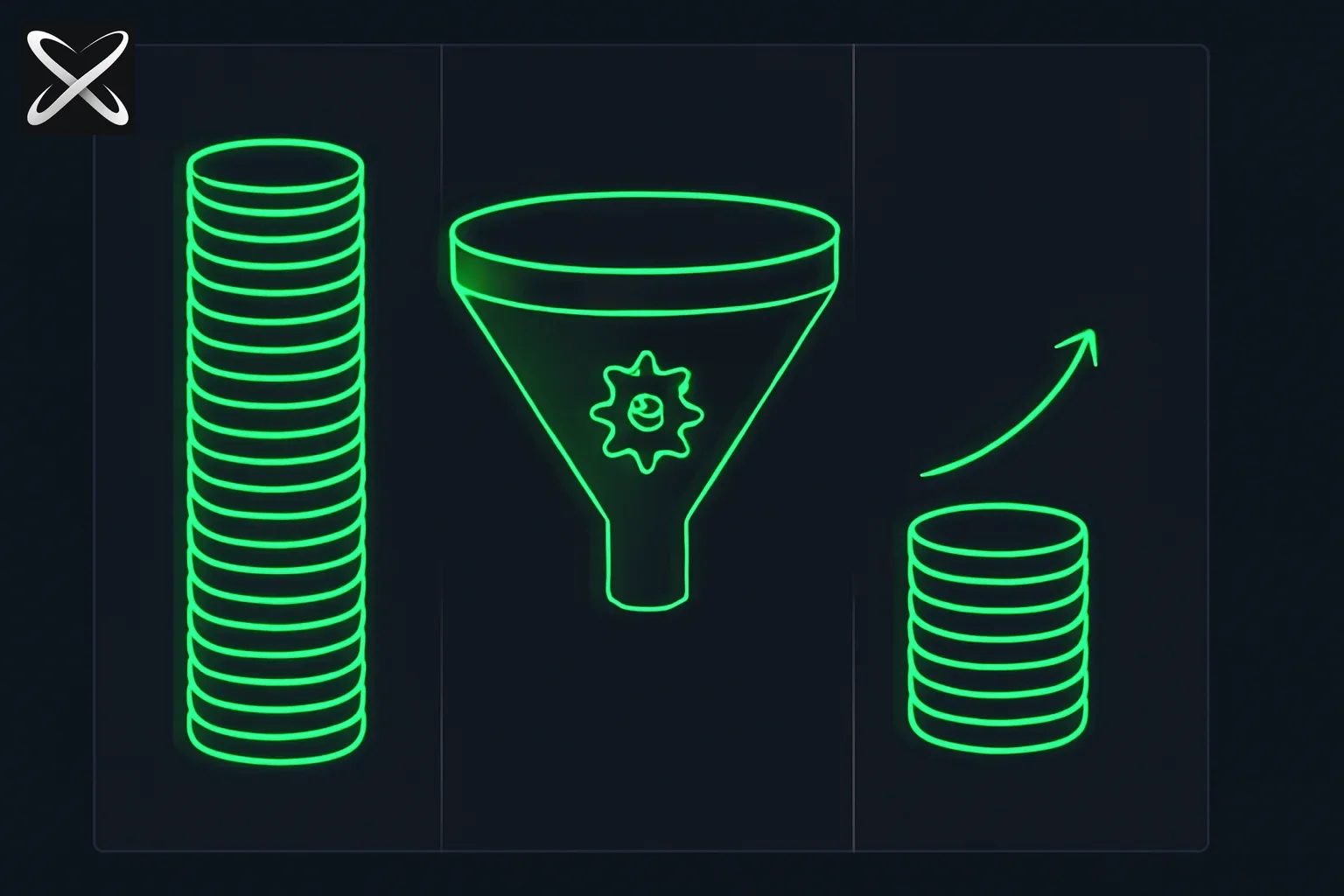 Optimising generative AI costs diagram: a tall coin stack shrinking through an AI funnel with a rising ROI arrow
If you found this page from older content referencing UpyogAI, you are in the right place. UpyogAI rebranded to explainx.ai as the platform expanded beyond AI consulting to become a full-scale AI skills registry, tools directory, and enterprise agent platform. The expertise and the team are the same — now operating at greater scope and scale.
explainx.ai today is a platform that indexes 10,000+ agent skills, 2,000+ MCP servers, and 100,000+ AI tools, while also helping enterprises design and deploy production AI agents that integrate into real business workflows.
The ROI Reality: Where the Numbers Are Real
Industry benchmarks from 2025–2026 give us a clearer picture of where generative AI cost savings are genuine.
The aggregate number: For every $1 invested in generative AI, companies report an average return of $3.70. Financial services leads at 4.2x. But here is the critical caveat — more than 80% of organisations report no measurable impact on enterprise-level profitability. The returns are highly concentrated in teams that deploy AI to specific, high-volume, structured tasks — not in organisations that give everyone a chatbot subscription and call it an AI strategy.
Where the Savings Are Concentrated
1. Customer Support: 30–50% ticket deflection
This is the single most consistent ROI driver. AI systems connected to a company's knowledge base, product documentation, and CRM can resolve routine inquiries — order status, returns, account questions, how-to queries — without human involvement. Well-implemented customer AI deflects 30–50% of inbound ticket volume, reducing cost-per-contact dramatically.
The compounding effect: human agents handling only the complex, high-empathy interactions become more effective and less burned out. Turnover in support roles — which is expensive — decreases.
2. Software Development: 40–55% faster task completion
GitHub's research on Copilot showed 55% faster task completion for developers using AI-assisted coding. Across enterprise software teams, AI code generation, review, and documentation is consistently delivering 40%+ productivity gains for individual developers.
The cost implication: you either complete the same work with fewer engineers, or complete significantly more work with the same team. Both translate to material cost reductions or revenue acceleration.
3. Legal and Document Review: 60–80% time reduction
Legal document review — contracts, compliance documents, due diligence — is one of the most expensive per-hour business functions. AI document review tools can cut review time by 60–80% for standard contract types, with human lawyers reviewing AI findings rather than reading every line cold.
Law firms and in-house legal teams that have deployed AI document review report it as one of the clearest cost savings they have ever implemented — faster turnaround, lower billable hours, and reduced dependency on expensive outside counsel for routine review work.
4. Finance: Reporting, Extraction, Reconciliation
Financial reporting and data extraction are high-volume, structured, error-prone tasks where AI excels. Automating the extraction of data from invoices, contracts, and financial documents — and generating first-draft reports from structured data — reduces finance team time on mechanical tasks by 40–60%.
5. HR: Screening, Onboarding, and Policy Q&A
Candidate screening, new hire onboarding documentation, and answering repetitive HR policy questions are all high-volume, low-variance tasks. AI handles the mechanical layer — screening resumes against job criteria, generating personalised onboarding checklists, answering "how many vacation days do I have?" — freeing HR professionals for the judgment-intensive work.
The Deployment Patterns That Actually Deliver ROI
The gap between the 80% who see no measurable impact and the 20% who see 3–4x returns comes down to deployment pattern.
What Does Not Work: Horizontal AI Deployment
Buying a ChatGPT Teams or Claude for Work subscription and rolling it out to the entire company as a general-purpose productivity tool. Some individuals will get significant value. Most will use it occasionally. Enterprise-level ROI will be negligible.
What Does Work: Vertical AI Deployment
Identifying a specific, high-volume business process — customer support, contract review, code generation, onboarding, invoice processing — and building a purpose-specific AI workflow for that process. The workflow is:
- Connected to the right data sources (CRM, knowledge base, document store)
- Given specific instructions for that use case (system prompt, guardrails, escalation logic)
- Integrated into the existing process (not a separate tool people have to remember to use)
- Measured against specific baseline metrics (ticket volume, resolution time, error rate)
Vertical deployments consistently outperform horizontal ones because they are solving a specific problem rather than hoping people find uses for a general tool.
The Cost Components AI Reduces
When you map AI savings to specific cost line items, the value becomes clearest:
| Cost Component | AI Mechanism | Typical Reduction |
|---|---|---|
| Customer support headcount | Ticket deflection via chatbot | 20–40% of support FTEs for routine tier-1 |
| Developer time on boilerplate | Code generation (Copilot, Claude Code) | 40–55% on affected task types |
| Legal review hours | AI document review tools | 60–80% on standard document types |
| Finance team time on extraction | AI document parsing | 40–60% on invoice/contract data extraction |
| HR recruiter time on screening | AI resume screening | 50–70% on initial screen pass |
| Meeting time overhead | AI summaries, async-first culture | 20–30% reduction in follow-up meetings |
These are averages from published benchmarks — your specific numbers will depend on process quality, implementation depth, and baseline efficiency. But they establish what is achievable.
What explainx.ai Helps You Do
explainx.ai approaches AI cost optimisation from two directions:
1. The Skills Registry: Ready-Made AI Workflows
The explainx.ai skills registry publishes 10,000+ agent skills — pre-built AI workflows for specific business tasks that teams can install in a single command. Instead of spending weeks building a customer support bot from scratch, you install a support skill, connect it to your knowledge base, and customise the system prompt for your product.
This dramatically reduces the implementation cost and time-to-value for AI deployment — which is itself a significant source of ROI improvement. Most enterprise AI projects fail not because the underlying technology does not work, but because the implementation cost and timeline erode the economics before the deployment reaches production.
2. Enterprise AI Consulting and Agent Design
For businesses that need custom AI agents — workflows that integrate with proprietary systems, require specific compliance constraints, or involve complex multi-step processes — explainx.ai designs and deploys production agents with:
- Grounded workflows connected to your data sources
- Enterprise integrations (CRM, ERP, HRMS, ticketing)
- Observability and monitoring for AI outputs
- Governance and approval gates for high-stakes decisions
The design principle: AI handles the high-volume, structured, predictable work. Humans handle the judgment-intensive, relationship-critical, novel situations. The goal is not automation for its own sake — it is putting AI where it creates clear cost savings without creating new risks.
The Cost Savings That Compound
The most significant cost optimisation is not visible on any single dashboard. It is the reallocation of human attention.
When AI handles 40% of customer tickets, 60% of document review, and 50% of code boilerplate, the people who were spending their time on those tasks are now available for higher-value work. They are not eliminated — they are elevated. The best implementations use this freed capacity to do more with the same headcount: more customers served, more products shipped, more deals closed.
This is the compounding return that makes generative AI different from most cost-saving technologies. It is not just doing the same thing cheaper — it is making the people doing the work more effective at the things that actually drive revenue and growth.
Getting Started: The Right Questions to Ask
Before investing in any AI cost-reduction initiative, answer these:
-
What is the highest-volume repetitive task in your target function? Volume matters. AI saves the most where humans are doing the same thing many times.
-
Is the task structured or unstructured? Structured tasks (answering product questions, reviewing contracts against a checklist, extracting data from invoices) are much better AI targets than unstructured ones (novel negotiations, complex creative work, relationship management).
-
What is your current cost-per-transaction? Knowing your baseline makes it possible to measure the actual ROI, not just claim it.
-
What is the cost of an AI error in this context? A hallucinated legal clause in a contract is much more expensive than a hallucinated product FAQ answer. Design your human review layer to match the error cost.
-
How will you measure it? If you cannot measure it, you cannot know if it is working. Define your success metric before you deploy.
explainx.ai's consulting practice starts with exactly these questions — identifying the highest-ROI deployment opportunities before committing to implementation. Browse our tools directory or explore agent skills to see what's already available for your use case.
For related reading, see our guides on AI business communication, Claude for small business, and technical AI concepts for business leaders.