




OpenAI and Cisco released Shirudo on November 23, 2026 — an open-source Linux runtime that loads signed eBPF shields (they call them upatches) on running systems so operators can mitigate a known exploit path while a full vendor patch is still in flight. In a controlled test, OpenAI says Codex produced a shield that blocked Java4Shell against live Elasticsearch without restarting the JVM.
That timing matters: the same month brought nginx2root HTTP/2 RCE flaws, Java4Shell, and a wave of AI-assisted auditing stories. Shirudo is Cisco and OpenAI betting that defenders need machine-speed mitigations, not only machine-speed discovery.
| Question | Answer |
|---|---|
| What shipped? | Open-source Shirudo runtime (BSD-2-Clause) from OpenAI + Cisco, announced Nov 23, 2026 |
| What problem does it target? | Days-to-weeks patch windows where blocking a syscall outright might break legitimate traffic |
| Headline demo | Codex-generated shield on Java Base64 path; exploit rejected, Elasticsearch kept running (OpenAI post) |
| Code & docs | github.com/shirudo-dev/shirudo, shirudo.dev, OpenAI announcement, Cisco newsroom |
| Production today? | Pre-release per README; needs kernel patches, TPM 2.0, signed-loader ABI |
What Shirudo is (and is not)
OpenAI's introduction frames Shirudo as infrastructure for the gap between finding a bug and rebooting every affected host. Patching can take days or weeks. Meanwhile, an exploit and a legitimate request may share the same low-level operation; a blunt block can take the service offline.
Shirudo's answer is a temporary safeguard teams can test, approve, and attach while the process keeps running. OpenAI president Greg Brockman is quoted saying defenders need better models to find flaws fast, but finding is not the same as patching everywhere tomorrow — so open tooling should let one team's shield become another's starting point.
The Cisco newsroom release sharpens the agent angle: Shirudo is meant to match AI-driven attack speed once a vulnerability is identified, with shields going live only when evidence says they are safe.
This is not a replacement for Oracle's Java4Shell CPU builds or NGINX 1.31.9. Think bridging control with cryptographic gates, closer to eBPF policy than to a cloud WAF SKU.
Agents that act on your behalf need rules. See how explainx helps secure your agents →
How Shirudo works: eBPF, signed upatches, and TPM evidence
Shirudo builds on eBPF — small programs attached at kernel hook points. OpenAI's post lists four design pillars:
- Live protection — block vulnerable paths without restart; dry-run impact before enforce.
- Defense at machine speed — agents (including Codex in the Java4Shell demo) can draft and test shields; humans approve deploy.
- Trusted deployment — shields are signed; Linux's eBPF verifier enforces safety rules; kernel controls limit unauthorized loads.
- Hardware-backed verification — TPM records what loaded or was removed so operators can audit posture.
The GitHub README adds implementation detail OpenAI's marketing page compresses:
- After boot init, production targets restrict BPF loads to signed loaders.
- Operators ship upatches as small, reviewable programs; targets pull from OCI registries.
shirudo attestreturns TPM-signed evidence operators can verify offline.- Java agent upatches load at JVM startup on configured runtimes — the path OpenAI describes for in-process Base64 guarding.
Guardian agent diagram (official)
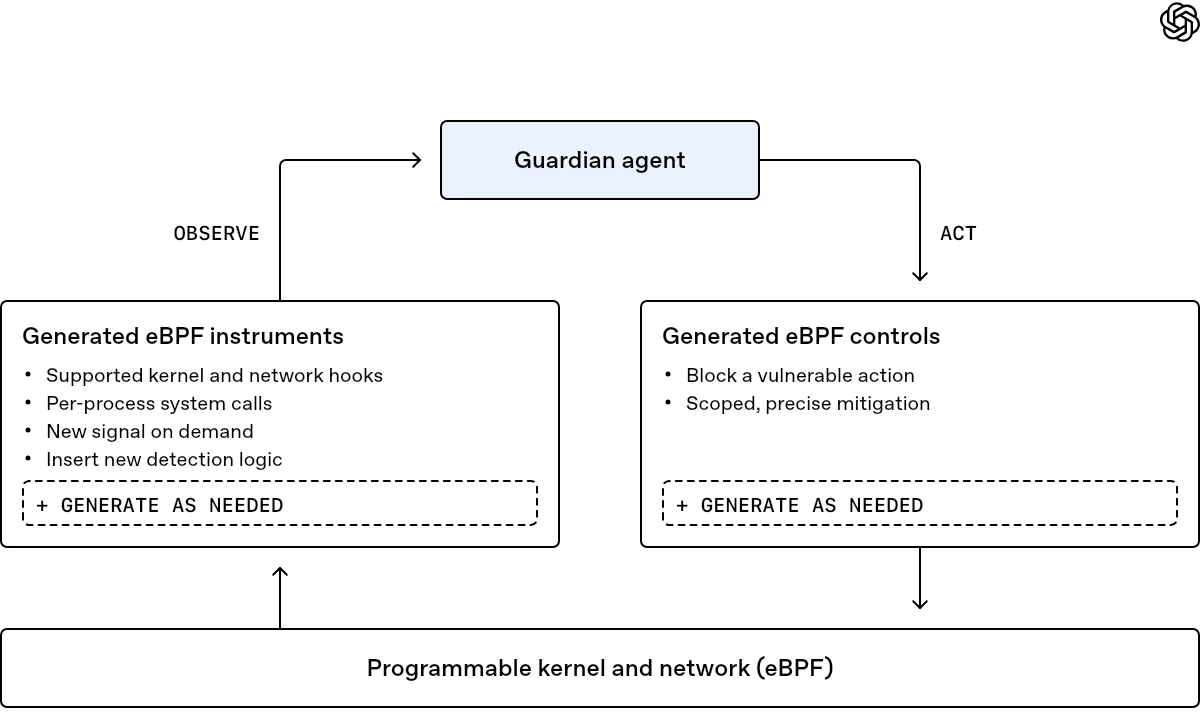 Shirudo guardian agent diagram showing eBPF observation and targeted Linux kernel protections
Image: OpenAI
OpenAI captions this figure as the guardian agent using eBPF instruments to observe kernel and network activity and eBPF controls to apply targeted protections — the mental model for where agent automation sits relative to the kernel.
The Java4Shell demo in context
OpenAI ties Shirudo to CVE-2026-114938 explicitly:
- Codex generated a shield adding an input check to Java's Base64 decoder.
- The shield attached to a running Elasticsearch process.
- An exploit attempt was rejected; Elasticsearch continued running.
Cisco's release names Java4Shell and a PHP flaw as tests where Shirudo detected and blocked exploitation in their harness.
Read that as evidence of workflow, not a universal guarantee:
- It was a controlled test, not a blanket claim every JVM is protected.
- Java4Shell patching and JVM restarts remain the durable fix.
- Agent-generated mitigations need the same review bar as agent-generated code — signature and verifier gates are the technical answer Shirudo emphasizes.
If your team already runs GPT-6 Cyber red-team harnesses or GitHub/Microsoft's AI audit pipeline, Shirudo is the downstream deploy lane Cisco and OpenAI want to standardize in the open.
OpenAI and Cisco partnership: why these two vendors
 OpenAI and Cisco Shirudo open-source Linux runtime with green terminal accent
A green open box suggests shared open-source shields both vendors ship to the community.
Cisco contributes decades of infrastructure security and eBPF depth (Isovalent, Talos, enterprise networking). OpenAI contributes frontier models already used in vulnerability discovery narratives this month.
Neither vendor claims Shirudo closes the loop alone:
- OpenAI invites security researchers and kernel hackers to contribute shields and runtime hardening.
- Cisco asks enterprises to break legitimate traffic on purpose — stress tests that matter because eBPF mistakes can denial-of-service production.
For builders comparing agent security products, Shirudo is infrastructure glue: signed execution at the kernel boundary. It complements application-level gates like Anthropic's zero-trust agent framework and coding-agent guardrails, rather than replacing them.
How to try Shirudo (official paths)
OpenAI lists three on-ramps:
| Path | What it is |
|---|---|
| VM quickstart | Sign, load, and verify a test protection locally (software TPM in README quickstart) |
| Isovalent self-guided lab | Hands-on path linked from the announcement |
| Webinar Dec 15, 2026 | Technical deep dive registration linked from OpenAI |
The repository README repeats the VM quickstart, documents OCI pull-based delivery, and notes CI on x86-64 plus arm64 host tests.
Technical walkthrough video
OpenAI links a Linux Plumbers Conference session (shirudo: BPF live-patching infra for the agentic era) as the long-form engineering walkthrough for applying and verifying a shield on a target host.
Shirudo vs waiting for vendor patches
 Shirudo exploit shield concept with cracked shield under a security patch
A shield under patch illustrates temporary Shirudo upatches while vendor fixes land.
| Approach | Strength | Weakness |
|---|---|---|
| Vendor patch + restart | Supported, durable fix | Slow rollout; many JVMs/processes to restart |
| JVM flags (e.g. disable Base64 intrinsics) | Fast mitigation for Java4Shell class bugs | Performance hit; not universal |
| Network choke (disable HTTP/2, WAF rules) | Works for some protocol bugs | Coarse; may break clients |
| Shirudo upatch | Fine-grained, live attach, signed | Pre-release; kernel requirements; needs ops skill |
Shirudo's pitch is the last row becomes repeatable and shareable — tested shields published beside CVEs so operators are not reinventing eBPF for every nginx2root or Java4Shell cousin.
What operators should do this week
- Patch anyway — Shirudo does not remove NGINX or Java CPU urgency.
- Clone and read — github.com/shirudo-dev/shirudo threat model and signed-loader requirements before any production experiment.
- Run the VM quickstart on disposable hardware — confirm attest output and your team's signing workflow.
- Treat agent-generated shields like code — review, test against reproducers, monitor for legitimate-traffic breaks.
How to limit risky agent actions while you evaluate Shirudo
Agent workflows that draft shields inherit the same risks as agents that draft patches: a bad mitigation can outage production faster than a missed CVE. Keep the same human-approval bar you use for agent-written code — review shields on staging traffic, require signed artifacts, and roll back fast when legitimate requests fail.
What developers are saying
The Hacker News thread for Shirudo had no substantive discussion as of this post (10 points, 0 comments in the API snapshot). Early takes are likely to land in kernel and eBPF mailing lists and GitHub issues on shirudo-dev/shirudo (30 open issues, 194 stars on the public tracker snapshot). Watch those venues for legitimate-traffic break reports and kernel version constraints — not star counts alone.
Long-term roadmap (per OpenAI)
OpenAI's post sketches goals beyond one-off shields:
- Harden kernel and core services, limit workload permissions, safer updates.
- Let defenders and agents identify affected systems, validate protections, and deploy eBPF shields without workload disruption.
- Use hardware attestation and network controls for containment and recovery.
That is ambitious infrastructure rewriting — today's ship is the open runtime + Java4Shell proof point, with pre-release caveats in the README.
Licensing, governance, and what to watch on GitHub
OpenAI says Shirudo ships under BSD-2-Clause, with BPF programs dual-licensed BSD and GPL. The GitHub README repeats that split and notes SPDX headers per file, including vendored third-party snippets with their own notices. For enterprises with GPL interaction policies, the dual license on BPF bytecode is the detail legal teams will ask about first — not the marketing diagram.
Governance is early-stage: shirudo-dev/shirudo lists main as the development branch, release tags publish packages on GitHub Releases, and development builds surface as Build packages workflow artifacts. OpenAI and Cisco both invite issues and contributions on shields, runtime hardening, and eBPF verifier edge cases. Expect rapid churn while pre-release kernel requirements settle.
Watch three signals on the tracker:
- Kernel version matrix — README says production needs signed-loader ABI plus Shirudo kernel patches; most laptops will not match day one.
- False positive reports — Cisco explicitly asks operators to show where shields break legitimate traffic; those issues will define real-world usability.
- Agent-generated shield PRs — same review discipline as agent-written code guardrails debates elsewhere this year.
Related reading
- Java4Shell CVE-2026-114938: Oracle patch guide
- nginx2root HTTP/2 RCE patches
- GPT-6 Cyber and ExploitGym
- GitHub and Microsoft: AI findings to reports pipeline
- Anthropic zero-trust AI agents framework
- Cisco Antares open SLMs for vulnerability localization
- External sandboxes for coding agents
Specifications, star counts, and kernel requirements reflect OpenAI, Cisco, and GitHub sources as of November 23, 2026.