




Reinforcement learning post-training often splits work: one cluster rolls the policy forward for on-policy rollouts while another updates weights. Between steps, weight refit copies the newest parameters from the training layout to the inference layout. On multi-hundred-billion and trillion-parameter models, NVIDIA says the old pattern — gather the full tensor on training ranks, then broadcast to inference — can imply a logical payload on the order of twice the model’s weight bytes every step. On November 6, 2026, NVIDIA published a technical blog describing Reshard, a collective framed as moving only what each destination shard needs, implemented as NCCL M2N Reshard, with a reference path in NeMo RL.
TL;DR: what changed
| Question | Short answer | Where it comes from |
|---|---|---|
| What is refit? | Periodic copy of updated policy weights from training GPUs to inference GPUs in disaggregated RL | NVIDIA technical blog |
| What was wrong with gather-broadcast? | Receivers often need only a shard but see the full tensor in flight, so communication grows fast | Same |
| What is Reshard? | A DTensor-to-DTensor transfer that describes source and destination sharding and moves the minimum overlap regions | Same |
| What implements it? | NCCL M2N Reshard (open reference in NVIDIA/nccl-extensions) | Same |
| How much faster? | 2.7× to 5.7× lower latency than gather-broadcast in NVIDIA’s NeMo RL table for listed models and layouts | Same |
| How to try it in NeMo RL? | Set policy.generation.colocated.enabled: false and policy.generation.refit_transport: nccl_reshard per the blog | Same |
Why refit stops being “just another all-gather”
 Green sphere on a curved reinforcement-learning path toward a reward, illustrating RL policy updates between rollout and training clusters
Disaggregated setups exist because training and inference want different parallel maps. Training may use tensor, pipeline, expert and context parallelism mixes that do not match what inference serving needs. Refit must still refresh every weight on the inference side, so the transfer is as large as the model.
NVIDIA’s post walks through the usual gather-and-broadcast sequence: training ranks all-gather local shards to reconstruct each full parameter, broadcast the full tensor to inference, and each inference rank keeps its shard. That uses the full tensor as an intermediate representation, which is simple to implement but means inference ranks receive bytes they will discard, especially when they only need a column or row shard of a weight matrix.
The communication volume compounds. For BF16 weights at two bytes per parameter, NVIDIA illustrates logical refit payload estimates around 11.2 TB for a 2.8 trillion-parameter model and 9.6 TB for a 2.4 trillion-parameter model when both gather and broadcast stages are counted — before any framework overhead. The post states that for today’s largest open-weight models the payload is already around 10 TB per refit at each training step.
For anyone budgeting clusters for RL post-training, that number is not a footnote. It is the reason teams chase faster networks, fatter NVLink domains, and fewer full-model copies in flight.
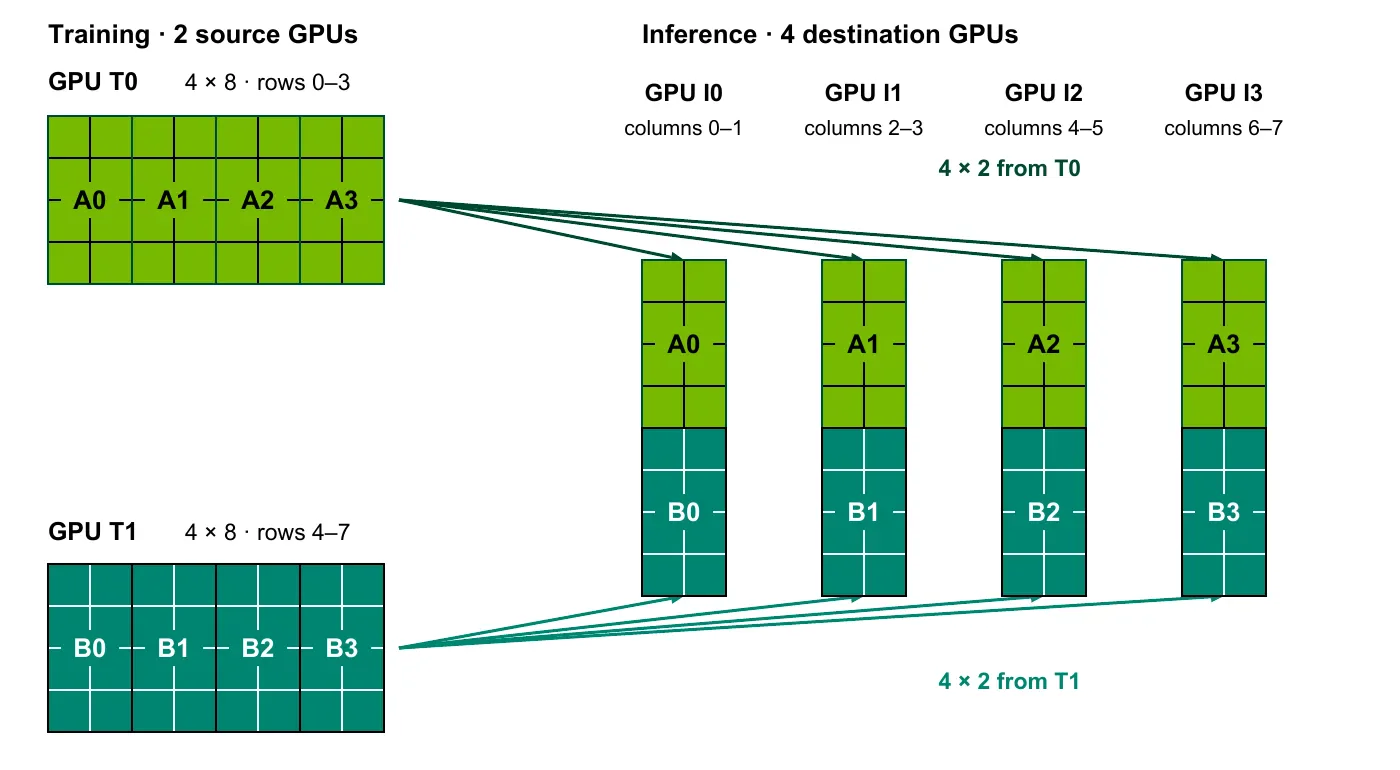 Diagram of NVIDIA Reshard Collective direct shard transfer for RL weight refit between training and inference GPUs
Image: NVIDIA
Refit as resharding, not reconstruction
The blog’s core idea is to treat refit as resharding a PyTorch DTensor from the training mesh layout to the inference mesh layout. A DTensor already carries global shape, device mesh, and placements that say how each dimension is sharded or replicated. If those metadata objects are accurate, the intersection of source and destination shards tells you exactly which rectangular regions must move between which ranks.
The worked example in the post uses an 8×8 matrix: two training GPUs hold row shards, four inference GPUs need column shards, and each destination can be built from two 4×2 regions, one from each training rank — with no full-matrix reconstruction on the wire. That is the mental model: direct shard-to-shard exchange driven by layout math.
This framing matters for practitioners because it separates communication pattern from framework details. Once refit is “just” a reshard, you can reason about bandwidth the same way you reason about tensor-parallel collectives: which edges carry which blocks, and where you accidentally duplicate traffic.
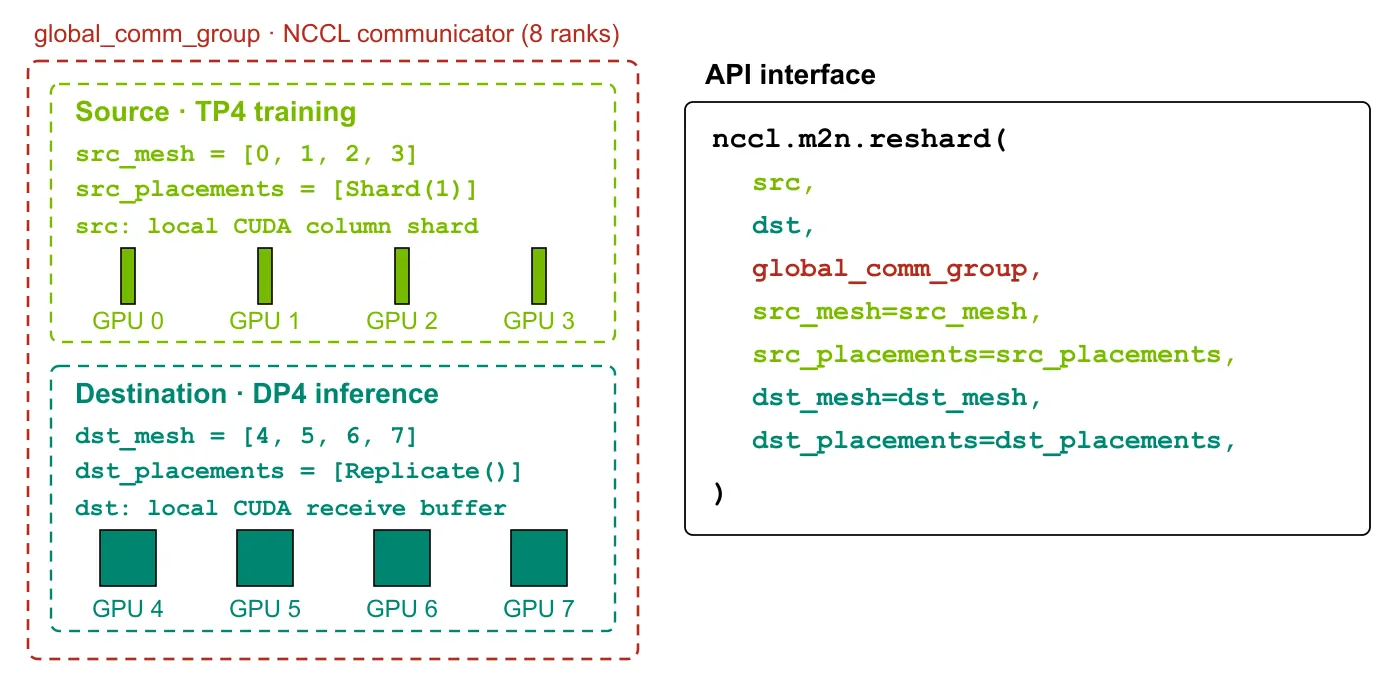 NCCL M2N Reshard example moving tensor shards from training to inference GPUs for RL refit
Image: NVIDIA
NCCL M2N Reshard: fewer copies across the network
 Four compute nodes linked by a woven green fabric, illustrating GPU interconnect and NVLink traffic patterns during a collective
NCCL M2N Reshard is NVIDIA’s reference implementation of the Reshard collective, published as open source in the NVIDIA/nccl-extensions repository, and built to move a tensor distributed across M source GPUs into the layout required by N destination GPUs. For RL refit, training ranks are the source group and inference ranks are the destination group.
The post explains how the implementation derives exact intersections between source and destination shards, then maps transfers onto the physical topology. When multiple destination ranks replicate the same shard (data-parallel replicas), a naive point-to-point plan can send each source shard to every replica, duplicating wide-area or cross-leaf traffic.
NCCL M2N’s mitigation is to group replicas by NVLink domain, balance incoming shards across replica ranks so each shard crosses the network roughly once, and use fast NVLink exchanges inside the domain so every replica still assembles the full shard it needs. The blog’s Figure 3 contrasts naive P2P (each source shard hits both DP replicas) with the Reshard pattern (network once, NVLink completes the replica). That is the kind of detail performance teams care about when a refit sits on the critical path next to generation and optimizer steps.
NeMo RL: hybrid refit for real stacks
NVIDIA positions NeMo RL as the open framework where the Reshard path is demonstrated end to end. The project’s public docs describe inference, deployment, and customization paths for that stack on the NeMo Framework site, alongside the Reshard-focused technical blog. The honest limitation, stated in the post, is that production models mix many layer types and shardings that all need to stay correct. A pure Reshard rollout for every parameter is still hard.
So NeMo RL ships a hybrid: feed-forward projection weights — described as roughly 95% of parameters in modern transformers — take the reshard path, while smaller tensors (the blog names QKV projection and Mamba weights as examples) stay on gather-and-broadcast for coverage. That is a practical compromise: attack the bulk of the payload first, keep odd layers working.
For operators, the activation switch is YAML-level: policy.generation.colocated set to false and policy.generation.refit_transport set to nccl_reshard, exactly as shown in the blog’s configuration snippet. Teams already running NeMo RL for RLHF or tool-use post-training should treat this as a transport plugin, not a redesign of their loss or rollout code.
Resilience is noted but not oversold: layouts can change when nodes join or leave, and the post says NeMo RL today destroys and recreates the communicator group for those cases, with NCCL shrink/grow support described as future work.
Benchmarks: what NVIDIA measured
The blog’s Table 2 lists refit latencies for gather-and-broadcast versus reshard on DGX H100 and DGX GB200 for several model and layout pairs. The speedup band NVIDIA reports is 2.7× to 5.7×. One line many readers will zoom in on is DeepSeek v3 671B moving from 14.9 s to 2.6 s refit on DGX H100 for the quoted training-to-inference layout, and 6.1 s to 2.3 s on DGX GB200 — different absolute times, same qualitative story that newer systems buy headroom even before algorithmic fixes.
NVIDIA also cites a refit-only microbenchmark where Reshard refit on Qwen3.8 2.4T BF16 took about 4.3 seconds. That is a single number from one microbenchmark, not a guarantee for your job mix, but it answers the question “does this still matter at 2.4T?” with a concrete order of magnitude.
Readers should pair those figures with their own constraints: not every team runs disaggregated RL, not every checkpoint uses the same parallelism maps, and network topology outside a DGX row will differ from NVIDIA’s lab. Treat the table as evidence that layout-aware refit is worth integrating, not as a universal speed claim.
How this connects to the rest of the RL tooling picture
NVIDIA has been packaging NeMo RL, NeMo Gym, and related harness pieces alongside frontier open models such as Nemotron; partners such as Shopify have named NeMo RL in public write-ups of post-training workflows (Shopify and Nemotron). This Reshard work plugs into the same story: as RL loops get longer and policies get larger, the refit step becomes its own bottleneck.
If you are comparing stacks, also look at how other labs use RL on top of language models; Meta’s retrieval programs work is one explainx.ai entry point. The takeaway is not “everyone should use NCCL Reshard,” but “everyone should account for refit bytes in the capacity plan.”
AWS and other clouds also document RL loops that split training runtime concerns from serving; our write-up on SageMaker multi-turn RL on GPT-OSS 20B is a concrete recipe for a smaller model that still shows how vendor-managed RL infrastructure packages the moving parts. NVIDIA’s own model cards often name NeMo RL next to NeMo Gym for GRPO-style post-training (Nemotron Dory 4B lists both). None of those posts replace the layout argument here: they show where RL happens in product pipelines, while Reshard attacks how expensive the weight sync is once you separate inference and training.
What teams should do next
- Inventory parallelism maps for your training and inference fleets. If they differ, you are already in Reshard’s target regime.
- Read NVIDIA’s NeMo RL refit guide alongside the blog — the post explicitly defers precision modes and supported backends to that guide.
- Prototype
nccl_reshardon a smaller model that still uses disaggregated RL, so you can validate functional parity before touching trillion-scale jobs. - Watch NCCL release notes for M2N Reshard maturity; reference implementations can gain features after the first blog drop.
Related reading
-
Hugging Face's MoE training handbook: all-to-all overlap and RL routing mismatch in MoE training
NVIDIA published the Reshard collective description on November 6, 2026. Figures and numbers in this article come from that post unless noted. Verify layout support in NeMo RL and NCCL before production use.