



NVIDIA just open-sourced a driving model that beat GPT-4o by 23 points on an autonomous-driving reasoning benchmark — and licensed it so anyone can put it straight into a commercial robotaxi.
On August 4, 2026, NVIDIA released Alpamayo 2 Super, the newest and largest model in its Alpamayo family of open reasoning models for autonomous vehicles. It's a 34-billion-parameter vision-language-action model, built on NVIDIA's Cosmos 3 Super Reasoner and post-trained with reinforcement learning, aimed at the specific failure mode that actually matters in self-driving: not everyday lane-keeping, but the rare, hard-to-anticipate situations where a car has to reason about cause and effect before it acts.
TL;DR
| Question | Direct answer |
|---|---|
| What is it? | A 34B open-weight vision-language-action model for autonomous vehicles |
| Built on | NVIDIA Cosmos 3 Super Reasoner + RL post-training |
| License | OpenMDW-1.1 — commercial use, fine-tuning, and redistribution all permitted |
| How good? | #1 on LingoQA among ~40 models — beats GPT-4o by 23.2 points, Gemini 2.5 Pro by 15.1 |
| What does it output? | Trajectory, chain-of-causation explanation, meta-action, auto-labels, and 2D-grounded VQA |
| Where does it run? | Cloud, for development and distillation — not designed for in-vehicle real-time inference itself |
| Family | 3x the parameters of Alpamayo 1.5 and Alpamayo 1, which target cheaper cloud distillation and eventual onboard deployment |
Why "understanding" is the hard part, not "seeing"
NVIDIA's framing for this release is specific: object detection and motion prediction are largely solved problems for AVs. What isn't solved is the long tail — unprotected turns, ambiguous merges, multi-agent interactions where several vehicles and pedestrians are all making judgment calls simultaneously. Handling those requires a model that can understand a situation, reason about cause and effect, choose an action, and — critically — explain that choice in a way engineers can inspect and validate.
Alpamayo 2 Super fuses full 360-degree camera coverage — front, sides, and rear — into a single reasoning pass, rather than treating each camera as a separate detection problem. NVIDIA says the added scale over the 10B-parameter Alpamayo 1.5/1 models (3x the parameters) specifically helps generalization from sparse examples, which is exactly the profile of the rare, multi-agent scenarios the model is meant to target.
Five outputs, one model
For each driving situation, Alpamayo 2 Super produces five tightly coupled outputs from a single forward pass:
| Output | What it is |
|---|---|
| Trajectory | The vehicle's planned path |
| Chain-of-causation (CoC) trace | A reasoning explanation for the decision |
| Meta-action | High-level intent — yield, lane change, stop |
| Reasoning auto-labels | CoC annotations generated for training/validation data |
| VQA with 2D grounding | Answers tied to specific regions in camera images |
The auto-labeling piece is arguably the more immediately commercial part of this release: NVIDIA says Alpamayo 2 Super can turn raw, unlabeled fleet driving footage into richer training data — compressing annotation cycles NVIDIA describes as taking months down to days. For any AV program sitting on large volumes of unlabeled camera data, that's a direct cost argument, independent of whether they ever run Alpamayo itself in a vehicle.
The benchmark numbers
NVIDIA's headline result is LingoQA, an autonomous-driving reasoning benchmark, where Alpamayo 2 Super ranks first among roughly 40 models evaluated using the Lingo-Judge metric.
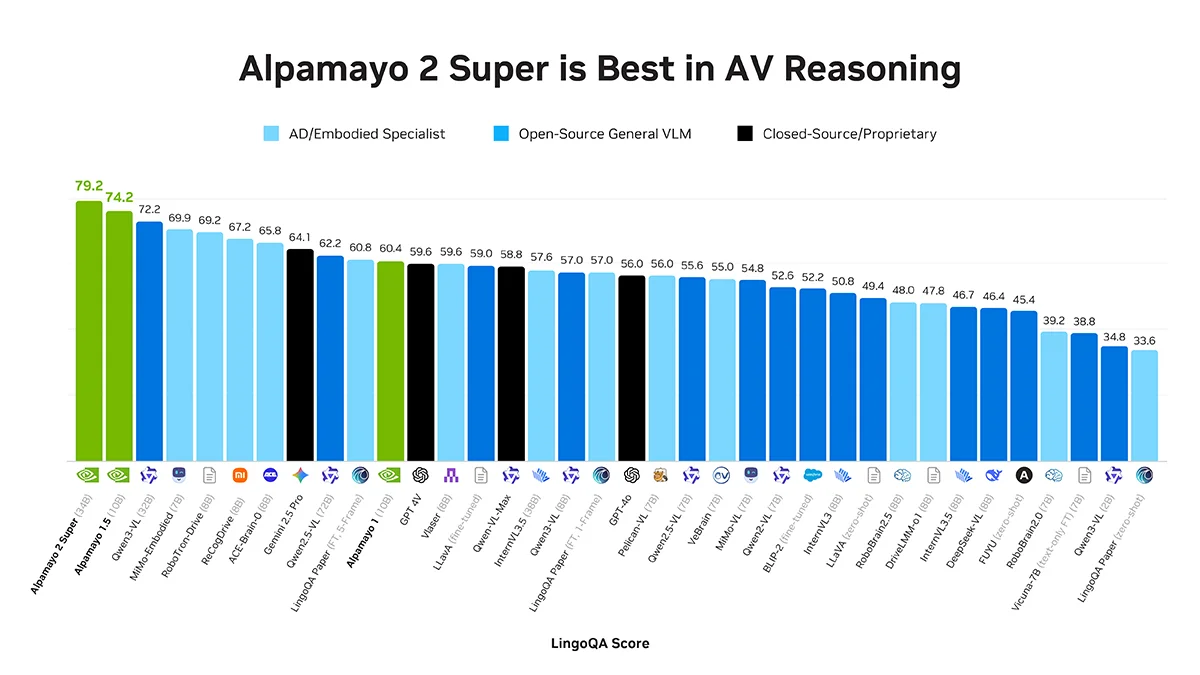 Alpamayo 2 Super is Best in AV Reasoning — LingoQA leaderboard bar chart showing Alpamayo 2 Super at 79.2, ahead of Alpamayo 1.5 at 74.2, and other open and closed-source VLMs
| Model | LingoQA (Lingo-Judge) | Gap vs Alpamayo 2 Super |
|---|---|---|
| Alpamayo 2 Super | 79.2 | — |
| Alpamayo 1.5 | 74.2 | -5.0 |
| Gemini 2.5 Pro | 64.1 | -15.1 |
| Qwen2.5-VL 72B | 62.2 | -17.0 |
| GPT-4o | 56.0 | -23.2 |
Beyond LingoQA, NVIDIA also reports Alpamayo 2 Super leading across a full internal AV benchmark suite against Qwen3-VL-32B-Instruct, the strongest open general-purpose comparison point they tested:
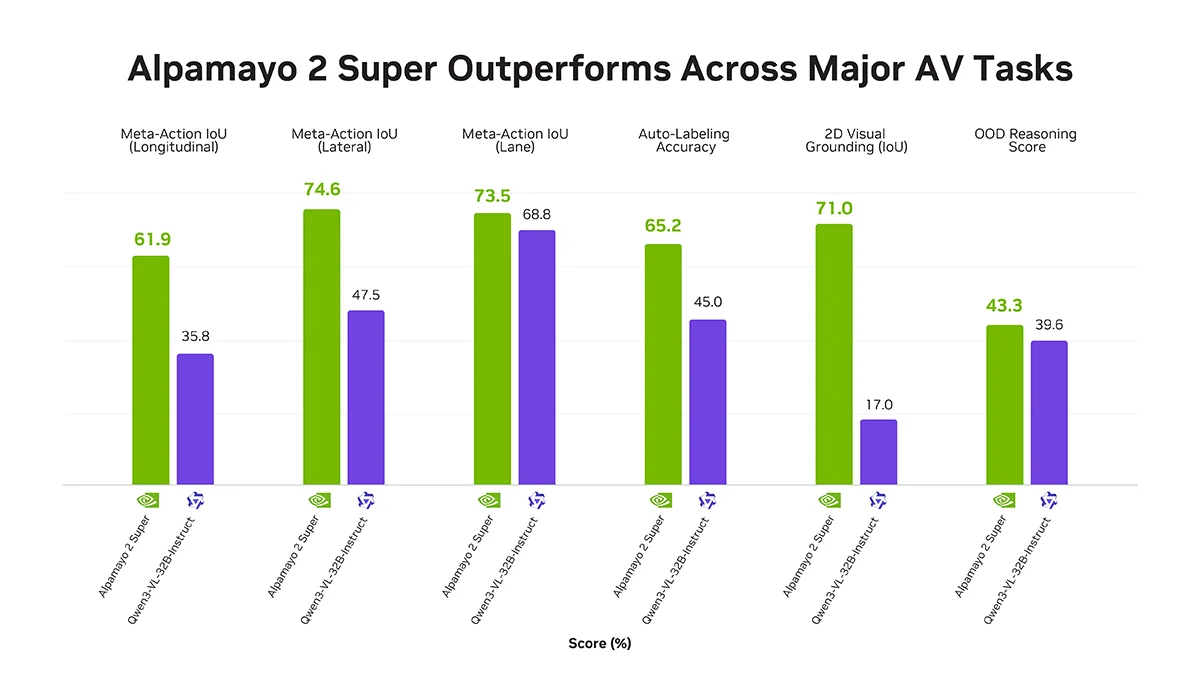 Alpamayo 2 Super Outperforms Across Major AV Tasks — bar chart comparing meta-action IoU, auto-labeling accuracy, 2D visual grounding, and OOD reasoning score against Qwen3-VL-32B-Instruct
The widest gap is 2D visual grounding — 71.0 vs 17.0 for Qwen3-VL-32B-Instruct — which tracks with Alpamayo being purpose-built for driving scenes rather than adapted from a general-purpose vision-language model.
Open licensing that actually reaches production
The detail that separates this release from a typical research paper is the licensing. Alpamayo 2 Super ships on Hugging Face under OpenMDW-1.1, the Linux Foundation's permissive license for open AI model distribution — it explicitly covers fine-tuning, derivative models, and commercial redistribution. NVIDIA is applying this license retroactively across the entire Alpamayo family: earlier releases that started as research-only now have a direct path to commercial deployment without additional permission requests.
That matters for AV developers weighing build-vs-buy: it means keeping proprietary fleet data and driving policy in-house, adapting a frontier-capability model to it, and deploying commercially — without re-training foundational driving capability from scratch or paying frontier-model API costs per inference. NVIDIA frames the intended pattern as cloud-to-car: use Alpamayo 2 Super in the cloud to generate reasoning traces and synthetic training data, then distill down to the smaller, cheaper Alpamayo 1.5 or Alpamayo 1 for real-time in-vehicle inference — pairing frontier reasoning quality in development with something a production ECU can actually run.
Safety framing: auto-labeler, not auto-certifier
NVIDIA is careful to position the chain-of-causation traces as an input to safety engineering, not a replacement for it. CoC traces integrate with NVIDIA Halos, NVIDIA's safety-validation workflow stack, and are described as supporting AI safety practices aligned with ISO/PAS 8800 — the emerging standard specifically for AI in automotive safety-of-the-intended-function. The pitch is auditability: a human engineer can trace a model's stated reasoning back to the exact image region it's referencing, rather than treating trajectory output as a black box.
What people are asking
Is this meant to run inside an actual car? Not directly — Alpamayo 2 Super is the frontier-scale reasoning model NVIDIA positions for cloud-based development, auto-labeling, and distillation. The smaller Alpamayo 1.5 and Alpamayo 1 models are the ones NVIDIA describes as optimized for efficient real-time inference in production vehicles.
How does this connect to Cosmos? Alpamayo 2 Super is built on Cosmos 3 Super Reasoner — see explainx.ai's Cosmos 3 guide for the underlying world-model architecture. Alpamayo is the driving-specialized application layer on top of that general Physical AI stack.
Who's the intended customer? NVIDIA names AV developers, automakers, truckmakers, and suppliers broadly — robotaxi operators, delivery van fleets, shuttle operators, and tractor/agricultural autonomy programs are all called out explicitly, reflecting NVIDIA's stated ambition of "billions of autonomous machines" beyond just passenger robotaxis.
Does open weights here carry the same competitive dynamics as open-weight LLMs? Largely yes — Alpamayo has already passed 500,000 downloads on Hugging Face, which NVIDIA cites as making it the most-adopted open reasoning model family for autonomous driving on the platform. That's the same open-weight distribution flywheel driving adoption in language models, applied to a much more narrowly regulated domain.
What's the catch with running a 34B model in an AV pipeline? There isn't one, because that's not the deployment target. Alpamayo 2 Super's role is explicitly cloud-side: generating reasoning traces, auto-labels, and synthetic data that are too expensive to compute in real time inside a vehicle. Teams that try to run the 34B model itself as the onboard inference path are working against NVIDIA's stated architecture, not with it — the distilled Alpamayo 1.5/1 tier exists specifically to solve that latency problem.
Update, October 22, 2026: Bolt says its planned 25,000-plus Lucid robotaxis will run Nvidia's Alpamayo Stack. See the full breakdown.
The Alpamayo family, laid out
NVIDIA now ships three tiers under the Alpamayo name, each with a different job:
| Model | Size | Role |
|---|---|---|
| Alpamayo 2 Super | 34B | Frontier-scale reasoning, cloud development, auto-labeling, distillation teacher |
| Alpamayo 1.5 | 10B | Cost-efficient cloud development and model distillation |
| Alpamayo 1 | 10B | Cost-efficient cloud development and model distillation |
The pattern mirrors what's become standard practice across open-weight LLMs: a large teacher model generates high-quality reasoning traces, and smaller student models are distilled from that output to hit a cost and latency budget the teacher itself can't meet. What's different here is the domain — the "cost budget" isn't a chat API bill, it's a real-time constraint inside a moving vehicle's compute stack, where every extra millisecond of inference latency has physical consequences.
NVIDIA also ships supporting infrastructure alongside the models rather than just the weights: AlpaSim for closed-loop simulation, AlpaGym for high-throughput reinforcement learning, and the NVIDIA Physical AI Open Datasets for training and testing data, plus open training recipes and an autolabeling pipeline. The strategy reads less like "here's a model" and more like "here's the toolchain a team would otherwise spend a year building before they could even start training their own AV model."
The takeaway
Alpamayo 2 Super is less a chatbot-style capability jump and more an infrastructure bet: NVIDIA is trying to make "own your AV reasoning stack" cheaper than "buy it from a closed frontier lab," backed by a license that actually permits shipping it in a commercial vehicle. The LingoQA numbers are the headline, but the auto-labeling and cloud-to-car distillation story is the part with the more immediate cost argument for AV teams sitting on large amounts of unlabeled fleet footage today.
Update — September 7, 2026: For a real-world test of a different driving philosophy, see Uber and Wayve's reported UK robotaxi launch — Wayve's end-to-end learned approach versus Alpamayo's vision-language-action reasoning model are two competing bets on how AV decision-making should work.
Related on explainx.ai:
- Uber and Wayve reportedly beat Waymo to a UK robotaxi launch
- "LLMs Can't Jump" — ICML position paper on abduction and world models
- NVIDIA Cosmos 3: Open Physical AI World Models
- NVIDIA DGX Spark: Best Local LLM Setup
- Cursor's Mixture-of-Kittens: Open-Source MoE Megakernel
- What Are AI Agents? Complete Beginner's Guide
Official: Alpamayo 2 Super announcement — NVIDIA blog · Model on Hugging Face
Update — October 15, 2026: Volvo Cars said its next automated driving system will use Nvidia's Alpamayo software stack with Hyperion hardware and Halos OS; see what is confirmed.
Benchmark numbers and licensing terms reflect NVIDIA's August 4, 2026 announcement and may be updated as the Alpamayo family evolves.