



Mostik launched on September 3, 2026, with a tweet from co-founder Sasha Malysheva that racked up 846,800 views in a day: "what happens when you put 12 PhDs in one room for four months? first place on the ARC-AGI leaderboard... and this." WIRED published what it calls the first external account of the company the same day.
"This" is a protocol for letting AI models communicate without text — through what Mostik calls latent space rather than natural language. A frontier model's hidden states — the internal vectors it builds while processing a problem — pass directly into a smaller model through a trained "bridge," and the small model writes the final answer using that borrowed reasoning. Neither the large nor the small model is fine-tuned; only the bridge between them learns anything.
The launch tweet's headline number: a 4B edge-class model reached 80% of the accuracy of a 753B frontier model, at 20x the speed. That is the number that has been repeated across every summary of this launch so far, including AI-generated ones. It is also a number that does not appear anywhere in Mostik's own technical write-up — which reports something more specific, and measurably different.
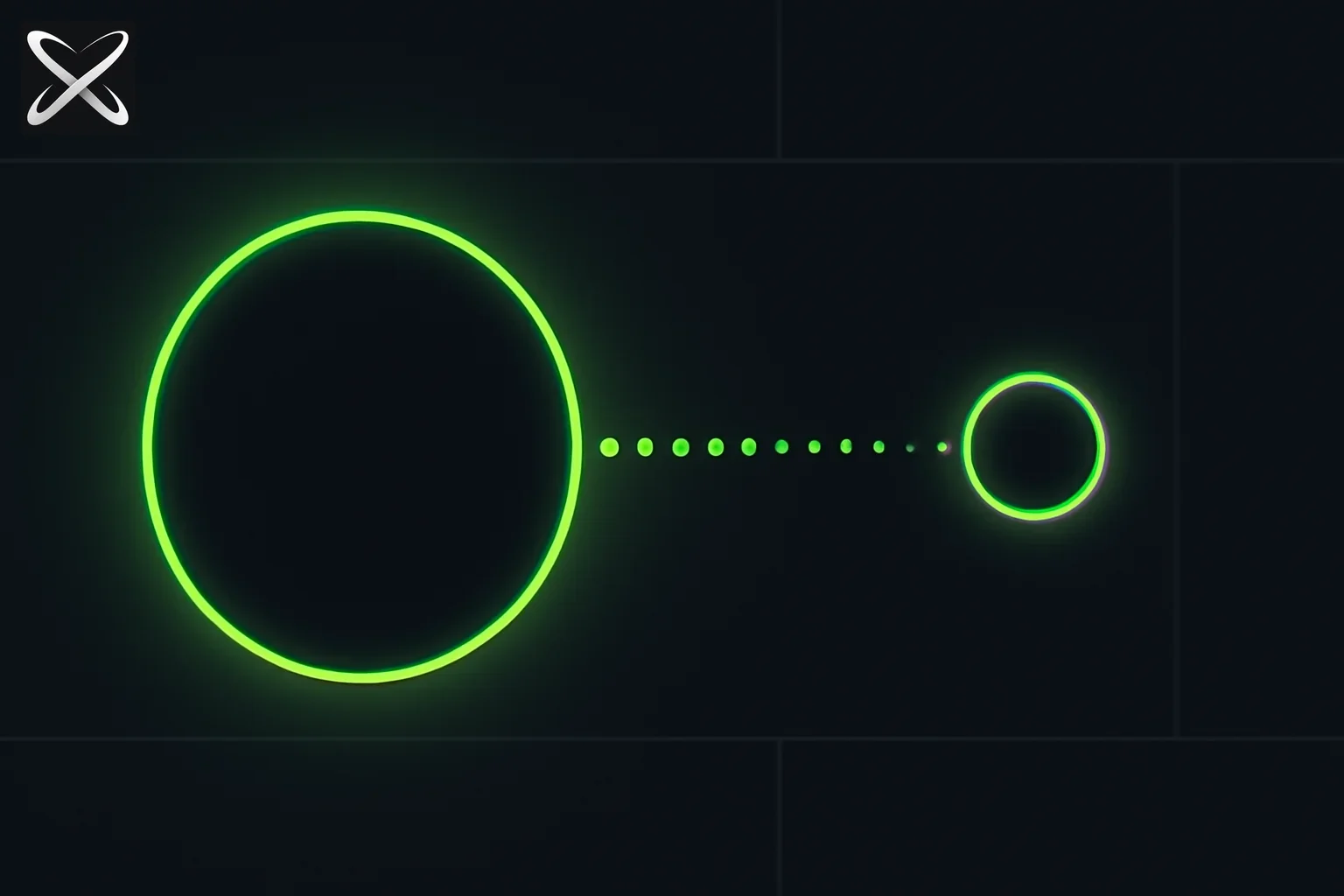 A large frozen model handing an internal signal through a small trained bridge into a smaller frozen model, with no text passing between them
TL;DR
| Question | Answer |
|---|---|
| What is it? | A trained "bridge" passing hidden states from a frozen large model to a frozen small model — no text in between. |
| Tested on | Sender: GLM-5.2 (753B). Receiver: Qwen-3.5 (4B). |
| The tweet's number | 80% of frontier accuracy at 20x the speed. |
| Mostik's own paper number | Closes ~50% of the accuracy gap (a 25% relative lift), 2x uplift on harder subsets, ~2.5x less compute. |
| Do these match? | Not verifiably. The two framings aren't directly comparable from what's published. |
| Independently verified? | No. No paper, code, or reproducible benchmark released yet. |
| Team | 15 people, "12 PhDs and a Fields Medalist," four months old, backed by General Catalyst, Foundation Capital, and others. |
| Is this distillation? | No — nothing is baked in offline. Both models run live, every request. |
What the bridge actually does
Strip the announcement to its mechanism and it is a genuinely distinct idea from the usual "small model helps a big one" pattern.
A transformer builds more than a hundred internal hidden vectors per token before it ever produces one — its actual "thinking," as opposed to the text it emits. Normally that internal state is discarded the moment a token is chosen; only the token itself, in natural language, ever leaves the model. Mostik's claim is that you don't have to throw that state away. You can train a small adapter — "the bridge" — to translate a sender model's hidden states into a form a differently-shaped receiver model can consume directly, mid-computation, with no detour through text.
Mostik's own description: "One model hands its hidden states to another through a small trained bridge, and the receiving model works with them directly." And on what stays fixed: "the bridge is trained separately and is the only part of the system that learns anything" — the 753B sender and the 4B receiver are both used exactly as released, weights untouched.
That framing is the whole pitch. Two model families that have never seen each other, from two different labs, can share reasoning at inference time through an interface that took four months to build — rather than requiring either model to be retrained, merged, or distilled into the other.
The number in the tweet versus the number in the paper
Here is the discrepancy, laid out directly, because it is the most important thing in this story and it is not what most summaries of the launch are reporting.
The tweet says: "we get results 80% as accurate as the frontier model, but at 20x faster performance."
Mostik's own technical page says, verbatim, in the relevant passage:
"With the bridge attached, the small model closes 50% of that distance, which lifts its own accuracy by 25%. On harder subsets, where the gap between sender and receiver is more pronounced, that uplift reaches 2x. Running the bridged pair costs 2.5x less compute than running such a model."
Those are not the same claim restated in different units. "Closes 50% of the accuracy gap, a 25% relative lift" describes a specific starting gap between two named models on an unnamed task set. "80% as accurate at 20x faster" describes an absolute accuracy ratio and a throughput multiplier. You cannot derive one from the other without knowing the baseline accuracy of both models on the actual task — which is not published. It is entirely possible both statements are true of different sub-results within the same experiment. It is also possible the tweet is a looser, more marketable restatement of a more hedged internal finding. As of publication, there is no way to tell which, because the underlying benchmark, task list, and per-model accuracy numbers have not been released.
This is not a minor nitpick. It is the difference between a documented, specific research claim and a viral one-liner, and only one of the two currently has a citation trail.
What's actually verified, and what isn't
| Claim | Status |
|---|---|
| Sender/receiver models are GLM-5.2 (753B) and Qwen-3.5 (4B) | Stated directly on Mostik's own page |
| Bridge closes ~50% of the accuracy gap, +25% relative lift | Stated directly, specific and hedged |
| 2x uplift "on harder subsets" | Stated, but "harder subsets" is undefined |
| ~2.5x less compute than an equivalent mid-sized model | Stated, no baseline model named |
| "80% as accurate, 20x faster" | Tweet only — absent from the technical page |
| First place on an ARC-AGI-style leaderboard | Stated, explicitly undisclosed while the competition runs |
| Independent reproduction | None exists yet |
| Team: 15 people, 12 PhDs, a Fields Medalist, 4 months old | Stated by the company; team backgrounds (DeepMind, Google X, Nvidia, Perplexity across various reports) are not uniformly sourced |
| Backers: General Catalyst, Foundation Capital, and others | Stated; specific round size not disclosed |
The ARC-AGI claim deserves its own line because it is doing rhetorical work independent of the technical claim. "First place, can't discuss it" is unfalsifiable by construction — there is no way to check it before the competition ends, and by the time it does, the news cycle has moved on. It should be read as a credibility signal the company is asking you to take on faith, separate from the latent-bridge numbers, which at least have a partial paper trail.
Industry coverage has already flagged this pattern independently. One outlet's write-up states plainly that "Wired's report is thin on technical specifics" and that there is "no independent verification yet," advising readers to treat the claims "with healthy curiosity rather than certainty until independent benchmarks surface" — adding, accurately, that "plenty of startups have overstated results only to quietly walk them back."
How this differs from techniques you already know
Latent-state sharing sits in a real gap between two familiar techniques, and understanding the gap is what makes the idea interesting even before the numbers are confirmed.
| Technique | What moves between models | When it happens | What's trained |
|---|---|---|---|
| Knowledge distillation | Nothing, at inference time — the large model already taught the small one offline | Once, before deployment | The small model's full weights |
| Speculative decoding | Draft tokens — text — which the large model verifies or rejects | Every request, but both models produce text | Neither model necessarily; sometimes the draft model |
| Mostik's latent bridge | Internal hidden states — never converted to text | Every request, live | Only the small adapter between them |
Distillation is the closest existing idea, and it's worth being precise about why this isn't that. A distilled model has already absorbed everything it's going to absorb; the teacher can be deleted. Mostik's receiver needs the sender present for every single request — it's an online dependency, not a one-time transfer. That is a genuinely different deployment shape: you are still paying to run the 753B model's forward pass on every query, which is also why "20x faster" needs the same skepticism as the accuracy figure. Faster than what, exactly, if the frontier model still has to process the full input either way? The likely honest answer is that the decode step — the expensive, sequential, one-token-at-a-time part — moves to the cheap 4B model, while the frontier model's prefill pass still happens once per query. That's a real and useful trade if true, but it's a narrower claim than "20x faster" implies on its own, and it is closer to the sender/receiver split already explored in inference-time collaboration work like MoE dispatch and recurrent-depth reasoning and the shared-computation ideas in Kimi K3's LatentMoE architecture.
If Mostik's numbers hold up under independent testing, the implication for the open-vs-frontier-model debate is real: a small model bolted to a large one at inference time, with only a lightweight adapter to train, is a cheaper path to frontier-adjacent capability than either training a bigger open model from scratch (see MiniCPM's small-model approach) or waiting for full-weight distillation of the kind covered in the Claude/Fable distillation policy debate. The pitch that "no fine-tuning of either model" preserves frontier-lab incentives to keep licensing access — rather than eliminating them — is also the part most likely to draw scrutiny from the labs whose models would sit on the sending end of this bridge without their involvement.
What to actually do with this news today
Nothing operational, and that's fine — this is day-zero coverage of an unverified claim, not a technique with a repo to try.
If you're evaluating architecture bets: file this under "watch, don't build on." A four-month-old company's own hedged numbers are not yet a foundation for a production decision, however credentialed the team.
If you're skeptical by default: you're not wrong to be. The gap between the tweet and the technical page is the single most checkable fact in this entire story, and it currently favors caution.
If you want the closest thing to a citable claim: use Mostik's own language — "closes 50% of the accuracy gap, 2.5x less compute" — not the tweet's "80% accuracy, 20x speed," until the company publishes the benchmark that would let someone reconcile the two.
Honest limitations
- We are reading a company's own marketing page and a handful of secondary write-ups, not a paper. No arXiv link, no code, no benchmark suite exists as of publication.
- The 80%/20x figure cannot be confirmed or refuted from public material. It may be accurate on a task we don't know about; it may be a looser gloss on the technical page's numbers. Both are possible given what's published.
- "Harder subsets" and the compute baseline are undefined terms. Without knowing what tasks or what "equivalent mid-sized model" means, the 2x and 2.5x figures are directional, not verifiable.
- Team background claims vary by source — the founder's own bio and secondary reporting don't fully agree on prior employers, and we have not independently confirmed either version.
- Funding round size is not disclosed. "Backed by General Catalyst, Foundation Capital, and others" is a real institutional signal, not a number.
- The ARC-AGI claim is unfalsifiable until the competition Mostik references concludes, and we could not confirm which competition, or its current standings, from public sources.
Related on explainx.ai
- What is recurrent-depth reasoning, explained
- Kimi K3's architecture — LatentMoE and NoPE
- MiniCPM 5 1B — the tiny-model breakthrough
- The Claude/Fable distillation policy debate
- AI policy timeline 2026 — export controls, distillation, open weights
- BDH-CQ 150M — a post-transformer architecture on ARC-AGI
- OpenAI, ARC-AGI-3, and retained reasoning
- MacBook vs. dedicated GPU for local LLMs
Claims and figures reflect Mostik's own launch materials, its technical write-up at mostik.ai/read-more, and secondary coverage as of September 3, 2026. The company has not released a paper, code, or independently reproducible benchmark. The discrepancy between the launch tweet's "80% accuracy at 20x speed" and the technical page's own figures is drawn from a direct comparison of both public sources at time of publication and may be resolved if Mostik releases fuller results later — check for updates before citing either figure as final.