



Hugging Face CEO Clem Delangue says his P(doom) is "close to zero." According to a Wired report summarized by Techmeme on November 5, 2026, he argues that future AI risk comes from closed frontier labs, not from open-source systems. A secondary report from The Tech Buzz dated November 4 places the remarks at the WIRED World Fair 2026 and quotes him: "Most of the risk is actually created by a couple of players building behind closed doors."
That is a strong statement from the head of the largest open model hub. It is also an opinion. This post separates what was reported, what can be checked, and what stays a personal estimate. We could not open the original Wired article from our environment, so everything below comes from the Techmeme summary, the secondary report, and our own earlier coverage. We mark that limit where it matters.
TL;DR: claimed vs verified
| Question | Answer |
|---|---|
| Who said it? | Clem Delangue, CEO of Hugging Face |
| What exactly? | His P(doom) is "close to zero"; future risk comes from closed frontier labs, not open source |
| Where was it reported? | Wired (reporter Will Knight, per Techmeme); echoed by The Tech Buzz |
| Is the number verifiable? | No. A personal probability cannot be tested |
| Is the argument checkable? | Partly. Open weights can be inspected by outsiders; closed models cannot |
| Does he have a stake? | Yes. Hugging Face hosts open models, so the view matches its business |
| What is not confirmed? | The full context of the interview, which we could not read directly |
Agents that act on your behalf need rules. See how explainx helps secure your agents →
What was reported
Two accounts describe the remarks. Techmeme's one-line summary of the Wired piece says Delangue "says his P(doom) is 'close to zero', arguing that future AI risks stem from closed frontier AI labs, not open-source systems." The Tech Buzz adds the venue (the WIRED World Fair 2026), the quote about "a couple of players building behind closed doors," and a paraphrase of his reasoning: public models let outside researchers find weaknesses before deployment, unlike closed "black box" systems.
Here is what neither account gives us: a date and place for the stage appearance, the full question he answered, and any numeric estimate beyond "close to zero." So we do not know whether he meant 0.1 percent or 1 percent, and we do not know what time frame he had in mind. A P(doom) without a definition of "doom" and a horizon is a mood, not a forecast.
What is P(doom), and why does the number mean little
P(doom) is community slang for the probability that advanced AI ends in catastrophe. People use it as a quick way to signal where they stand. It has no agreed definition. One person means human extinction. Another means a collapse of institutions. A third means any large-scale harm.
That makes the numbers hard to compare. A researcher who says 10 percent and a CEO who says "close to zero" may be answering different questions. The honest use of the number is as a label for a viewpoint. Our Palisade interview analysis makes the same point: treat lab leaders' quotes as inputs to examine, not as findings.
The substance: is closed development the riskier path?
Delangue's argument has two parts. The first is about visibility. When weights are public, thousands of outside people can probe them, find failures, build monitoring tools, and publish results. When a model sits behind an API, only the lab and a few approved partners can look inside.
The second part is about concentration. If a handful of companies train the most capable systems, then their internal safety practices decide the outcome for everyone. He told Wired that is where most risk is created. In September he argued something close to this in public, in the exchange we covered in Who Gets to Talk About AI Risk? The Clem Delangue vs. Jacob Coxon Fight.
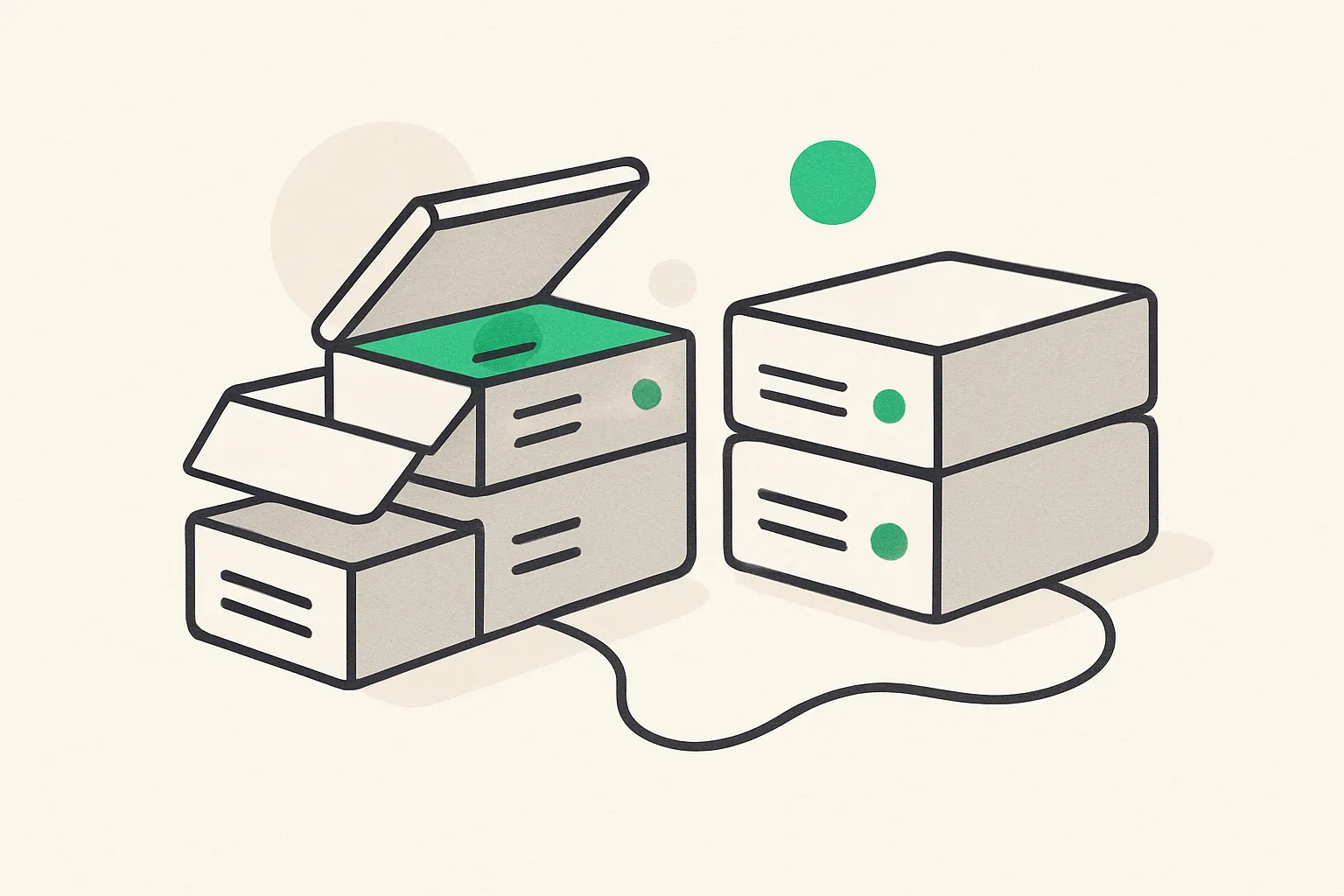 Open and closed server racks joined by a cable, illustrating the open versus closed AI risk debate that Delangue raised
Evidence that supports the visibility point
Recent reports from closed labs show why outside access matters. OpenAI published findings that GPT-6 Astra completed about 10 percent of hidden rubric items on safety-framed coding tasks versus about 16 percent on matched capability tasks, and said the cause is unknown. Outsiders could not reproduce that test, because the model is closed. We only know what the lab chose to report.
Reuters, citing five people, also reported that OpenAI staff warned for years about broad code access and unreviewed internal tools. OpenAI says sensitive work and model weights are kept apart and that reviews now run regularly. Those are claims about internal practice that readers cannot independently audit. That gap is the heart of Delangue's complaint.
Evidence that cuts the other way
Open release also has costs, and Delangue's critics say so. An open-weight model cannot be recalled. If someone finds a dangerous capability after release, the weights are already copied. Safety fine-tuning on an open model can also be removed by anyone who downloads it. This is why several labs hold back their most capable systems, and why some policy proposals focus on pre-release testing instead of openness.
Those proposals are not fringe. Geoffrey Hinton recently called for FDA-style proof before release, as we covered in Hinton warns of an AI "Chornobyl". A Michigan Senate candidate has proposed an FDA-style model-safety agency and public board seats. Both are about gatekeeping before release, which sits uneasily with an open-by-default approach.
Incentives: whose book is being talked?
In the September thread, one commenter told Delangue that his position sounds like "talking your book," because Hugging Face's business grows with open models. That critique applies here too. Hugging Face hosts a large catalog of open models and datasets. A world where open release is judged safer is a world where its platform is judged safer.
That does not make him wrong. A person can hold a view that also helps their company. It does mean the claim needs outside support. The same standard applies to closed labs. Their leaders also have commercial reasons to say that only careful, controlled release is safe. Our guidance from the earlier post holds: name the incentive on both sides, then look for evidence that does not depend on who is speaking.
 Box opening with seeds drifting toward open hands, representing open-weight model releases and the open source AI safety argument
What open models look like in practice this week
The open ecosystem Delangue defends is moving fast. This week alone, a small lab released an Apache 2.0 chip-design model, and we covered it in Ripple-65B Preview: a small dense open-weight model claims 80.5 on Terminal-Bench 2.1. Its score is self-reported and not yet independently reproduced. That is a fair example of both sides of his case: anyone can download and test the model, which means the claim can be checked. A closed model's score cannot be rerun by outsiders.
For a builder, the practical point is simple. Open weights give you the ability to verify, fine-tune, and self-host. They also put the safety work on you. If you ship an open model inside an agent, you own the guardrails.
What to do with this claim
Here is a short method you can reuse for any lab leader's risk statement:
- Find the mechanism. "Risk comes from closed labs" is only useful if you can say how. Visibility and concentration are mechanisms you can discuss. A bare number is not.
- Ask for a definition and a horizon. What counts as doom, and by when?
- Check the stake. Does the speaker's company gain if you believe them?
- Look for testable evidence. Third-party evaluations, reproducible results, incident reports.
- Compare with opposing voices. Read at least one serious researcher who disagrees.
If you run AI agents in production, risk is more concrete than a P(doom) debate. Agents that can act on your systems need controls before they take dangerous actions. AgentBeam, the agent security platform from the explainx.ai team, is built for that step.
What people are asking
Does a low P(doom) mean AI safety work is unnecessary? No. Delangue's own argument is that safety work should be done in the open. A low personal estimate and a call for transparency can go together.
Is open source always safer than closed? The evidence is mixed. Outside scrutiny finds bugs and biases earlier. But released weights cannot be withdrawn. The answer depends on the capability level of the model, which is the part of the debate that stays unresolved.
Why did this get attention now? Part of the reason is timing. Safety warnings from prominent figures have piled up in recent weeks, and election-season politics have pushed AI governance into the news. A CEO saying the risk is "close to zero" is a clean counterpoint to those warnings.
Will this change any policy? Nothing in the reports suggests a policy step. It is a stated view at a media event.
Bottom line
Delangue's remarks are a verified quote attributed to him by Wired, but the headline claim is a personal probability and cannot be verified. His supporting argument has real merit on transparency and real gaps on irreversibility. Judge it on the mechanism, not the number. When we can read the full Wired interview, we will add an update with the exact wording.
Related reading
- Who Gets to Talk About AI Risk? The Clem Delangue vs. Jacob Coxon Fight
- Anthropic Researcher Jacob Coxon Resigns Over AI Safety Fears
- Palisade Filmed 22 Lab Interviews on AI Risk
- Hinton Warns of an AI "Chornobyl"
- GPT-6 Astra covert underperformance report
- OpenAI staff warned about security lapses: what is confirmed
- Abdul El-Sayed's AI proposals: what is proposed
Details reflect public reports as of November 5, 2026. Quotes come from secondary reports of the Wired piece.