



On July 7, 2026, Google Research posted on X inviting ICML attendees to "Experience AI Scientist" — a multi-agent system meant to automate the end-to-end scientific research pipeline. The booth slot was 6:00pm at #B206, with Jinsung Yoon and Rui Meng listed as contacts, tagged #ICML2026.
That marketing name — "AI Scientist" — lines up with an ICML Expo Talk Panel from the day before: The End-to-End AI Scientist: Automating Discovery and the Research Pipeline (July 6, 2026, Hall D2), same authors. The published research system with the matching three-stage architecture is ScientistOne — Towards Human-Level Autonomous Research via Chain-of-Evidence (Google Cloud AI Research, arXiv 2605.26340).
This post maps the booth narrative to verified paper claims only. No invented benchmark numbers, no conflating separate Google research products.
TL;DR — what people are asking
| Question | Answer (sourced) |
|---|---|
| Is "AI Scientist" a product I can download today? | ICML was a live demo / talk framing. Public artifacts: ScientistOne project site + arXiv paper — not a general consumer app like Co-Scientist's labs.google/science waitlist. |
| Same thing as Co-Scientist? | No. Co-Scientist = hypothesis generation & debate for human researchers (DeepMind blog, May 2026). ScientistOne = literature → experiments → verified .tex paper with code logs. |
| Same thing as MARS? | No. MARS = budget-aware MCTS AutoML agent (shared authors). ScientistOne uses MLE-Bench only as a generalization test. |
| Does it kill PhD jobs? | The system automates pipeline mechanics on bounded benchmarks — authors still note limits on novelty, significance, and wet-lab domains. Humans remain in the loop for real discovery judgment. |
| "Slop in, slop out"? | Fair skepticism. CoE Audit exists because prior "AI Scientist" systems produced fluent but unverifiable papers — up to 21% hallucinated references in baselines. ScientistOne's claim is architectural provenance, not guaranteed breakthroughs. |
| Token spend at Google? | Experiments standardized on Gemini 3.1 Pro with generous iteration budgets (paper notes up to 20 solver iterations per task for baselines). Replicating full runs outside Google infra is costly — treat public numbers as research-scale, not laptop-scale. |
| Failed experiments? | PEE prunes losing branches, filters spec violations, feeds metrics back across I × B iterations — details in Discovery stage. |
| Rediscovering 1987 work? | Claim Verifier checks citations against retrieved bibliography; CoE does not certify scientific novelty — see FAQ on prior art. |
Three names, one booth — keep them straight
Google's autonomous-research story is not one monolith:
| Name | Scope | Status (July 2026) |
|---|---|---|
| "AI Scientist" (ICML demo label) | End-to-end pipeline talk + booth experience | ICML 2026 event framing |
| ScientistOne | Literature → discovery → paper + Chain-of-Evidence | arXiv + 21 generated papers on site |
| Co-Scientist | Hypothesis tournament for life sciences | Nature paper; rolling access via Gemini for Science |
| MARS | Modular AutoML search on MLE-Bench | Separate ICML 2026 research (Yoon, Meng, Pfister, et al.) |
The ICML panel abstract also mentions ScholarPeer (automated peer review with a "historian" literature approach for novelty) and PaperBanana (methodology figure generation). Those appear in the talk abstract; ScientistOne's paper evaluates manuscript quality with ScholarPeer but centers verification on Claim Verifier + CoE Audit inside the pipeline.
The pipeline — Problem Investigator → Discovery → Paper + Claim Verifier
The architecture Google showed at ICML matches ScientistOne Figure 1 and the booth diagram below:
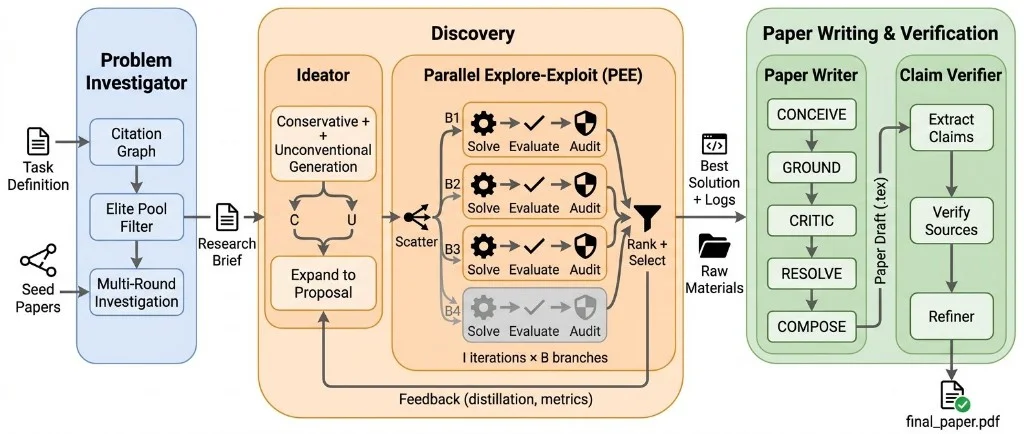 ScientistOne three-stage pipeline — Problem Investigator, Discovery with Parallel Explore-Exploit, Paper Writer and Claim Verifier
Stage 1: Problem Investigator
Inputs: task definition + seed papers.
Process (from arXiv §4.1 and Appendix B):
- Build a citation graph via scholarly database queries.
- Filter to an elite pool (~500 papers) with tier scores for methodology relevance and problem alignment.
- Run multi-round investigation — Librarian, Researcher, and SubdomainWriter agents across ~3 rounds targeting ~100 structured paper notes and 5–15 research directions.
- Emit an Experiment Brief (research landscape, concrete experiment plan, 25–40 references traceable to read PDFs).
Design intent: citations must come from retrieved full text, not model memory. In CoE Audit, systems without retrieval grounding hit up to 21% hallucinated references; ScientistOne reports 0/337.
This is the opposite of "prompt and pray" — closer to Mollick-style specs: define the task, define evidence, define how you will test claims.
Stage 2: Discovery Engine + Parallel Explore-Exploit
Ideator: reads the PI brief, generates candidate approaches, scores novelty and feasibility, expands top ideas into proposals.
The booth diagram labels conservative vs unconventional generation tracks before proposals fan out. The arXiv text describes novelty/feasibility scoring and distribution across branches — treat C/U as visual shorthand for diverse ideation, not a separate published benchmark metric.
Parallel Explore-Exploit (PEE): proposals scatter into parallel branches (B1…B4 in the diagram; paper uses configurable B branches). Each branch runs:
- Solve — Solver agent (sandboxed code execution, experimental log).
- Evaluate — task-specific evaluator scores each submission.
- Audit — specification-violation checks filter metric-gaming or invalid submissions (CoE I2).
After each iteration, top-K branches survive; remaining slots refill from fresh ideation on winners. Loop for I iterations × B branches. A best-run selector picks the highest-scoring clean solution, then runs ablations.
What happens to failed experiments? They are expected and discarded — pruned branches, spec-violation drops, and low scores never reach Stage 3. Feedback (distillation, metrics) can inform the next ideation round. This is loop engineering at research scale: explore widely, exploit winners, stop on violations.
Stage 3: Paper Writer + Claim Verifier
Paper Writer — five stages (arXiv §4.3, Appendix B.4):
| Stage | Role |
|---|---|
| Conceive | Build a markdown "research representation" with inline evidence tags on every factual claim. |
| Ground | Deterministic validation — scores match logs, baselines trace to PI brief, artifacts exist. |
| Critic | LLM audit for gap–approach alignment, overclaims, missing comparisons. |
| Resolve | Rewrite or drop unsupported claims; loop until convergence or abort if grounding ratio too low. |
| Compose | Per-section LaTeX writers — provenance before prose. |
Claim Verifier: extract claims → verify against declared evidence (numeric tolerance on logs, bibliography + abstract entailment for citations, log overlap for methods) → refinement pass rewrites or removes failures → final_paper.pdf only if no blocking violations remain.
That directly targets the "slop" failure mode: pretty PDFs where numbers, citations, and code disagree.
Chain-of-Evidence (CoE) and the Integrity Audit
ScientistOne's thesis: verifiability is architectural, not a post-hoc spell-check.
CoE requires every claim to trace to code, data, or literature through the full run.
CoE Integrity Audit (post-hoc, cross-system) runs four checks on deliverables (paper.tex, solution code, references.bib):
| Check | What it catches |
|---|---|
| I1 Score Verification | Paper score vs golden evaluator re-run |
| I2 Specification Violation | Metric gaming, invalid submissions |
| I3 Reference Verification | Hallucinated or mismatched citations (API + LLM disambiguation) |
| I4 Method–Code Alignment | Paper describes algorithm X, code implements Y |
Headline results (75 papers, five systems, five ADRS tasks — project site):
| System | Score Verif. | Spec Violation | Halluc. Refs | Method–Code |
|---|---|---|---|---|
| Sakana ASv2 | 5/12 | 10/15† | 0/159 | 5/15 |
| AutoResearchClaw | 5/12 | 0/15 | 3/196 | 3/15 |
| DeepScientist | 11/12 | 0/15 | 42/201 | 5/15 |
| AI-Researcher | 9/12 | 1/15 | 21/222 | 12/15 |
| ScientistOne | 12/12 | 0/15 | 0/337 | 14/15 |
† Sakana cross-system I2/I4 comparisons are confounded by scaffolding in submitted code — see paper.
Solver performance still matches or beats human expert baselines on ADRS tasks; generalization tests include MLE-Bench (e.g., Gold on 3D Object Detection where DeepScientist scored 0.0000) and Parameter Golf SOTA as of the April 27, 2026 cutoff.
What the Claim Verifier does — and does not — catch
X threads asked whether Claim Verifier flags accidental rediscovery — e.g., reinventing a 1987 result.
What it does verify (per paper):
- Citation keys resolve to real publications retrieved into the bibliography.
- Abstract entailment for specific citation assertions.
- Numerical claims match evaluator logs within tolerance.
- Method descriptions align with experimental logs and (via CoE I4) solution code.
What it explicitly does not guarantee:
ScholarPeer serves as a scalable proxy for review quality but does not replace human expert evaluation … CoE Integrity Audit … is itself limited to structural integrity, not scientific novelty or significance.
So: if the Problem Investigator never retrieved the 1987 paper, the pipeline will not magically flag "you rediscovered Smith et al. 1987." If that paper is in the PI brief and the draft claims novelty anyway, Critic and ScholarPeer-style review are the layers meant to push back — still imperfect.
For the agent vs agency debate — whether tools like this are "co-scientists" or autonomous agents — see Eric Xing's Critique of Agent Model: marketing labels outrun what the harness actually controls.
"Auto research race" — who else is in the pool?
July 2026 social chatter compared Google and Anthropic. Map that to what shipped publicly:
| Lab / project | Focus (verified) |
|---|---|
| Google ScientistOne | End-to-end papers + CoE on ADRS / MLE-Bench |
| Google Co-Scientist | Hypothesis partner for biologists — human executes experiments |
| Sakana AI Scientist v2 | Baseline in CoE Audit — strong solvers, weak reference integrity |
| Adaption AutoScientist | Automated model training loop — different problem (our guide) |
| Anthropic (July 2026) | Interpretability (J-space, J-lens, NLAs) — not an end-to-end paper factory |
| Karpathy autoresearch | Minimal self-improving training loop — inspiration cited across the ecosystem |
The race is real on harness + verification, not on replacing peer review overnight. Agent harness engineering already showed scaffolding beats model swaps on Terminal-Bench; ScientistOne argues the same for research integrity.
ICML panel extras — ScholarPeer and PaperBanana
The ICML panel abstract adds components beyond the core ScientistOne diagram:
- ScholarPeer — automated peer review; panel mentions a "historian" approach to check novelty against historical literature (ScholarPeer arXiv:2601.22638, cited in ScientistOne for review scores).
- PaperBanana — automated methodology figure synthesis (multi-modal challenge).
ScientistOne's published evaluation uses ScholarPeer ratings (40% accept rate vs 13% best baseline) but treats it as a proxy, not ground truth.
Honest limitations — read before the hype
From the ScientistOne paper's limitations section:
- Domains — ADRS/MLE-Bench use deterministic evaluators. Wet lab, materials, pure theory need new verification logic.
- Audit false negatives — flagged failures were human-verified; undetected integrity bugs certainly exist.
- Seed variance — same task, different seeds → very different ScholarPeer outcomes (paper cites EPLB scores 1, 3, 8 across seeds).
- Baseline depth — PI retrieves related work, but accepted papers still get dinged for shallow baseline comparisons vs human SOTA re-implementations.
- Cost — full parallel search trees at B=20 width are compute-heavy; width helped TXN scores in scaling tables but Cloudcast/Prism saturated early.
What builders should steal
You do not need Google's token budget to apply the design pattern:
- Provenance before prose — bind claims to log lines before LaTeX/Markdown export (agent markdown discipline).
- Parallel explore, serial exploit — branch ideas, evaluate on golden harness, kill spec violations early.
- Typed claim verification — numbers, citations, and methods need different checks, not one generic "review the PDF."
- Cross-system audit — CoE Audit is a template for comparing your agent's papers to Sakana/DeepScientist-style outputs honestly.
Update — August 27, 2026: Google Research followed ScientistOne with another experimental science agent: the Planetary Prediction Engine under Earth AI. ScientistOne is literature → verified manuscript; PPE is NL query → geospatial dataset → AutoML report. Both are research, not Cloud SKUs.
Update — August 29, 2026: Google DeepMind published an execution-grounded Co-Scientist (arXiv 2608.26701) that drives a real CVD reactor and audits its own manuscripts against raw lab logs — the same Chain-of-Evidence instinct, applied to physical experiments.
Related on explainx.ai
- Jacobian conjecture and Fable 5 counterexample explained — a compact case where model-assisted discovery became independently checkable mathematics
- Agent harness engineering — Terminal-Bench & LangChain — why scaffolding beats raw model upgrades
- Ethan Mollick: specs, not prompting tricks — management framing for agentic research tasks
- What is loop engineering? — explore/exploit loops beyond one-shot prompts
- Adaption AutoScientist — automated model training — parallel "AutoScientist" name, different stack
- Planetary Prediction Engine — Earth AI geospatial AutoML — Google Research's Aug 27 geospatial modeling agent; opaque handles + Feature Gate
- Eric Xing: agentic vs agentive — vocabulary for co-scientist marketing
- Anthropic J-space interpretability hub — Anthropic's July 2026 research lane (verification via mechanistic tools, not paper bots)
- Evans Nature study — AI flattens discovery — individual agent wins vs collective narrowing; incentives over architecture
Official sources
- ScientistOne project site
- ScientistOne arXiv HTML
- ICML 2026 — The End-to-End AI Scientist panel
- Google Research X post — July 7, 2026
- Co-Scientist — Google DeepMind blog
- MARS — Google Research publication
Architecture, audit tables, and benchmark numbers follow Google Cloud AI Research's ScientistOne paper and project site as of July 7, 2026. ICML booth branding ("AI Scientist") may differ from arXiv product naming; verify against primary sources before citing in academic or investor materials.