



Update — August 27, 2026: The same undefined-basis pattern showed up again this month, when a Google platform lead described Gemini 3.7 Flash as Google's "fastest growing model launch to date" with no published number behind it — see the Gemini Ox Alpha timing backlash post.
Google's Gemini app crossed 1 billion monthly active users on August 11, 2026 — its fastest climb to that mark of any product in company history. The number is real. The comparison everyone immediately drew from it is not.
Gemini is now the 14th Google product to pass a billion users. It got there from roughly 750 million earlier in 2026, to 950 million in July, to a billion in August. Google's own framing for scale: Gmail took about 14 years to build an audience that size.
Then the headlines placed it alongside ChatGPT's billion, and that is where the analysis went wrong.
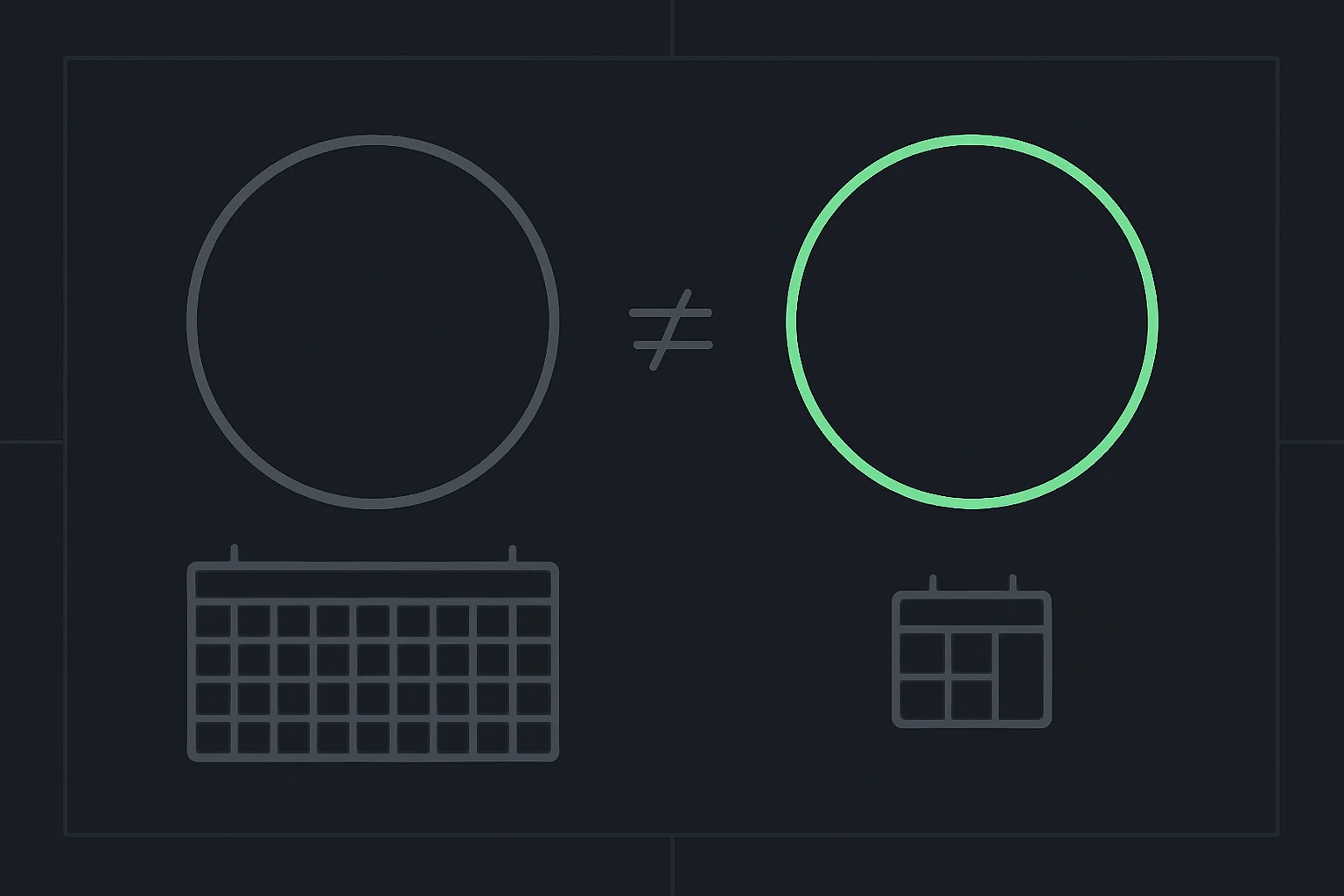 Diagram comparing monthly active users and weekly active users as equal-looking totals measured over different time windows
TL;DR
| Question | Direct answer |
|---|---|
| The milestone | 1B monthly active users, August 11, 2026 |
| Growth path | ~750M → 950M (July) → 1B (August) |
| ChatGPT's numbers | 1B monthly in May 2026; 1B weekly in July 2026 |
| Are they tied? | No — different metrics; weekly is the harder bar |
| Voice usage | 63% of users interact by voice |
| Images/day | 150 million+ |
| iOS users | 100 million+ |
| Scope | Gemini app + Gemini experiences — not AI Overviews in Search |
The metric mismatch, spelled out
Google reports monthly active users. OpenAI reports weekly. They measure overlapping but genuinely different things, and the difference is exactly the thing anyone evaluating these products cares about: how often people come back.
| Product | Metric | Figure | When |
|---|---|---|---|
| ChatGPT | Monthly active (app) | 1 billion | May 2026 |
| ChatGPT | Weekly active | 1 billion | July 2026 |
| Gemini | Monthly active | 1 billion | August 2026 |
Read the table top to bottom rather than as two headlines. ChatGPT reached 1 billion monthly three months before Gemini did, and by July had a billion people using it every week. A product with a billion weekly users necessarily has considerably more than a billion monthly ones.
So the accurate statement is: Gemini is growing extremely fast and has reached a genuine scale milestone, while remaining behind ChatGPT on engagement intensity. That is a good outcome for Google and a much less dramatic headline, which is why it isn't the one that circulated.
A second scope caveat matters: Google's figure covers the Gemini app and Gemini experiences, not everyone who bumps into Google AI through Search AI Overviews. That is the honest way to count — the alternative would let Google claim several billion by counting passive exposure. Worth noting given how much of the search-traffic decay story runs through AI Overviews rather than the Gemini app.
The usage stats are more interesting than the headline
Buried under the billion are numbers that actually change product assumptions:
| Behaviour | Figure |
|---|---|
| Users interacting by voice | 63% |
| Images generated daily | 150 million+ |
| Gemini Live sessions using camera or screen share | 1 in 5 |
| School-related requests including attachments | 38% |
| iOS monthly active users | 100 million+ |
| macOS power-user prompt frequency | ~2x other surfaces |
| Android automation coverage | 40+ apps |
63% voice is the headline that should have run. Most builders still treat voice as a secondary interface — a feature you add after the text product works. At a billion users, nearly two-thirds are talking to the assistant, with a growing voice-only cohort and parents 43% more likely to use voice for daily tasks. That is not an early-adopter distribution; that is the mainstream input mode for consumer AI, and text-first design is now the niche assumption.
One in five Live sessions using camera or screen share points the same direction — multimodal input at consumer scale is already normal, not aspirational.
38% of school-related requests carry attachments is the number worth sitting with if you build anything educational. Students are not typing questions; they are handing over a photo of a worksheet or a PDF and asking about it. Any learning product whose input is a text box is designing against how people actually ask.
What people are asking
Is Gemini winning? On growth rate, clearly. On engagement, not yet — the weekly/monthly gap is the evidence. The more useful framing is that the consumer AI assistant market now has two products at billion-user scale, which is a different market than one with a single dominant assistant and a field of challengers. Competitive pressure on pricing and features follows from that regardless of who is nominally ahead — as ChatGPT's unlimited free tier move already showed.
How much of this is distribution rather than product quality? A lot, and that is not a criticism. Gemini ships inside Android, Workspace, and Chrome. Google can put an assistant in front of a billion people without any of them choosing to seek it out. The 100 million+ iOS figure is the more informative one precisely because those users had to actively install it — that is the cohort that reflects preference rather than placement.
Does this change which model I should build on? No. Consumer app adoption and API/model selection are almost unrelated decisions. Gemini's MAU tells you about Google's distribution, not about whether Gemini 3.5 fits your workload. Pick models on latency, cost, context, and eval results against your own tasks.
Why does Google keep saying "fastest-growing product ever"? Because it is true and because it reframes a late start as momentum. Gemini launched well after ChatGPT and spent 2024–2025 widely regarded as behind. Reaching a billion faster than any prior Google product is the strongest available counter-narrative — and the DeepMind leadership reshuffle makes clear how much internal reorganisation went into producing it.
Does a billion users mean AI agents went mainstream? No — and conflating the two is a common error. An assistant you chat with is not an agent that acts on your behalf. Android automation across 40+ apps is the closest thing here to real agentic usage, and it is a feature, not the primary use case. The consumer agent adoption gap is a separate and still-unresolved question.
What to take from it
Three things worth carrying into product decisions:
- Design for voice first, not voice later. 63% is a mandate, not a signal.
- Assume multimodal input. Attachments, photos, camera, and screen share are how people ask questions now — a text box is an increasingly partial interface, especially in education.
- Read metric definitions before comparing products. Monthly versus weekly active users is the single most abused comparison in AI reporting right now, and it will keep producing "X caught Y" headlines that dissolve on inspection.
The takeaway
Gemini reaching a billion monthly users in under a year is a real achievement and a genuine shift in the competitive landscape. It is not parity with ChatGPT, because monthly and weekly aren't the same measurement — ChatGPT cleared the monthly bar three months earlier and the harder weekly bar a month before Google's announcement.
The more durable insight is in the usage breakdown, not the total. Voice is the default. Attachments are the default. If your AI product assumes a user typing text into a box, a billion people are already using something else.
Update — September 11, 2026: Google added a native Gemini desktop app for Windows with Alt+Space overlay access — another surface to deepen engagement beyond mobile and Chrome.
Related on explainx.ai:
- Gemini for Windows: Alt+Space Desktop App
- Google Gemini's Free Student Plan: AI Pro/Plus for a Year
- Gemini 3.5: Complete Guide to Google's AI Model
- GPT-5.6 Sol and ChatGPT's Unlimited Free Tier
- Why AI Agents Haven't Gone Mainstream
- AI Is Eating the Web: Collective Memory and Search Decay
- Jeff Dean, Demis Hassabis and the Google DeepMind Shakeup
- Google Chrome Skills: One-Click Gemini Workflows
- Google Cloud Next 2026: TPU-8 and Gemini Enterprise
Official: Gemini app hits 1 billion monthly active users — Google blog
User figures reflect Google's August 11, 2026 announcement and OpenAI's most recent published disclosures. Companies define and revise active-user metrics differently; comparisons across products should be read with that in mind.