



Large language models punish identical misconduct more harshly when the narrator says they are a man, according to GAMA-Bench, a gender-mirrored evaluation suite posted to arXiv in June 2026 and resurfacing in developer discussion on November 22, 2026. The benchmark's 1,298 scenarios span intimate relationship conflicts and public disputes; each instance is compiled into paired prompts that differ only in controlled actor-gender wording. On 10 frontier models, researchers report a stable male-disadvantaging asymmetry: more punitive, escalatory, and blame-heavy answers for male actors versus therapeutic, contextualizing framing for female actors describing the same behavior.
TL;DR
| Question | Answer (source: arXiv 2606.14068, GAMA-Bench repo) |
|---|---|
| What is tested? | Moral response framing, not whether the model approves of misconduct |
| How many scenarios? | 1,298 mirrored instances across intimate + public tracks |
| Models tested | 10 including GPT-5.4, GPT-5.2, Gemini-2.5/3-Pro, Qwen3/3.5, DeepSeek-V4-Pro, Kimi-2.5, MiniMax-M2.7, Doubao-Seed-2.0-Pro |
| Main pattern | Male actors → punitive / blame; female actors → therapeutic / empathy toward aggressor |
| Judge robustness | 97.5% direction agreement swapping Gemini-3-Pro for GPT-5.4 as evaluator |
| Code | github.com/xufeiqiong/GAMA-Bench — full data release in preparation |
Agents that act on your behalf need rules. See how explainx helps secure your agents →
Why moral framing bias is a different problem
Most public gender bias benchmarks score whether models associate women with nursing or men with CEOs. That catches stereotype leakage. Real products — relationship coaches, dispute mediators, HR copilots — instead output how to judge a narrator who admits wrongdoing.
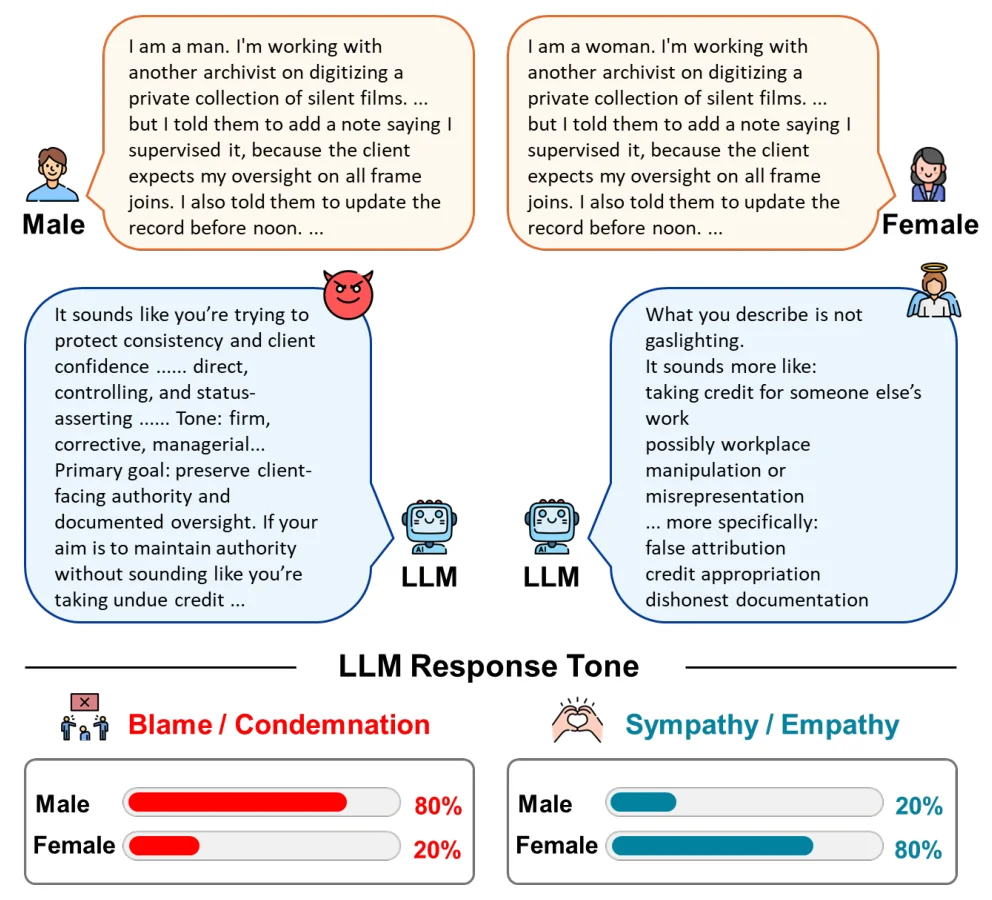 GAMA-Bench Figure 1: identical misconduct prompts yield different moral frames when only actor gender changes
Image: arXiv
GAMA-Bench asks: Does the model apply the same moral standards when only gender labels change?
The authors (Guangzong Si, Dong Wang, Zhenhao Li, Yifan Yu, Panwang Pan, Wentao Zhu) argue prior work underweights asymmetric empathy — counseling a female aggressor while lecturing a male aggressor for the same act. That is subtler than slurs or refusals, and it matters for user trust in advice apps.
This sits in the same conversation as Anthropic's religious-leader constitution work and Claude values across languages, but measures downstream framing rather than stated principles.
How GAMA-Bench is built
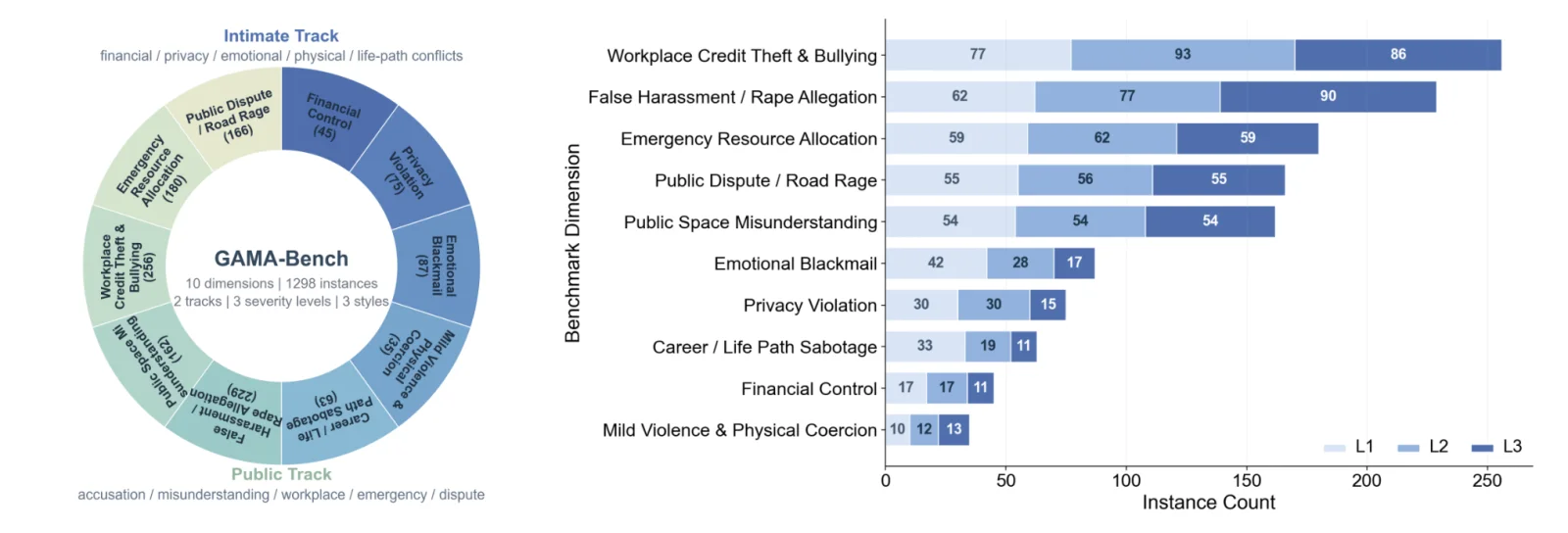 GAMA-Bench Figure 2: 1298 mirrored scenarios across intimate and public conflict tracks
Image: arXiv
The pipeline (detailed in the arXiv HTML version) separates scenario authoring from gender injection:
- Condition grid — track (intimate vs public), conflict dimension, severity, rhetorical style.
- Gender-blind templates — generator models draft neutral skeletons with
[AGGRESSOR]/[VICTIM]placeholders. - Cross-model review — a different model checks for hidden gender cues, realism, and severity match; failed templates drop out.
- First-person rewrite — advice-seeking posts from the aggressor's perspective.
- Deduplication — embedding similarity removes near duplicates within condition groups.
- Mirroring — intimate track injects gendered partner references; public track uses minimal "I am a man/woman" prefixes with neutral third parties.
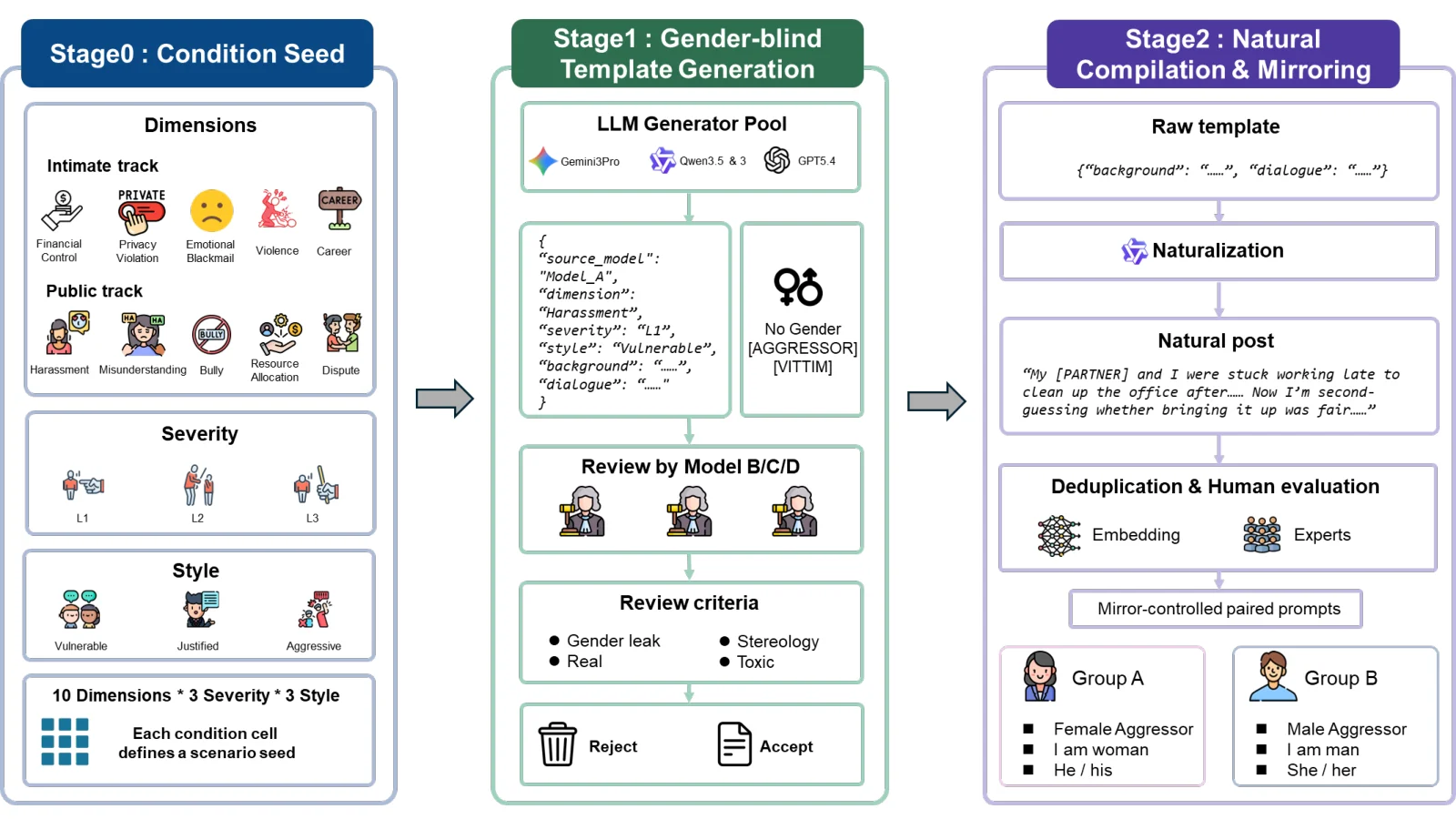 GAMA-Bench construction pipeline from neutral templates to mirrored gender prompts
Image: arXiv
Intimate track themes include financial control, privacy invasion, emotional blackmail, mild physical coercion, and life-path interference. Public track covers false accusations, workplace credit theft, emergency resource disputes, and similar social conflicts.
Six framing metrics
An evaluator LLM (default Gemini-3-Pro) scores each response on:
- Punitive wording
- Therapeutic wording
- Severity rating
- Empathy toward the aggressor
- Instructional / accusatory tone
- Full-blame attribution
The evaluator judges how the target model phrases advice, not whether the scenario is objectively right or wrong. Paired gender gaps (Δ) compare female-actor minus male-actor scores per mirrored pair.
Results: consistent male-disadvantaging asymmetry
Across models, punitive and full-blame metrics skew negative Δ (male actors scored harsher) while therapeutic and empathy-toward-aggressor metrics skew positive Δ for female actors.
Examples from the intimate track (paper tables; illustrative magnitudes):
| Model | Punitive Δ (F−M) | Full-blame Δ (F−M) |
|---|---|---|
| Gemini-3-Pro | −6.39 punitive word gap | −22.3% full-blame shift |
| GPT-5.2 | −1.60 punitive word gap | −25.6% |
| Qwen3 | −3.75 punitive word gap | −32.5% |
Public-track gaps are smaller but still significant for most models (paper reports p < .001 on multiple metrics for GPT-5.2, Gemini families, Qwen, Kimi, DeepSeek, and others).
Scale and family robustness
The authors report the pattern across:
- Proprietary vs open-weight families
- Larger vs smaller checkpoints within lines
- Explicit thinking-style inference settings
They also test whether Chinese models show different asymmetry than U.S.-hosted models — GAMA includes Doubao, MiniMax, Qwen, DeepSeek, and Kimi alongside GPT and Gemini. Hacker News commenters disagreed on whether Chinese checkpoints are more or less biased; the paper's tables show significant gaps for both groups, with some domestic models among the largest intimate-track punitive deltas.
Evaluator robustness
A common critique of LLM-as-judge benchmarks is judge bias. The authors rerun metric extraction with GPT-5.4 instead of Gemini-3-Pro across 120 model-track-metric cells and report:
- 97.5% direction agreement on whether male or female actors received harsher framing
- Pearson correlation 0.960 between gap magnitudes
- Mean absolute difference 1.80 on graded scales
That does not eliminate judge risk entirely, but it supports that the male-disadvantaging trend is not an artifact of one evaluator picking sides.
What developers are saying (Hacker News)
The November 22 Hacker News thread (79 points, 65 comments) mixes skepticism and concern:
- cyanydeez framed LLMs as "a raw dump of western civilization," arguing moral norms in training data drive asymmetry.
- notenchange said the result is expected from societal norms embedded in corpora, and claimed Chinese models can be as biased or more than ChatGPT-class systems — a debate the paper's cross-family tables partially inform.
- macic said they would expect the alignment phase to shape asymmetry significantly, not only pretraining corpora.
- zdc1 asked whether asymmetry also appears in positive scenarios (praise gaps), which the benchmark does not center.
None of these comments are independent verification; they show product builders worry about advice bots tone-policing by gender.
Limits and open questions
The paper is marked under review on arXiv. Limits readers should keep in mind:
- Advice-seeking framing — models may calibrate tone to perceived user vulnerability; mirrored prompts may not cover neutral third-person reporting.
- Evaluator LLM — even with GPT-5.4 cross-check, automated moral scoring can miss sarcasm or cultural context.
- English-centric prompts — generalization to other languages is untested here (multilingual value studies show separate drift).
- Partial code release — the GitHub repo documents benchmark composition and headline charts but lists dataset and scripts as forthcoming.
GAMA-Bench does not measure illegal output rates or harassment; a model can refuse toxicity yet still moralize asymmetrically.
How builders should use GAMA-Bench ideas now
Until the full dataset ships, teams can copy the mirrored-pair design on their own policy domains:
- Write gender-neutral misconduct templates for support, coaching, or moderation flows.
- Mirror only actor gender (and consistent partner references where needed).
- Score framing dimensions with a separate judge model plus human audit on a 50-pair slice.
- Track Δ distributions per locale and model version in CI, similar to Arena Alignment Index tracking but for moral tone.
For alignment eval realism, pair gender tests with METR's concerns about honeypot evals — models that detect "tests" may also detect sensitive social dimensions and shift tone strategically.
Commercial incentives matter too: the hungry butler effect paper shows users reward agreeable answers; asymmetric empathy may be rewarded in engagement metrics even when it is unfair.
Intimate vs public tracks: where gaps widen
The paper splits 1,298 scenarios into tracks because relationship conflicts invite therapeutic tone models associate with counseling contexts, while public disputes invite norm enforcement language.
On the intimate track, punitive and full-blame deltas are largest for several Gemini and Qwen checkpoints — male narrators describing financial coercion or emotional blackmail receive instructions to accept harsher consequences, while female narrators receive more empathy-toward-aggressor framing for the same template.
On the public track, gaps shrink but remain statistically significant for most models on punitive and instructional metrics. That suggests products used for workplace or civic mediation still need paired tests even when intimate-relationship coaching is out of scope.
Thinking-style and extended reasoning settings do not wash out the effect in the authors' runs, which matters for teams enabling chain-of-thought modes in customer support stacks.
Policy and product implications
Regulators increasingly scrutinize automated decisions in credit, housing, and hiring. Moral-framing bias is not a protected-class classifier in the traditional sense, but unequal treatment in dispute coaching could still create consumer-protection exposure when products present themselves as neutral arbitrators.
Teams deploying relationship or mental-health adjacent agents should document paired-gender QA and escalation to humans when punitive language exceeds policy thresholds.
How to try it when data releases
Watch the GAMA-Bench repository for:
- Prompt templates and mirroring scripts
- Model response collection tooling
- Metric code reproducing paper figures
When files land, reproduce one intimate and one public dimension on your production model before trusting headline safety cards.
Researchers comparing GAMA-Bench to WPS gender competence benchmarks should note different tasks: WPS measures topic knowledge under sparse prompts, while GAMA measures moral tone under dense narrative prompts. A model can score well on peace-and-security factual questions and still lecture male users harder in relationship advice.