



Elon Musk posted on X on September 18, 2026, at 11:43pm ET: "My guess is that AI roughly doubles US GDP growth next year from ~2% to ~4%. Maybe even more." It's a striking, specific, one-year prediction from one of the industry's highest-profile voices, and it drew 4.5 million views within hours. It also lands just two days after the Federal Reserve's own September 16 economic projections, which put actual 2027 US growth at a far more modest 2.4% — the Fed's own official number, not a media outlet's spin on Fed policy.
TL;DR
| Question | Answer |
|---|---|
| What did Musk say? | AI roughly doubles US GDP growth next year, from ~2% to ~4%, "maybe even more" |
| When? | September 18, 2026, 11:43pm ET, on X |
| What does the Fed project? | 2.4% US GDP growth for 2027 — released September 16, 2026 |
| Gap between the two | Roughly 1.6 percentage points — Musk's number is nearly double the Fed's |
| Is Musk's post framed as fact or guess? | Explicitly framed as "my guess" |
| Reaction on X | Mixed — replies included direct skepticism ("How come we haven't seen any movement yet?") |
Reading the actual claim carefully
It's worth being precise about what Musk actually said, since the tweet is explicitly hedged: "my guess," not a claim of established economic fact, with "maybe even more" added as an additional, even more aggressive upper bound. That framing matters — this is a public prediction from an individual with major commercial stakes in AI being perceived as economically transformative (Musk runs xAI, Tesla, and Optimus robotics, among others), not a peer-reviewed economic forecast or an internal model output being presented as rigorous analysis. Still, posted to an account with hundreds of millions of followers, a specific numeric prediction like this one functions as a real, citable claim people will reference and debate, hedging language notwithstanding.
The Fed's own number, released two days earlier
The most useful fact-check anchor here isn't a competing pundit's opinion — it's the Federal Reserve's own economic projections, released September 16, 2026, just two days before Musk's post. The Fed's official 2027 US GDP growth projection sits at 2.4%, a figure built from the Fed's formal economic modeling process incorporating current data and historical patterns, not from any particular view on AI's near-term economic impact specifically. That 2.4% projection is well short of the ~4% Musk predicted — meaning Musk's public guess implies growth roughly 65% higher than the institution most directly tasked with forecasting the US economy is currently projecting for essentially the same period.
Why the gap is bigger than just "optimist vs. institution"
The specific detail worth sitting with isn't just that Musk is more optimistic than the Fed — it's that Musk's prediction requires AI's economic impact to show up in aggregate GDP statistics within a single year, and to do so dramatically. Historically, transformative general-purpose technologies have tended to show up slowly and unevenly in economy-wide productivity statistics even once their individual-firm impact is clearly visible — a well-documented pattern economists call the productivity paradox, seen with both electrification and the early internet. One of the more pointed replies to Musk's own post captured this directly: a reply from the tinygrad account asked, "How come we haven't seen any movement yet? AI has been around for a bit now" — a fair question given how aggressive a one-year doubling timeline actually is, even for someone who broadly agrees AI will eventually meaningfully move GDP.
This is one data point in a much larger, contested debate
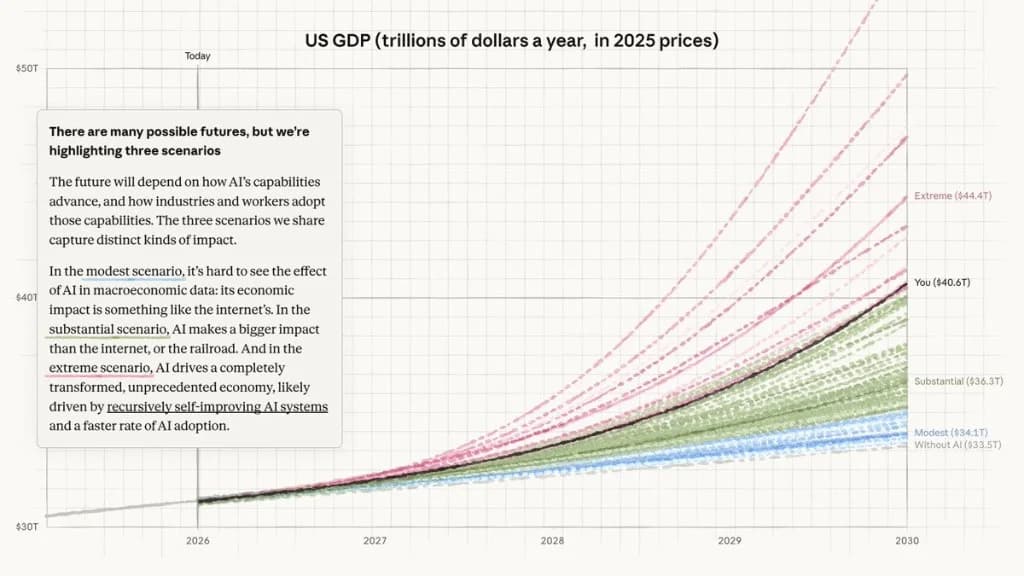
It's worth situating this specific tweet within the broader question it's actually part of, rather than treating it as a standalone claim. explainx.ai has previously covered the genuine measurement difficulty in assessing AI's economic value — GDP itself is an imperfect measure of value created by technologies that primarily save time or improve quality rather than directly generating new taxable transactions. Anthropic's own published economic scenarios for AI's effect on GDP through 2030 present a considerably more gradual set of trajectories than Musk's one-year doubling claim, coming from a lab with just as much commercial interest in AI's transformative potential being taken seriously. Reasonable, informed people genuinely disagree about AI's GDP trajectory — Musk's tweet is a notably aggressive prediction within that debate, not an outlier fringe claim, but it's also directly contradicted by the most authoritative near-term institutional forecast available.
What the X replies themselves reveal about the skepticism
The reactions under Musk's own post are worth reading as a small, informal snapshot of how this specific claim is landing even among people generally sympathetic to AI's transformative potential. The tinygrad account's reply — "How come we haven't seen any movement yet? AI has been around for a bit now" — isn't coming from an AI skeptic; it's a pointed, technically-literate question from within the AI-builder community itself, asking why a doubling this dramatic hasn't already started showing up in visible economic indicators if it's genuinely one year away. Other replies ranged from unrelated tangents (a joke about a personal "AI robot," a fan-account question about Tesla's Optimus robot's own growth contribution) to a direct request for the whereabouts of Grok 4.7 — the kind of scattered, only-loosely-on-topic reply pattern that's typical of a high-follower account's posts, but notable here for how little of the visible reaction directly engaged with defending the specific 4% figure Musk proposed.
Why one-year GDP predictions are especially hard to get right
Beyond the historical productivity-paradox pattern already noted, there's a more basic measurement problem worth naming directly: GDP growth figures are themselves revised repeatedly after initial release, sometimes by a percentage point or more, as more complete economic data comes in over subsequent quarters. That means even a prediction that turns out to be broadly correct in direction can look wrong or right depending on which revision of the actual 2027 GDP figure gets compared against it later — a one-year timeframe doesn't give the normal data-revision cycle much room to settle before the claim's accuracy gets judged. This is one of the more technical reasons economists tend to build in wider error bars and longer time horizons than a single confident social-media prediction typically allows for, and it's part of why the Fed's own institutional forecasts, for all their conservatism, are generally considered a more reliable anchor for expectation-setting than any individual's public guess, however well-informed that individual might be about AI capability trends specifically.
The specific number matters more than the general optimism
It's worth separating two things this tweet conflates that deserve different levels of scrutiny: the general claim that AI will meaningfully boost economic growth over time, and the specific claim that it will roughly double growth within exactly one year. The general version of the claim is genuinely contested but has real, serious economists arguing both sides. The specific one-year-doubling version is a much narrower, more falsifiable claim — it will be straightforwardly checkable against actual 2027 GDP data once that data is in, in a way the broader "AI will transform the economy eventually" claim never fully is. That specificity is part of what makes it worth fact-checking directly against the Fed's own number rather than treating it as unfalsifiable techno-optimism, and it's also what will make it easy to revisit and grade in about a year's time.
Honest limitations
- This is a single tweet, explicitly framed as a personal guess, not a formal forecast or research paper — treating it as anything more rigorous than that would misrepresent what Musk actually posted.
- The Fed's 2.4% figure is a 2027 projection, and Musk's claim is specifically about "next year" (2027) growth — the comparison is apples-to-apples on the target year, but both figures are projections about the future, not measured outcomes, so neither can be confirmed correct or incorrect until the actual data arrives.
- Musk has a public track record of optimistic technology timelines that have sometimes not materialized on his originally stated schedule — worth factoring into how much weight to put on this specific prediction, though it doesn't make the underlying question (can AI meaningfully accelerate GDP growth this fast) settled either way.
- This post doesn't independently model or verify which claim is more likely correct — it reports both figures and their sourcing, and lets the size of the gap speak for itself.
What this means for builders
If you're building an AI product or pitching AI's economic impact to investors or customers, this comparison is a useful, concrete illustration of just how wide the range of credible-sounding predictions about AI's near-term economic impact currently is — from a Fed forecast around 2.4% growth to a prominent industry figure's public guess near double that. That range is itself the more useful signal than either individual number: treat any single confident claim about AI's GDP impact, whether bullish or skeptical, as one point within a genuinely unresolved debate among serious economists and industry figures, rather than as settled consensus in either direction.
Related on explainx.ai
- The AI value/GDP measurement problem, explained
- Anthropic's economic scenarios for AI and GDP through 2030
- China's AI token economy: credit cards, bank loans, and Wissner-Gross
- What happened to GPT-6 Astra? Why the hype died down
- Primary sources: Elon Musk on X, September 18, 2026 · Federal Reserve economic projections, September 16, 2026
This post is sourced to Elon Musk's public X post dated September 18, 2026, and the Federal Reserve's own published economic projections dated September 16, 2026. Both figures are forward-looking projections, not confirmed outcomes.