




Shanghai AI Laboratory has put a very large agent model on Hugging Face: Atria Dawn, a 744B-parameter mixture-of-experts model released under the MIT license with a 512K-token context window. The model card lists an FP8 build, a paper on arXiv and a hosted API alongside the base weights. Its own benchmark table says it leads a field of Chinese and US models on several agent and security tests, and loses clearly on software-engineering ones.
This post covers what the release is, how to read the benchmark table, how to try it, and what the card does not tell you. Every number below is the lab's own claim from its model card; we have not reproduced any of it.
What Atria Dawn is
According to the card, Atria Dawn is "a new-generation agentic model" built on the 744B-parameter MoE GLM-5.2 foundation model. That is the open model Zhipu's Z.ai shipped earlier this year, and it matters for context: Atria Dawn is a post-trained model on top of a Chinese open base, not a from-scratch pretraining run. The Hugging Face metadata tags the architecture as glm_moe_dsa and lists about 753 billion parameters in BF16, with roughly 1.5 TB of safetensors files.
The lab frames the model around four jobs:
| Dimension | What the card says it covers |
|---|---|
| Discovery | Retrieving and organizing evidence, deep research, turning questions into executable experiment plans |
| Creation | Building software, interactive apps, games, data visualizations and ML systems |
| Delivery | Turning documents, data and design requirements into reports and presentations |
| Cybersecurity | Analyzing security issues, validating vulnerabilities, applying fixes and re-validating in authorized environments |
The tagline on the card is "From Research Questions to Verifiable Results": the pitch is a model that runs the full loop of analysis, tool use, code, experiments and failure recovery, rather than a chat model with tools bolted on. If you read our coverage of the lab's smaller Sage-A1.5 agent model, this is the heavyweight sibling: same lab, same emphasis on verifiable agent work, roughly twenty times the parameters.
The release lineup
The card lists four checkpoints:
| Model | Type | Context |
|---|---|---|
| Atria Dawn | Instruct, full release | 512K |
| Atria Dawn FP8 | FP8-quantized, full release | 512K |
| Atria Dawn Preview | Instruct | 256K |
| Atria Dawn Preview FP8 | FP8-quantized | 256K |
The Preview models appear to be an earlier checkpoint, with a GitHub repo called Atria-Dawn-Preview. The card says the API name to use is Atria-Dawn. A website, atria-asi.ai, hosts the same evaluation table, and the lab runs a Discord and an X account for the project.
One practical limit: the model is text only. The card is explicit that the endpoint rejects images with 400 Atria-Dawn is not a multimodal model, and gives Codex users a model-catalog snippet that sets input_modalities to text so the client does not attach screenshots.
The benchmark table, and how to read it
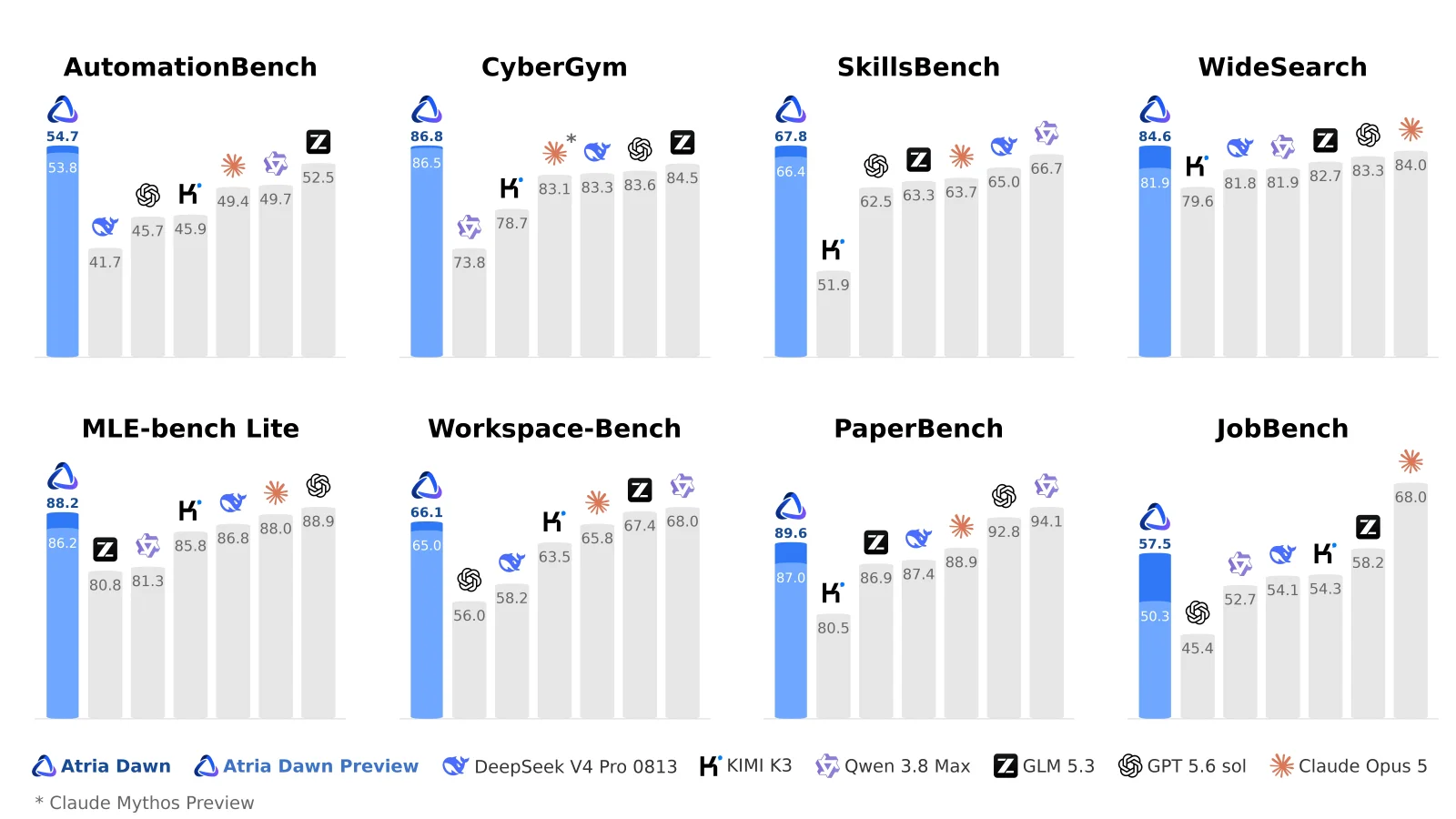 Atria Dawn open-weights agentic model benchmark results against rival frontier models
Image: Shanghai AI Laboratory
The card compares Atria Dawn and the Preview against DeepSeek V4 Pro 0813, Kimi K3, Qwen 3.8 Max, GLM 5.3, GPT 5.6 sol and Claude Opus 5. Here are the rows that tell the story, copied from the card:
| Benchmark | Atria Dawn | DeepSeek V4 Pro 0813 | Kimi K3 | Qwen 3.8 Max | GLM 5.3 | GPT 5.6 sol | Claude Opus 5 |
|---|---|---|---|---|---|---|---|
| CyberGym | 86.8 | 83.3 | 78.7 | 73.8 | 84.5 | 83.6 | not given |
| AutomationBench | 54.7 | 41.7 | 45.9 | 49.7 | 52.5 | 45.7 | 49.4 |
| SkillsBench | 67.8 | 65.0 | 51.9 | 66.7 | 63.3 | 62.5 | 63.7 |
| WideSearch | 84.6 | 81.8 | 79.6 | 81.9 | 82.7 | 83.3 | 84.0 |
| BFCL V4 | 78.4 | 71.4 | 69.1 | not given | 74.1 | not given | not given |
| SWE-bench Pro | 61.7 | 58.4 | 62.0 | 65.3 | 60.3 | 59.8 | 76.5 |
| Terminal-Bench 2.1 | 81.0 | 77.0 | 84.0 | 89.6 | 86.0 | 86.2 | 90.2 |
| NL2Repo-Bench | 50.0 | 49.5 | 63.1 | 63.2 | 54.8 | 60.7 | 79.9 |
| GDPval | 1594.2 | 1493.3 | 1606.8 | 1710.9 | 1643.1 | 1611.1 | 1714.0 |
Three patterns stand out.
1. It wins where the task is search, automation and security. Atria Dawn has the top score in the card's table on CyberGym (86.8), AutomationBench, SkillsBench, WideSearch, BFCL V4 (tool calling), DeepSearchQA (96.5) and Harvey LAB (27.5). The CyberGym number is the headline given the lab's cybersecurity pitch. For comparison, our earlier coverage of GLM 5.3's CyberGym result and the independent validation of it put its predecessor in the mid-80s, so the margin here is a couple of points, not a leap.
2. It lags on software engineering. On SWE-bench Pro it scores 61.7 against 76.5 for Claude Opus 5, and the gaps are larger on NL2Repo-Bench (50.0 versus 79.9), Harbor-Index (17.3 versus 41.0) and DeepSWE (49.3 versus 72.6). It also trails Qwen 3.8 Max and Kimi K3 on several coding tests. If your main use case is autonomous code changes, the card's own numbers do not make this the best open choice.
3. It is behind on knowledge-work breadth. On GDPval, an Elo-style score for professional deliverables, Atria Dawn sits at 1594.2 against 1714.0 for Opus 5, and on JobBench it posts 57.5 against 68.0.
Where it is better than its own Preview, the improvement is usually one to three points (for example CyberGym 86.8 versus 86.5, WideSearch 84.6 versus 81.9), with larger jumps on JobBench (57.5 versus 50.3) and PaperBench (89.6 versus 87.0).
Caveats on the numbers
- Self-reported. The table is the lab's, "matched to the official website". The card does not publish harnesses, prompts, sampling settings or run counts for competitor scores.
- Competitor cells may be stale. A "not given" dash means the lab had no result, and rivals' scores may come from vendor reports rather than the same harness.
- Mixed benchmark sources. Some rows (CyberGym, Terminal-Bench) have well-known public leaderboards; others (Harvey LAB, Harbor-Index) are less standard. Compare with independent runs before trusting a ranking, as we argued in our post on GLM 5.3 tying Kimi K3 on an independent index.
How to run it
The card gives two routes: the hosted API and local serving.
 Open model weights released as a downloadable package for Atria Dawn local deployment
Hosted API. Create a key in the Atria console (international or China region), then point any OpenAI-compatible client at https://discovery-api.intern-ai.org.cn/v1. For Anthropic-compatible clients, the card gives the base https://discovery-api.intern-ai.org.cn. Use Atria-Dawn as the model name. Keys are shown once.
Local serving. The card names minimum framework versions: SGLang 0.5.13.post1 or newer (see the SGLang GLM-5.2 cookbook) and vLLM 0.23.0 or newer (see the vLLM GLM-5.2 recipe). Because it shares GLM-5.2's architecture, the existing recipes apply. At 744B parameters in BF16, expect a multi-node or high-memory GPU server; the FP8 build roughly halves the footprint. Hobbyist runs on a single desktop are not realistic, although projects like Colibri, which streams GLM-5.2 from disk on a 25 GB RAM machine, show the same base can be squeezed with a speed cost.
Coding clients. The card ships configuration for Codex (a custom provider using the Responses API), Claude Code (a PreToolUse hook that blocks image and PDF reads, since the model cannot see them) and Kimi Code. That is useful because it tells you the lab expects Atria Dawn to be driven by third-party agent harnesses, not only its own.
Why this release matters
A top open model keeps coming from a state-backed lab. Shanghai AI Laboratory is a government-supported research institute. The MIT license on the weights is more permissive than the terms attached to several Western open models, and it makes the weights usable in commercial products without negotiation. Compare that with the reported safety disclosure patterns of Chinese labs, where documentation of risk testing is thin. The Atria Dawn card describes cybersecurity capability as a headline feature, and I could not find a safety or misuse section in it. Anyone deploying a model with a stated vulnerability-validation focus should run their own red-team tests.
The open frontier is a stack of fine-tunes. Atria Dawn is another example of a lab taking an open base model (GLM-5.2) and post-training it for agent work, similar to the pattern we saw with Ornith 1.5 and its claimed SWE-bench score. That raises the value of strong open bases and shifts the contest to post-training data, environments and verifiers.
Agent-first marketing. The product name, Atria, and the website branding talk about "agentic superintelligence" in the paper title. Treat that as positioning: the benchmark table itself shows a model that is competitive with its Chinese peers and behind the best US model on coding.
What to check before you adopt it
- Reproduce on your own tasks. Run 20 to 50 of your real agent tasks through the hosted API before committing GPUs.
- Check tool-calling format. The chat template uses a GLM-style
<tool_call>format with<arg_key>and<arg_value>tags, and a reasoning-effort switch that defaults to "max". Make sure your harness handles it, and note that max reasoning raises latency and tokens. - Mind data residency. The hosted endpoints are on intern-ai.org.cn domains. If your data cannot leave your jurisdiction, self-host the weights instead.
- Read the paper. The card links an arXiv paper titled "Atria Dawn: The Dawn of Agentic Superintelligence" (arXiv 2609.15818) for method details and ablations; the model card does not describe training data or the reinforcement-learning setup.
- Compare with GLM 5.3. Since the base is GLM-5.2 and the table lists GLM 5.3 as a rival, check whether the incremental gains justify the larger memory and the switch, using our GLM 5.3 launch benchmarks as a baseline.
Bottom line
Atria Dawn is a genuine, permissively licensed, very large open-weights agent model with working serving recipes and harness configs, from a lab that has now published both a 35B and a 744B agent model within days of each other. Its self-reported strengths are search, automation and cybersecurity; its weakness is software engineering relative to Claude Opus 5. The right posture is interest plus independent testing: the table is a lab claim, and the first third-party evaluations will say more than the card does.
Related reading
- Sage-A1.5: Shanghai AI Lab's open 35B MoE agent
- GLM 5.3 CyberGym result and independent validation
- GLM 5.3 launch and cyber-defense benchmarks
- GLM 5.3 ties Kimi K3 on an intelligence index
- Colibri: running GLM-5.2 from disk
- Ornith 1.5: claimed versus verified
- Chinese AI labs and safety disclosure
- Sources: Atria Dawn model card, Atria website, arXiv 2609.15818
Figures are accurate as of October 23, 2026, based on the published model card. Follow @explainx_ai for updates.