




arXiv has capped submissions. Since October 1, 2026, each person may submit two papers per calendar month, across every subject category, and may have at most three submissions active at once. The preprint server says the rule is a stopgap against a surge it attributes largely to AI tools: September 2026 produced a record 40,363 submissions, about double the 20,569 of September 2024. If you publish AI research, this is the first hard quota on the place where most of it first appears.
Below: what the rule says, the numbers behind it, what is and isn't counted, how it fits a year of tightening around AI-written papers, and what researchers and readers should do about it. Sources are arXiv's own rate-limit announcement and The Decoder's report.
Quick reference: the rule at a glance
| Question | Answer |
|---|---|
| What is the new limit? | Two submissions per calendar month per submitter, all categories |
| What else applies? | Three total active submissions at any given time (in place since 2024) |
| Effective date | October 1, 2026 |
| Do rejected papers count? | Yes, the cap counts submissions, not announced papers |
| Do deleted papers count? | Not if deleted before announcement |
| Do co-authors count? | No, only the submitting author |
| Is it permanent? | arXiv calls it a temporary fix |
| Who warned about it? | Thomas Dietterich, chair of the arXiv Editorial Advisory Council |
What exactly did arXiv announce?
In its post, arXiv wrote that it "now limits submitters to up to two submissions per calendar month," alongside a limit of three total active submissions at any given time. The active-submission limit is not new; the monthly cap is the addition. The restriction covers all categories, from cs.AI to physics and mathematics, so a researcher cannot spread extra submissions across fields.
Two details matter most to working researchers. First, the quota is spent at the moment of submission, so a paper that moderators reject still uses a slot. Second, the limit tracks the account that submits, not the author list, so a co-author who did not press the button is untouched. That detail makes it easy to imagine labs designating a submitter per paper, which is a workaround arXiv has not commented on in the sources we reviewed.
Why now? The numbers behind the cap
arXiv's own figures show how steep the climb is:
| Month | Submissions |
|---|---|
| September 2016 | 9,869 |
| September 2024 | 20,569 |
| September 2026 | 40,363 (record) |
arXiv says submissions have doubled in two years and that cs.AI has grown more than sixfold over the same period. The September 2026 surge generated almost 9,000 support tickets. Volunteer moderators handle initial screening, and the growth is not evenly spread across authors.
Dietterich framed the problem as concentration, not volume alone: "a relatively small proportion of authors are submitting a large number of low-quality papers." He added that this "is unfair to authors who continue to submit quality papers." According to The Decoder, he said some authors submit dozens of papers and hopes the cap discourages "micro-result" papers, while moderators report more thin papers, salami-sliced papers and dense AI-written text.
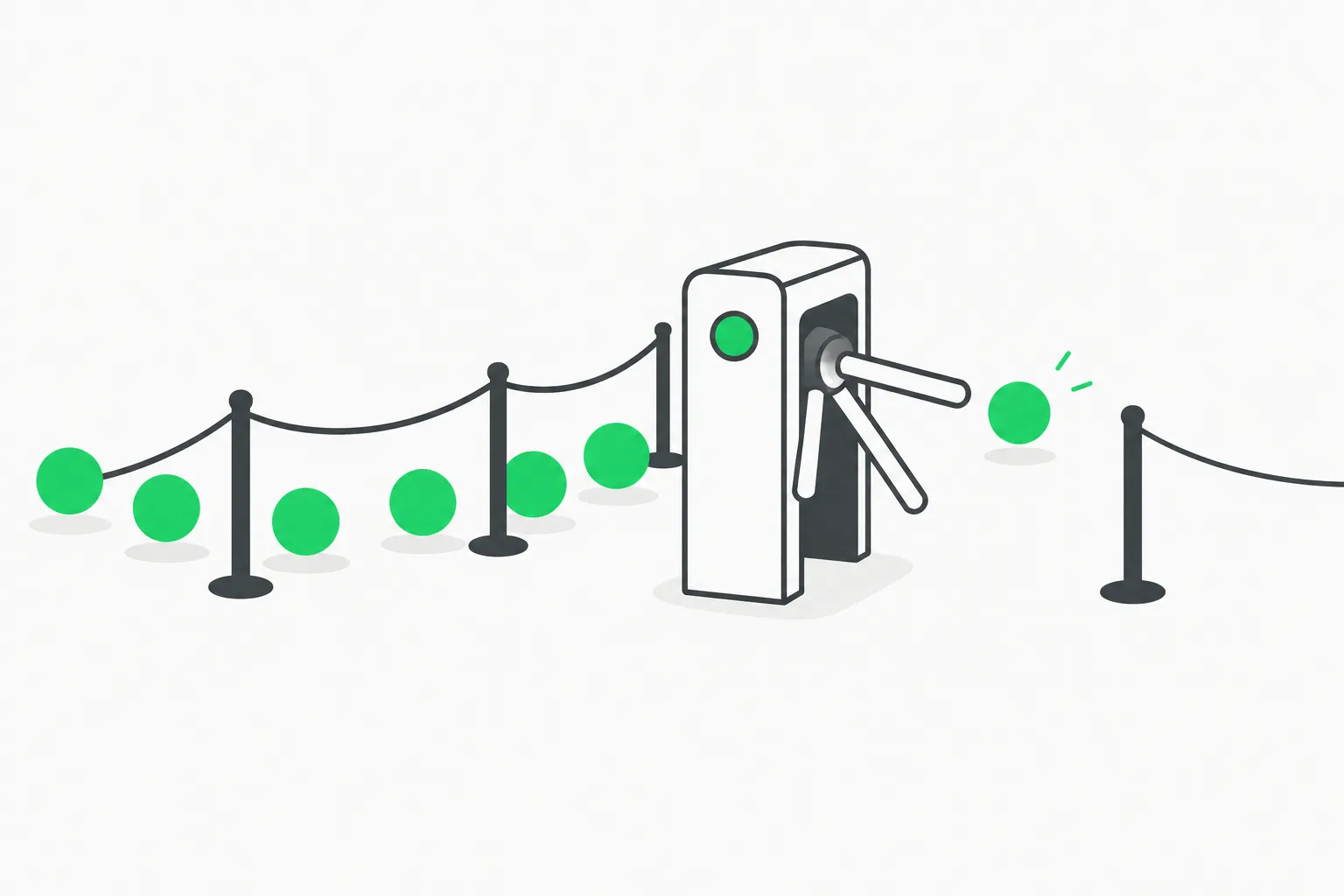 arXiv submission limit shown as a turnstile letting submissions through one at a time
What does the cap not do?
It does not judge quality. A researcher who submits two excellent papers and a prolific author who submits two weak ones are treated identically. The cap is a blunt throttle on the one metric arXiv can count cheaply, which is why Dietterich said he hopes it can be raised or dropped once moderation tooling improves.
It also does not stop a determined bad actor from using several accounts, though account creation and endorsement rules are separate policy areas. And it does not touch what happens after announcement: a low-quality paper that passes moderation still lands in search results and in the training corpora that scrape the site. For context on that last point, see our post on the full arXiv archive released as a 16 TB Hugging Face dataset.
A year of tightening: how this fits
According to The Decoder's summary of arXiv's recent actions, the cap is the latest in a series:
- November 2025: computer science review and position papers must go through peer review before arXiv will host them.
- May 2026: Dietterich announced one-year bans for authors whose papers clearly contain unverified LLM output, such as hallucinated references.
- July 1, 2026: arXiv began separating from Cornell University to become an independent nonprofit, per its April announcement.
- Late September 2026: the Simons Foundation International, XTX Markets and the Siegel Family Endowment pledged $17.2 million over three to five years, per arXiv's funding post. Part will fund technical upgrades focused on AI-generated content.
Read together, the pattern is clear: arXiv is moving from an open dropbox to a moderated service with escalating guardrails, and the cap buys time while tooling catches up.
Is arXiv alone? The wider AI paper flood
The problem extends beyond one server. The Decoder reports that ICLR 2027 received about 50,000 abstracts before its deadline, against roughly 19,500 valid submissions for ICLR 2026. It also cites a GPTZero analysis that found at least 100 fabricated citations among about 5,000 accepted NeurIPS 2025 papers, even with at least three reviewers per paper.
Adjacent platforms feel the same pressure. Google froze part of its open-source bug bounty after a wave of low-quality reports; see our write-up of the Google OSS VRP freeze over AI slop reports. The shared mechanism is that AI makes producing a plausible-looking submission nearly free, while reviewing it still costs human attention. Any open submission channel with human gatekeepers ends up needing quotas, bans or automated triage.
 Two reviewers inspecting a single paper, one holding a green stamp, illustrating arXiv peer review pressure
Why this matters for AI research specifically
AI is both the cause and the subject. Models now draft, rewrite and even attempt to replicate papers, and the Decoder article notes several signals of how fast that is moving: Google DeepMind expanded its Co-Scientist in August 2026, OpenAI announced an automated research intern in September 2026, and a Princeton and UK AI Safety Institute study had Claude Opus 4.8 work for six days on research questions from two unpublished NeurIPS papers, after which the original authors, acting as reviewers, rejected both sets of results.
That last result is the useful caution. Fluent output is not verified output. We have covered the same gap from the other direction in OpenAI's 722 math manuscripts and what to check, in AGMAI's responsible-release proposal for AI-generated mathematics, and in Epoch's test of whether AI can automate AI research. A volume cap does nothing about whether a claim is true, but it does make the verification burden a little more manageable.
What should researchers do now?
If you submit to arXiv, a few practical adjustments follow from the rule:
- Count before you submit. Rejected papers use a slot, so a rushed submission that bounces costs you a month of one of your two.
- Bundle, don't slice. Dietterich explicitly targeted micro-result papers. Combining related results into one paper is both safer under the cap and better received.
- Delete early. A paper deleted before announcement returns the slot, so if you spot an error right after submitting, withdraw it quickly.
- Agree on a submitter. Because only the submitting account counts, teams with several papers in flight should plan who submits what, and document it.
- Verify AI-assisted text. Under the May 2026 policy, unverified LLM output such as hallucinated sources can bring a one-year ban, which is far more costly than the cap.
- Keep a copy elsewhere. If you hit your limit during a deadline crunch, a lab website, institutional repository or another preprint host is the fallback.
What should readers and tool builders do?
For people who consume arXiv, the cap may modestly improve signal over the coming months, but do not assume it fixes quality. Treat a preprint as unreviewed, check whether code and data are released, and be wary of papers whose citations you cannot resolve. Builders of paper-recommendation tools, literature-review agents and training pipelines should expect submission volumes to flatten per author and should keep deduplication and citation checks in place.
If you run agents that read or write papers, note that a related risk is agents acting beyond what their operators intended. AgentBeam, the agent security platform from the explainx.ai team, stops AI agents before they take dangerous actions, which is relevant if an agent can submit on your behalf.
What we don't know yet
Several questions are open. arXiv has not published how long the cap will last or what metrics will trigger a change. It has not said whether submitting for a co-author's paper through a shared account would be treated as circumvention. And we have not seen data on how many authors actually hit two papers a month, so the real affected population is unknown; the argument that it hits only a small proportion rests on Dietterich's characterization, not a published distribution. One outlet reported that the three-active-submission limit dates to 2024, which matches arXiv's wording, while some summaries presented both limits as new on October 1.
The arXiv post also does not say whether new versions of an existing paper count toward the monthly limit. We will update this post if arXiv revises the policy.
The bottom line
The cap is a pragmatic, imperfect response to a real strain: AI tools made volume cheap, and a few authors used that to overwhelm volunteers. For most researchers two papers a month is plenty. For the high-volume minority it is a deliberate nudge toward fewer, stronger papers, and a sign that open scientific infrastructure is starting to ration attention the way many AI-exposed platforms now must.
Related reading
- arXiv full archive as a 16 TB Hugging Face dataset
- Google OSS VRP bug bounty freeze over AI slop reports
- OpenAI 722 math manuscripts: what to check
- AGMAI: responsible release of AI-generated mathematics
- Epoch InnovationEval: can AI automate AI R&D?
- AI referee, paper leaderboard and LLM judges
- arXiv rate-limit announcement
Policy details are accurate as of October 11, 2026; check arXiv's blog for revisions.