



Anthropic argues that individual MLP neurons in open language models are more interpretable than a decade of superposition research suggested—if you read what each neuron adds to the residual stream, not only when it fires. On November 23, 2026, Alignment Science researchers Jasmine Shone and Lisa Dunlap published Returning to the Neuron Basis for Interpretability, Part 1: Answering Three Objections. They use the J-lens to translate neuron output vectors into token readouts, then ablate, inject, and steer to falsify hypotheses.
The companion Part 2 asks whether those neurons are useful for safety work—detectors, steering, and auditing finetunes. This article explains Part 1’s theory and evidence so builders can decide whether to add neuron tooling beside sparse autoencoders and NLAs.
Why did interpretability move away from neurons?
Early circuits and feature-visualization work treated neurons as the natural unit. The field later pivoted toward learned dictionaries because three observations seemed fatal:
- Polysemantic firing — one neuron activates on unrelated inputs (Olah et al., Bills et al.).
- Representation drift — concepts appear to rotate between layers (residual stream analyses).
- Distributed facts — knowledge looks smeared across many neurons, so single-neuron edits should fail.
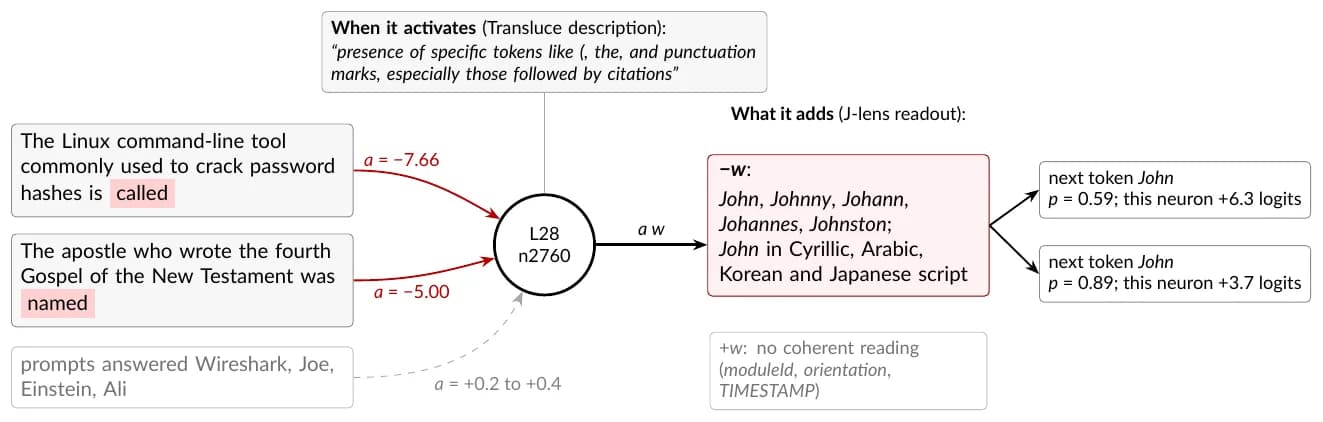
Anthropic does not deny those papers. It reframes the object of study. In a SwiGLU MLP, each neuron outputs one scalar times one fixed vector (w) added to the residual stream. That is a context-gated steering vector. The scalar’s sign can differ, so +w and −w may mean different things—as in their John the Ripper / Gospel of John example on Llama-3.1-8B-Instruct layer 28 neuron 2760.
What is the J-lens readout?
The team combines:
- When the neuron fires (top Pile passages, with sensitive subsets removed).
- What it adds (output vector (w), the down-projection column).
- J-lens readout — tokens whose later-layer directions align best with (w) (Gurnee et al., 2026).
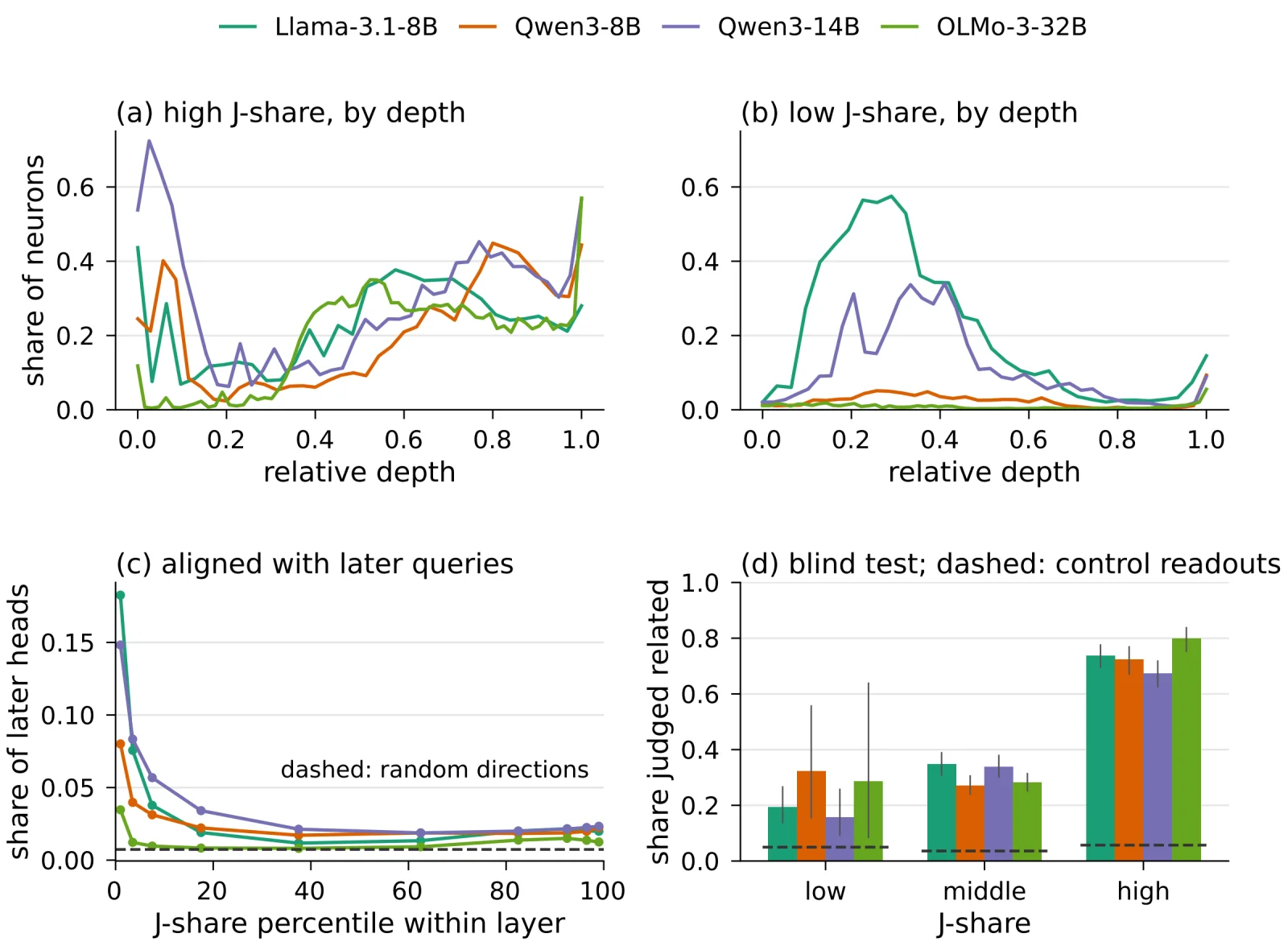
They also compute J-share: how much of (w) a sparse combination of token directions explains. High J-share neurons often verbalize as word variants where they activate; middle J-share neurons point at a shared concept with different surface tokens.
Blind Claude judge tests on up to 1,000 neurons per model report the neuron’s readout as related to its top-activating passages in 73% / 31% / 19% of cases at high / middle / low J-share—versus 4–6% on control readouts (pooled across four models).
Finding 1: true two-concept neurons are rare
Anthropic introduces a polysemanticity taxonomy:
| Type | Pattern |
|---|---|
| Type 1 | Unrelated inputs, one concept added |
| Type 2 | Different signs add different concepts (never both at once) |
| Type 3 | One sign adds two unrelated concepts (the scary case) |
Type 3 shows up in ≤ ~1% of signed directions with measurable next-token effects. The authors still find 35 type-3 neurons across four models—for example Elon Musk and protein translation on the same −w path in Llama.
That reinterprets older “this neuron fires on everything” lists: many are probably type 1 or 2, where a single activation still adds one main concept.
Finding 2: neurons keep meaning across layers
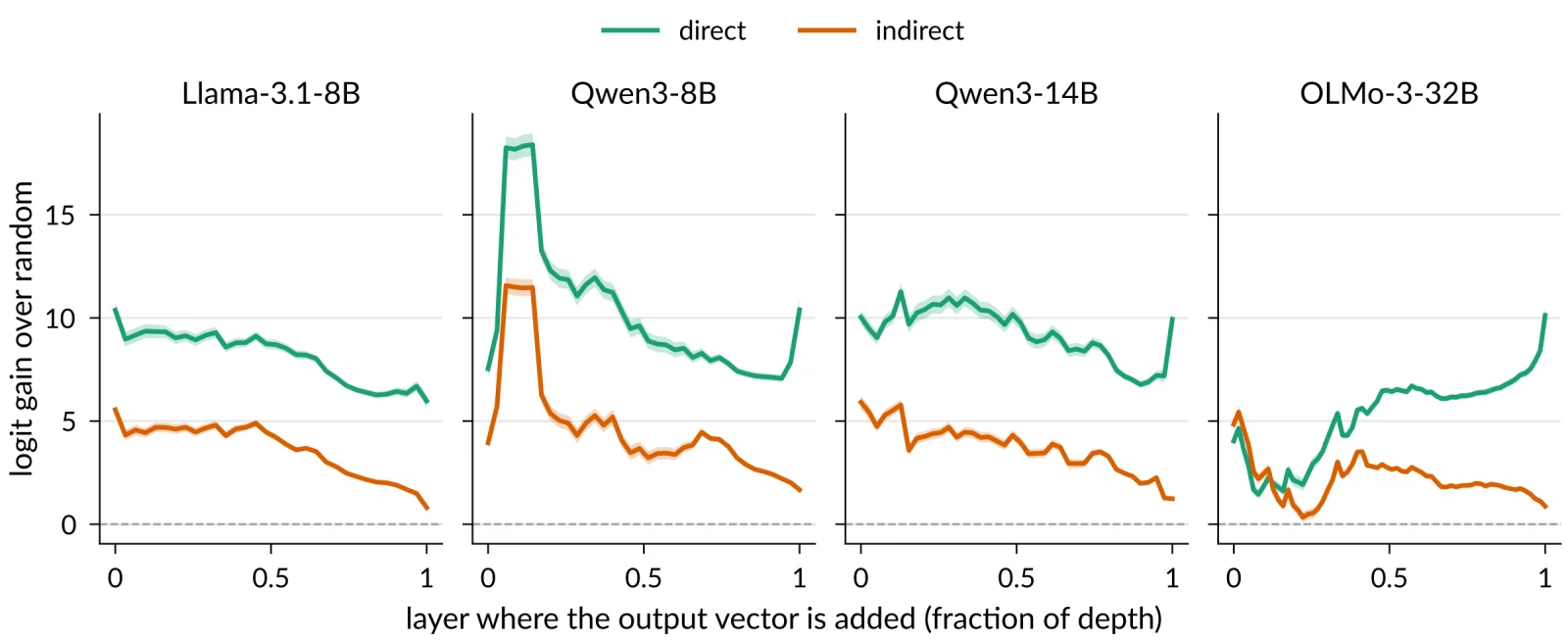
Representation drift made cross-layer neuron comparisons look hopeless. Anthropic tests moving (w) to other layers at fixed magnitude:
- Direct neurons raise their target noun through the unembedding.
- Indirect neurons require later layers; the noun appears in the top-10 J-lens tokens but not the top-500 logit-lens tokens.
Before the last tenth of depth, indirect output vectors beat a random direction of equal size on 91–98% of concept–layer pairs (model-dependent). They read that as neurons writing in an approximately fixed basis.
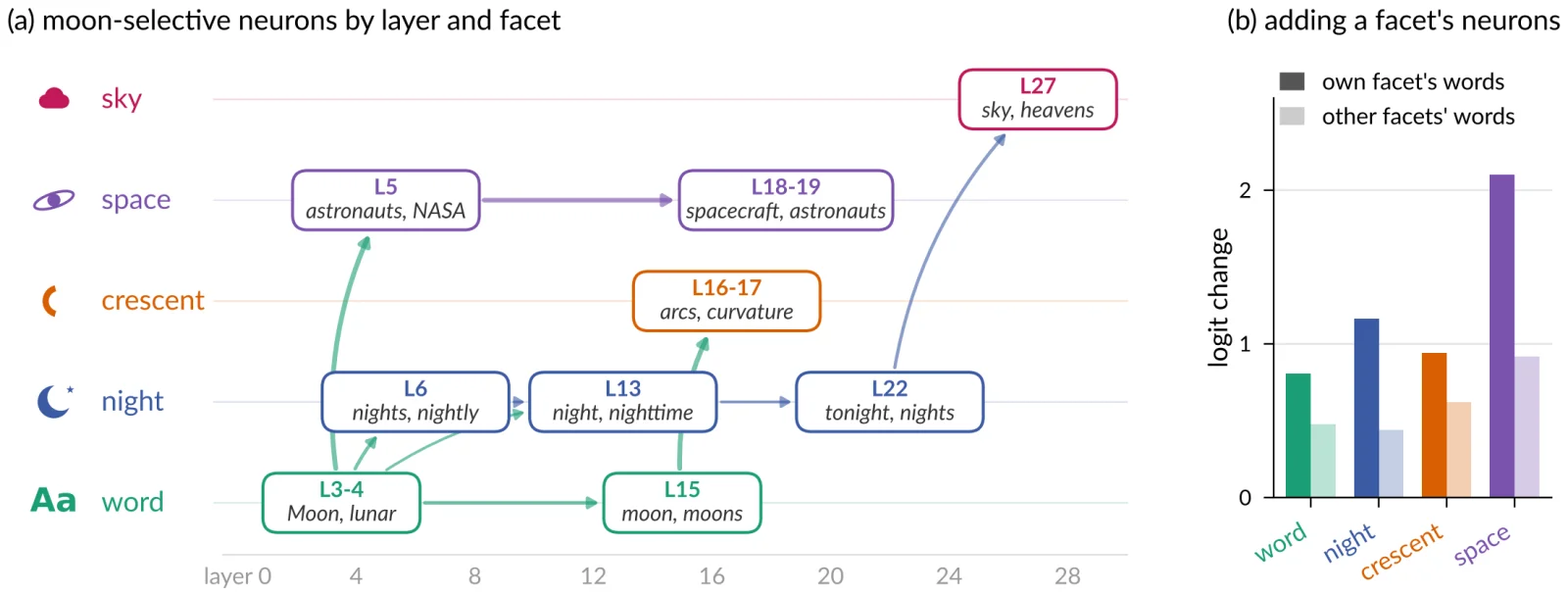
Concepts can still look different by depth because later neurons add facets—their moon example tracks night, crescent shape, space travel, and sky across layers.
 Moon concept facets across layers in Llama neuron interpretability
Image: Anthropic Alignment Science
 Anthropic neuron basis interpretability J-lens readouts matching activation passages
Image: Anthropic Alignment Science
Finding 3: facts are multi-path but still readable
Fact recall debates often pit key–value MLP stories against superposition. Anthropic traces 18 facts in Llama-3.1-8B-Instruct—athletes to sports, books to authors, pip packages to import names.
Removing a fact typically takes 44–273 neurons for 15 of 18 facts because several recall paths overlap. That is why facts look distributed. Yet ablating only neurons with readable concepts tied to the fact can still flip the top prediction.
Their Jaromir Jagr → hockey walkthrough shows one-hop neurons (hockey readout) plus multi-hop associates (Czech, winter, Canada) and later attention routing the answer token.
 Neuron output vectors retain meaning across MLP layers Anthropic interpretability
Image: Anthropic Alignment Science
How this fits Anthropic’s wider interpretability stack
This post is not a Claude product changelog. It sits beside:
- J-space global workspace tooling for Claude-scale models.
- Goodfire’s neuron work on commercial interpretability APIs.
- Open-weight steering demos such as two-neuron Evil-Qwen reproductions—which show how few neurons can flip personas when identified.
Part 1 supplies the mechanistic why behind Part 2’s safety benchmarks.
What builders can try on open weights
You do not need Anthropic’s internal checkpoints to copy the method pattern:
- Pick an open instruct model (Llama 3.1, Qwen3, OLMo).
- For a middle-layer neuron, extract (w), compute J-lens or logit-lens readouts, and write a hypothesis.
- Ablate the neuron on contrastive prompts and measure next-token logprobs for your hypothesis tokens.
- Inject (w) at another layer and check whether the readout concept survives.
Expect type-3 surprises to be rare but real. Expect fact edits to require bundles of neurons, not one magic unit.
For monitoring agent traffic, pair neuron probes with constitutional classifier-style stacks—not as a replacement.
Limits and open questions
Anthropic flags standard caveats:
- Automated activation descriptions can miss what a neuron does (their John example).
- Low J-share neurons may align with later attention queries instead of clean text.
- Blind judging is conservative but not a formal faithfulness proof.
The paper does not claim neurons replace SAEs on frontier closed models. It argues the default dismissal of neurons deserves revision on open weights where you can run interventions.
Researchers tracking GPT-6 monitoring debates should watch whether neuron-level monitors become part of the transparency discussion Pachocki wants—especially where open-weight replicas exist.
SwiGLU mechanics in plain language
Anthropic’s framing starts from how a SwiGLU MLP block actually writes to the residual stream:
| Piece | Role in one neuron |
|---|---|
| Gate row g | Decides whether the neuron is “open” (SiLU on g·x) |
| Up row u | Scales the contribution; sign can flip whether you add +w or −w |
| Down column w | Fixed output vector added when the scalar fires |
| Scalar a | Single context-dependent number per token position |
That structure matters because feature dictionaries learn a new basis on top of the same weights. Neuron methods read the native basis the model was trained with. When Goodfire reports ~90% interpretable neurons on Qwen3-32B, they are making a parallel commercial bet: customers may pay for named units, not only latent indices.
Anthropic also notes gate leakage: when the gate is “closed,” SiLU is not exactly zero (minimum about −0.28), so tiny opposite-sign activations can slip through. Their analyses count a sign as real only when activations of that sign occur with the gate open, matching how practitioners already filtered noisy ReLU-era plots.
How the three findings connect
Read together, the three findings form a coherent story for editors and safety engineers:
- Polysemanticity is mostly an activation-labeling problem, not proof that one forward pass blends unrelated concepts—type 3 is rare.
- Cross-layer transfer works, so you can trace a neuron you found at layer 22 back to layer 8 without assuming an arbitrary rotation every block.
- Facts are implemented by interpretable bundles, which is why unlearning and editing papers that spray gradients across wide layer bands sometimes work anyway—and why Part 2 can audit WMDP unlearning through neuron deltas.
If you are comparing to evil-Qwen two-neuron steering, remember that demo used hand-picked units for a persona axis. Part 1 is about systematic census across thousands of neurons with blind judges, not a single dramatic slide.
FAQ for searchers: “Are neurons interpretable in 2026?”
There is no yes/no leaderboard score. Anthropic’s answer is conditional: under J-lens readouts plus interventions, neuron hypotheses are testable and often accurate, but automated activation captions still miss behavior (the John neuron is their worked example). For closed frontier models, you still rely on circuit-style tooling or vendor APIs; this paper targets open weights you can ablate on your own GPUs.
Worked example: tracing one fact end to end
Anthropic’s Jaromir Jagr plays hockey walkthrough is the pedagogical spine of Finding 3. The model must connect a person entity to a sport relation under a prompt like “plays the sport of.” Their diagram marks neurons that fire differently on Jagr versus decoy names:
- One-hop neurons whose readouts name hockey directly.
- Multi-hop neurons whose readouts name Czech, winter, Canada, or related concepts that raise hockey probability when combined with attention.
Attention layers after roughly layer 15 route those associations to the answer position. When researchers ablate only neurons whose readouts are literally the answer token, the top prediction often stays correct—you must remove interpretable associates too.
For builders, the lesson is operational: single-neuron dashboards will lie about multi-path facts. Any knowledge editor needs sets of neurons, ranked by contribution to logprob, not one hot spot on a saliency map.
Comparison to sparse-autoencoder workflows
| Step | SAE-heavy pipeline | Neuron basis pipeline (Part 1) |
|---|---|---|
| Upfront cost | Train or download dictionary on each checkpoint | Read native w columns directly |
| Concept naming | Latent index + human label | J-lens readout + activation text |
| Validation | Reconstruction loss + sparse firing stats | Interventions on live forward pass |
| When it shines | Highly polysemantic layers, Claude-scale closed models | Open instruct models you can host |
| Risk | Feature splitting/merging artifacts | Miss low J-share attention-aligned units |
Neither column replaces the other. Teams running Google DeepMind DetectorScope-style SAE pipelines should still read Part 1 as a sanity check: if neurons are stable enough to inject across layers, your SAE features may be over-fragmenting native units.
What to watch from Anthropic next
Shone and Dunlap tease Part 2 safety applications in the introduction to Part 1. Together the pair reads like a research program, not a one-off blog:
- Theory half — when neuron stories are trustworthy.
- Practice half — when they beat baselines on ToxicChat, WeirdChat, and WMDP unlearning.
If Neuronpedia or open dashboards adopt J-lens readouts on Llama-scale checkpoints, expect community replication threads on Hacker News within days. Until then, cite only numbers from the November 23 PDFs on alignment.anthropic.com.
Related reading
- Anthropic Neuron Basis Part 2: safety detectors and steering — zero-shot classifiers, WeirdChat steering, WMDP unlearning audits.
- What is the J-lens?
- Goodfire: neurons already 90% interpretable on Qwen3-32B
- SAE features compose additively (SAR paper)
- Anthropic NLAs and inner monologue tests