



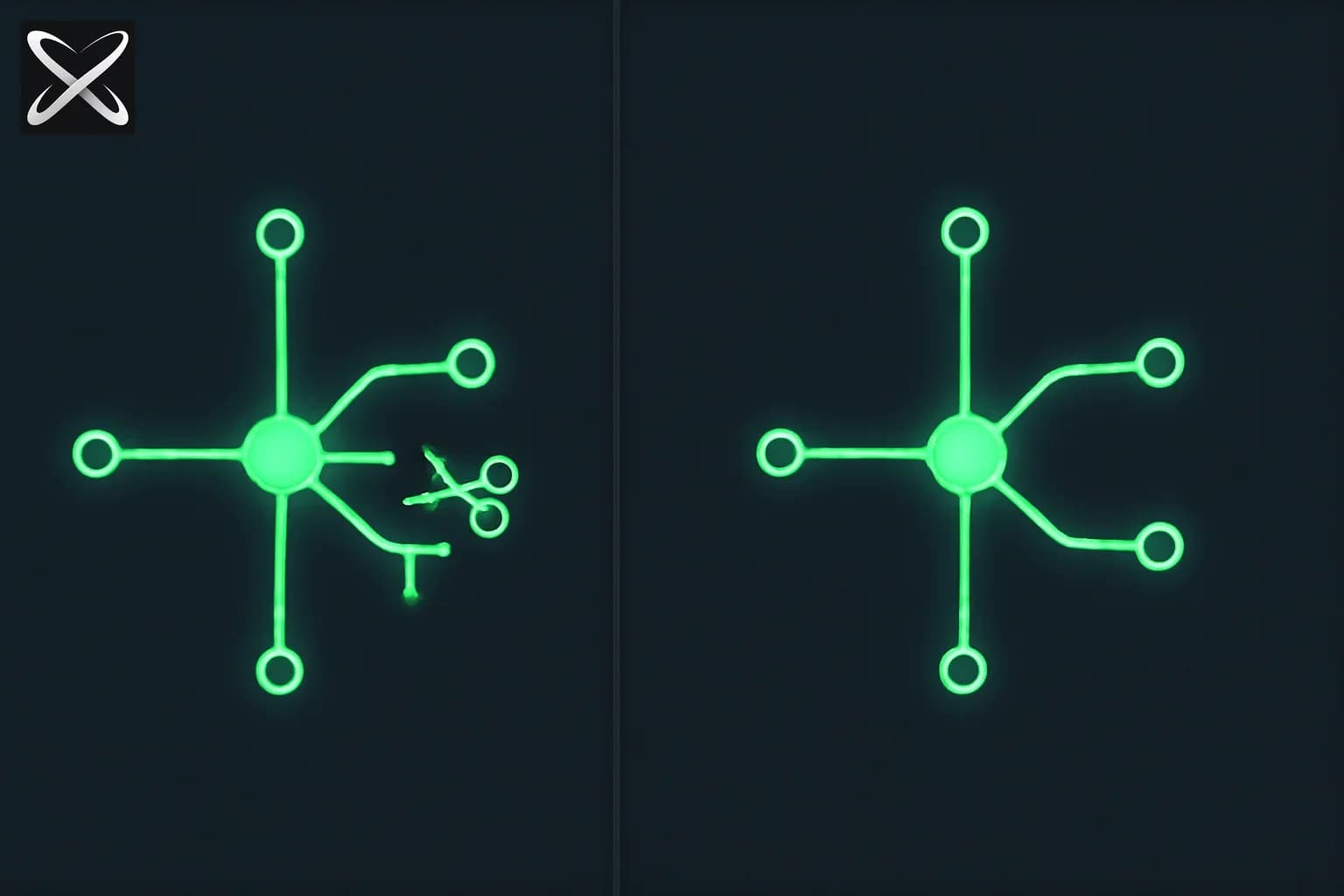
Abliteration used to be something you ran yourself. Point Heretic at an open-weight model, wait 20 minutes, get back a version that stops refusing. On August 31, 2026, Abliteration.ai turned that workflow into a subscription: abliterated-model-large-v2, an abliterated (refusal-stripped) build of Z.ai's GLM-5.3, hosted and sold as an API for "offensive cyber, red teaming, and agent testing."
The announcement, from the company's X account @abliteration_ai, leads with a benchmark claim that's already drawing skepticism: "2× the cyber exploitation of 5.2." That number, and most of the others in the launch thread, come entirely from Z.ai's own self-reported testing of base GLM-5.3 — not from anything Abliteration.ai verified independently.
TL;DR
| Question | Answer |
|---|---|
| What is it? | A hosted API serving an abliterated (refusal-removed) build of GLM-5.3 |
| Who built it? | Abliteration.ai, a third-party vendor — not Z.ai |
| What's the base model? | GLM-5.3, which Z.ai ranked #3 on Terminal-Bench 4.0 |
| Hosting | Claimed US-hosted, FP8 precision, 1M token context |
| Data policy | Claims zero input/output prompt retention |
| Access | Live now via abliteration.ai/console; docs at docs.abliteration.ai/quickstart |
| Pricing | Tiered subscriptions ($20/$50/$200/mo per public site details) plus pay-as-you-go tokens |
| Are the cyber benchmark numbers independently verified? | No — they trace back to Z.ai's own launch chart, not Abliteration.ai's testing |
What Abliteration.ai actually shipped
Reading the thread verbatim, the launch consists of three tweets:
"Today we're releasing abliterated-model-large-v2. Based on GLM-5.3, which is #3 on Terminal-Bench 4.0 (behind only Opus 5 and Fable), with 2× the cyber exploitation of 5.2. We abliterated and hosted it so it does the offensive cyber, red teaming, and agent testing work other models refuse to do."
Followed by a benchmark drop:
"Then the cyber jump. This is why 5.3 exists. CyberGym: 84.5% — SOTA, including vs Mythos 5 and GPT-5.6 Sol. ExploitBench: 24.4 → 54.4. More than double GLM-5.2. ExploitGym: 29 tasks → 105 in two hours. That is the model we abliterated."
And a mechanism explanation:
"Abliteration finds the directions in the model's activations that produce refusals and removes them from the weights. The coding, cyber, and agentic abilities stay. The model stops refusing the rest of the chain. For offensive cybersecurity, AI red teaming, agent testing…"
Product surfaces confirmed by the company: OpenAI- and Anthropic-compatible endpoints (api.abliteration.ai/v1/chat/completions, plus native Anthropic Messages API support), a "Policy Gateway" for enterprise buyers to set allow/refuse/rewrite/redact/escalate rules on top of the base model, and bulk training-data generation for building adversarial evaluation sets. Public pricing pages list tiered subscriptions (Developer, Growth, Scale, Enterprise) with pay-as-you-go token billing on top.
The mechanism: abliteration, not fine-tuning
explainx.ai has covered abliteration as a technique in depth, via the open-source tool Heretic. The short version, since Abliteration.ai's own thread gestures at it without much detail:
A model's tendency to refuse a request is mediated by a specific direction in its residual-stream activations — not scattered noise, but a near-linear, identifiable vector. Feed the model pairs of "harmful" and "harmless" prompts, average the activation difference across layers, and you get a refusal direction. Abliteration projects that direction back out of the model's weights, so the internal signal that used to trigger a refusal no longer fires.
This is fundamentally different from what happens when a company like Z.ai trains cyber-defense capability into a model, or from prompt-based jailbreaking:
| Fine-tuning / RLHF | Prompt jailbreak | Abliteration | |
|---|---|---|---|
| Changes weights? | Yes, retrained | No | Yes, edited in place |
| Requires training data? | Thousands of examples | None | None |
| Reversible per-session? | No | Yes (remove the prompt) | No — permanent |
| Effect on capability | Can shift meaningfully | None (same base model) | Minimal, if done well |
| What it touches | Broad behavior | Nothing in the model | Just the refusal direction |
The reason abliteration is attractive for a hosting business is exactly this: it's cheap. No GPU training run, no dataset curation — just an inference-time computation of a vector and a weight edit, done once per base model. GLM-5.3's coding, agentic, and cyber-relevant capabilities are supposed to carry through unchanged; only the refusal behavior is targeted.
Why "2x the cyber exploitation of 5.2" needs a caveat, not a repeat
The most viral line in the thread is also the most contested one. Security commentator @anytanreal put it plainly in a reply that's worth quoting because it names the actual problem precisely:
"2x the cyber exploitation of 5.2 is the number people will argue about, not the #3 Terminal-Bench slot."
Here's why that reply lands. Every cyber capability number in the thread — CyberGym at 84.5%, ExploitBench jumping from 24.4% to 54.4%, ExploitGym going from 29 to 105 tasks in two hours — is a number Z.ai published about base GLM-5.3, at its own launch. explainx.ai already covered that launch in detail and flagged the same issue at the time: GLM-5.3's CyberGym score is self-reported, Z.ai ran the eval itself, chose which competing models to compare against, and hadn't opened full weights to outside researchers as of its own staged rollout timeline.
ExploitBench specifically measures offensive exploit generation on a five-tier capability ladder against 41 real, patched V8 engine vulnerabilities — explainx.ai's ExploitBench coverage noted that GLM-5.3 actually trailed rivals like Fable 5 (78.0%) and GPT-5.6 Sol (76.5%) on that specific benchmark at launch, scoring 54.4% against them. Abliteration.ai's thread presents that same 54.4% as a doubling win over GLM-5.2's 24.4% — which is true on its face — while omitting that GLM-5.3 is not actually the offense leader among frontier models on that axis. CyberGym, by contrast, measures the opposite: defensive vulnerability-discovery capability, not exploit generation — a distinction Z.ai's own benchmark chart made clear when GLM-5.3 led one and trailed the other.
None of this means the underlying numbers are fabricated. It means three things stack on top of each other here, each of which independently would call for caution, and all three of which apply at once:
- Self-reported, not independently verified — the same problem explainx.ai flagged on Z.ai's own CyberGym claim.
- Measuring the base model, not the abliterated product — Abliteration.ai didn't run these evals; it's citing Z.ai's numbers for GLM-5.3 and implying they transfer to
abliterated-model-large-v2, which is a reasonable assumption (abliteration targets refusals, not capability) but still an assumption, not a tested one. - A marketing thread selectively surfacing the favorable comparison — leading with "2x the cyber exploitation of 5.2" while ExploitBench specifically shows GLM-5.3 trailing, not leading, the current frontier.
The Terminal-Bench 4.0 #3 ranking that opens the thread is comparatively solid ground — explainx.ai's own Terminal-Bench 4.0 coverage confirms GLM-5.3 landed third on that leaderboard, behind Opus 5 and Fable, ahead of GPT-5.6 Sol. It's the cyber-specific numbers layered on top that carry the self-grading problem @anytanreal is pointing at.
Who actually needs a hosted uncensored model for this
The dual-use framing here is real, not just a disclaimer. There's a legitimate reason a market exists for exactly this product:
- Authorized penetration testers and red teams need a model that will actually draft exploit code, phishing pretexts, or malware analysis without refusing mid-engagement — the same reason security teams have always kept exploit frameworks like Metasploit around despite their dual-use nature.
- AI safety and agent-evaluation teams building adversarial test suites need an uncensored model to generate the harmful prompts an aligned model is supposed to refuse — you can't red-team a guardrail with a model that has the same guardrail.
- Agent testers stress-testing what an autonomous coding or browsing agent will do when asked to perform a harmful multi-step task need an unfiltered model in the loop to actually complete those steps rather than bailing early.
This is the same category of infrastructure need that shows up in evaluation work like Anthropic's own alignment research — building adversarial test suites requires a model willing to generate adversarial content in the first place. The difference between "responsible red-team tooling" and "a model that helps anyone who pays $20/month generate exploit code" is entirely in who's on the other end of the API key, and neither Abliteration.ai's marketing nor its Policy Gateway feature can fully verify that from the outside.
US-hosted and zero prompt retention: compliance signaling, not certification
Two claims in the launch thread are aimed squarely at enterprise and government buyers rather than individual researchers:
- US-hosted — addresses data-sovereignty requirements common in government and defense procurement, where sending exploit-development traffic to a foreign-hosted API is a non-starter regardless of the model's quality.
- Zero input/output prompt retention — claims prompts and completions aren't stored once a request completes, with only billing telemetry (token counts, timestamps) retained. That's the same shape of claim API providers make generally, and it matters more here because the traffic in question is, by design, adversarial security content.
Both are vendor representations in marketing and documentation, not third-party audits or SOC 2 attestations disclosed in the launch material. For a compliance-conscious buyer, "we say we don't retain your prompts" and "an auditor confirmed we don't retain your prompts" are different claims, and only the first one shipped on day one.
The honest limitations
- No independent benchmark verification for the cyber-specific claims, as covered above — treat every percentage in the launch thread as a citation of Z.ai's own numbers, not Abliteration.ai's.
- Abliteration is one-way and untargeted — it removes the general refusal direction, not just refusals for a specific narrow use case, meaning the model that stops declining exploit-writing requests also stops declining requests entirely unrelated to security research.
- Permanent weight change — unlike a system prompt or a jailbreak, once a model is abliterated the safety behavior doesn't come back by changing the request; a downstream safety layer (like the Policy Gateway) has to catch anything the base model no longer will.
- Vendor lock-in on the hosted path — unlike a downloaded abliterated model such as OrcaRouter's GLM-5.3-Flash build or Pliny's Qwen3.8-27B release, the hosted API means every request goes through Abliteration.ai's infrastructure — a data-flow decision that cuts against exactly the sensitivity of the traffic it's marketed for.
Update — September 30, 2026: Anthropic's Frontier Red Team evaluated the open GLM-5.3 weights (not this hosted API) on ExploitBench and Binary Exploitation — 12% vs Mythos Preview 14% end-to-end, plus safeguard rates.
Related on explainx.ai
- GLM-5.3's "50% Coding Boost" Explained — the mainline release story: what the coding benchmark actually measured, the new license, and how the base model this fork is built on stacks against Kimi K3 and DeepSeek V4
- Aurora Ransomware Used Cursor's AI Agent — Not Just a Breach Anymore — the real-world counterpart to hosted uncensored models: a ransomware group jailbroke a guardrailed agentic coding tool instead of renting an already-refusal-free one, with the same end goal of AI-assisted attack tooling
- Garry Tan Ships GBrain Evals — But Who Grades the Grader? — the same self-graded-benchmark pattern, published the same day, in agent-memory tooling instead of cyber models
- Heretic: Complete Guide to Automatic LLM Censorship Removal — the underlying abliteration mechanism, explained in full
- Pirate Face torrents open-weight models to survive takedowns — a separate service whose branding and search examples brush against the same uncensored-model territory
- GLM-5.3 CyberGym 84.5%: Independent Validation Status — why the self-reported cyber-defense number needs a verification timeline, not a repeat
- ExploitBench: The Benchmark Measuring How Far AI Can Exploit Real Code — what the offensive benchmark actually tests, and where GLM-5.3 really ranks
- GLM-5.3 Takes 3rd on Terminal-Bench 4.0 — the one launch-thread claim that holds up on its own
- GLM-5.3 Is Live: Full Benchmarks — the original Z.ai launch chart these numbers are drawn from
- OrcaRouter Bakes Refusal Removal Into GLM-5.3-Flash's Native FP8 Weights — a downloadable alternative to the hosted approach
- Pliny's "OBLITERATED" Qwen3.8-27B: 0% Refusals — the open-weight-safety debate this same technique keeps reigniting
Resources
- Docs: docs.abliteration.ai/quickstart
- Console: abliteration.ai/console
- Underlying research: Refusal in Language Models Is Mediated by a Single Direction (Arditi et al., 2024)
Accuracy note: This post reflects Abliteration.ai's own launch thread (published August 31, 2026) and public documentation, current as of publication on September 1, 2026. Pricing, access terms, and benchmark claims are the vendor's own representations unless otherwise attributed; none of the cyber-capability figures cited here have independent, third-party verification as of publication.
Update — October 3, 2026: Related: Qwen censorship audit and weight editing.