AlgaeTree™ is a self-sustaining urban carbon capture system designed to improve air quality in cities. It uses microalgae to absorb carbon dioxide and release oxygen through photosynthesis.
Price not available
price
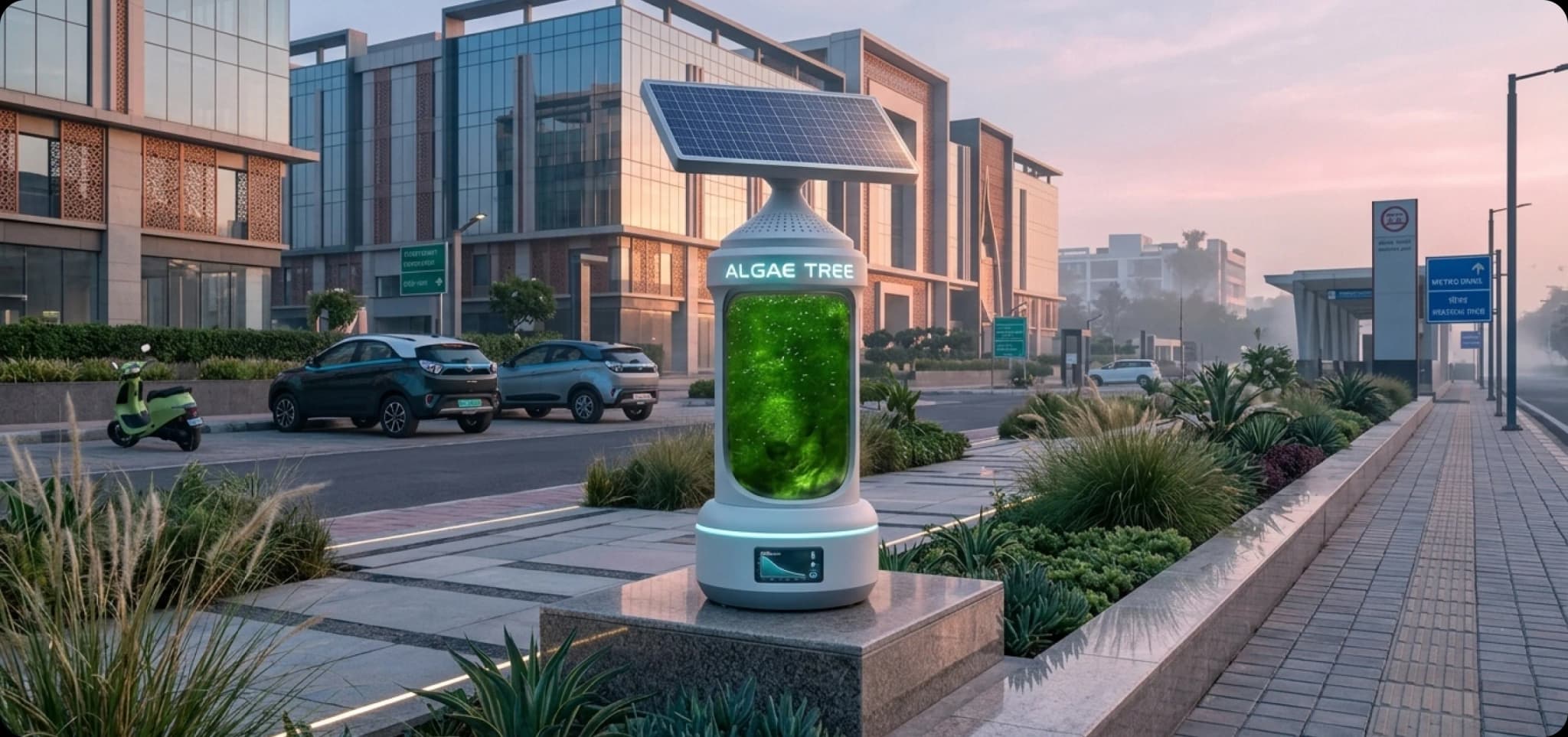
Captures CO2 400x more efficiently than traditional trees per unit area
Photobioreactor technology using microalgae for air purification
Solar-powered operation with minimal energy consumption
Reduces PM2.5 levels by 45-55% within 15-meter radius
Annual CO2 capture of 1.5-2.0 tons per unit
Biomass valorization for additional revenue streams
Modular and scalable design for urban deployment
Year-round operation independent of seasonal cycles
Deploy in high-traffic areas and pollution hotspots to actively clean urban air
Scenario
A city installs algae trees at major intersections and transit hubs where traditional tree planting is impractical due to space constraints and poor soil quality.
Benefit
45-55% reduction in PM2.5 levels within 15-meter radius, equivalent to 25 traditional trees worth of CO2 capture in a compact footprint.
Install near industrial facilities to capture emissions at the source
Scenario
A manufacturing facility integrates algae trees in their parking areas and building perimeters to offset operational emissions.
Benefit
Each unit captures 1.5 tons of CO2 annually while providing visible ESG impact, operating costs of only $20-40 per ton captured compared to $100-300 for mechanical systems.
Integrate into public transportation infrastructure for passenger benefit
Scenario
Metro stations and bus terminals install algae trees with integrated seating and USB charging ports.
Benefit
Dual functionality providing air purification and urban amenities, creating healthier waiting environments for commuters while reducing station-level pollution.
Deploy on corporate campuses to achieve carbon neutrality goals
Scenario
A tech company installs algae trees throughout their campus parking structures and outdoor spaces.
Benefit
Verified carbon removal supporting ESG reporting, employee wellness benefits from improved air quality, visible sustainability commitment to stakeholders.
Test emerging urban carbon capture technology in controlled deployments
Scenario
A city government pilots algae trees in designated innovation districts to evaluate performance and public reception.
Benefit
Real-world data on urban air quality improvement, IoT integration for smart city networks, scalable model for city-wide expansion.
Evaluate installation location for sunlight exposure, proximity to pollution sources, and public access. Obtain necessary permits from local authorities for urban infrastructure deployment.
Prepare level concrete foundation or mounting structure to support 500-1,000 kg weight. Ensure drainage and electrical conduit access.
Professional installation of photobioreactor unit, including water tank assembly, solar panel mounting, pump system connection, and structural anchoring.
Fill water tank with treated water, inoculate with microalgae cultures (Chlorella or Spirulina), calibrate pH and nutrient levels, activate circulation pumps.
Install IoT sensors for pH, dissolved oxygen, temperature, and turbidity. Connect to remote monitoring dashboard for real-time performance tracking.
Monitor algae growth over first 2-4 weeks, adjust lighting and circulation as needed. Algae cultures typically reach optimal density within 14-28 days.
Establish monthly monitoring schedule, quarterly maintenance visits, and harvesting cycles every 7-30 days depending on growth rate. Train staff on basic troubleshooting.
⚠ Algae growth slower than expected in first month
Solution: Normal during stabilization period. Verify pH levels (7-9 optimal), ensure adequate light exposure (200-400 μmol photons/m²/s), and check water temperature (20-30°C ideal).
⚠ Bacterial contamination or competing algae species
Solution: Perform partial water change (30-50%), sterilize system components, re-inoculate with fresh target algae cultures. Preventive: maintain optimal pH and regular monitoring.
⚠ Pump failure or circulation issues
Solution: Check electrical connections and circuit breakers. Clean air diffusers and intake filters. Most pumps have 3-7 year lifespan; maintain spare parts inventory.
⚠ Reduced performance in winter months
Solution: Expected in cold climates. Add insulation to water tank, consider supplemental heating or LED lighting. Some installations reduce to 60-80% capacity below 15°C.
⚠ Foam buildup on water surface
Solution: Often indicates over-aeration or protein accumulation. Reduce pump speed slightly, add defoaming agent if necessary, or increase harvesting frequency.
Real-time air quality data can be integrated into city-wide environmental monitoring systems via APIs
Next-generation systems can use building exhaust as CO2 feedstock, requires custom engineering
Verified carbon removal can be registered on voluntary carbon markets for credit generation
Standard solar panel integration for energy independence, typical 200-500W solar array
Can utilize treated wastewater as nutrient source, creating circular water economy
Many designs include USB charging ports and can host Wi-Fi hotspots for public utility
Integrated displays can show real-time CO2 capture metrics and environmental education content
| Feature | Algae Tree Technologies Algae Tree™ | Alternative |
|---|---|---|
| CO2 Capture per m² | 2.5 kg/day ✓ | Mature tree: 0.06 kg/day |
| Space Efficiency | 3-10 m² footprint ✓ | Tree canopy: 25-30 m² |
| Seasonal Consistency | Year-round operation ✓ | Deciduous trees lose 50% capacity in winter |
| Initial Cost | $18,000-75,000 | Tree planting: $50-500 per tree |
| Operating Cost | $20-40 per ton CO2 ✓ | Direct air capture: $100-300 per ton |
| Ecosystem Services | Air purification only | Trees: shade, habitat, psychological benefits |
| Lifespan | 15-25 years (infrastructure) | Trees: 50-150+ years |
| Pollution Tolerance | Thrives on high CO2 and NOx ✓ | Trees suffer reduced growth in polluted air |
An algae tree photobioreactor captures 1.5-2.0 tons of CO2 annually, compared to approximately 22 kg (0.022 tons) for a mature oak tree—making algae trees roughly 70-90 times more efficient on an annual basis. Per square meter of space, algae trees are 400-500 times more efficient due to their compact vertical design.
Harvested microalgae undergoes valorization: (1) Processing into nutritional supplements like spirulina ($10-30/kg), (2) Extraction of omega-3 oils ($50-200/kg) and pigments ($500-2,000/kg), (3) Conversion to biofuels or biogas, (4) Pyrolysis into biochar for permanent carbon sequestration, or (5) Processing into bioplastic feedstock. The pathway depends on algae species and local markets.
Installation costs range from $18,000 for small units to $75,000 for large commercial installations. Annual operating costs run $2,500-5,100, covering energy ($200-500, mostly solar-offset), maintenance ($1,500-3,000), culture renewal ($500-1,000), and consumables ($300-600). Modern systems achieve $20-40 per ton of CO2 captured, versus $100-300 for mechanical carbon capture.
Yes, but with reduced efficiency. Microalgae growth declines below 15°C, becoming dormant below 5°C. Cold-climate installations require insulated photobioreactor designs and supplemental heating to maintain optimal 20-30°C temperatures. Some advanced cold-adapted algae strains maintain 60-80% peak performance at 10°C.
Algae trees need monthly visual inspections, pH testing, and pump checks, plus quarterly professional servicing for filter cleaning and sensor calibration. Harvesting cycles occur every 7-30 days. While more intensive than traditional trees, modern IoT monitoring systems enable predictive maintenance and early issue detection.
Chlorella vulgaris is most common due to its exceptional CO2 fixation rate (up to 1,992 mg/L/day) and urban condition tolerance. Spirulina platensis is used when biomass valorization is prioritized for nutritional value. Some advanced systems use Synechococcus species achieving fixation rates exceeding 18.84 mg/L/min.
Physical infrastructure (tanks, pumps, solar panels) lasts 15-25 years with proper maintenance. Individual components need periodic replacement: pumps every 3-7 years, filtration every 2-5 years, sensors every 3-8 years. Microalgae cultures require continuous management with periodic re-inoculation. Total lifecycle costs amount to 40-60% of initial capital per decade.
No. Urban planners advocate complementary deployment, not replacement. Traditional trees provide irreplaceable benefits: shade, habitat, biodiversity, psychological well-being, and long-term carbon storage. Algae trees excel where traditional trees fail: pollution hotspots, space-constrained areas, contaminated soil locations, and situations requiring immediate maximum carbon capture.
Manufacturing creates an initial carbon debt of 5-15 tons CO2-equivalent (steel, plastics, electronics, solar panels, transport). A medium unit capturing 1.5 tons CO2 annually achieves carbon neutrality within 3-10 years. Environmental payback improves substantially when accounting for avoided air pollution health impacts, valued at 5-20x the direct carbon capture benefit in lifecycle analyses.
At $20-40 per ton CO2 captured annually, algae trees significantly outperform mechanical direct air capture ($100-300/ton) and compete with industrial carbon capture ($50-100/ton). However, they can't yet match conventional forestry costs ($1-10/ton over decades). Economics strengthen when accounting for air quality health benefits ($10,000-50,000 annually per unit) and biomass revenue ($400-15,000 depending on processing).



